



insights! #88: From chatbots to metaverse: How you transform your business with AI
 Joubin RahimiManaging Partner · synaigy
4 min read
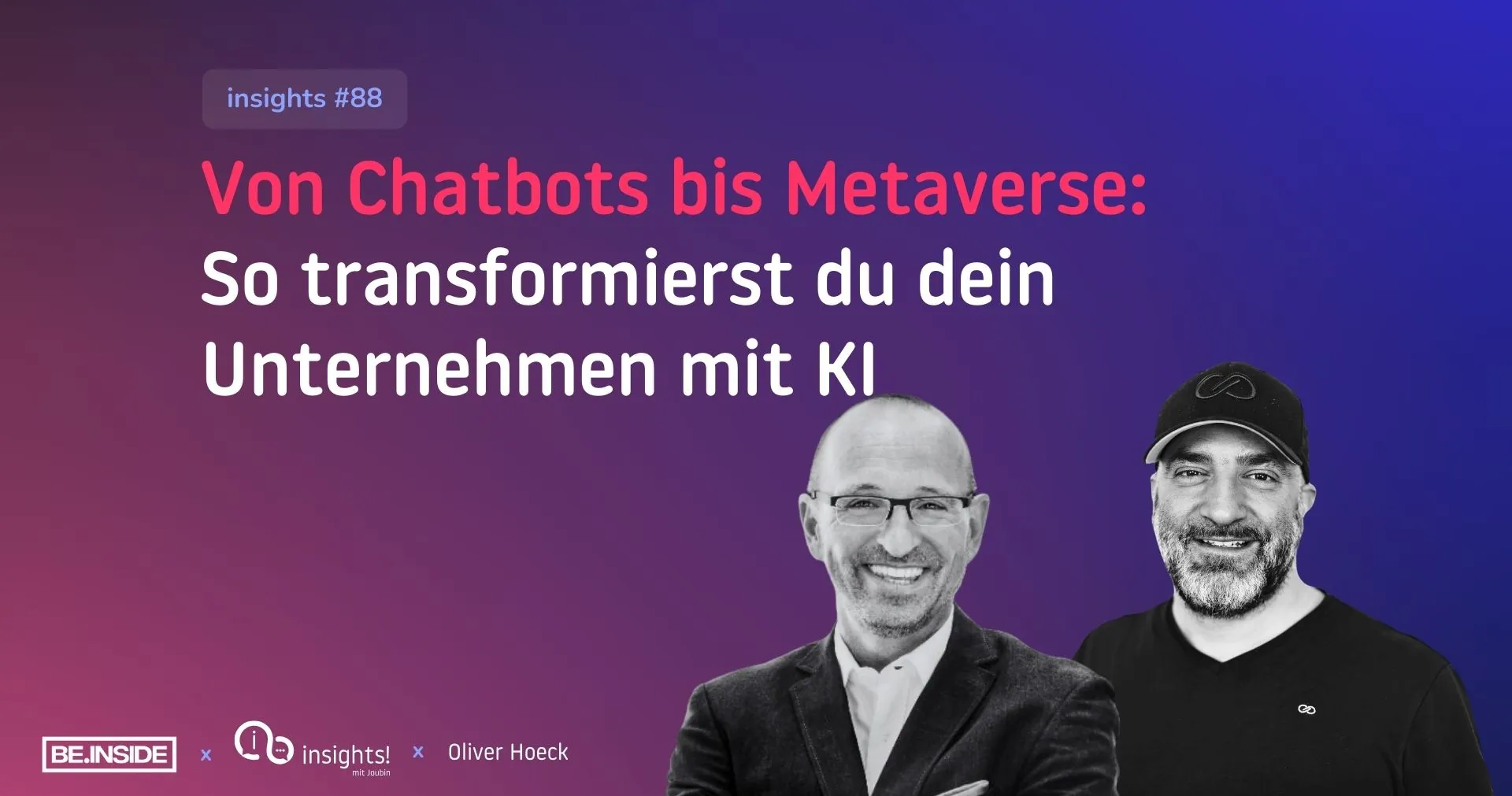
In this insights! episode with Oliver Hoeck, co-founder of digital dna, we discuss artificial intelligence, digital transformation and the challenges companies must overcome along the way. We explore how AI projects can be set up sensibly to achieve real success and what role agile methods play in this. We also take a look at the challenges of change management, the impact of AI on the job market and how small, strategic steps can bring about major change.
What data do I feed into it and what framework do I set for a chatbot to achieve good results with it?
There's a lot of talk about the power of artificial intelligence and the importance of digital transformation. But amid all the headlines and trends, there's an often overlooked truth: the path to success isn't a single giant leap, but a series of small steps. That's exactly what this insights! episode with Oliver Hoeck, founder of digital dna, is about — how companies can successfully shape their digital projects.
The myth of the big AI leap
In many discussions and articles, it sounds as though successfully integrating AI into a business is a one-off feat of strength. But real success doesn't lie in immediately implementing the biggest, most groundbreaking AI project. Rather, it all starts with the right strategy and realistic expectations. AI isn't a magic solution — it's a tool that needs to be properly trained and set up to actually work.
Projects often fail not because of the technology itself, but because of the wrong expectations. Companies start out assuming that AI will deliver perfect results straight away. But without careful training and the right data setup, success doesn't materialise. The lesson? It's about thinking and working in small, iterative steps — and staying agile along the way.
Small steps, big impact: agility as a success factor
Agility has almost become a buzzword in the digital world, but there's more to it than that. The approach of launching projects in small units has proven especially effective. Not everything needs to be perfect from the start — it's enough to begin with a small pilot project that can be flexibly adapted. This not only enables fast learning, but also builds the know-how needed to approach bigger topics such as the metaverse or augmented reality. What many companies underestimate is the need to improve the process step by step. Setting off with expectations pitched too high quickly leads to disappointment. Instead, companies should work specifically on the quality of their AI results, relying on methodology and structure.
Bringing people and technology together
Besides technology, there's a decisive factor that determines the success of digital transformations: people. Change management isn't just a buzzword — it's the art of guiding employees and entire organisations through change. Behind every technical innovation stands a team that has to implement the changes and work with them.
Two levels are decisive here: the organisational and the personal. While departments and processes need to be restructured on one side, on the other it's about empowering employees and equipping them with the necessary skills. Good change management ensures that people feel comfortable with new technologies and can use them successfully.
AI in customer service: opportunities and risks
One particularly exciting topic in the conversation was the use of AI in customer service. Large companies such as Klarna already show how AI-based solutions can transform jobs — for example through the use of chatbots. Here it becomes clear just how disruptive AI can be. But here too: success depends heavily on how well the AI is trained and implemented. The Klarna case also shows that AI projects can drastically change how software such as Salesforce is used. AI creates new interfaces and approaches that can replace existing tools. However, this isn't a short-term process, but the result of long, targeted work.
Want to listen to the full episode?
Here's the podcast of the interview:
Please accept the corresponding cookies to view this embedded content.
Would you rather watch the episode?
No problem!
Here's a recording of the interview:
Please accept functional cookies to watch this video.
Would you rather read?
Transcript of the episode:
Joubin Rahimi:
Welcome to a new episode of insights! My name is Joubin, Joubin Rahimi, and with me today is Oliver Hoeck from digital dna. Hi Oliver.
Oliver Hoeck:
Hi Joubin. Glad to be here.
Joubin Rahimi:
Yeah, it's great. We've known each other for a while now, and I really value you and your team, because in projects you handle the things that are so incredibly important but often overlooked. Because when you're there, I know the project is set up and managed properly. Everything that happens before an implementation. Could you say a few words about yourself?
Oliver Hoeck:
Thanks for the kind words upfront, Joubin.
Joubin Rahimi:
Sure.
Oliver Hoeck:
Yes, exactly. I'm Oliver Hoeck, one of the founders and managing directors of digital dna. We've indeed been working together for a long time, we go way back. What do we do? We help companies make their digital, retail, omnichannel-oriented projects successful. And not by implementing software or selling software, but by embedding ourselves with the client teams and doing change management, project management, programme management. And these topics, making sure a project really becomes successful and also shows a return on investment.
Joubin Rahimi:
Important, right? That's the whole point. We're here today at BE.INSIDE. Great that you're here and investing the time. Now, you're also a pro when it comes to AI, and AI is a topic here today too. Were you able to take anything away where you thought, I've got new impulses here too?
Oliver Hoeck:
Yes, first of all, I find it exciting how many projects are already running that you hear little about in public. There was an interesting talk on that too. I always find it quite interesting that in the times we're living in right now, everyone talks about AI. Everyone also has an opinion up to a certain point, whether it's about the AI angle or America or whatever. There are still relatively few actual projects, even though a lot of people are engaging with it, but here I've seen quite a lot.
Joubin Rahimi:
Yes, first of all a knight's battle. That would have earned praise from you, because you also do AI projects, or much of it is about AI, but is it about AI, or what exactly is it about?
Oliver Hoeck:
Well, the discussion that's currently being held in public – the Handelsblatt has written something about it too – is that in America the question is being asked: Do all these investments actually pay off? Yes, the ones Microsoft is making, and Nvidia, and so on. It's all going towards infrastructure. In other words, do investments in infrastructure pay off financially in the end. I think that discussion misses the reality that affects us, though, because among our client base, with the companies we work with, it's firstly about the question: are there processes – repetitive, recurring, error-prone in nature – that could be optimised using AI? And the second thing is certainly topics like, I'd say, text to action, or purely text-based applications, chatbots for example. We heard that Klarna – this went through the press – is cutting 700 jobs worldwide through the use of AI in customer service, and they're decommissioning Salesforce and decommissioning Workday, because a different interface is simply being layered on top and they're now working AI-based. Those are topics that are disruptive.
Joubin Rahimi:
Are they fast, or do you think Klarna worked on it for a long time?
Oliver Hoeck:
I think they worked on it for a long time. When we talk to clients, the expectation is often: we do one project and then become professionals, and then we tackle metaverse and augmented reality topics and so on. But it's actually about, or far more important is, gaining know-how as a first step. Taking small steps first, building up know-how, and then you can take on the big topics.
Joubin Rahimi:
So the path is the goal, first and foremost.
Oliver Hoeck:
Yes, simply start. That's something we're not so good at in Germany.
Joubin Rahimi:
Start, do, try, act. Now.
Oliver Hoeck:
Exactly, now. Do it now.
Joubin Rahimi:
What are some fuck-ups you can share, that you've seen, that one should definitely make in order to really learn a lot, or also to say: okay, I won't make that one, I'll make the next ones.
Oliver Hoeck:
Well, if we talk about the topic… Let's start with AI-based chatbots. Everyone's experimenting with them. Then you often hear the complaint: we've tried this now and the results actually aren't that good. The support, the return, it's actually just not there. And this is one of the things that keeps getting forgotten: the training of the AI. In other words, what data am I feeding in, and what framework conditions am I setting for such a chatbot, such a layer, ultimately on top of the large language model, in order to achieve good results with it? And you actually have to combine that with criteria too: what's a good answer? What's a bad answer? Because that's the only way to achieve improvements.
Joubin Rahimi:
Okay. So essentially not setting expectations too high right away, and then improving step by step within the framework you've set, is that right?
Oliver Hoeck:
Yes, and another aspect too. There's a tension between a small project you start just to have a look, and yet a quality you still want to achieve. And that's why it's worth taking a methodical approach from the start, rather than diving in completely headlessly. That has a certain agility to it, of course – we just start. But if you adopt a certain sequence of methods for yourself, then you can achieve really good results even with small pilot projects, because you're able to apply a quality criterion.
Joubin Rahimi:
Okay. So then more the agile way of working, which is unfamiliar in some companies and not in others, but those who've already implemented it simply have an advantage, because they say: okay, I don't even know what the end goal is, but I take small steps and can still deviate left or right without having to think in terms of change requests.
Oliver Hoeck:
Right, right. I start, think about a path, but also how I want to get there, and adjust as needed along the way.
Joubin Rahimi:
How do you bring people along? That's also part of your task, isn't it? Yes, exactly, this human aspect always relates to two levels. One is the actual organisation in which people work, which then has to change through, let's say, software projects, IT initiatives, or entirely different topics as well. So what kind of organisation, of responsibilities, of departments, of processes do I still need access to? The second aspect is the personal level. So what does it do to the individual person, to the employee, when something changes significantly? And we serve both by looking, on the organisational and change side, at what needs to be done. And on the other side, we also cover an enablement topic: what personal skills and abilities need to be developed?
Joubin Rahimi:
I already know. We'd need to collaborate much more, also in the group context, because so far we've only worked together in the synaigy context. But I think there's still a lot of shared potential there.
Oliver Hoeck:
Absolutely. We do.
Joubin Rahimi:
Thanks for the insights. Great that you watched. If you have questions, feel free to post them. I assume Oliver, just like me, will be happy to answer quickly on LinkedIn too.
Oliver Hoeck:
We can do that. And with that … it was great to have been here. Thanks.
Joubin Rahimi:
Great that you were here. Thanks.
Do you have questions or feedback?
Then feel free to contact us directly.
- Joubin Rahimi
Managing Partnersynaigy
Show phone numberShow mobile numberShow email address
Subscribe to the blog now and never miss any news
✔️free ✔️weekly news ✔️expert knowledge
Please accept the corresponding cookies to view this embedded content.