
Digital Trends 2018
9 min. reading time
Digitalisation isn't only happening at Google, Amazon and Facebook. But they are the drivers of an ever-accelerating development that is transforming our working world. In 2018, it's more important than ever for internationally operating organisations to set the course for the future and engage with new working methods and digital technology. Whether it's user centricity, marketing automation, internationalisation or the need to break up familiar structures and processes – we show you which digital trends we believe will matter in 2018.

1. Consulting/know-how transfer: how does digital actually work in 2018?
Many large corporations have already built their own in-house digital departments, or are in the process of rejuvenating and expanding themselves with the help of so-called digital hubs and incubators. They want to learn from the "young rebels" of the start-up scene how they work, how they think, and how to address a younger target audience online as well as future-proof their existing business. But how do you best bring the existing workforce along, how do you upskill them for new tasks, and how do you find new qualified employees and get them excited about your own organisation?
Change management describes a process that covers the transition from the here and now to the digital organisation. Under buzzwords such as design thinking, corporate innovation and lean project development, there's a colourful range of support services from providers and solution vendors. But how do you find the right offer, the right solution for your own organisation?
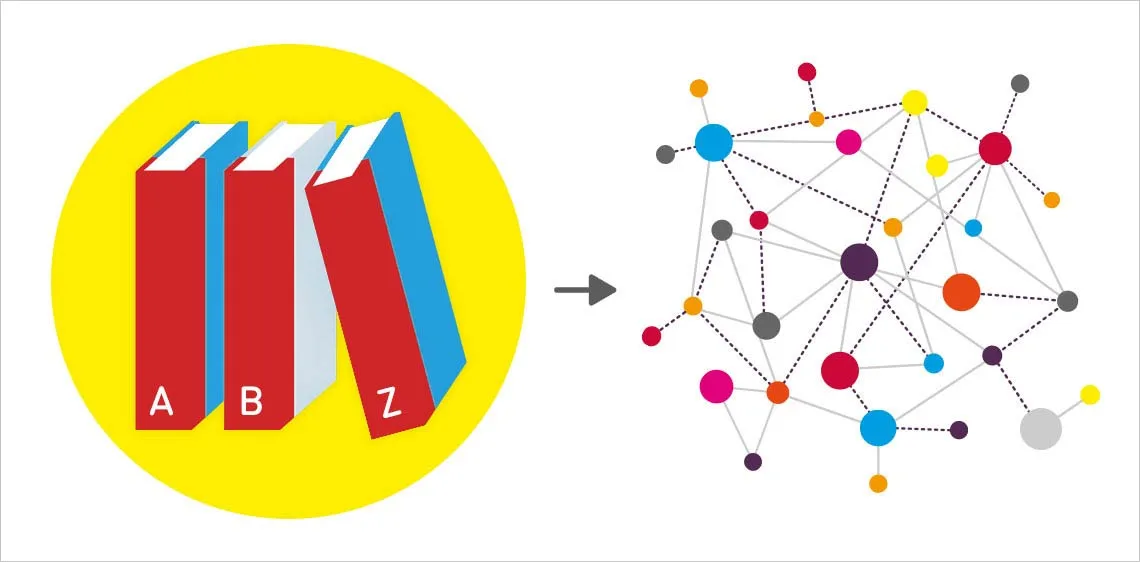
Consultants and service providers are increasingly shifting their offerings away from a full-service mindset ("everything from a single source") towards the role of enabler and transition companion. To support especially B2B organisations with digitalisation, integrative concepts are becoming increasingly important: the digital agency, with its staff, forms the nucleus of a team within the organisation, helping to build and develop that team. Beyond the project's start-up phase, organisations value the outside perspective of external consultants to deepen existing knowledge and gain new impetus.
Get updates on digital trends now via newsletter.
2. Organisation: From departmental thinking to networked teamwork
Digitalisation doesn't just create new technological solutions. It brings with it a fundamental change in the working world. We often see that organisations aren't able to react quickly enough to digital trends or competing business models. Rigid structures make them cumbersome. Where in the past IT had someone responsible for looking after the website, many organisations and departments have now understood that they should collaborate in a more networked way. The model is the small start-up shortly after its founding phase, where a handful of employees are often 200 per cent or more productive, because everyone has to be able to do everything and get involved to keep "the shop running." But how can agile methods be transferred to teams within an established organisation?
What's needed are radically adaptable processes. This means rethinking established structures, implementing agile and interdisciplinary working within the organisation, and developing new forms of organisation. This is often achieved through so-called lighthouse projects. An interdisciplinary team is put together to take responsibility for a digital product within a project and to work like a start-up within the organisation. This team and its way of working are meant to radiate out into the wider organisation like a lighthouse.

The need for such change processes becomes clear when we look at how job profiles have changed. The role of the corporate spokesperson has evolved through new digital channels. To achieve as high an impact as possible with a press release, some companies already very successfully involve social media, bloggers and trade portals in their communications, because this gets them to their goal faster, gives them direct feedback, and allows them to adjust or counter-steer earlier where needed.
The new working world requires continuous coordination across all departments and must create solutions that simplify and make communication channels manageable (e.g. Ordering, approval or application processes). Large organisations are often very experienced at setting up processes. A frequent challenge, however, is the flexibility and speed of adapting established structures once new requirements arise, since decision-making processes often span multiple levels.
It's not only in Communications that some departments are now working according to the newsroom principle, with the aim of processing all internal and external activities in a bundled way. The idea is to produce and use content (such as news or product texts, image material from employees, products or events) across disciplines and departments. The colleagues working in the newsroom come from different departments and take on the practical implementation of the content strategy. All departments pass their information and content on to the shared newsroom team, who sit together at one table to decide what is needed, and how and where it is communicated. Rigid structures are broken up, knowledge is shared, and the newsroom becomes the hub of all communication.
3. Brand portal: one presence for everyone, individual for each
Internationally positioned organisations with multiple country locations often face a conflict of objectives: standardisation vs. diversification. The brand, its values and messages should be perceived the same way in as many countries as possible. At the same time, customer engagement and offerings should take regional and individual customer specifics into account and enable local employees to work as efficiently and successfully as possible.
Depending on how autonomous the country locations are in choosing their IT solutions, some organisations end up, viewed globally, with a whole zoo of IT landscapes, solutions and ways of working. On this basis, quickly implementing a global digital strategy is almost impossible. Purely digital organisations such as Amazon have a much easier time here, since they are designed for change from the outset, are managed in a strongly centralised way, and often don't have political structures with multi-stage decision-making processes.
The use of brand portals, as has long been common in large B2C corporations (telecommunications, automotive), is one approach to creating a single roof for everyone: a digital, interactive brand portal bundles all information and elements of the corporate identity in one place. The portal provides tailored guidelines and material for employees, for example those working in different country organisations or business units. This makes it possible to steer, for instance, the implementation of the corporate design via a central tool that can be accessed over the internet regardless of location. In future, this enables integrated communication that unites different business fields, business units, sub-brands and target audiences under one brand umbrella.
If we look, for example, at the field of online marketing in international markets, the right digital strategy and a one-web solution play an increasingly important role. Companies looking to expand into new markets or business fields should adopt best practices and tools from their core markets and be able to adapt them to the particularities of the target market. The basis for this is a digital marketing strategy that takes into account the respective market's local particularities while also leaving room for manoeuvre in implementation.

4. Marketing automation: it no longer works without automated marketing
For those responsible for communications, the challenge of serving these channels regularly and, above all, in a user-appropriate way keeps growing. Marketing automation noticeably relieves the workload on employees. Take the example of CRM and newsletters. Today, this process typically runs automated and is already integrated into existing sales structures and marketing processes at many organisations.
While automated generation of newsletters is already widespread, delivering individualised content based on, for example, users' interests, browsing behaviour, user location, various devices, or the use of big-data applications is still a thing of the future for many. Bigger challenges when introducing such a solution include the unambiguous identification of users and the assignment of user activities across different channels and devices to a single data base.
In addition, the sheer number of products available on the market (e.g. Web CRMs, marketing automation platforms) often causes confusion among those responsible for marketing. When evaluating target systems, it's important to seek vendor-independent advice, test solutions on a small scale with a prototype, and gather feedback from employees and users before rolling the solution out organisation-wide.

5. Usability testing: test-driven user experience, why the effort pays off!
An outstanding user experience is not just aesthetics. Users should be able to recognise the benefit of a digital solution and reach the goal of their interaction as intuitively as possible. If this doesn't succeed, frustration runs high. The use of user testing and the rapid gathering of customer and user feedback should be a key part of daily business for many companies today. In the concept phase of a new portal or a digital product, user tests provide valuable insight into whether the concept and user guidance are understood by the relevant target audience. Early tests often reveal stumbling blocks that can be removed before costly technical implementation (programming). They also give decision-makers early data on whether the business objectives can be achieved with the first agreed design.
For existing portals, it is also worth using feedback forms or interactive contact centres to gather customer wishes (and subsequently implement them). Companies whose annual revenue depends heavily on seasonal peaks (e.g. The Christmas season, trade fairs) or on the successful launch of new products are investing increasingly more effort in preparing campaigns. For example, for the launch of the Countryman estate, BMW Mini created 50 personas, each representative of the respective target audience, along with corresponding customer journeys, and produced content tailored to them. The effort seems to pay off. The launch of the Countryman generated 30 per cent more leads, i.e. qualified contacts. Another area of application for usability testing lies on the user side, among the editors who are to maintain the brand portal.
Companies about to introduce new software solutions should gather feedback from their departments on their wishes and requirements at an early stage. This gives them early insight into which features bring employees added value in handling their daily business and should therefore be given high priority when evaluating a solution. If employees are actively involved in the introduction of new software, acceptance of adapting to a new system and working with it increases, as employees have had the chance to gain insight in advance and help shape it.

Conclusion
From change management through brand portals and marketing automation to test-driven user experience – the digital trends for 2018 show that introducing new working methods and digital processes holds far-reaching opportunities for organisations. Networked thinking, strategic action and digital expertise are among the decisive success factors in global competition. Now it's a matter of seizing these opportunities, breaking up rigid structures, establishing agile and interdisciplinary working methods, and driving forward your own digitalisation. As a digital agency in Berlin and Munich, we offer organisations comprehensive support with consulting, strategy and delivery of these initiatives. We'd be glad to develop ideas and concepts together with you to implement digital trends in your organisation too.
Your contact
- Klaus Cloppenburg
Managementsynaigy
Show phone numberShow email address