



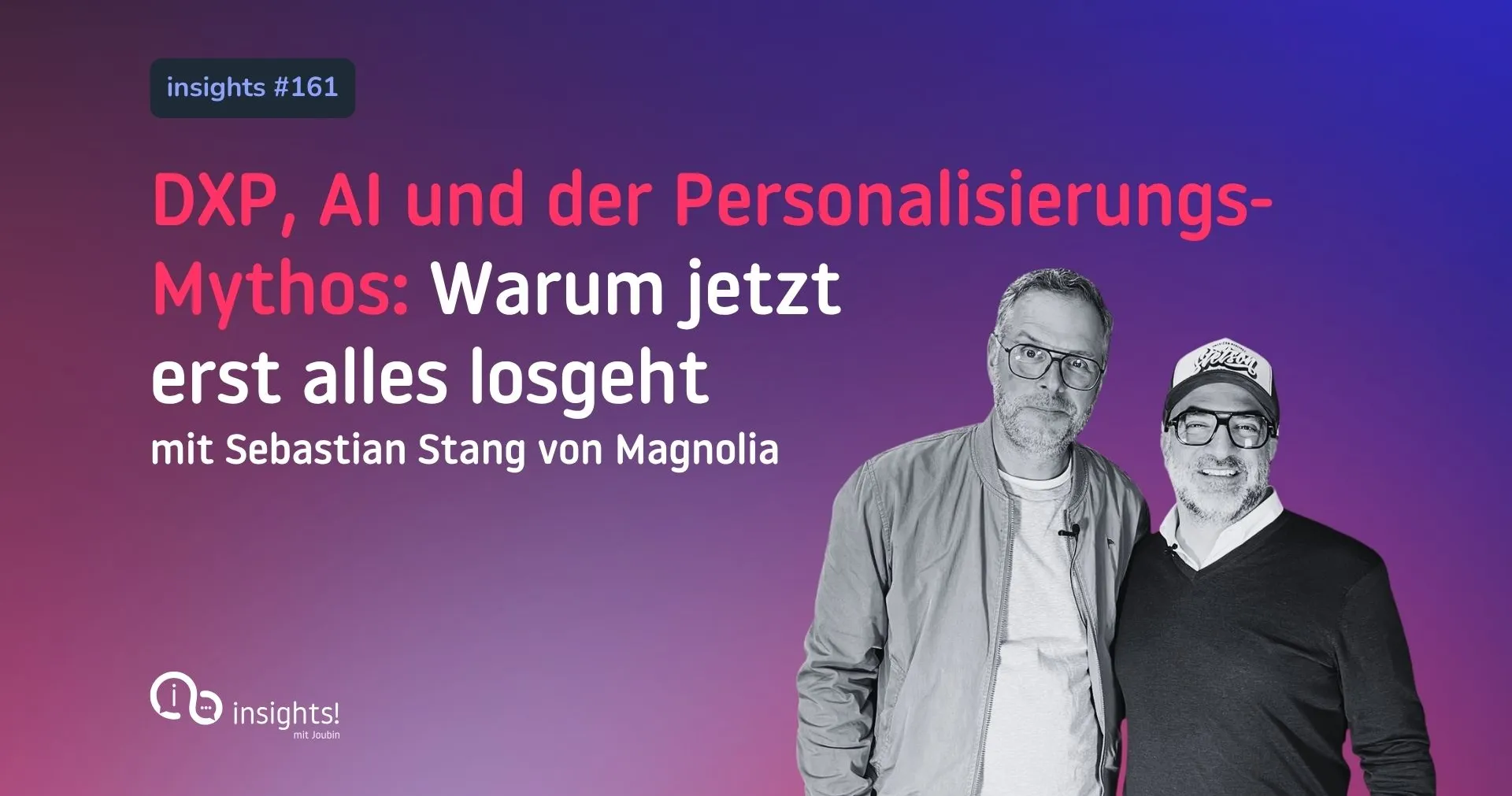
#tbd - DXP, AI and the personalisation myth: why things are only just kicking off now
DXP, AI in the CMS, personalisation and GEO, four buzzwords that keep landing on the table in the marketing engine room right now. In the current insights! episode, Sebastian Stang, CRO of Magnolia, sorts out where there's substance, what's overhyped, and which strategic levers you should pull now. This blog post summarises the key theses concisely, adds some context, and gives you concrete pointers on where to start first in your content and platform strategy.
 Joubin RahimiManaging Partner · synaigy
7 min read
"The efficiency gain will be massive and you'll be able to target far more precisely. You need the right tools, but the journey is clearly heading in this direction, and it's only just beginning. In the end it'll result in hyper-personalisation, with AI assembling the site for you automatically, depending on which cookies or data it has on you."
DXP, the term even Gartner is currently reinventing
If you've been anywhere between CMS, commerce and marketing operations in recent years, you'll inevitably have come across the term DXP. Digital Experience Platform sounds big, sounds like a platform, sounds like a solution. In fact, DXP is a term that Gartner originally coined because, in the web content management quadrant, there simply wasn't any innovation happening any more. Adobe, Sitecore and others dominated, and a new term was meant to bring fresh dynamism.
Sebastian Stang puts it clearly in conversation: in practice, a DXP isn't a single piece of software, but the orchestration of several components. CMS or headless CMS form the core, with PIM, DAM, commerce and increasingly AI components added on top. It's precisely this reality that has led even Gartner to shift the DXP quadrant by a year and bring new analysts on board. So if you're currently in the middle of an RFP on the topic of DXP, pay less attention to the label and more to the integration capability of the individual building blocks.
Why your CMS needs to think with AI now, not later
Truth is uncomfortable: most marketing teams have been copy-pasting between language models and their CMS for months. A text gets generated in Claude or ChatGPT, manually revised, translated in DeepL and then copied into backend. That's not AI adoption, that's a workaround. Real adoption only begins where workflow is anchored in system, from text creation through image generation to automated translation and publication in all relevant markets.
Sebastian Stang makes clear in this episode that this is exactly where most friction arises in the German economy. There are workflows that have been running for 15 years, whose compliance was clarified once and that no one likes to touch. This very inertia becomes a strategic liability when internationally active competitors have long since switched their content engines to AI. Whoever doesn't start now making their workflows AI-ready will still be optimising manually in two years, while others are already tapping into the next market.
Bring Your Own LLM, the only sensible way in a token economy
A central point in the interview is the question of which language model should even be used. Sebastian Stang's answer is pragmatic: Magnolia doesn't force any LLM on you, but lets you connect the model you're already using anyway. Sounds like a detail, but in practice it's a huge lever. Every B2B company has gone through its compliance process, involved data protection, legal department and works council, and in the end approved one or two providers.
If your CMS now dictates that you have to switch to an in-house model, you start the entire process again from scratch. You don't want that. So when choosing any AI-capable system, pay attention to the following points before committing:
Does the system support Bring Your Own LLM, i.e. ChatGPT, Claude, Gemini and proprietary models?
Can translation tools such as DeepL, Across or Lengoo be integrated natively?
Are token consumptions transparent and controllable, especially in an international rollout?
Does the content owner remain in control of their workflows, or is a vendor workflow enforced?
Personalisation was just a promise for ten years, now it's becoming real
In 2015, personalisation was the industry's big promise. Ten years on, your newsletter CRM probably still has exactly one tier of segmentation, A-customers and B-customers, perhaps split by country too. The reason is sobering: the matrix of brands, stakeholder roles, topics, languages and buying centres grew faster than the marketing team could produce content. In many organisations, personalisation therefore remained a PowerPoint promise.
With AI, exactly this point changes. Today, with the same resources you once used to write a newsletter, you can create ten or twenty curated variants a month, each tailored to a stakeholder, an industry or a region. Sebastian Stang calls this the logical endgame hyper-personalisation, where AI builds the site live based on behavioural data, cookies and context. This isn't sci-fi, this is 2026. And whoever structures their content for AI now will win in this world of hyper-personalisation.
GEO instead of SEO? A sober look at the next hype
No trend filled more marketing conferences in 2025 and 2026 than GEO, i.e. Generative Engine Optimization. The logic sounds compelling: if AI assistants increasingly serve up answers directly, content needs to be optimised to land in those answers. Tools for this already exist, and Magnolia itself offers a corresponding module. But Sebastian Stang is refreshingly unenthusiastic.
In B2C segment, he considers GEO clearly overrated in my view. In highly specialised B2B, especially with hidden champions with products needing explanation, matter looks different. Here buyer doesn't go via three generic AI snippets anyway, but via deep specialist content. Concrete pointers for your strategy:
Use GEO as a sensible complement to SEO, not a replacement.
Keep optimising for clean content structures, metadata and keyword strategies.
In B2B, invest deliberately in in-depth specialist content that AI models cite.
Look for a platform that delivers GEO functions automatically, without your editorial team having to learn new tools.
What you should tackle right now
If you've read this article this far, you're probably currently facing a platform decision, a replatforming project or a larger content project. There are three steps you should tackle next. First, stop fixating on the term DXP and focus on the orchestration of your components. Which tools are you using, which are missing, and where are the data silos slowing down your customer experience?
Second, bring AI into your workflows, not just onto the clipboard. Define a pilot use case, ideally content creation plus translation for a new market, and measure the efficiency gains properly. Third, plan personalisation two steps ahead of today. If you split newsletters by country today, think in personas tomorrow, in dynamic segments the day after, and in hyper-personalisation in two years. Whoever prepares their content model for that now will have a lead in 24 months that the market won't catch up on.
Conclusion: it's only just begun
The best closing line from the episode probably comes from Sebastian Stang himself: we're ready, we can get going. Exactly right. The technology is there, the models are there, the platforms are there. What's missing is the willingness to question old workflows and forge new adoption paths.
If you want to do exactly that, the full insights! episode with Sebastian Stang is the right next half hour. And if you notice that you need support with the details, that is exactly the bridge between strategy, platform and AI adoption we at synaigy are built for. Write to us, get in touch, let's talk.
Would you like to listen to the full episode?
Find the podcast of the interview here:
Prefer to watch the episode?
No problem!
You'll find a recording of the interview here:
Please accept functional cookies to watch this video.
Prefer to read?
Joubin Rahimi
Great to have you back for a new episode of insights!. My name is Joubin, Joubin Rahimi, and joining me today is Sebastian Stang, CRO of Magnolia. Hi Sebastian.
Sebastian Stang
Teams.
Joubin Rahimi
Yes, great. Well, I'm really pleased we're here today, for various reasons. For one, we have a partnership also through Interactive Tools, which has now merged with us. But I've known Magnolia for probably 15 years through the partnership with IBM.
Sebastian Stang
Yes, exactly.
Joubin Rahimi
Really long time ago. So I'm all the more pleased to welcome you here. Introduce yourself and Magnolia a bit, then let's dive deep into the content world.
Sebastian Stang
Yes, exactly. About me: Sebastian Stang, born in Baden, from Freiburg im Breisgau, have lived there my whole life. Have been with Magnolia for 14 years, responsible for the Revenue area, so the whole go-to-market motion with sales, partners and customer success. About Magnolia: We come from classic content management and that has transformed somewhat too. Nowadays it's called DXP. Not everyone is fully sure about that yet.
Joubin Rahimi
We can jump straight into that too, what DXP is.
Sebastian Stang
Exactly, what is DXP, where does it actually come from? We have around 500 customers, operate worldwide, headquarters in Basel, Switzerland, but also have office in USA and Singapore, and serve large customers like BASF. We work for Aldi, we work in Germany certainly for website everyone knows, Bahn.de. But yes, that's somewhat known. We do lot in classic B2B midmarket, hidden champions, but also insurance, banking worldwide are all our customers. So mainly B2B, but we also have few e-commerce brands, Kik, Aldi, in UK Sainsbury, Tesco, so they also do business with us there. But B2B is definitely our strongest segment.
Joubin Rahimi
Before we move on to the actual topic, DXP, namely why is this a topic? As some of you know, Interactive Tools is being merged into synaigy. The logo is currently changing a bit and we are of course discussing what we write on our own website, what services we offer. Big discussion, but the term DXP is of course important. What does it mean? Perhaps we can start there briefly.
Sebastian Stang
We're very happy to talk about that. So where does it come from? Let me take a step back, historically. The DXP, Digital Experience Platform, was actually invented by Gartner, and the background was that there was this web content management quadrant. But there was no innovation left there any more. So the players there were Adobe, Sitecore, and it was all geared towards content management, and no innovation was happening, because content management isn't really that disruptive. It's just content management. And then the topic was redefined by Gartner. Defined by their analysts, and then came the DXP topic. In a certain sense it makes sense now; at first it caused more confusion. What's actually the core theme of a DXP? A DXP is meant to be able to orchestrate the digital channel, and a DXP isn't a single piece of software; usually a DXP is a combination of several pieces of software, where the focus is on content orchestration and the orchestration of the individual digital channels. Where's this heading a bit? You've got a product information system, a PIM, you've got a DAM, you've got e-commerce, data sits everywhere, and I, the marketer or the corporate communications person, want to run my channels. And for that I need a tool. And that's why this content topic comes up, because it was always somehow the layer in between that connected everything. And that's how we now talk about DXP. There's also a difference between the big players, Adobe, who can deliver everything to you from one stack, or this best-of-breed composable approach. We actually come more from the classic CMS business, but have always had a very strong integration framework. That means for us it's essentially plug and play – a DAM comes in, a PIM comes in, whatever, and it's done. And the future is heading towards us being the orchestration layer with the human in the loop plus AI, which can then run all the touchpoints, channels.
Joubin Rahimi
So I'm asking so precisely because that, I understand, and DXP is also often used by other market competitors who are in the content space.
Sebastian Stang
Right.
Joubin Rahimi
The commerce camp, let's call it that, doesn't necessarily say DXP. I find that quite funny. And when I stop looking from our perspective and instead ask: what does the fish want? What does the customer want from us? What terms do they work with? And that's actually what we're currently working through. Is it DXP? Is it something else? What's the customer's language? But I don't think that's landed yet.
Sebastian Stang
No, that's still a way off too. So a DXP, for example, as we see it, a DXP needs certain basic functionalities and a DXP always has a core component, which is the CMS or the headless CMS. That's a basic building block. Without this content management, it won't work. Headless or not headless is simply a method. Exactly. And with commerce, it's the case that commerce is always decoupled. Because what does commerce do? Commerce gives you the checkout, the products. But that's not the digital experience, because you build the experience with a DXP. And that's why there's always this question: how much can I actually do with a shop? A shop already delivers a lot out of the box. But if I want to build a genuine experience, I still always need something on top. And of course that could now be, yes, a headless CMS as well, ultimately a DXP. So what?
Joubin Rahimi
Yes, or thought even further, then you have services that you redesign. Those belong in there too, that's also a digital experience. And then you might do that with other partners as well, like you said. It's more, isn't it? Yes, well, it's just that the term itself isn't clear, it's clear for us.
Sebastian Stang
Yes, but the DXP is, you know, we're actually not a Digital Experience Platform, we're only part of one, and every customer actually assembles their own platform. And that's why it's so misleading, nobody knows where it's heading. And here again, we're doing a bit of an inside talk, even Gartner has now postponed the DXP by a year, brought in completely new analysts. Because for them this definition of a DXP is also always moving. So they themselves don't quite know how they— So not just the topic, but also the partners. Right, the partners too, and Forrester have exactly the same. Ah, great.
Joubin Rahimi
Sort of a pre-talk already, but a great segue. With AI, a lot is changing. Content creation is also changing drastically. Sure, there are things people just go along with, they have certain processes, but a lot is changing. We are also currently doing a replatforming and rewriting all the texts from scratch. We are doing that with Claude, that is what we have done now. In the process, we also decided as part of the merger to change our service tone of voice from the informal to the formal form of address. We are changing from informal to formal, because we are simply becoming a bit more grown-up, but not everywhere in our tone of voice. Here it stays informal, because that is simply the norm. But if we do not know someone yet, we use the formal address. Push a button, changed. But we were always in Claude, or rather we were just in a different tool. And the question was, that is probably also something that belongs in CMS systems, right? So I am trying to draw out how you see that and where you are heading with it.
Sebastian Stang
That's exactly challenge. So that's exactly challenge. We've always been able to do content, and how does that run? Copy-paste. Everyone goes into AI, copy-paste. So what's challenge? Bringing these content-creation workflows with AI into CMS. We now have that at various levels. Of course every customer again has their own workflows, their own processes. And that's actually where we currently see entry point with many customers. But, and we know this from German economy, everything's very slow there. They've existed for 15 years, they're all cleared with compliance. And now you come round corner, say: hey, we can generate an image here at push of a button with AI and texts, we can have them translated automatically, then you can publish them directly. That always gets an immediate: oh wow, great. And you need a lot, and that's why we need strong partners like you too, who actually show this kind of adoption to customer, who also do consulting of: okay, we've understood your content workflow, that's how it was, and now we take that and integrate it into new setup with Magnolia or into workflow. That's where we currently see a lot of question marks with customers. Expectation, and now other thing comes in again, expectation is it all has to work anyway. So expectation is, it all has to work. Doing it and then real adoption, that's not happening yet at all. On other hand of course there's topic of token economy and so on. We have to integrate these LLMs on our side too. We take an approach there, of course, because we have many B2B companies. They've all been through a certain compliance process already and say, we've settled on ChatGPT, we work with Claude, we work with whoever. And that's why they mostly bring their own LLM. That's already a benefit. So we don't say, hey, with us it's always ChatGPT and you can only— you can actually use whatever you want. You currently still have to bring that flexibility yourself. Really smallest share expects a translation workflow already integrated out of box. There they also say, we use DeepL or we use Across. So, and that's actually what it's about, what needs to be mastered. And of course we as software vendors can't do that alone. We build framework, we build integration capability, but now specifically you as synaigy, you as partner, you have to carry that to customer and actually then there. And that's just a broad topic. Lot of people don't see that yet.
Joubin Rahimi
We actually have a tool for that too. It reads out the existing texts and the information structure, maps that onto the new desired one, however that's created, to see where I already have content, which content also fits the new structure. So it's not just that because you describe service A, it also fits the new system or the new look and feel it's meant to have. And where you still need to work in, and where it doesn't meet quality criteria. That gets read out automatically, and then you can say yourself, okay, now let's generate the texts for the rest and match them against it.
Sebastian Stang
Right.
Joubin Rahimi
And then you build it in. What I'm thinking about is really the step after that. Why do clients do this? A) When they say I'm switching platforms, doing a new refresh, the design, or when they say I'm entering a new country and want to do it as fast as possible. So then you say, okay, I'm entering a new country, need to launch it fresh, at the push of a button. Somewhat exaggerated, of course.
Sebastian Stang
That's the requirement of most of our customers. They're also mostly international companies who then, well, create this one master faster than usual, and then they start rolling out into the different markets. And I still see that with our customers now. And especially with e-commerce players it's a whole different topic again. They're a lot slower again. They start here in one core market, or usually not the strongest market, and then slowly adapt into the other markets. Whereas I sometimes see mechanical engineering firms, for example, that of course have service units in 80 other countries. They're of course sometimes faster on the move. And the good thing is, thanks to that they can, well, two ways, firstly, they can enable the team in the market faster, but also support them through these new AI processes. And we see that, that will - well everyone's talking about it. Take a step back again, like with personalisation 10 years ago. Everyone wanted to personalise.
Joubin Rahimi
This is actually only starting now, I think.
Sebastian Stang
That's actually only coming now.
Joubin Rahimi
This personalisation hype, I don't understand it.
Sebastian Stang
Yes, well, and it is on everyone's lips, we have fully reached the top of the hype cycle, adoption will be a bit like with mobile phones or like with everything, it will simply take a bit longer, and it is not quite as fast as everyone imagines. Technically, though, one has to say, it is all already there.
Joubin Rahimi
That's much faster.
Sebastian Stang
We're ready, we can get going. That's it.
Joubin Rahimi
As a closing question: many say you no longer need SEO, but GEO instead. I always find it a bit exaggerated – just because something new comes along doesn't mean everything else suddenly collapses, but GEO is indeed a topic. How would you say one should sensibly approach it now? How much time should really be invested? How do you support your clients in this area?
Sebastian Stang
We also have a module that automatically helps you write your texts geo-optimised. It's not just texts, of course there's also a bit of doing behind the scenes in all the other mechanisms, keywords, meta descriptions and so on. It actually checks that like with SEO too. It's a huge hype. Everyone wants in on it. I'd say, and I was just with Pip Klöckner, 1% of people click through to the next leading link in these AI overviews and traffic will keep declining. If you're a specialist manufacturer for some special parts and the buyer googles it and finds it at the top, they'll get to your site relatively quickly, and that's why your site should—
Joubin Rahimi
In any case, yes.
Sebastian Stang
I think, especially in the B2C space and so on, it's a bit overhyped in my opinion. It's supportive, but it's back to personalisation again. It's also the hype. You can convince customers of it. It's already there, it's all there, but don't overdo it.
Joubin Rahimi
I think with geo, yes, always include everything, but let's take personalisation. Now, from my point of view, we're really getting to the point of saying, let's take us, TIMETOACT GROUP. We have buyers, we have the line-of-business heads, we have IT, we have the CIO, and then we also have the person actually running the project. Those are our customers out there, and we have them all in the CRM. When we send out newsletters, everyone gets the same thing. That doesn't make sense. Creating something for every customer group was far too much effort. Okay, so do you do 3 customer groups, or 5? We have 9 brands and I'd say 6 levels, and within the brands there are also 3 to 5 different topic areas. That's a huge matrix. I'd say, do you really have the tools in hand to say to Claude, generate me a best-of news roundup once a month, which you then still curate with the same effort you'd otherwise put into a newsletter.
Sebastian Stang
Absolutely, I'm fully with you on that and I see it the same way. So it simply becomes, the efficiency gain will be massive for us and especially right now for you, and also, you're a mid-sized company, you have different countries, some products aren't available there, you'll be able to target far more easily. You'll need the right tools for that again, but that's where the journey is heading, and I fully agree with you, this is only just beginning. And in the end it will end up in hyper-personalisation anyway. The AI will automatically build the site for you, depending on whatever cookies or data you have. Exactly, and that's where it's heading. It stays exciting, it stays exciting.
Joubin Rahimi
Great closing words too. It's only just starting, no one's missed anything. I believe that too actually. I of course always have a bit of fear of missing out, that's how it is for me too. And I've spent more than one Claude night already. But de facto you can see, that's another week or two, and then you can prepare for it.
Sebastian Stang
Definitely. Great.
Joubin Rahimi
Sebastian, thanks for being here.
Sebastian Stang
Thanks for the invitation.
Joubin Rahimi
And here's to a great partnership going forward. And if you have questions for Sebastian about what he said, or about Magnolia, post below, message directly and add on LinkedIn. Exactly, and add on LinkedIn.
Sebastian Stang
Very important. Alright.
Joubin Rahimi
Thanks all.
Sebastian Stang
Thanks. Thanks.
Have questions or feedback?
Then feel free to contact us directly.
- Joubin Rahimi
Managing Partnersynaigy
Show phone numberShow mobile numberShow email address

Subscribe to the blog now and never miss any news
✔️free of charge ✔️weekly news ✔️expert knowledge
Please accept the corresponding cookies to view this embedded content.