



100 million in 5 years – learn THIS from TEVEO
 Joubin RahimiManaging Partner · synaigy
4 min read
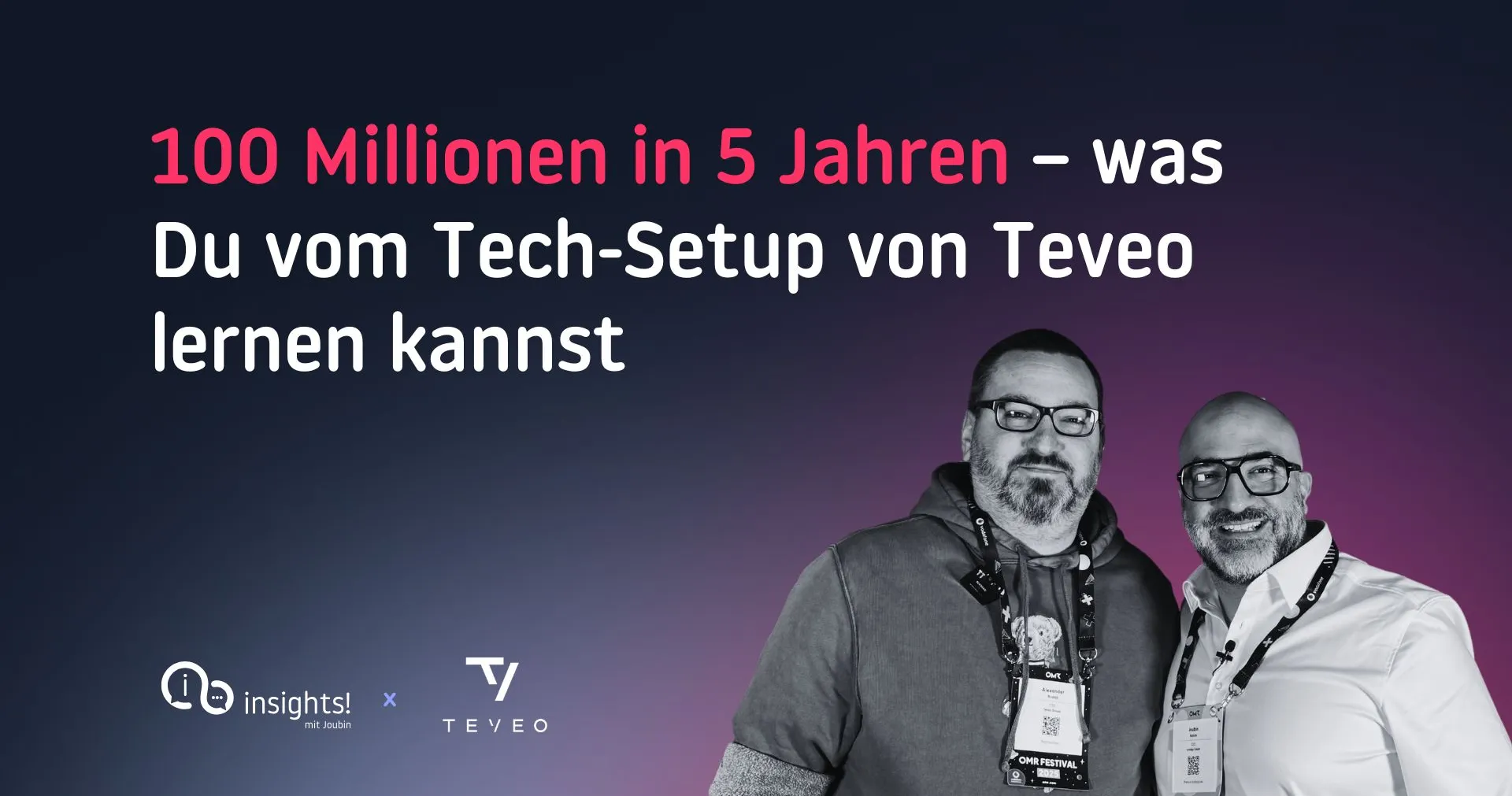
insights! #105: TEVEO - becoming a 9-figure brand in 5 years: what really matters when you want to scale
€100 million turnover – Teveo achieved what many fail at: scaling fast, staying clean – and having fun while doing it.
Alex gives insights into his leadership style, Teveo's technology infrastructure, and explains why the key to success lies not only in tools, but in the way of working together. His focus is on psychological safety, trust within the team and pragmatic system choices.
100 million euros in revenue from pure online sales within five years – that's not luck, that's system. And the system is: the right people, trust and scalability.
In this episode of insights! we talk to Alex Roddis, CTO of Teveo – e-commerce wonder that made 100 million euros revenue in five years. Alex gives exciting insights into his role, why tech isn't most important thing, which platforms they use and what other CTOs can learn from his journey. A conversation about growth, good failure culture and question: Magento or rather Shopify?
Teveo is one of those brands you might not (yet) know, but certainly should. While other e-commerce players moan about stagnating revenue, Teveo cracks the €100 million mark with a lean setup and clear stance – in just five years. CTO Alex Roddis shows why attitude and pragmatism matter more than technology here.
Technology? Sure. But first: leadership culture
When Alex talks about his role as CTO, one thing stands out: for him, technology is a means to an end – not an end in itself. His most important task? Creating an environment where people enjoy working, feel safe and take on responsibility. Psychological safety instead of micromanagement. Trust instead of ticket dictatorship. Sounds soft? It isn't. It's highly effective – especially in a full-remote setup.
Scaling means: getting rid of what no longer carries weight
What worked yesterday is a millstone tomorrow. Alex calls that the jump from the district league to the regional league: systems, processes and tools have to grow along with it. That takes courage to change and a good instinct for team building. Because it's clear: you don't scale with tools, but with people who solve problems together – and who choose the right systems for it. While many CTOs instinctively look towards SAP and highly complex platforms, Teveo deliberately takes a different path. With Shopify and the integration platform Kato, they manage to operate in a highly automated and efficient way – without building up technical debt. The principle: as little complexity as possible, as much performance as necessary. And that doesn't just work because Teveo is a D2C player. For B2B too, they're currently evaluating: which platform makes it easiest for the field sales team on site? Not the content manager. Not IT. The salesperson who has to convince at the point of sale. Customer first, even in the tech decision.
Influencers are the new sales reps
Teveo understood early on where the real levers lie: in influencer marketing. While many brands are still planning performance campaigns in Excel sheets, Teveo goes directly to the platforms with TikTok shops and strong creators, where target audiences really are. And yes – performance marketing joins in eventually. But as a complement, not as the basis.
Total Cost of Ownership – the nasty awakening
Many systems look cheap on paper – until first invoices flutter in. Good example: order management systems unusable without implementation partner. Or licences for users who never open system. Alex warns against looking only at feature lists and licence prices. TCO is more than Excel. It's: what does system really cost you – time, money and nerves? Teveo proves it: you don't need huge team, no legacy-driven infrastructure and no meeting culture to grow scalably. You need clear stance, working setup – and courage to keep questioning whether what you use today still holds tomorrow.
Christina Skoeries shows how modern leadership works: with clarity, empathy and real responsibility. She doesn't think in positions, but in potential. For her, empowerment isn't a label – it's daily practice. And no matter whether your traffic is currently dropping, your team is uncertain, or you doubt yourself – the path always begins with the first step: just do it. Or as Christina would say: „Can't isn't a thing.“
Would you like to listen to the full episode?
Find the podcast of the interview here:
Please accept the corresponding cookies to view this embedded content.
Prefer to watch the episode? No problem!
You'll find a recording of the interview here:
Please accept functional cookies to watch this video.
Prefer to read?
Joubin Rahimi
Great to have you all back for a new episode of insights! My name is Joubin Rahimi and joining today: Alex Roddis. Hi Alex.
Alex Roddis
Hi.
Joubin Rahimi
Great that you're here, especially in times like these where everywhere we face the challenge: how do we deal with revenues that tend to be lower? We need to look at cutting costs. You've got a brilliant story. Five years of hard work by Teveo, €100 million in revenue, pure online. There you are, and I'm delighted for everyone who achieves that, amazing, right now still rather the exception. So, to start: what's actually behind it? Because most of us are men, and it'll soon become clear why we might not know the brand so well.
Alex Roddis
I think, overall, where Teveo is very strong is sport that you can also wear a bit in everyday life, so to speak – that's working very well at the moment, it's interesting for many people. We have two founders who are very, very skilled in design and also in organising, and I think what we're now building together on the IT side to support all of this – so a lot in the direction of e-commerce, marketing, automation, AI – that's genuinely great fun together. And I'd say, given the current situation the world finds itself in, everyone's trying to stay afloat a bit. That's working quite well.
Joubin Rahimi
And your role as CTO is … ?
Alex Roddis
I look after everything to do with tech, so, to put it in modern terms, as you'd say: I do computers go beepupup. So we build our WMS for the AutoStore. We've got a highly automated logistics facility. We build the Shopify shop, we build the CRM system, the whole integration. But I think what matters as CTO, or generally as Head of IT, whatever, is creating a work environment where people actually want to come in and do things. We've got a full-remote setup, which makes it a bit more interesting too. You just have to make sure people feel they can work independently, that they're heard, that they trust themselves, that you create psychological safety in your department, across the whole company. Chris does that really well too, one of our founders. He's someone I'd say I'd go through fire for, because he's just so attentive to the people working for him. That's genuinely enjoyable.
Joubin Rahimi
What you've just described, in my view, makes for a really good CTO.
Alex Roddis
I hope so.
Joubin Rahimi
Did you notice something? You didn't even talk about technology.
Alex Roddis
No.
Joubin Rahimi
What's going on?
Alex Roddis
I love technology, but I believe the important thing is, technology can be handled by anyone to some degree, better or worse, but I believe talking to people, bringing people along and, above all, creating an environment for people in which they want to deliver top performance. That is the important thing. I do not think you get far by pushing hard; rather, highly qualified people need to be enabled to do highly qualified work.
Joubin Rahimi
Great, great. And how many countries are you currently active in?
Alex Roddis
We're now in the process of internationalising, step for step. Seven, I believe, at the moment. So France, Spain, Holland. We're now in England and also considering the USA a bit, but what might come later. That's not so simple either, because delivering internationally with German logistics, the provider Seven Centers, that's what they're called, helps us a lot there. I can only recommend it.
Joubin Rahimi
Now 100 million, so mainly in Germany then, right?
Alex Roddis
Still mainly, yes. And that's several brands too. So it's spread out a bit. Five years, 100 million - lots of people dream of that, but how do you then build up the infrastructure?
Joubin Rahimi
Was that a big topic?
Alex Roddis
So I think, on one hand Chris already freestyled it very well, as they say. I was very impressed by what was already there. And then there's simply this: what works in the lower league at some point stops working in the top league, and then certain things need swapping out and improving. That's basically the main thing I'm doing right now. So swapping out things that used to work well, once you're slowly hitting the limits. And I've already done that at many companies now. You just need a good team for that. The first thing you do is always bring good people on board, and bring the right people on board. Because I alone would sink, and it's great fun then to see how the teams grow, how people start solving problems together.
Joubin Rahimi
Chris has no technical background.
Alex Roddis
No. Well, I think he - sorry, Chris - did something with economics.
Joubin Rahimi
Just like we do something with computers.
Alex Roddis
Exactly, I did something with computers. He does something with economics.
Joubin Rahimi
Yes, because I think this must be highlighted and said: okay, we have 100 million euros, running through it. You also have responsibility for 180 employees. If goods like that are ordered, produced, delivered, paid for, and the shop doesn't run or you can't get it out, that's a lot of risk too. It is, indeed.
Alex Roddis
It's always like that, but I'd say the nice thing is, the company has a mentality that when something breaks or goes wrong, yes, it's annoying, it's rubbish, but then you deal with it, and afterwards you don't look at: who's actually to blame here? Instead: hey, why did that actually happen? What can we actually improve so it doesn't happen next time? I've experienced really, really bad Black Fridays at other companies, and the Black Friday I went through at Teveo was one of the most relaxed and smoothest I've experienced. And not because nothing happened – a lot happened – but it was well prepared, it ran brilliantly. People were together in a war room, it was genuinely enjoyable.
Joubin Rahimi
Which platforms do you use for that?
Alex Roddis
So for shops overall Shopify. That works very well. For the whole integration between the various best-of-breed systems we use Kato. Can only recommend it too, it's an integration-platform-as-a-service. There you can... So even business dullies can basically drag and drop pipelines together there.
Joubin Rahimi
That's great, but we should also, well, I'm responsible for a lot in the enterprise segment, and then we think, SAP. You need the SAP XI platform, or BI platform. You always have that kind of hurdle. But if you hear, with few staff, so not skilled from an IT perspective, you can run 100 million. Yes.
Alex Roddis
So I think that's where it's heading too. So with ever fewer people who are highly competent, with lots of automation and AI and whatever else, really pushing things forward strongly, so you simply test how far you can go, to the next person. It's always worked that way.
Joubin Rahimi
You said, for the B2C part you left some room. Do you have other ideas, towards B2B, perhaps?
Alex Roddis
Yes, we have a supplement brand. I come from the fitness sector now. I'd say I spent three years on the board of ESN and More Nutrition, and we experienced and did a lot there, and B2B is always an issue with supplements. You want to offer your protein bars at various Edekas and Rewes and so on, and you have to work out how to get the setup right. How do you get it organised so that the orders, which are already far more complicated than in B2C, get sent sensibly to all systems and then somehow make their way out of logistics.
Joubin Rahimi
For you, it's probably like this: I might have an order that needs to go to x different points in time, or at different times, to various Edeka stores, right?
Alex Roddis
Yes, there are usually about three or four types. There are these small gyms, then there are the somewhat bigger ones that buy by the pallet, then there's central listing, where you really ship a huge amount, and then there's also Amazon, who always want it done in a very specific way. So you have to set all that up in your logistics first, fit it into your system. It all then has to be labelled and packed differently, and so on. It's not that simple. With D2C, an order comes in, three T-shirts get packed into one parcel, they move through the conveyor system and then get labelled and go out. With B2B, it's just not like that.
Joubin Rahimi
How do you approach the process? Do you then go with Shopify, or do you do a re-platforming? No, re-platforming is wrong. Or do you make a selection, and if so, how do you do it?
Alex Roddis
So we're currently looking at various systems, Shopify, VTEX, and one or two others as well, to see what's most comfortable for the people who actually sell on site. And I'd say we can somehow connect to any system. I think it's much better to look at what works for the people who later sit down with the customer and say: Yes, of course we can do that. Check. And then the systems in the background are more of a secondary matter.
Joubin Rahimi
Just so I understand correctly, you're not concerned with the backend user maintaining content, that you'll sort out somehow, but with the sales rep on site?
Alex Roddis
I think, companies that scale very strongly always focus on their superheroes and superheroes in B2B always people sitting on-site saying: Yes, we have cool deal now here, want try it? Support on-site sales after that. Must support them, give them best tools. In B2C it's, there our influencers, those our superheroes. So must become as supportive as possible there. And if you do that, sales basically run by itself.
Joubin Rahimi
Support from the superheroes? Yes. That's great. How important is marketing in this construct?
Alex Roddis
I think for us, influencer marketing is naturally a big part of it. We've also just opened a TikTok shop as one of the first brands to do so. Yeah, Philipp. Our CMO is called Philipp. He got very involved in that, did it really well. And I think influencer marketing on Instagram, TikTok, that's something for us. Now, of course, performance marketing is also coming in step by step. That's always the way it goes, once you get a bit more mature, you have to move in that direction too, but that's much more complicated, much more expensive, much more demanding, and comes with a much lower margin too, I'd guess.
Joubin Rahimi
Okay, for sure. You've been through several selection processes already. What would you tell another CTO who's new to the role?
Alex Roddis
To select a system?
Joubin Rahimi
Right.
Alex Roddis
That is a good question. I think you can no longer really go wrong with shop systems if you go for one of the common solutions. They all somehow manage it. I think what matters is how well you are supported. Customer success management, that is extremely good, both at Shopify and at VTEX. And you simply have to look at what markets you want to trade in. And I think Shopify is still relatively far ahead there. That is also something I would always look at: where do I want to go? Do I just want to stay in DACH, do I want to keep expanding?
Joubin Rahimi
Being active worldwide.
Alex Roddis
In DACH you could maybe set up another Magento shop.
Joubin Rahimi
How nicely you put that?
Alex Roddis
Yes, no idea. Wouldn't recommend it.
Joubin Rahimi
Why wouldn't you recommend it?
Alex Roddis
I think, for one thing, you're often a lot slower. The scaling … So if you have a shop that's really exploding and you have a Magento shop, then sure, there are people who can scale a Magento shop too, and I'm one of them, but it's a lot more strenuous and a lot more intensive. And the total cost of ownership of building and maintaining something like that yourself, and then supporting it down the line, is much higher than if you simply use Shopify Plus and then launch with that, or VTEX also has a model. I think that's the real reason. You sleep better, it's easier, it's faster, less hassle.
Joubin Rahimi
I'd sign up to almost everything I want to say. I don't know whether it's too inside-out from us as an agency now. All these SaaS providers, that's changing a lot. Often it's a percentage-based model on what they earn, and some are actually moving away from that again now, saying: if I grow, that becomes too much. And then they come back to on-premise things, and then there are two differences: those who do everything themselves, where I'd say: no, that's completely pointless. You're not making it cheaper, you need management time to focus on it, and that's why we offer this too. We also manage SaaS platforms.
Alex Roddis
So essentially as an intermediary too?
Joubin Rahimi
Yes, if the product data, the price is all zero, why? You know the platforms are running. Somewhere the price of 39.90 for the trousers has become zero. But where?
Alex Roddis
I think it's good to have someone at your side when you have a small IT team, that can really help. We also work a lot with agencies. I think if you do a lot yourself, at some point you can't avoid building a good internal IT team. At a company I worked at before, we once calculated it and we all thought: Shopify Plus, really expensive. And generally people say other solutions are very expensive. And we simply came to the conclusion: okay, if we factor everything in, it's still relatively affordable. But I think that always depends on the company. Everyone has to work that out for themselves.
Joubin Rahimi
And I think that brings us to a rather good point: thinking it through yourself and costs, called total cost of ownership. Where are the hidden costs from your point of view? So let me frame it a bit further. We mustn't just talk about platform costs, but everything that somehow comes with it.
Alex Roddis
Well, I think if you're talking purely about platforms, then, if it's a platform that's always basically with … That's my implementation plan, but they only tell you that once the contract has basically already been signed. I think those can be hidden costs.
Joubin Rahimi
But if you don't even know, the company needs someone who …
Alex Roddis
Right, we needed an order management system. They said: Here, we're the best order management system in the world. They're not bad at it either, but you basically couldn't implement it yourself. You then had to bring in an implementation partner, otherwise you couldn't use the system. That's the kind of thing I'd count as a hidden cost. But I also think, if you have a lot of users who rarely use the system but still exist as users and cost money, that can add up a lot – I'd always move towards that. Bring everyone in who needs it at first, but then clear it out quickly twice a month, so people aren't blocked but can work quickly, yet they disappear if they don't use the system. And otherwise, I think platform usage – payment might be another topic. So I think you need to keep a close eye on payment costs, and what I've learned is to keep renegotiating regularly too, as I said.
Joubin Rahimi
Nice how you still involve other people here.
Alex Roddis
That's something that can quickly spiral out of control. Especially when you keep selling more, these things keep growing more and more and more.
Joubin Rahimi
I think, okay, the scaling effects, where you can then say: okay, now we have ten times the revenue. Payment needs to get cheaper. Yes, great. Alex, thanks for all the insights.
Alex Roddis
Very glad to.
Joubin Rahimi
When people have questions, can they write to you directly?
Alex Roddis
Sure.
Joubin Rahimi
Great. Then do that. I think the exchange is hugely important, and hats off to the whole team again there. Then a hundred million in five years. Great idea, great execution. You have to take your hat off to the fact that it's achievable. Then continued success. The billion in another five years, right?
Alex Roddis
We will try.
Joubin Rahimi
Yes, okay. Great. So in five years we're sitting here again.
Alex Roddis
Alright.
Joubin Rahimi
Thanks, see you soon.
Alex Roddis
Bye.
Joubin Rahimi
Cool.
Have questions or feedback?
Then feel free to contact us directly.
- Joubin Rahimi
Managing Partnersynaigy
Show phone numberShow mobile numberShow email address
Subscribe to the blog now and never miss any news
✔️free of charge ✔️weekly news ✔️expert knowledge
Please accept the corresponding cookies to view this embedded content.