



insights! #72: Maximizing efficiency through AI & personalization
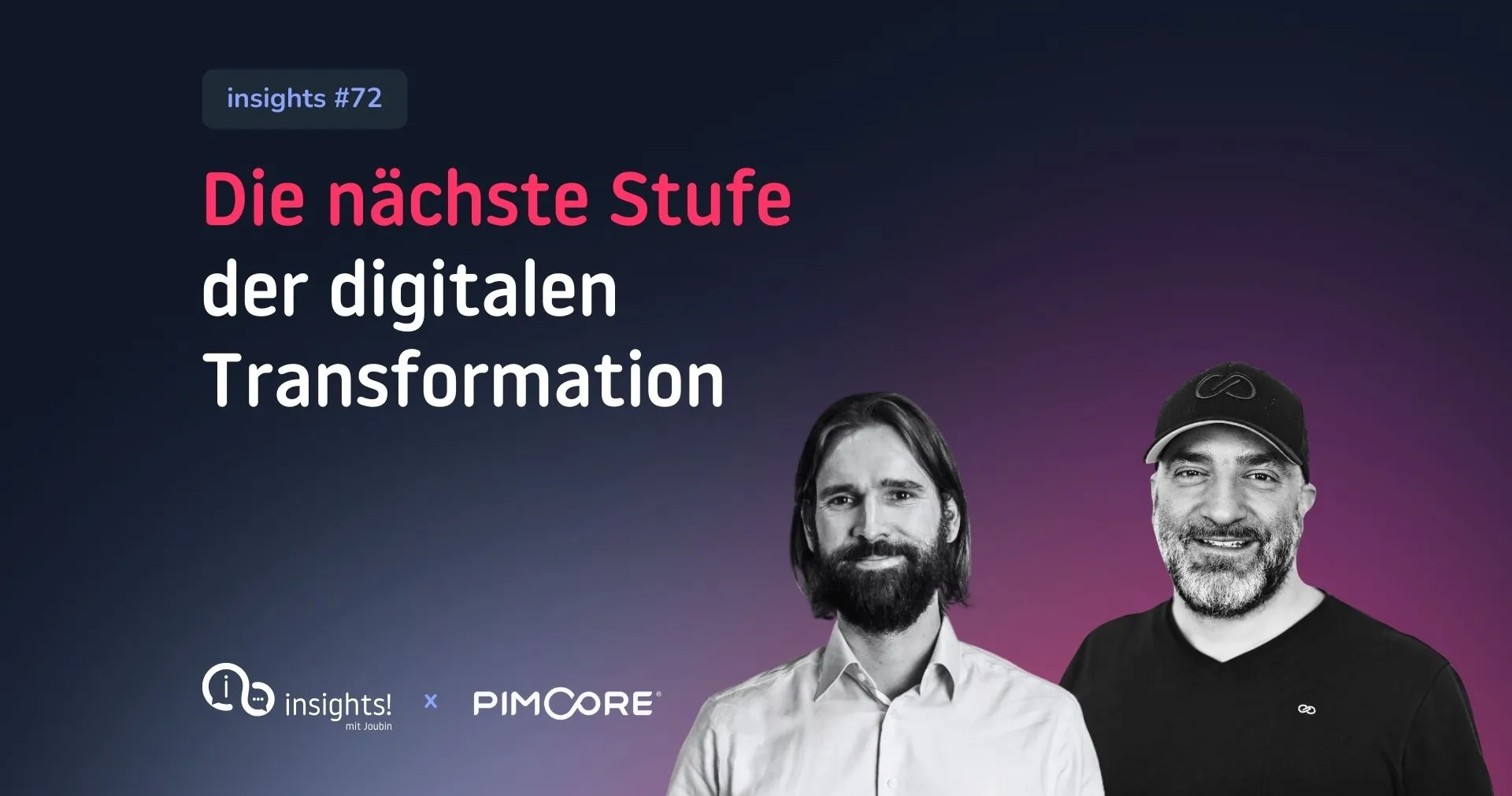
In this insights! episode, our guest is Philipp Krüger, Vice President Marketing & Consulting at Pimcore. Together we discuss the future of digital technology, focusing on the impact of generative AI, hyper-personalization and advanced data management solutions on marketing and e-commerce.
 Joubin RahimiManaging Partner · synaigy
2 min. read
As always, we are seeing job profiles change. I just noticed it with one of our graphic designers. These days she basically only does prompt engineering with MidJourney and Dalle.
Together we discussed various key aspects of digital transformation and the role of artificial intelligence in today's business world. In particular, we look at the possible applications and challenges of AI technologies as well as the importance of personalized customer experiences.
Pimcore is presented as a leading platform solution for managing data and customer experiences. It enables companies to manage data efficiently and make it accessible across various channels, which is an essential prerequisite for creating seamless customer interactions.
A key point of discussion was the growing importance of generative AI models. These technologies offer the potential to significantly increase efficiency in the development and delivery of digital services. Using AI successfully requires careful evaluation and adaptation to specific business processes. Alongside the technological aspects, companies must create suitable organizational conditions in order to fully realize the potential of AI. Integrating omnichannel strategies that go beyond purely sales and marketing approaches is seen as forward-looking for creating value-adding customer experiences.
Closely linked to this is the possibility of addressing customers in a hyper-personalized way. In the context of e-commerce and digital marketing, it is becoming clear that the ability to address and support customers individually represents a decisive competitive advantage. Data management and analysis systems such as Pimcore are considered essential for delivering these personalized customer experiences.
Would you like to listen to the full episode?
Here you will find the podcast of the interview:
Please accept the corresponding cookies to view this embedded content.
Would you rather watch the episode? No problem!
Here you will find a recording of the interview:
Please accept functional cookies to watch this video.
Would you rather read?
Joubin Rahimi:
Fantastic to have you with us again for a new episode of insights! My name is Joubin Rahimi and today my guest is Philipp Krüger from Pimcore. Hello Philipp.
Philipp Krüger:
Hi, good to see you.
Joubin Rahimi:
Great for a start. As you can see, today we are not doing this remotely, but in person.
You are from Dortmund, and maybe you can say a few more words about yourself.
Philipp Krüger:
Isn't that enough? Yes, gladly. So, my name is Philipp Krüger. I am Vice President Marketing and Consulting at Pimcore, for Pimcore, with Pimcore. I have been on board since the middle of last year and I am responsible for our entire topic. Go-to-market strategy. How we position ourselves, how we communicate, how we do things and how we talk about who Pimcore is. Maybe a quick note for your viewers as well. We are a platform solution for data management and experience management in one platform. We are not only extremely good at managing data with a workflow engine and Delta Modeling Engine, we are also very good at delivering that data again through a component, through e-commerce components, through portal components, making the data accessible. That is at the core of what we do, and of course we do much more. We could talk about it at great length, but that is just to give you an idea of where we actually are.
Joubin Rahimi:
We also have two or three projects together with you, which we won't be talking about today. They are great, really great. You have far more experience than just your experience at Pimcore. You told me you have over 20 years of experience in the industry, and that is what we want to tap into today.
Philipp Krüger:
Now I feel a bit old again, but that's fine. That's okay at our age. We are all just 29 years old. I hear that quite often.
Joubin Rahimi:
Exactly. And now, quite bluntly: which three trends do you see in the coming years?
Philipp Krüger:
Well, okay. I think the first one is the elephant in the room that everyone can see right now. That is certainly the whole topic around generative AI, so the whole generative AI thing. What is it actually doing to us? Honestly, I have noticed in a few discussions I have been part of that I am not really on this. I am maybe not quite on
Top of the hype train, because I still have a few questions about it, not moral or ethical ones or anything like that, but simply. I think the big effect we will see is not so much in usage, that we will all no longer have to write anything ourselves because ChatGPT does it all. I think the big effect happens above all where we have, let's say, the classic white collar worker, where we have development teams, so service providers like you. We see that in a great many places. I think there is a very, very big lever there. We will see that over the next months and years. The supposedly bad development shops, and I am deliberately putting it in that tone, so the bad development shops will get very, very significantly better by using these tools. That is one effect that will emerge, which of course will also be reflected in pricing. And things like that, whereas the benefit for those who are already good today is a bit smaller, a bit of an efficiency gain at the end of the day. But I think, further down the line, there is a bit less there. Otherwise we are of course seeing everywhere, I think, that the topic of efficiency gains, whether through testing, whether through taking over repetitive tasks, things like that. As always, we are seeing job profiles change. I just noticed it with one of our graphic designers. These days she basically only does prompt engineering with MidJourney and Dallee and goodness knows what else. That is essentially what she does. So I think that is a very, very big topic, across a great many areas. Whether that is development, whether that is the creation of texts. A second topic, I think, is something that has simply been running through the last few years. So a topic like hyper-personalization in the content area, but also in e-commerce, as far as I can see. The personalization of product data, for example, in e-commerce, or the personalization of how you address people. Over the past years we have rolled that out at a great many companies. So the system integrators have rolled it out at a great many companies, and at some point someone always asked the question: well, if we are now personalizing for everyone, who is actually going to write all of that? We can't hire that many students. Now we have this missing link with the AI story. So again, of course, ready to fill that gap. So that I am suddenly able to actually produce this volume of content at all, which I could not do before. Those are certainly the kinds of things that are simply continuing now, that are also being taken to the extreme, where we will certainly see completely new kinds of websites, especially in e-commerce and in content, that work quite differently, that also work quite differently in terms of user flow, that can capture much more input from users as well, because they also see the direct added value, because suddenly it really is about them. That, I think, is a very, very big point.
Joubin Rahimi:
It is actually an old topic. So I don't know whether that is really a new trend. Probably not, but yes, technologically. As I said, I think, well, we are where we are. I think that is what I see now.
Philipp Krüger:
Yes, of course, we have more and more low code no code platforms. But by now we are all in the cloud, in big quotation marks. Well, most of us are at least in the cloud. So I think those are topics where, on the infrastructure side, I would claim we will have peace for the next two to three years, for example, until the next big wave comes. At least from my humble infrastructure perspective. It is not a big one. So from my humble point of view, okay.
Joubin Rahimi:
But that makes three topics: the generative topic, hyper-personalization and finally infrastructure technology, which then changes. I would like to dig into generative AI again. You said you are not at the very top level. I have a short anecdote about that. A managing director colleague said: hey, come on. You are online a lot and you have those videos. I can do that too, and I will have them created as well. And exactly, and as I said, we told him: you can do it, but it is rubbish. And he says: why is that? I have a video like that too. Sure I do, but it does not feel authentic. And did you really try it out properly?
Philipp Krüger:
We really did try it out. So we have, actually there are things where it is cool. For example, we have now done it with an enormous amount of training content and documentation content in our customer areas, where people watch videos on how things work. And of course it is a huge effort to keep that up to date. With every major release. You have to swap things out, you have to reshoot videos. You have to make sure people have time, the video team has to come and so on and so forth. That is incredibly exhausting. For something like that it is worth its weight in gold. So if you do that with an AI thing, HeyGen, I think it is called, the one we did it with, and it works incredibly well, because it is training content anyway, nobody expects to be blown away, they expect it to be explained calmly in a nice tone, and then you go through it and you can look things up and it fits and that is cool. It works that well. We then have Christian Fasching, our lead developer so to speak, explaining it, and that is cool. Yes.
Joubin Rahimi:
And he can do his real job.
Philipp Krüger:
That is exactly the point. He can actually do his job. And if we see, okay, there is a mistake in that video or something, we don't have to drive to Salzburg with a camera team and interview him, we can simply correct it. That is of course great for something like that. But if you, we had this recently. We did it just for fun. We invited our employees to an event in March and used HeyGen for that thing too. Our HR colleague took an avatar of our HR colleague, and then this avatar says, in a completely neutral, grave voice: we are very excited. And it is just like that, you have a complete mismatch between text and image. So it simply does not work. It does not fit together at all, the tone does not fit, the gestures and facial expressions do not fit. So for something where you really want to be engaging, where you maybe also want to pitch something or invite people.
Joubin Rahimi:
You want to convey a certain energy. No chance.
Philipp Krüger:
Or our managing director, our CEO, Dietmar. Yes, he is a very, very extroverted person. He moves around a lot when he talks. He almost always has a lot to say and a lot of movement in him. He simply said about the thing: does not work. So either you tie him to the chair or it will not happen. Yes, so I do think there are things that are cool and where it makes sense. But it is simply not the silver bullet in every situation. That is what I always believe about IT in general. Whenever someone comes around the corner and says this will solve all our problems, they are probably lying. Basic assumption. That is why I also think it does not work there.
Joubin Rahimi:
But yes, good tip, good point. If you have training videos, also for your own customers, use it in that form. We are also repeatedly in customer situations where they say: ah, I am considering setting up my own development team. Now you also said that bad developers will get significantly better because they simply get support. I completely share that view. We think about that too, because we are there with the good developers, so we have to have good people, otherwise the whole thing does not work. And over time we are also seeing that those who maybe cannot or do not want to keep up the pace, for whatever reason, tend to end up at an insurance company.
Philipp Krüger:
That makes sense.
Joubin Rahimi:
It is unkind, putting people into a drawer like that, whether you want to or not. But we are simply in a different situation. Now we also have many retail companies saying: I want to do more tech. What advice would you give them, since some of them have no IT and tech know-how at all?
Philipp Krüger:
Yes, so I think this retail tech topic, there I am again, that is another architect's answer. So first and foremost I would say: it depends is our answer.
Joubin Rahimi:
A consulting answer.
Philipp Krüger:
Well, I think, so I think you have to, you have to be clear about a few things. We have done that in the past too, advising customers who said: yes, as a retailer we actually want to get to a point where we build our own tech capabilities. I think the first thing you have to be clear about is that you are stepping right into this war of talents. And that is of course a problem. For example, we had a retailer from, I don't even know whether it is Lower Bavaria or the Allgäu. In any case it is the end of the world. I won't say where it is, because otherwise the Lower Bavarians or the Allgäu folks will come along and say I got it wrong. So somewhere down there, far away from North Rhine-Westphalia, far away from Dortmund. For me, basically. Basically, yes. No train goes there. In any case they came along, so they really, really are at the end of the world, and they said we want to become retail tech now, and they actually included that in their tender for an e-commerce solution. And it came down to very traditional solutions on the one hand, with an SAP Commerce, and a slightly cooler variant with a Spryker on the other, and that was the question, and the team said: no, we want the hipper part, so we want to do Spryker with the young technology, and we also want to build up this capability ourselves. Then we said: fair. But what you have to have on your radar is that you are right in the middle of this issue, competing for the same people as synaigy does, but of course also the PPCs, the EYs, the Accentures, the Deloits and the Replies and whatever they are all called. And that is simply a problem. And if you are a traditional retailer who traditionally pays retail salaries and traditionally sits somewhere at the family headquarters, somewhere in Lower Bavaria or the Allgäu, then that is a problem. And if you are not the amazing brand that can attract digital talent, like Hugo Boss for example, because it is Hugo Boss, or now also Aldi, Aldi Nord, incredible, or Aldi Süd. Aldi Süd's IT is simply, if you believe LinkedIn, roughly the hipster place you can work at. Yes, but I think getting there and first having this employer branding strength to really pull people in, when on the other hand they could also work at the Big Four. Or at the big integrators or at the cool agencies.
Joubin Rahimi:
Yes, then it really is difficult.
Philipp Krüger:
And I think if you want to do that, a lot of it goes through new work topics. Actually, you obviously have to allow remote work, of course you need some hubs somewhere in big cities. In fact, back then we thought about it together with the customer, building a development hub in Düsseldorf or in Berlin, saying there are central meeting points where people can also come together, to have this whole co-creation, coworking thing as well. Because that is the other point. I also think, at Pimcore we are a remote first organization. Personally, I sometimes find it very difficult. I spent two days with my team in Salzburg. That was fantastic. It was cool simply having direct access to the people, and you can talk to each other and you get to topics you otherwise would not get to. But especially in technology jobs, where people have to exchange ideas, where a UX designer has to talk to an architect, where a developer has to talk to another developer, where the tester can simply join in and say: folks, how does this look with the data? Those are all things where I think you do have to make that available. So I think that is a very, very long answer to what was actually a short question: what would I advise them? Yes, I come back to it depends. So depending on what you are planning. But rest assured, if you are planning that, it is a long road. And I think it hurts, too. It is also really expensive. Because the core intention of the question was whether AI would help a lot here, and you are actually saying it depends, but there are lots of other things, I think. There I do think so. So will AI help there? I think, from my own experience. You have probably observed something similar. Let's say things that used to be incredibly labor-intensive are not necessarily that anymore today. But if we are talking about test automation, building test data, things like that, so the stuff you can automate really nicely, where you used to need a test engineer or goodness knows what, you do not necessarily need that today. I think the team composition you need today is definitely a different one from the one you needed two or three years ago. If you had said: yes, well, okay, that is basically a development team. And then you come around the corner with a classic Scrum team. There is a business analyst, then there is a tester, then there are somehow three developers and a front-end person. So somehow these classic pizza team setups. I think the cut looks a bit different today, because in parts you can also scale quite differently. So again, things like: do I still need pair programming if I have a Copilot from GitHub? Yes, to a certain degree, but maybe not as labor-intensive as I needed it two years ago. So those, I think, are the levers in there, does that answer the question?
Joubin Rahimi:
Well, I find that great, because on the one hand you say yes, it helps you, but it does not actually solve the core issue, because you have to restructure your organization, you have structural issues, salaries, you have structural issues. Geography. There is still a huge amount to do in that construct, and how that works for agencies, which is obviously your target group here as well. But you can take a look at that.
Philipp Krüger:
Well, of course we see a lot. We have almost 170 or over 170 partner agencies out there whom we are also regularly in contact with. And of course we see a lot of movement, and there is a great deal going on right now, especially since the pandemic, around the whole topic of remote work and so on, so those who classically operated more locally started, during the pandemic, hiring globally or Europe-wide or Germany-wide, depending on their size, and are now trying to pull this employee structure back together again to some extent. So I think that is a very big challenge for many agencies, for ourselves too, and I think also for many vendors. Because I am not the one saying we all have to go back to the office all the time. That is nonsense too. But I do think we have to somehow come to terms with the fact that there has to be some model where people also come together, because at the end of the day. In this completely remote setup. I don't know how happy you will be there. We see that too. So we spoke with two agency owners, shortly before Christmas I was at a partner who said: one very big problem they have today, which they did not have at all before, when they still hired locally. It is a much, much higher turnover issue, because people identify far less with the company. So if the only difference left is how your Microsoft Teams background changes, whether you are at company A or company B, then there is not much. And that, I think, is a very big point. And especially at agencies, I think a lot of it comes from the fact, to be fair, that the work is also very, very similar, logically, because everyone is to some extent doing the same thing. Everyone has their own player, everyone does it in a different way. But at the end of the day we all deliver more or less the same thing. That is certainly the case. I think this business of binding people to the company again, to values and so on. I think organizations that cannot answer for themselves what our, what are our values, what is actually the core of us and of what we do? Those have a very, very big problem. But AI does not help with that either. So if you ask ChatGPT what my company values are, sure, you can do that, but whether that is really helpful, I don't know. But I think that is the big one for agencies, that they now have to bring this probably larger, locally distributed staff back together a bit more. That is the challenge we see at a great many of them.
Joubin Rahimi:
And on that I have a more concrete question, because let me take a bit of a run-up, AI.
Philipp Krüger:
I have talked so much, now it is your turn.
Joubin Rahimi:
You are the focus here, not me. AI. I will make a few analogies and I will start with the first one: Gutenberg's printing press, who invented printing. And what that essentially did was this: the knowledge that was conveyed back then was also conveyed through books. But only a few could afford them, because they could neither read nor write. And that was basically religion or the church and the nobility. With the printing press, however, the broad masses could, and through that democracy, also a bit the first steps toward equality, an even distribution of knowledge, that changed a huge amount, and it was also the foundation for industrialization and so on, because those who then had books could learn, develop further, do research and so on. Then, much later, came information, and by information I mean what is much more fleeting but is also spread very widely around the world. Namely through the internet combined with the smartphone and social media. That produced the Arab Spring, so it endangered democracies or non-democracies, dictatorships and other political systems. It also changed buying behavior. Whereas at 29 we used to go to Media Markt to see which was the best TV, nobody does that today. You know what you want. And buying behavior changed, because now everyone could broadcast information into the world. And I could gather a huge amount of information, whereas before I had employees who did that sort of thing. PR agency. With generative AI, the situation is that the generation of content, of knowledge, of concepts is no longer reserved for the elite group, so that is always the entrepreneur who says I have employees, I commission a consulting firm, they write me a concept, they select software for me. Instead I now just ask ChatGPT: please do a scoring for me. That is what I need for a DXP application. Boom, I no longer need an advisor and consulting. That is changing. And I took this long, long detour because that is what we are dealing with, buying behavior for you and for us is changing, and so is coding behavior.
Philipp Krüger:
I see it exactly the same way.
Joubin Rahimi:
And now I have an assumption about what you have to do. I think we have to create much better customer experiences, because if the outcome is similar. I do think it will take a long time before a bad agency with bad developers achieves results similar to ours. But we have to start working now on experiences that are better for the customer. And then it is not necessarily about the generation of content, but about the generation of the right strategic content or code. That is my assumption for now. I am curious to hear what you say about what will define the successful agencies of the future.
Philipp Krüger:
I would go along with that for a start. I think the differentiation obviously lies exactly in whether you are able, first, to use these tools correctly and, second, to arrive at a mix that is relevant for your customers. So it is like this: we are experimenting with it a bit ourselves right now and looking at, okay, can we. We have quite a lot of market research, whether that comes from Gartner, whether it comes from ourselves, Forrester and so on. We work with the big analysts and have now started experimenting with it, saying: yes, let's see whether we can't derive enough from just an email address and domain name, so that from the domain we get the customer's industry, and from the industry the classic problem areas they have in a master data management environment, in order to then generate something that already creates greater added value for the customer in the first conversation. A generic PDF about master data manager. So that is also the, so on the one hand I think it works really, really well, on the other hand things happen again and again that are completely, completely unexpected. So it is this thing where, on a topic like the one you just mentioned, a tender or a scoring via ChatGPT, I would have serious misgivings, simply because as someone who has been in this market for 20 years I know how volatile it is. And when I then look at how current the LLMs are. So is it enough if I have a knowledge cutoff of, say, 2020, 2021, 2022? Is that actually enough to make the assessment today? Small hint: I think the answer is no. So I think, I don't know. I think it gives an indication. It gives an indication.
Joubin Rahimi:
That is certainly true. In which direction can you look?
Philipp Krüger:
On the other hand, two years on the internet is really long. So it is the case that if you think about it, what, what? What a Spryker was doing two years ago, or an SAP Commerce, or commercetools or whatever they are all called. I have to name them all at once, it does not matter. So all our friends, or also what we ourselves were doing two years ago, that looked considerably different, stood on technologically considerably different feet than it does today. So also the question of whether you, I think it will be interesting, what we all have to learn now from a marketing perspective. What we all have to learn is: how do we actually manage, via the information that is publicly available about us and that we put into the market? How do we manage to get this information cleanly into the LLMs, so into the publicly accessible LLMs, so that what we do is actually reflected in the answers. So I think that is the big challenge. The whole topic of how do I actually do SEO for ChatGPT? And I think that is really exciting, and I would like to underline it once more. It affects everyone. All vendors, all retailers. It affects you, that you already have to think about it now. How do I ultimately do that?
Joubin Rahimi:
Because you say okay, the LLMs still have old data. If I look a year ahead, they will be much more current, because the cycles are getting shorter too. And then exactly that comes into play.
Philipp Krüger:
Of course, every person has to make that decision for themselves. I think it will be really exciting to find out how it actually works and how I can influence it too. So if you want to do it just for fun, ask something like: who is the best PIM? Who is the best MDM? Who is the best DAM? Just to have a look at ChatGPT and ask: where does this answer actually come from? What is the answer and where does it come from? If it is a competitor, what do they do better than we do? So we are looking into that very, very intensively right now. So we are looking into it very intensively right now, and he said: well, obviously search behavior is also changing so fundamentally right now. If we also look at what Microsoft has done with Bing and Copilot, how suddenly ChatGPT is basically a thing. Okay, thankfully hardly anyone uses Bing at the moment. That is why it is not quite so dramatic yet, but if Google makes the same move and it really becomes this natural language exchange with the search engine, the way my parents were already trying ten years ago to google with full sentences and question words. If that suddenly becomes reality and we pull this knowledge together from the most diverse sources. And also that the ranking of your own website actually becomes completely irrelevant, because what is really relevant, also for the purchasing process and for the decision-making process, actually happens in the prompt window. That is where it gets very, very exciting.
Joubin Rahimi:
Let's take another example that has nothing to do with technology. Every two and a half to five years, an oil tank owner has to have it tested for leaks. So not often. If you have dozens of properties, great. Now just imagine you are simply the owner and you say: where do I do that? How do I do that? And now you search for something like an expert for oil tank inspection. But what do you actually want? You want to have the certificate. And I think that is where, whatever the system is ultimately called, it will say: okay, get me an expert for that topic, and then it will ask you two or three follow-up questions: who do you want there? These are the appointments. Which one will you take? You pick one. These are the prices. Boom. So a personal assistant. I think that is the direction this is going.
Philipp Krüger:
I would sign off on that too. Well, we are already seeing the first ones. It is also so exciting how it is all coming together now. I remember, three, four, five years ago there was this big natural language interface hype, where people started talking to Alexa and Siri and co., and actually do so. Now there are people who really do that. Honestly, it never got through to me, because I always feel so odd when I talk to my phone. I always try not to make phone calls in the first place. That is already me. It has always been odd to talk to the phone like that. But I do think that when you see how it is all coming together again, it is of course really exciting. So what is possible there now, and I think in a great many places, we are also working on AI integrations and have now created something. We call it Copilot too. So it is basically our integration surface for AI. And what we actually said was: we are not building a button saying generate product data for me now, we are building a context-sensitive assistant that I can talk to, that then does things for me, that I can also ask questions like: if I also keep my product availabilities and stock levels somehow, or prices of articles in my PIM, then I can say something like: please create me a report on this and that topic with these and those data and these and those attributes, because that is what I would like to know. So that I can actually start asking the system, so that it outputs data to me, yes, or please give me all the blue T-shirts in all sizes that we currently have available in store XY, whatever I need that for, that does not really matter. The point is simply that I am able to formulate such things to the system in natural language.
Joubin Rahimi:
That is where it gets really interesting.
Philipp Krüger:
Especially on the topic of reporting, these requirements lend themselves to that wonderfully. What do I actually want answered? And then the system finds the data for me. With a specially trained model, or also for category building. So if we are in the PIM environment. So if I now say, I don't know, I need. I actually want to build a landing page because right now, I don't know, for Valentine's Day I want to promote all my red clothes or whatever, because I say I think that is cool. Yes, it is an incredible ordeal in a classic PIM to sit down and work through that. Then I need a Valentine's Day category and then I have to duplicate the products into it and then that is annoying again and then they are not connected and I forget half of them and so on. Whereas if I can simply tell the PIM: listen, I now need, temporarily for the next three weeks, a view of the data that gives me all the red T-shirts in sizes M to S or whatever. Then that is a task that goes really quickly. And I think that is where it gets very, very exciting. This kind of small work relief. And I think, coming back to the question about the big trends. I think that is where it comes together a bit as well. I think the truly innovative cases will not come at all, will not come from the big LLMs the way we know them today. That is incredibly impressive and really awesome right now.
But there are already these first screenshots of some insurance chatbots that can give you answers to some programming questions or whatever, simply because it is completely unfiltered ChatGPT. So that is nonsense of course, an insurance company does not need to be able to review my code. So that is very obviously nonsense, but I think the innovation will come. That is why we also said we are going for an open approach, so we are not integrating ChatGPT or Meta or whatever, we are integrating toward Hugging Face with all the models hosted there. That is over 400,000 by now, I believe, in order to be able to use specific use case driven private LLMs, because I think that is where it gets really, really interesting. We experiment with it enormously ourselves. We have now, for our "Open Knowledge" project inside our company, because we said we actually have to get to a point where it is much easier within the company to, well, we are reaching a critical size where we have to make it easier to get to information. Because in the past you could simply ask Stefan or ask Herbert or ask Christian or goodness knows who. That does not work anymore now, because they might be remote or they might be gone. So we started feeding our own data model with our internal Confluence pages, our developer documentation, our sales collateral and so on, and now we have a Pimcore chatbot you can ask when you want to know: what reference cases do we actually have? I don't know. For a company with 500 million € in revenue in the manufacturing industry, and then it spits out the list and the links to the website. Or: how does data modeling for retail actually work in Pimcore? What do we have there? Then it spits out the matching pages from the documentation, or who I have to ask internally if I want to know where to send my vacation request. So that too. So things like that work too. Or if I have to do a business.
Joubin Rahimi:
You do not actually want to search for that at all, it simply has to be accessible.
Philipp Krüger:
And we have all probably spent what feels like 100 years in the internal Confluence search, trying to find some page to know how to file some travel expenses or whatever, and those are simply things that are incredibly unnecessary, and those are, I think that is where it gets really exciting, for companies too, to really extract this efficiency advantage. But for that I do not need a ChatGPT. For that I need a small model that analyzes and holds exactly the data I give it, where I can curate it properly, where I know what comes out at the other end, that can properly assure quality because I have influence over the data.
Joubin Rahimi:
So a niche ChatGPT.
Philipp Krüger:
Yes, exactly. I think that is where it gets very, very exciting.
Joubin Rahimi:
I would like to bring up hyper-personalization again, and the thought just came out of this conversation. So it is really fresh. Well, let's see. Hyper-personalization is one-to-one personalization, personalizing the individual topics even more precisely. But I don't think that is the case at all. That is then just another 5% better on top. I think that does not matter. With the topic of: I need someone who takes care of what I want, that is much closer to it. Let's take an example, a short story, and you give your opinion on it. I have a box spring bed. Those are always a bit higher. And now I need new nightstands. And I am a retailer who has everything. And if I then say, okay, a customer currently has the issue of: I want to buy nightstands, maybe even lamps to go with them. I don't know that yet. And I am not searching for nightstands at a height of x, y, z, but saying: hey, I bought this and that from you, I am the one, or I bought that wherever, in this color. This is my room. Let me drop in a picture and I am looking for matching bedside lamps and nightstands that match the style of the bed. Give me some suggestions. That would be a form of, well, you don't call it hyper-personalization, but actually that is exactly what it is. That is a kind of guided selling, an automated guided selling on top of it. I think that is also really exciting, so with hyper-personalization I am with you: do you actually need one-to-one personalization?
Philipp Krüger:
Yes, I don't know, probably not. So I think that is also because nobody can maintain it either, and nobody understands it afterwards. Yes, you simply cannot anymore. You have lost your grip on it. So you are also missing a bit of the ability to intervene, because you can no longer trace what a customer actually sees. I think personalization with more segments does make sense. We did that for one of the big electronics retailers, who said: if I go to the product detail page and I am in a rather technology-savvy target group, then I play the full card of screen size, resolution, how many ports and so on, and how great does it work with the PS5? If I am in a less tech-savvy target group, then I get things like build, height, depth and so on. How well can I hide cables, and these things, or the color is already there somehow, and how wide is the bezel? So that I then know, okay, how does this actually work in my room? Because maybe the aesthetic point of view is more important to me. I think things like that are just really exciting, and that is where a real, good, proper PIM system or product experience management system like Pimcore helps. A miracle. In combination with these generative AI capabilities, that can of course work wonders for doing things like that. So the case you just described, I find that really exciting. I think we have to prepare for that sort of thing becoming much, much more relevant for us. But it is also something that takes incredible volumes of data, that really needs solid volumes of data, because at the end of the day someone or an AI has to sit down at some point. And yes, also connecting articles with each other, to different styles and so on. Modeling that is considerably more complex than simply saying we have beds and we have lamps. That is easy. Then you also have a situation and tastes. And then there are these stories.
Joubin Rahimi:
Those, I think, are things that started with this whole shop the look thing in fashion, about five, six, seven, eight, ten years ago, I think, where it began a bit, also a bit image-based, to do those things, so that you also had a more immersive shopping experience, as people always said back then. And now rebuilding that for search will, I think, be really exciting too.
Philipp Krüger:
And if you look at the big search players and what they are doing in the AI area, that is all pretty cool, with these vector searches and so on, and then image recognition, but what is technically needed for it. Again, I always find it quite amusing when people run around saying it is all new now, it is all completely different, it is all new. Well, that is not really true. Because image recognition, auto-tagging of data, recognizing connections between data, also from text and image material and so on, none of that is new. It just took considerably longer two years ago. You could already do it, but then you maybe did it manually and someone sat down and said okay, that is a bathroom, it has this and that main color, and so on and so on. Today I do that automatically, and then it gets exciting, because you can suddenly offer these cases. And one last thought on that, which I think many people underestimate. I had the discussion again the other day, where a customer, or rather a prospect, asked me: do I even still need a PIM? Yes, but today you need a PIM more than ever, because, and then he says: we have said it is in the online shop. Yes, but maybe you also want it in a big store in Munich. Maybe you also want these capabilities you are building online. You want to see them in the store too, because what do you do today if a customer comes in and you have a consultation-intensive sporting goods, a consultation-intensive product, say skis, a helmet, so things where you want advice, a mountain bike. Or, or, or. We all know that all of that is very complex. If I have a product like that, then I need someone in the store to explain it to me. Up to a certain point I can do it alone, but really I need someone to explain it to me. What is the frustrating outcome of this situation? When I go into the store, of course it is: I come into the store and there is someone working there, but they are currently in a sales conversation with someone else. And I do not actually have enough time and I really only need a bit of information, and I leave the store frustrated again. That is the worst possible outcome. But if I already have these cool guided selling things online, the customer can either inform themselves online first. But if they of course also need the haptic and the physical. Especially with athletes. Athletes are very, very, pick up, it is all equipment-based sport, to see how three grams lighter actually feels in a running shoe. That is rare. But if you can of course also bring this kind of capability onto a kiosk in the store, onto a display in the store, and the customer first has the chance to have a similar experience, or a similar light version of the consultation, doing it self-service and killing five minutes until the staff member has time. Then you have got it again. Then you have another turn in this customer experience. That is great, that is great. Do I need a PIM system today? Yes, more than ever. So to build all these cool experiences or journeys, you need data. And then comes what you just said, on top of that, the thought, incredible, what you just said, on top of that as well. These journeys and these experiences also produce an incredible amount of data again. And of course you then want that back in a DM, in master data management, in a customer data platform. Yes, all parts that we have in our platform as well. You want to feed that back again, because you want to react to it in the next step. Because how cool is it if I have first configured my shoe in the store and then I come to the online shop and the thing is already sitting in my shopping cart. And by the way, they have already thought about which ski boots would look great with it, or which pants I still need to really make it pop.
Joubin Rahimi:
Yes, so those are the things that are really exciting, and then this whole topic of omnichannel and channel integration becomes a completely different story too, because it becomes much, much more rounded and not just like that.
Philipp Krüger:
Yes, by the way, the online shop to extend our assortment. Yes, congratulations. Or we send a parcel there, then you can do returns. That is omni channel. That will not be enough.
Joubin Rahimi
:That is a great closing line. Yes, that will not be enough.
Philipp Krüger:
We are ending on such a positive note. I like that. Yes.
Joubin Rahimi:
Yes. Do the PIM, take care of it with AI and technology, but you need organization. And you have to create the structures. That is what you gave us. I also found the topic of hyper-personalization and how it develops interesting, and I am even more curious about where agencies have to develop. Took that away too, and ultimately: omni channel is not dead.
Philipp Krüger:
No, absolutely not. Not at all.
Joubin Rahimi:
Instead it is moving to a new level. And then combined with technology, in order to create new experiences. So if there is nothing in it today, then I don't know either. And now ChatGPT has to summarize everything we have talked about. Or I would say, if you have comments and questions, post them, write to us, we are happy to get into the discussion. Thank you for being here, Philipp.
Philipp Krüger:
Many thanks for the invitation. Great today. I really enjoyed it.
Joubin Rahimi:
Same here, and I hope you did too. And then, until next time.
Philipp Krüger:
Bye.
Do you have questions or feedback?
Then feel free to contact us directly.
- Joubin Rahimi
Managing Partnersynaigy
Show phone numberShow mobile numberShow email address

Subscribe to the blog now and never miss any news again
✔️free ✔️news every week ✔️expert knowledge
Please accept the corresponding cookies to view this embedded content.