

Energy
A market under fluctuating voltage.
6 min read

How a contemporary digital presence makes the difference
From political bodies to network operators to regional energy providers: few markets are as defined by constant change as this one. The reasons are shifting political frameworks, technological progress, volatile prices and growing information and customer needs among consumers. To balance all of this communicatively, a modern DXP becomes unavoidable. That's why, for over 25 years, we've been advising companies and institutions in the sector on the strategic direction and implementation of their platforms.
Our references in the energy sector:
Our approach: a shift in perspective with radical user-centricity
We regularly invite users searching for a new tariff into our UX & Design Thinking Lab. In interviews and UX tests our experts identify the needs when searching for a suitable electricity tariff and customers' expectations of the website and online services of a modern energy provider.
Our Usability & Design Thinking Lab
How well does your digital product actually perform? Do users find their way around intuitively? Does it meet their expectations? In our User Experience & Design Thinking Lab, we've spent over 25 years examining digital applications for functionality, structure and usability. Test participants from relevant target groups work through typical tasks while our usability experts pinpoint weaknesses and opportunities for improvement. The result: an intuitive, user-friendly product that delights — and satisfied customers who keep coming back.
The framework of a digitally successful (energy) brand
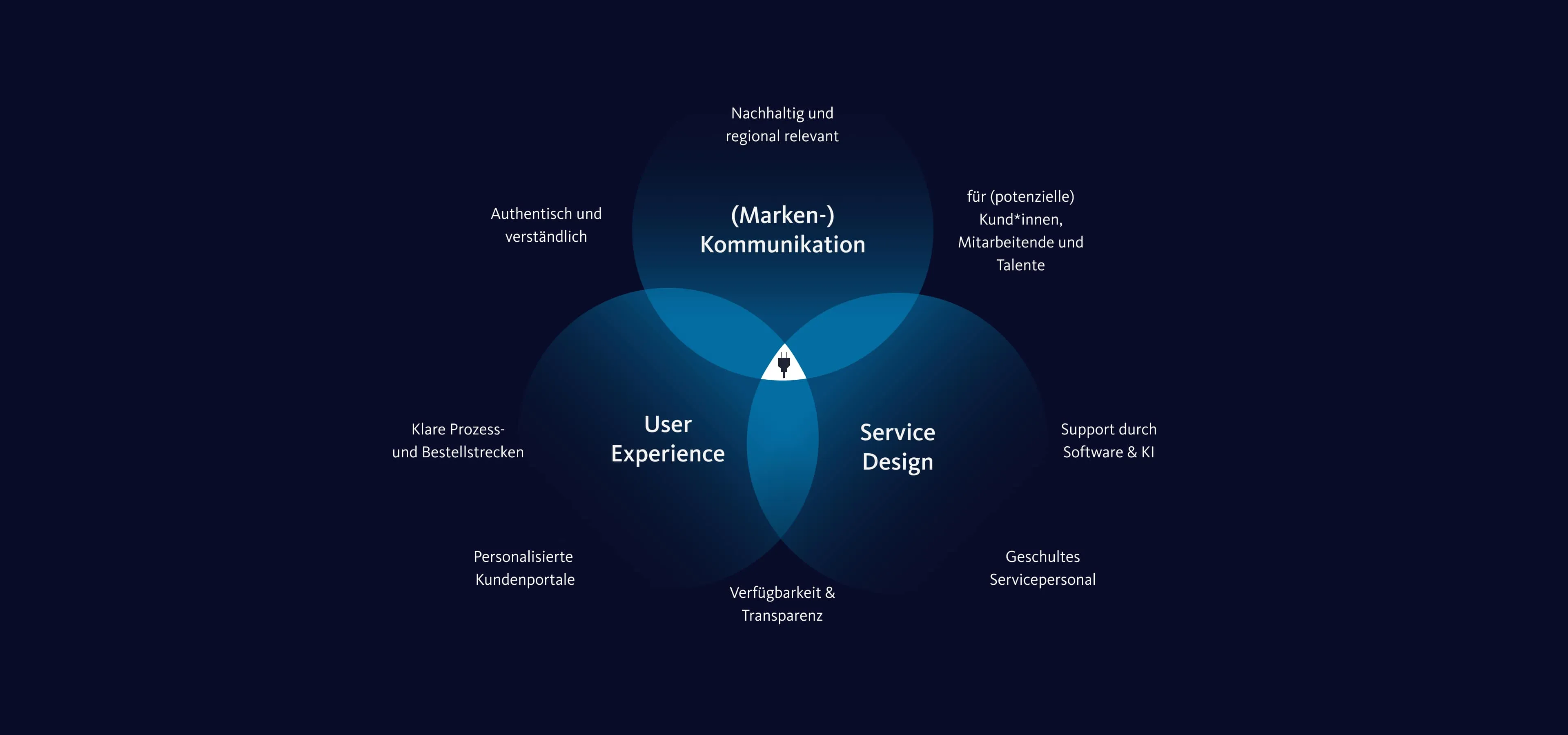
Price remains the top decision criterion for consumers. We can't influence that within our field of action. A positive user experience and outstanding service design should be the basis of all digital activities. Because even the most beautiful brand story only has (at best) limited value for dissatisfied new and existing customers. Below, we outline the interplay of these disciplines in more detail.
1. Loyal customers cost
In the liberalised energy market, customers can switch providers at any time. Suppliers face the challenge of retaining customers through attractive offers and good service while preventing churn. At the same time, there are revenue opportunities in acquiring new customers. Making switching easier while also rewarding loyalty is therefore a key challenge energy suppliers must address. Marketing automation and a lifecycle-oriented CRM can help here by enabling personalised offers and tailored communication – from customer acquisition through to long-term customer retention. Automated processes help deliver relevant content at the right time via customers' preferred channels, while analytics tools provide valuable insights for optimising the customer journey.
2. When playing field changes, new moves needed
Legal changes, such as the introduction of price caps or new consumer protection rules, require utility providers to continuously adapt their processes and their communication with customers. The key to this is a high degree of flexibility and a technical infrastructure that enables content changes in real time Headless content management systems (CMS) and API-based platforms play a central role here. They not only enable the rapid integration of new legal requirements, but also ensure these are communicated clearly and comprehensibly across the various channels – from the website to newsletters to customer portals. In addition, data-driven approaches such as predictive analytics can be used to identify possible impacts on the customer base early and respond in a targeted way. This turns regulatory headwind not just into tailwind, but also into an opportunity to position yourself as a reliable and transparent partner in the market.
3. Whoever wins trust wins customers for future
Incorrect billing, unclear contract terms or unexpected price increases often lead to customer complaints. To maintain customer trust, energy providers need to address these concerns promptly and transparently. Personalised customer portals, which provide up-to-date status information at all times and allow customers to independently adjust and change contract details, are key building blocks for building trust in the long term. Real-time notifications and personalised service offers can help strengthen customers' sense of control and security. By integrating AI-powered tools such as chatbots or automated assistants, many queries can already be resolved at the first step, which not only increases customer satisfaction but also lowers service costs.
interactive tools - your agency for digital energy communication.
We look forward to your call or your message!


4. Service that connects rather than annoys
Customers expect support with questions about tariffs, invoices and technical issues. Customer service that's reachable at all times and competent is crucial here. Digital tools such as intuitive chatbots and intelligent FAQ systems on the website can answer initial questions around the clock, while a clearly structured contact form or a callback function makes it easier to reach experts directly. In addition, omnichannel solutions can be used to ensure seamless communication across different platforms – whether by phone, email, social media or live chat. Customers expect their queries to be handled consistently regardless of the channel chosen. With CRM integration that captures all interactions centrally, queries can be resolved quickly and in a personalised way. By combining people and technology, customer service becomes not only more efficient but also more personal – a decisive factor in building genuine relationships.
5. Content that keeps what tariffs promise
A holistic content strategy gives energy suppliers a wide range of ways to target new customers, retain existing customers over the long term, and hold their own successfully despite cheaper competitors. Through informative, engaging content that puts regionally relevant topics such as sustainability or local energy projects front and centre, leads can be generated and potential customers kept on the supplier's own channels. Marketing automation makes it possible to deliver personalised offers and relevant information automatically at the right time – for example tariffs tailored precisely to the target group's consumption and needs. Customer portals give existing customers transparency and self-service options, strengthening customer loyalty. A strong social media presence helps communicate regional roots, interact directly with customers and strengthen brand image.
How do we bring this together?
Together with our customers, we use these insights to make strategic and technical decisions for the conception and development of their digital communication. Tailored, and following proven project and process standards. We're happy to offer a free initial consultation for your current challenges. We look forward to the exchange with you!
Get in touch now

Your contact person

- Nico Hübner
Consultingsynaigy
Show phone numberShow email address