



insights! #107: what Asia does better than us – and what we should learn from it
What does it really take to succeed as an entrepreneur today – in competition with China, Gen Z and one's own comfort? Sven Rittau, serial entrepreneur and co-initiator of K5, talks with Joubin Rahimi about genuine networks, sustainable entrepreneurship, Asian energy, recruiting fails and what could shake Germany up again. It's about staying the course, thinking in terms of responsibility – and plain speaking.
 Joubin RahimiManaging Partner · synaigy
3 min read
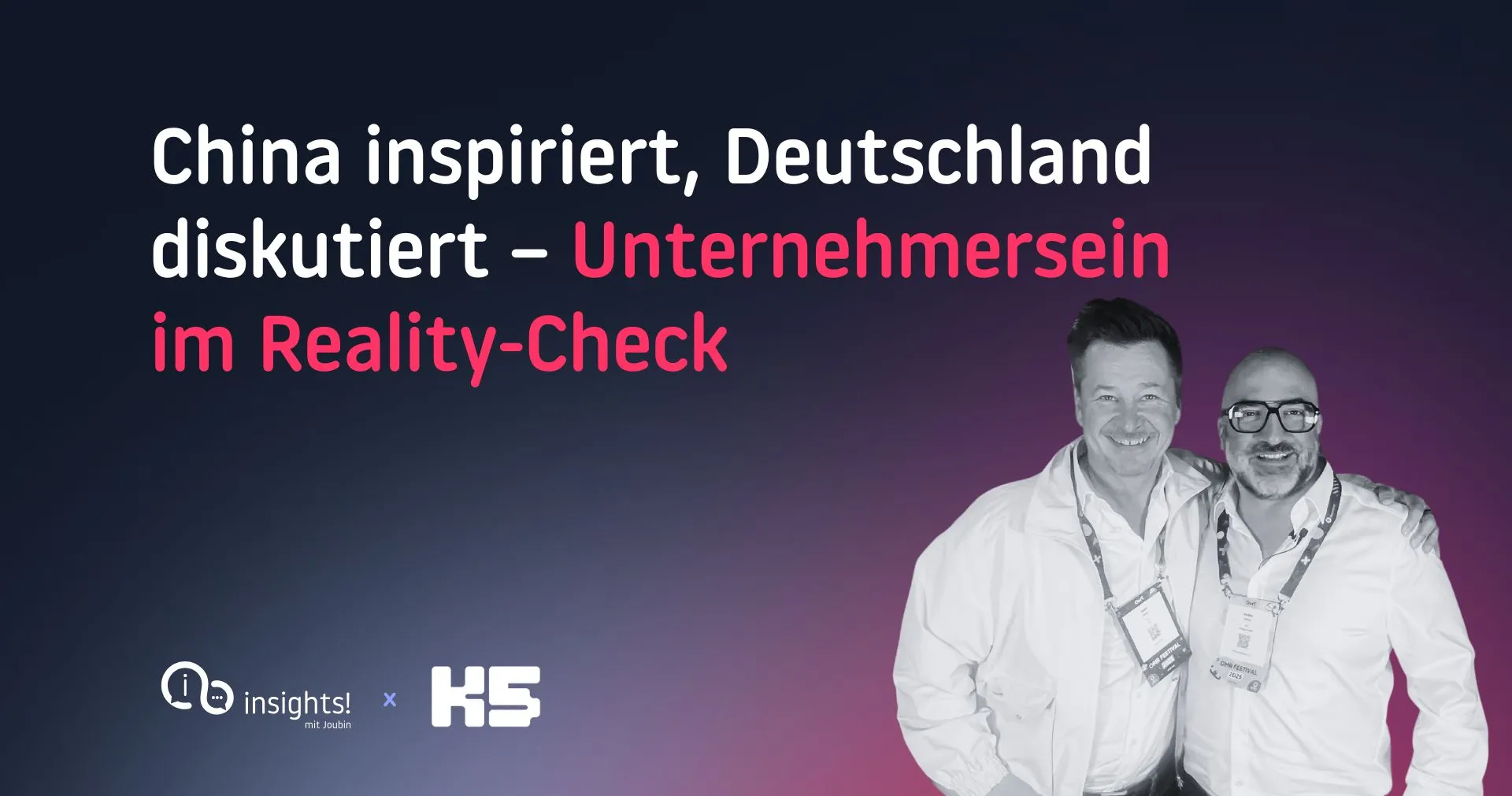
„In China it gets done, here it gets regulated.“
What distinguishes founders from real entrepreneurs? Why networks are worth more than business plans? And what we can really learn from Vietnam, China & Co.? Sven Rittau talks about attitude, responsibility, recruiting, Asia – and about why more clarity is needed if you want to lead today.
Entrepreneur, not founder – with substance please!
Sven Rittau puts it in a nutshell: the term "founder" sounds too much like exit fantasy and quick flipping to him. Entrepreneurs, on the other hand? They stick with it, grow with it, build it up, fight their way through. And that's exactly what's missing – not only in many pitches, but also in the mindset. You want to build something? Then you also have to be ready to go through dry spells. And you have to bring others along – people who fill your gaps, challenge your ideas and carry the whole thing with you.
Recruiting: better a fit than plentiful
One of the most exciting points in the conversation: good recruiting is based on personality, not CV. Tools like the Predictive Index help make exactly that visible – and so ensure a genuine fit. Sven puts it charmingly provocatively: “Three applications are enough – if one of them is the right one.” Naturally, that takes courage. Less choice, more quality. But that’s exactly where the difference between management and leadership lies. Because: a team isn’t a hodgepodge of all-rounders, but a puzzle. And only when the pieces fit together does something viable emerge.
Networks: the underrated success lever
Whoever nurtures their network early and deliberately saves time, mistakes and grey hairs later. For Sven, it's clear: network is part of the business model. The K5 Circle is a prime example for him: exchange on equal footing, commitment, trust – and from that come connections, ideas and even investments. Still, many forget exactly that because they need to "quickly" finish the product. Wrong thinking.
Asia Drive: what you can really take away from China & Vietnam
Now it gets uncomfortable. Because while we're debating the four-day week, Asia is building. Not because it's romantic. But because there's often real substance at stake there.
When someone studies from Vietnam, the lives of entire families change. When someone starts a business in China, there is a hunger that here you often have to search for with a magnifying glass. Sven was on the ground himself to understand it. The biggest difference? In Asia, things simply get done. In Germany, things often get regulated first.
Leadership needs friction – and the courage to have an opinion
Another point that becomes clear in conversation: this permanent fear of causing friction slows us down. Discussions get smoothed over, differences get silenced. Yet that's exactly where development potential lies. Leadership without friction? Doesn't work. You need strong opinions, stance, a clear "no" – and an even clearer "this is what we stand for". Sven says: "I don't want compromise solution of middle. I want best solution." If you're honest – don't you want that too?
Would you like to listen to the full episode?
Find the podcast of the interview here:
Please accept the corresponding cookies to view this embedded content.
Prefer to watch the episode? No problem!
You'll find a recording of the interview here:
Please accept functional cookies to watch this video.
Prefer to read?
Great to have you for a new episode of insights! My name is Joubin Rahimi and today Sven, Sven Rittau joins us. Hi, Sven.
Sven Rittau
Thanks for the invitation.
Joubin Rahimi
Very gladly. You're a familiar face through K5 to most people watching, I think. Yes.
Sven Rittau
Probably, yes.
Joubin Rahimi
Probably. But today not want talk about K5. Not me, anyway. Don't know what you're planning. We got to know each other differently through your K5-Circle. Not sure if you'd like to say a couple of sentences on that? And then I'd like to go into the history and the tipping points, what the secret source of success brings in, because it's not always the case that we're with the founder, or you say, no, not founder. Then we can go into what's important there.
Sven Rittau
Yes.
Joubin Rahimi
Yes, K5 circle. Can you say a few sentences?
Sven Rittau
Yes, I say, you sit down on the side. Yes, I say, absolutely happy to. I've been doing the K5 topic for almost ten years now, that we don't want to cover, and that's a very, very large number of people. So one insight from that for me is the network, as they say, your network equals your net worth. And I think there's a lot of truth in that. That means the quality of your network determines which shortcuts you can take, which doors open up, perhaps which book recommendations you get that move you forward. There's so much intangible value in that, so we said: what would it be like if we made this a bit smaller? And I was in the Entrepreneurs' Organization for a long time, in a forum model like that, where you regularly exchange ideas with a group of 10 to 12 people. Then we said: it would be quite exciting if we did this in a professional environment like e-commerce, online retail, for K5. So we put a call out and said: who would be interested in joining a circle like this? And then you become one of the members, and we've now been running this for almost a full year, I believe.
Sven Rittau
And from my point of view, it confirms that even if you don't know each other, coming together in a setting like this, one that builds trust and creates a closed framework, you can take away learnings that go far beyond this here and now, we're here at OMR after all. I love it here, I love K5 too. But of course you have much less time to go deep and really get to know each other. I think that's a bit what we're building there. One is community network, and the other is really connection and deep bonding. And I think we operate somewhere between those two poles.
Joubin Rahimi
These conversations really go deep. And that might bring us to the Secret Source. We tried that out a bit with you too, what that was for you. Perhaps you'd like to start there? You simply said "founder" and your answer was … No. I had to say that straight away, but not founder, rather entrepreneur, right?
Sven Rittau
Yeah, I'm bit unfamiliar with term founder, though course you're always founder too, and we're founding something right now as part of K5, which we'll also announce at K5, gonna be very, very fun. But I generally see myself more as entrepreneur, but that's bit semantic distinction. So for me I translate entrepreneur as sticking with it, grinding, not giving up, and also not. And founder always sounds to me like quick in, quick out, quick flip, get rich quick. And my experience is, that doesn't exist. Everyone I know who's really successful built something that works long-term. And that takes time. That's why I find this entrepreneur term much nicer, cause I think building company, that's much more than founding something. I mean, one part is ideas, but everyone knows that themselves. So when you go from 0 to 10 employees, it changes from 10 to 50 to 50 to 100, same with revenue, you gotta grow yourself, gotta make sure you bring in really good people.
Sven Rittau
Usually also people who are better than you.
Joubin Rahimi
Yes, always actually, especially for the topics themselves.
Sven Rittau
Exactly. That's why I'd see myself more as a serial entrepreneur, but then it's not about the number of companies you've built, it's more something that emerges, I think. For me it's probably three, on the whole, that I'd say were really relevant. But of course I've done many other things alongside that.
Joubin Rahimi
Now regarding people. We said people matter. You have to hire other people. You have to grow yourself. You have to grow yourself, or then you have to hire other people. How do you manage to hire the right ones? Who are the right ones?
Sven Rittau
Yes, I think there's a lot of myth around this topic. Especially in the whole investor game, people always say: yes, the founding team, incredible. But properly operationalising and making tangible what actually makes a good founding team? Or what is a good entrepreneurial team? Or what is a good management team? I found that far too fluffy, and we started very early, over 20 years ago, simply working with tools, and then we stuck with one tool that we also tried out in the Circle once – this Predictive Index, where you can relatively simply find out the motivational drivers. And the nice thing is, you can of course turn that around from the person to the other side and say: what does the position actually look like? What does the position offer potential applicants. And what happens if you work like that is you get far fewer applications, but ones that fit much better. But then you also quite quickly lose your nerve, because then you say: ah, what? Only three applications? And then one drops out and you have two left. But from my experience, it's really important to have this match between: what do you actually need to bring to the role?
Sven Rittau
So not about ideology or the craft skills you've learned professionally, but: who are you as a person? My example is this: if I had to do Excel spreadsheets all day or work in accounting – I can do it, but after three weeks I'd jump out the window. I need freedom, I need to move forward. But if I only have people in the company who move forward and spin ideas.
Joubin Rahimi
Then nobody structures it.
Sven Rittau
Yes, and then at some point I end up in jail because nobody pays the taxes. That's how it is. And I think having a clear view of that, of what you can do, where you're good, where you need people to cover what you can do but don't enjoy. And then of course you also really need a bit of luck. You have to find the good people. And I'd say, now in the K5 context … Verena was already here too. She started with me as a working student. And which for the company? At the ZOOplus company. She had a dog and then she said: that's great. Then I can buy cheaply there? And now she's co-managing director at K5 and the growth of recent years comes above all because she gets involved, because she manages, because she's also rebuilt the team internally a bit.
Sven Rittau
What I, where I actually didn't feel like doing it anymore either. But you have someone doing it for the first time, and she does it with such great energy.
Joubin Rahimi
She probably likes structuring far more.
Sven Rittau
Yes, exactly.
Joubin Rahimi
It's not good or bad. How do the pieces of the puzzle fit together?
Sven Rittau
Right.
Joubin Rahimi
That's how I took it. Exactly. And that's the one secret sauce, where you say people don't just need to be skilled technically, but also puzzle pieces. Do you have two more? Great numbers always come in threes.
Sven Rittau
Yes, exactly.
Sven Rittau
With us it's always five, of course. But I probably won't find five. I already said at the start: I think what's really underestimated is this networking thing. And I understand that when you're starting out, you say: I need to tweak my product, I need to talk to my customers – I see all that. But the question is: can't you also go out in measured doses, move in networks that take you further, and simply start building that up? Because you know it yourself: you meet a person, they recommend you on, then another door opens. And I think that's part of it nowadays too, even in the virtual world, that as an entrepreneur you go out and build a network relatively early. That, I'd say, is for me basically number two, almost even.
Joubin Rahimi
Now you this year … You made two special trips too. Probably more special trips, but two I follow: China – that was last year I think – and Vietnam. And that still always with entrepreneur or decision-makers together. You do it for the reasons or? It immense much time. You pay for it course, but you not get rich from that. So if you not rich from what you organised there? So much energy flow into that.
Sven Rittau
No, I think you have to-. Now, of course, my line of business is right in the middle of this topic. But I mean, at ZooPlus it wasn't quite like that, it was about selling dog food. Still, I did start, admittedly far too late, only around 2005, 2006, to open myself up to the whole topic.
Joubin Rahimi
The topic of networking.
Sven Rittau
Networking, yes. My product basically a network. So can always argue from my own view, say: hey, great, do your job. But sure.
Joubin Rahimi
But you're of course adding value for those who come along with you, right?
Sven Rittau
Exactly. So what I notice is that you really … So you have to – sounds a bit odd now – but you have to go on such a journey without intention too, because my motivation for doing China was: I wanted to learn it myself. And then the quality of the people, it was such a gift. And this exchange, especially on the bus afterwards, after you'd seen various things, everyone had a different perspective, everyone took a different photo. That brought such a complete 360-degree view of China. That was incredible. And from that things have now come about, that I can now somehow make an intro to someone, some investment of ours, where then suddenly a strategic collaboration emerges again. Now I'm going ballooning with Dominik. And there are people there again that I'd always wanted to meet. So for me that's … So in the end I do believe something comes out of it, but yes, you have to take the time. For me personally it's also like this: when I step out of everyday routine, I always come up with new ideas again.
Sven Rittau
And I don't know how it is for you, but actually, creativity mostly doesn't happen at the desk, but out in nature, at the beach, when you're playing with your kids, suddenly it hits me.
Joubin Rahimi
To mow the lawn at my place. Exactly, an hour and a half of mowing. Exactly.
Sven Rittau
Yes, exactly. Yes, now look.
Joubin Rahimi
The China trip and Vietnam, is that the same or totally different?
Sven Rittau
That was quite different. I mean, China was really eight days, hardcore intensive dose, and that was more like immersing in culture, getting to know entrepreneurs, which in China really is difficult, must say. There it was more theory, but that energy infected me too. And I'm now making investment probably in Vietnam and we're currently working with someone I'd also done interview with. We're currently working on small project for K5 there. So already real tangibles have emerged. Yes, great. Maybe it's down to me, but I always see the angles, because I walk around with such open mind and above all with open heart too. I'm always totally on fire when I see people who really give it their all. Different from here, here I always have to search a bit with magnifying glass. But when you're in a country with average age of 32, that does something to a country.
Joubin Rahimi
And it changes something too. I was in Thailand and then afterwards I went to Malaysia, Vietnam as well. It was amazing seeing the cities, and how different they … It's Southeast Asia, but it's really quite different. And what really became clear to me is that when someone comes from university and before that their parents worked in the rice field, and that sounds really clichéd, then life changes for them. And not just for the person, but for the family too. And what intrinsic motivation do you feel when you say I'm learning something and then we'll all have a better life. Versus with us, I came back and my daughter said: Dad, I just want a four-day week. Is that even a thing? Forget it. Be glad if we soon don't have a six-day week. What would that change for her? Life will change a bit, but if she doesn't feel any drive from within to achieve something, then she'll have a decent life, but nothing that pushes things forward. That's what became clear to me. Vietnam, Malaysia, China. A completely different drive. And then I think: what does that mean for our society?
Sven Rittau
Yes, I made a post about this and said: I still invest in companies where at least one Chinese person is on the founding team or in the management team. Everyone was like: what do you mean by that? I said: it's about the mentality. And there's this-
Joubin Rahimi
These still exist.
Sven Rittau
This Asian mentality, it still exists, but you have to look for it. And I don't think you can fake it either, because everyone's full, no one has scarcity. My kids don't have scarcity either, I had scarcity. So this hunger to move forward and break through a life-changing hole, that's obviously different from saying: I've got a good job now and a living and so on. But it doesn't have to be purely economic either. I'd wish people would say: I have a vision, I have a passion, and I'm putting everything into it.
Joubin Rahimi
That comes after.
Sven Rittau
Right.
Joubin Rahimi
It's not successful if I have lots of money, but if I've created something that others … Because you actually always do it for someone.
Sven Rittau
Right.
Joubin Rahimi
That is my quite open opinion: do we really get out of this? Because I mean, Germany had the economic miracle because Germany was really badly off, and its people were too. And everyone noticed: if I make an effort, my life changes. And now it is like this: if I make an effort, only my tax payment increases. A bit exaggerated again. And then I also have the envious ones on top, who say: wow, look at him.
Sven Rittau
Yes, well I think there's this nice saying somehow: Hard times create a hard man. Hard man create soft times, soft times create soft man. And I think we're in soft times, 80 years of peace, unprecedented. And we've all gone soft. And we can't cope with hardship any more either. And exactly, four-day week and wow, that's exhausting, and after one day of work: What's my career path actually? Where I'd say: I would never have asked that, and probably the generation before three times over wouldn't have either. And I think, not defeatist now, but I think it probably has to properly crash downwards first before people say again what they should appreciate, what they perhaps had. And maybe it's also over, that you say you simply have peace, it's basically a given, it's simply no longer the case. And this way of thinking probably needs time to change, and I'd wish we could manage it differently, but honestly, I think you have to experience it again first.
Joubin Rahimi
That's right, exactly. One go. Gen Z is a frequent topic on our podcast too, and we have Patricia in the back organising the whole thing, our youngest employee, and she's not really Gen Z with these things: What comes to mind first? And that has history too, like with you. Similar for me. We don't come from a cushy situation. That's what makes the difference, I think. We then hired students, and it got really wild. There was a question from People and Culture at one point: We need to be more Gen Z-friendly. So they said: Yes, okay. And we had the typical Gen Z thing. No, we're not doing that anymore. We're doing it exactly the other way round. And the wild thing is, it doesn't even get said that loudly. We have a Pitch Developer Club. Can I fill six minutes? You have six minutes to pitch the company. And I pitch with the line: We have customers, airports, we deployed from Sunday to Monday, and then from two to four. And then the question always comes back: Do we always have to work in situations like that?
Joubin Rahimi
Not at all. But if you ask that question, well, you get insurance, you get 9:00 to 5, a 9 to 3:00, and you can bring your dog. With us, you get to do brilliant stuff. Have responsibility and real impact? You have to want that. And then people come to the stand and say: Yes, great. I actually don't fancy that either. I'm not Gen Z, so you've already got the idea. I want to build something. But you're barely allowed to say that at the moment, or are you allowed to say it- I don't know.
Sven Rittau
I think interpretive authority, now we've had a new government since yesterday. Hooray. You felt it too. But interestingly I find that this whole topic, as you can see, isn't carried by the majority. The majority tolerated it, and we've sort of come to terms with it being part of things. We also have the discussion in the company, gendering or not. I'm just, I say: no, that's sort of the... Well, in Bavaria it's not anyway, but I also find it generally difficult personally too. But anyway, you can do it, but I don't do it that way. But I think, exactly the question is, I box for example too, and you take a few hits now and then. But that wakes you up. And I think, a bit... Well, going too soft. You're taking away people's chance to go full throttle.
Joubin Rahimi
And also to rub against and grow through it.
Sven Rittau
Yes, and I think you know yourself, somehow, in the army they used to say, pressure creates friction, and where there's friction, it's nice and warm. Everyone settles down there. But great solutions also emerge from that, when you're not always of one opinion. You have to see how you get along with each other. I think that's a bit of a theme where he says: hey, it's always straight away: no, that won't work, and no, that won't work. And then says: hey, that's not my opinion, I've never seen it that way. Let me listen to you, because I like listening. I have children too, who are roughly that age, and of course they have completely different topics. Totally, sure. But that's what's exciting. And then, if you still want to have a dialogue with them, then I have to sit down and listen too. So I think this generalising is just always rubbish.
Joubin Rahimi
Like with gendering, because I like to bring that up too. Personally, torn, because you don't gender the manager.
Sven Rittau
Generic masculine, sorry. That's not a value judgement. This discussion is tiresome enough.
Joubin Rahimi
No, that's also generic feminine, die Führungskraft. But there aren't that many examples, are there. But I do find the point interesting when you say, the doctor – could also be the female doctor – and the nurse. Breaking down these stereotypes, I can understand that. But we're really mega German about it and push it through quite rigidly. But we also notice, right now it's not just about gender, also what can you say about Trump? I was with the other vendor there, but not Vtex this time, that was a different one. And I had an image with Trump on it, and my best sales person was there, and they're also active in America. And then they said: no, no. Okay, it was in the session, but we didn't use the image. But it's striking how this political opinion, through social media and so on, on Amazon develops such a pull that we end up getting really streamlined in this discussion. So what strikes me is that this discussion of really going at each other's heads, where we're in boxing terms, rhetorically. That's becoming less in some ways, including within companies.
Joubin Rahimi
That's my perception. You have far more touchpoints.
Sven Rittau
Yes okay, but I mean, if you zoom back out again and say: look at China, Vietnam and so on. We act as if in Germany we're somehow independent from what's happening out there. The Chinese aren't interested in us not fancying a fourth, five-day week or six-day week. They just carry on. They're coming here too now, they're standing here at the door with their goods, with their platforms. And that's, I think, what you have to see. We're simply in global competition, as Germany, but also as Europe. And that's where I'd wish, that's where my vehemence on this topic comes from, where I think: mate, we have everything here, all the potential, but let's really pull together properly. Let's rebuild your stuff. And if you look at the Americans, they have venture capital, endless money, and the Asians have endless drive.
Joubin Rahimi
But we have the rules.
Sven Rittau
Yes, exactly. That's how it is. And a friend of mine did his habilitation on German democracy, from an economic perspective. And the conclusion is, unfortunately: He did his doctorate, sorry. He's not habilitated. He's a professor, but he did his doctorate for that. So the German political system can't reform itself from within. Now look at it, Merz or not, we now have a government spending ratio of 53%. That means we've arrived at real existing socialism. More state than economy. So we asked ourselves: Do we want that? As an entrepreneur, no fucking way. I got this far on my own. I believe I'll go further too. I don't need the state taking me by the hand. I also don't think the state is the better investor, or this tax redistribution thing. I don't think that's right. But I'd like to have that discussion sometime, because it does something when you say: Hey, more personal responsibility. And I let people keep more of their net income. Instead of everything-It's not like, the wealth tax discussion is also like this: Yes, but actually it's about, when people here really put in the effort and earn, say, 100,000 or 200,000 euros, because they studied, worked hard: Don't take that away from them.
Joubin Rahimi
And above all, that might sound like a lot of money, but if you think about it, someone had – there are comparisons of what a high earner made 20, 30 years ago. What you'd actually need to earn now, how different the tax burden is, because everything has simply become so incredibly more expensive. With a family income of €100,000, that's not little, but you're not exactly well-off either.
Sven Rittau
Döner 10 euros. Hello McFly, anybody home? Yes.
Joubin Rahimi
Burger King, 20 euros gone quickly on something like that. It annoys me every time, but there's just a charging station right next to it. That's where they get me. That money obviously flows away. Okay, we won't change that ourselves today.
Sven Rittau
No, but think you can raise awareness for it. Starts with us in end, what you vote or what you demand, I reckon. Can also lean bit on your elected MP, say: here, another e-mail with ChatGPT, done fast enough. Total, yes all. Just say: hey, these the topics, these the topics. Why aren't we doing anything? So I don't know. I mean, you and me, we get to cast a vote once every four years. Then you think: for all that Zinova stuff and all things I read, don't know either. Lateral entry doesn't work in German politics either.
Joubin Rahimi
Would you be able to handle that too? I once considered it.
Sven Rittau
No, I don't think so. A democracy always has this tendency towards compromise. I don't know, I'm not a compromise person. I want the best solution, not the solution in the middle that everyone can agree to. That's why I do what I do. But it would be nice if people could bring themselves to make tough decisions a bit more. I think now is the time when tougher decisions should also be made in politics.
Sven Rittau
And I think a lot of people would say: yeah, okay.
Joubin Rahimi
That's fine. If it works in the long run, then it's worth considering too.
Sven Rittau
But well, no idea.
Joubin Rahimi
But perhaps it's also simply our bubble and the network we move in. After all, you're always only in one quite small segment. Then to finish: China. That's also a topic again at K5. What can you share as one, two, three things where you'd say people should look into this? What should entrepreneurs take away? Should you take a trip like that, or get to know the culture, or is "a Chinese person" perhaps simply a synonym for hiring someone who has that mindset?
Sven Rittau
Yes, I think what I'm trying to get across with this whole topic is: form your own picture. Because it's this reading of whatever, whichever sources, mostly, I have to say, aren't well researched either, by people who weren't there themselves, who then steal some photo and form an opinion about it. I say: that's not enough for me personally. To really understand whether China is a threat now, you have to be on the ground. You have to understand where does it come from? What's the cultural background? Why do the Chinese come with such pressure? They're taking back what they held for 2,000 years and haven't had for the last 100 years, reclaiming the place they actually held. But you only understand that if you're there, if you talk to people, if you ride the underground, if you go out to eat and if you really dig deep into it. That's my main reason. For anyone keen, we're doing it again in October. Half the places are already gone. I haven't really promoted it yet. For me that's more than just topics.
Sven Rittau
I can read about that here. I can experience that myself. But what really matters to me is, if you ever need a push, for yourself personally or your company or your management team, you have to look at it. You can also look at other countries. I found Vietnam very, very inspiring. Thailand is more of a beach-style thing for you. But hire a Chinese person? No idea. But for myself I've really defined it, I try to strengthen the source from which everything I do comes. So that's the K5 and my team right now. And at the same time I try to bring in this Asian impulse. And with investments, I really mean this too, I look at whether they're burning from both sides and want what I could no longer deliver myself either. I actually find that quite exciting. And that's why, yes, I think it's more than just a threat, or you could also dismiss it as, yes, the de minimis rule and "This is not a level playing field" and so on. Yes, but the Chinese just get on with it. They come here, they keep going until someone says "Stop." And what do they do then? They just drive around the stop sign. That's what they're used to from their home market. Here, we regulate everything to death straight away.
Joubin Rahimi
Yeah? No one's driving off.
Sven Rittau
No, then nobody sets off, right? If you say: yes, good idea, go write a business plan. That's the killer of every great idea.
Joubin Rahimi
Totally. That's why our name is also TIMETOACT as a group.
Sven Rittau
Yes, very good.
Joubin Rahimi
Exactly that. We just need to do it and see. Yes. Yes, great. Thanks for the time. We talked much, much longer than planned, but we could keep going. And I'm looking forward to K5 and to every circle meeting with the whole group. Thank you, thank you. Yes,
Sven Rittau
Thank you.
Joubin Rahimi
And great fun on it, OMR.
Sven Rittau
Yes, thanks.
Have questions or feedback?
Then feel free to contact us directly.
- Joubin Rahimi
Managing Partnersynaigy
Show phone numberShow mobile numberShow email address
Subscribe to the blog now and never miss any news
✔️free of charge ✔️weekly news ✔️expert knowledge
Please accept the corresponding cookies to view this embedded content.