



insights! #113: What executives can learn about transformation from a South Pole expedition
 Joubin RahimiManaging Partner · synaigy
6 min read
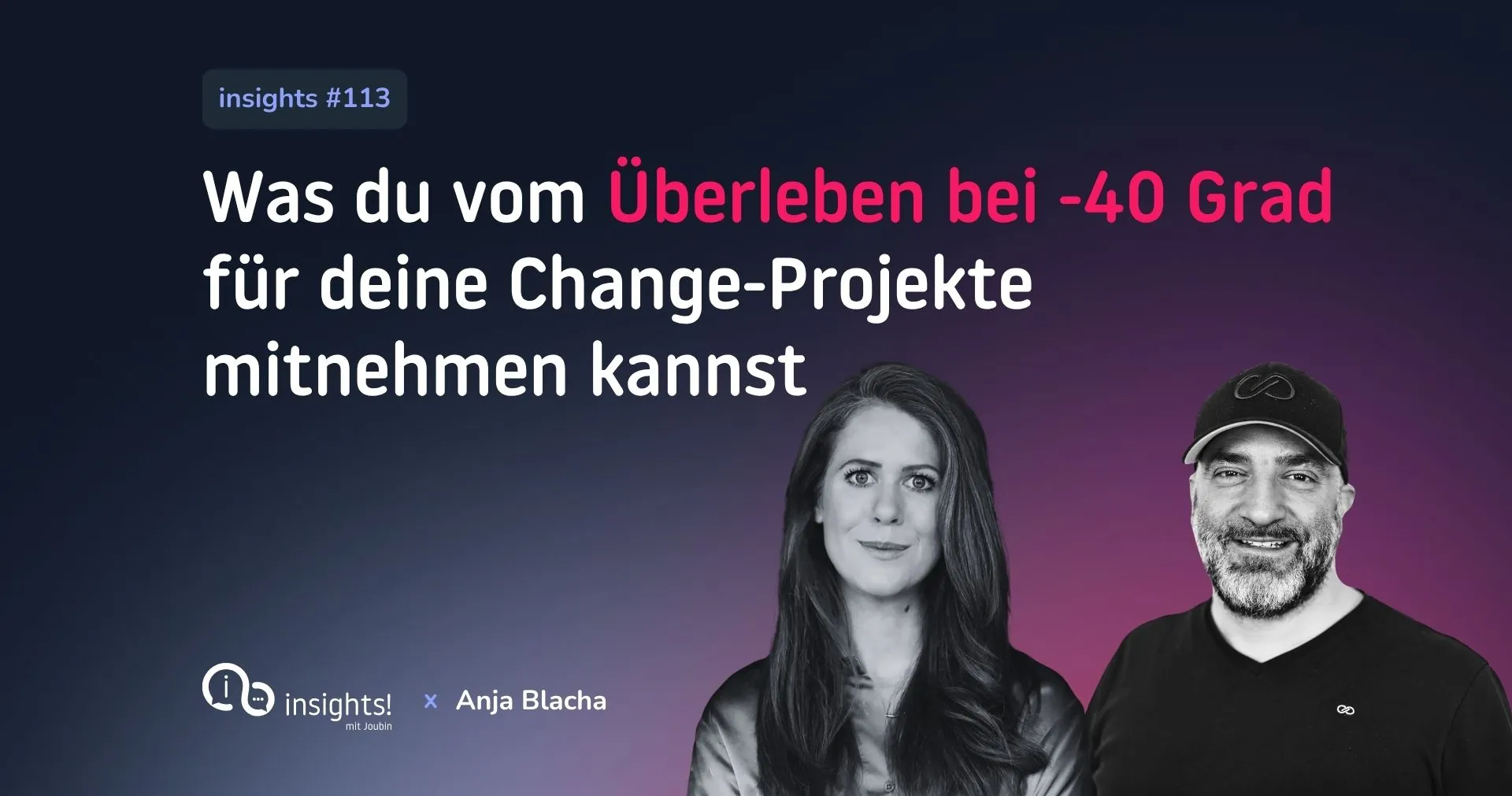
"Do the tough things before things get tough. So everything that's tedious, difficult, draining – do it while you're still in a comfortable setting. [...] If we've done that beforehand, the implementation afterwards isn't so tough anymore."
Expedition South Pole – what transformation has to do with icy cold
What if you approach job like Anja Blacha approach her South Pole expedition? Not half-speed, not "see how far I get", but unbending will to achieve something big. Her goal: 1400 kilometres solo through Antarctica, coast to geographic South Pole. Anja didn't let this huge distance just happen to her. She split it into stages. Six "sprints" instead one unconquerable monster project. Same lever for change in companies: split big goals into realistic stages. And always know what awaits on the way — from mirror-smooth ice to crevasses and katabatic winds.
Sleep reimagined – why 24 hours isn't sacred
24-hour days are a construct. In Antarctica, where the sun doesn't set at all in summer, you can question that pretty quickly. And that's exactly what Anja did. Instead of clinging rigidly to the daily rhythm, she simply designed her own – with 28 or 30 hours. More sleep, longer phases of productive activity, fewer annoying switches between pitching tents, moving camp, eating, sleeping. The result wasn't just more energy, but also an aha moment for everyday life: the day isn't the limit – you are. If you stop thinking in rigid time slots and instead think in energy cycles, you get a completely different level of control over your performance. And be honest: when did you last adjust your sleep rhythm so it fits your life – rather than the other way round? Three food for thought for your rhythm: • Why should your day have 24 hours if 30 works better? • What if you didn't cut off productive phases just because it's “break time”? • When do you really feel awake – and do you actually use that time?
Planning is everything – and sometimes even 80%
Many people want to charge ahead without knowing beforehand where they are going. Anja is the opposite. Her expedition did not begin on skis, but with a spreadsheet. Every calorie, every gram of fuel, every day's stage – carefully planned. And that was not an obsession with control, but a strategy: the more that is thought through beforehand, the less you have to improvise along the way. That reduces stress, saves resources and increases the chance of survival. Rather useful when it is -40 degrees outside. Applied to business projects, that means: good preparation is not a luxury, but a survival strategy. Anyone who only starts doing the sums once the budget is tight has already lost. Anja's motto "Proper planning prevents poor performance" is as simple as it is true. And honestly – how often have projects of yours failed because no one had really thought through in advance everything that could happen? In a nutshell, Anja means: "Do the tough things before things get tough."
Motivation starts with a real "why"
It wasn't kick that brought Anja to South Pole. It was will. Deep wish to reach exactly this goal. This kind of inner drive can't be faked - it's either there or not. And when there, it bring courage with it. Courage to leap into unknown. Courage not just endure unpleasant stages, but grasp as part of deal. So if you sit in office wondering why your transformation drag so slow - better ask why you want it at all. Only if you really want your goal, you hold out when it annoy. And exactly there second motivation booster come in play: positive feedback loop. Because who accept challenges because they belong to goal, get quite different sense of achievement.
Three essentials for real change: • A goal that electrifies you • A plan that structures you • A mindset that strengthens you
It's not the disasters that cost you energy
What really drains energy isn't the dramatic escalations. It's the small disruptions. The rattling Slack messages, the 17th round of corrections, waiting for the reply that never comes. These friction points that wear you down a little more each day. It's exactly these "small pinpricks", as Anja calls them, that break you – not the snowstorm or the boss. The trick? Learn to distinguish what you can change – and what you can't. And invest your energy not in frustration, but in action. Anyone who wears themselves out over every little thing loses sight of the bigger picture. Anyone who accepts that not everything runs smoothly stays capable of acting. And anyone who focuses on their sphere of influence stays healthy – mentally and operationally. "The small hurdles – those are what break you."
Avoiding burnout: it's not about pushing harder, it's about keeping reserves
If you regularly push yourself to complete exhaustion, that's not a sign of commitment – it's a sign of poor energy management. Anja says quite clearly: she never goes to her performance limit. Why? Because in the wilderness something unforeseen can happen at any time. And then you still need something left in the tank. Anyone without reserves in an emergency is in a losing position – whether at the South Pole or in the pitch. In the business world in particular, this topic is often underestimated. "Push whatever it takes" sounds motivating – but it's highly dangerous. You need breaks, you need sleep, you need air. Not later, but now. And above all you need the clarity that you don't have to drag everyone along just because they're running faster. Your pace. Your energy level. Your responsibility.
Would you like to listen to the full episode?
Find the podcast of the interview here:
Please accept the corresponding cookies to view this embedded content.
Prefer to watch the episode? No problem!
You'll find a recording of the interview here:
Please accept functional cookies to watch this video.
Prefer to read?
Joubin Rahimi
Great to have you back for a new episode of insights! My name is Joubin Rahimi and today I get to welcome Anja Blacha on the podcast episode. Hello Anja.
Anja Blacha
Many thanks.
Joubin Rahimi
Yes, it's really great that you found the time to come back up here after your keynote, because we'd just had our event here at INSIGHTS, where we bring all the brands together and celebrate a day of INSIGHTS with lots of customers, your insights on transformation, digitalisation, perseverance, and also your journey to the South Pole. And I'm rarely lost for words, but after the presentation I was genuinely very impressed by what you shared. Perhaps you could start by saying a couple of words about yourself.
Anja Blacha
Yes, first of all, many thanks. And exactly, about myself, Anja Blacha. I originally come from Bielefeld.
Joubin Rahimi
There was actually a lot of applause just now. That was funny.
Anja Blacha
And I grew up in the classic telecommunications industry, particularly in the business customer and transformation area. First at Vodafone, later at Swisscom. And alongside that I discovered a second passion, namely the world out there of high mountains and polar regions. From that first hiking holiday it kept going further and further, until suddenly the Seven Summits, the highest peaks of the seven continents, had all been climbed. Then came K2 and Broad Peak. Those are further 8000ers. By now I've climbed twelve of these fourteen 8000ers, and I've also gone out into the vastness, out to Antarctica, out to Greenland, out to Northern Canada, carrying out polar expeditions.
Joubin Rahimi
How many people have completed all 14 eight-thousanders?
Anja Blacha
No idea.
Joubin Rahimi
Are there many or not so many?
Anja Blacha
There aren't many. So looking purely at the women who climbed the 8000ers without supplemental oxygen, there are four women, or three other women and me, who have climbed twelve, 13 or, depending on interpretation, 14 of these. That's genuinely rare.
Joubin Rahimi
That's quite rare. I'd say, if you count the men too, we have a few billion people. That's pretty damn rare and a special achievement. And South Pole, you said. You also crossed the South Pole a few years ago, right?
Anja Blacha
Exactly, yes.
Joubin Rahimi
You'd already given us that in a presentation before. You simply divided the South Pole like that, your route. I thought that was a smart idea too, but of course you'd given it some thought. Why do you do that?
Anja Blacha
First of all, there was this big goal for me: I want to reach the geographic South Pole alone, under my own power, and without outside help. And specifically from the coast, from where a ship could also dock. And the route is 1,400 kilometres from the coast to the South Pole. And that's initially an overwhelming number, which gives no indication at all whether this is achievable for me or not. And I had to break it down, and I did that firstly simply by breaking it down into kilometres per day for a realistic sense of scale, where I then found, okay, if I ski eight hours a day plus break times and so on, and cover, say, three km/h in terms of speed, or slowness, on the route, then that's already something quite different, then I can somehow put it into perspective. And if I also know what to expect there, at each of these various stages up to the South Pole, then I also know how I can divide it up a bit better, rather than distributing it evenly. So I made six sub-stages, six sprints so to speak, out of this expedition route, where I knew, at the start I have this ice dome, then I have a flat stretch with very, very smooth ice, after that I have a mountain range I have to cross with the key section.
Joubin Rahimi
What's the key point?
Anja Blacha
The key section is first a small valley of blue ice, where the katabatic winds are extremely strong. That's why blue ice is there, because the snow drifts away there. And on the other side of this valley there's then a steeper passage going up, which you have to climb with the sled. There I covered the route twice, because I set up a depot once, went up with only half the load because otherwise it would have been too heavy, went back down and up again, also with crampons instead of skis. There are also particularly many crevasses, so in terms of terrain too, that was the riskiest terrain of the whole route. And so I looked in advance: what stages are there? How can I break all this down into these six different sections? And what can I realistically do per day in these different sections?
Joubin Rahimi
And that day, that was in summer, wasn't it? So summer there.
Anja Blacha
Right.
Joubin Rahimi
The sun never sets there, does it? Yes. I think that's also important to understand. It's always light. What about day and night, or sleeping, and 24 hours? I'd say I'd love to have 28-hour days. I don't know, are we already at 24 right now? Is that you, or did you change that?
Anja Blacha
Yes, you're exactly right. You have sunlight there 24 hours a day, which means this classic day-night rhythm doesn't exist at all. Still, I could sleep very well. You're simply exhausted, worn out, drained from the exertions of the day. And I actually did it this way, after first saying for a while that I don't need that much sleep. If I'm making slow progress, I need to cover more hours, so I kept making the nights shorter, tried to just pack many hours into the 24-hour day. But I noticed I do need the sleep, otherwise I'm simply slower and imprecise navigating during the day. Then I did exactly what I always wished for you. Really? Yes. I said, wait a second, why am I so stubbornly sticking to the 24-hour rhythm? I could just as well bring a 28 or 30-hour rhythm into the day, and that gives me much less – we already talked about context switching once – much less unproductive time relative to productive time. If I make longer days, ski for longer, but don't cut the sleep, then I go beyond the 24 hours, then I get to 28, 30, whatever, and don't lose as much time packing and unpacking at the fit tent.
Joubin Rahimi
So what was your rhythm like? Where did you say that was the sweet spot for you?
Anja Blacha
There wasn’t one in that form. So I’d say, for two-thirds of the route I just did the classic 24 hours, and then in the last third it started getting more dynamic. And what I did was really say, I won’t set an alarm, my body needs the sleep it needs. I have to switch off in order to be able to switch back on. And then during the day I did the stretches that were maximally possible without, by the end of the day, dragging myself along and not really making progress, and then simply carried on.
Joubin Rahimi
Did you notice over time that you got faster? So that you'd say, okay, not over 24 hours, but over five days or whatever, five sessions, that you noticed you cover more kilometres or leave more kilometres behind you and maybe got fitter too? Or did you collect data on that?
Anja Blacha
Yes, I tracked and measured everything, and always knew everything at any point, but most important for me was that I managed to get the overall route plan per time segment sorted, because I had very fixed food reactions, I had very limited fuel quantities, I even had limited time, because towards the end I wasn't allowed to go beyond the Antarctic summer, otherwise he might not have been able to sail out any more.
Joubin Rahimi
Aren't you allowed to travel out then? Or how does that work?
Anja Blacha
When sun no longer comes over horizon, that's the other end of summer season, then you can't travel well anymore either.
Joubin Rahimi
Does it go that fast then?
Anja Blacha
That's quite quick, yes.
Joubin Rahimi
Right. So from sun everything's all good, now we've got night, until in a few days or a few weeks then.
Anja Blacha
Yes, exactly. Yes, but ultimately I found the most important thing for me is to switch on fully, really starting each day with full energy. To do that, I also need to switch off completely. My body needs recovery and sleep for that, also because otherwise it's more sensitive to cold, more prone to illness, and the immune system isn't as strong, the mind doesn't function as well.
Joubin Rahimi
You had the 5 P's in your talk. I can't quite piece them back together, but in a nutshell it was: "prepare well, because the bad thing is coming either way, so at least you'll be prepared" and not "don't prepare." Maybe you can repeat it once more.
Anja Blacha
They say, proper planning prevents poor performance. Good planning prevents poor execution or performance.
Joubin Rahimi
That applies in business too, doesn't it?
Anja Blacha
Yes, 80% of this expedition was planning, planning, planning. And that was also one of the reasons I was so glad when it started, because suddenly I'd already made all the decisions: what do I take with me? How much food do I need per day? How much fuel do I need per day? After how many hours, or how many kilometres, can I end the day? And I only had to execute and deal with whatever unforeseen came my way. Everything foreseeable had been thought through. And even if something unforeseen happened, I could essentially recalibrate against my original plan. Then I knew, okay, now I need to cover more distance, or I'm doing really well and can dip a bit into my buffer, depending on the circumstances at the time. And I'd always say, unfortunately this one's in English again, do the tough things before things get tough. So do everything that's gruelling, difficult, draining, while you're still in a comfortable setting. So before it comes to execution, before you head out into the cold, but before it gets into project execution, while you still have the chance to plan resources, budgets, timings, or build up the skills, because if we've done that beforehand, the actual tough execution afterwards isn't quite so tough anymore.
Joubin Rahimi
Yes, and that applies to business life too. That's where I'd say, you can carry that over one to one. Or eat the frog first, as I like to put it. So just tackle the worst tasks of the day first. Always feels great afterwards, even if you never fancied it beforehand. What would have happened if you hadn't got up the mountain so fast, had to go up and down ten times and then realised your food ration was running out? Is there a plan B or a contingency plan for that? Because it's not about whether you blow a budget or not, it's about whether you survive or not.
Anja Blacha
Yes, firstly of course then dividing up the food ration differently again, because you notice, right, I needed more time now. Then I have to see whether I can perhaps save a bit from my food each day and add that on for the extra time I need. What I can't extend is how long the summer season lasts at night. It's over when it's over, so there's a hard deadline I have to meet there, even if I say I can manage on half the food per day. And fuel is of course always a difficulty too, because water is simply even more vital for survival than food. True.
Joubin Rahimi
How cold was it there? Minus 40 degrees, you said, up to minus 40 degrees? Exactly. And without fuel, no water, without water. You can't do that either … you can't put snow in your mouth in that cold either, can you?
Anja Blacha
Yes exactly, it's really energy-inefficient for the body to melt the snow yourself, so to speak.
Joubin Rahimi
What would you tell transformation people who are driving transformation within a company? What would you pass on to them, beyond what we've perhaps already said?
Anja Blacha
Above all, I think it's the mindset. What helped me carry out my projects was that I started with wanting it. I want to reach this goal, and that's my goal. And from that willpower grows a huge amount else. That's where the courage grows to say: right, I'm taking this leap into the unknown and tackling it now. That's where the understanding grows that: the challenges I'm facing along the way are of course never pleasant, but I wanted them, because I wanted to reach a demanding goal, and they come with it. Otherwise I wouldn't have set myself that goal in the first place. And then all at once you accept them completely differently and get quite different, positive feedback that you generate for yourself when you're in that challenge and think: now I can prove myself. Now I can show whether I can really do what I dared to attempt, and afterwards I can be proud of myself too. And of course, in the end, this perseverance too, because I think we underestimate that the big escalations, the big difficulties, the big challenges, they can lift you up and give us adrenaline and give us that positive feedback once we've mastered them. The small grinding hurdles in everyday life. Those wear you down. Those wear you down. And we have to be careful not to throw even more energy after them, by getting worked up about them when we can't change them, wearing ourselves down on them, breaking ourselves on them, but instead learning to accept them and refocus on our sphere of influence, and in a way preserve that focus, that stoicism.
Joubin Rahimi
What you can't really see or sense – Anja's eyes are totally clear –, maybe that sounds a bit odd now. We've done over 100 or 110. No, no. 110, 120 podcast episodes already, so quite a few. But I really sense how what you do is what you want. And I don't think there's burnout there. You don't get tired, because you're doing what you're keen on.
Anja Blacha
Yes.
Joubin Rahimi
You also get tired somehow, but not that burnout kind of tired. You know what I mean?
Anja Blacha
I think what also helps me there is: I don't go to my limits. Metaphorically I'm always told: I go beyond my limits. I show that there are no limits, but I must never reach my performance limit. Why? I'm in an environment beyond my control. Something can always happen. The weather can always turn, where I wanted to pitch my tent there can suddenly be crevasses and it becomes dangerous, suddenly it might be that something happens to me or, if I'm in the mountains with other people, to someone else, and suddenly I need a reserve.
Joubin Rahimi
And you don't have that then.
Anja Blacha
And if I don't have that, I have a big problem. And if I drop to zero, it takes me so much longer to regenerate and gather strength again for the next day or the next stage. And that's why I always say, I mustn't push myself to my limits and have to keep telling myself: enough. Switch off, don't burn out, even when the motivation is there.
Joubin Rahimi
Is that hard? Or is it hard for you, or do you manage well to maintain that balance?
Anja Blacha
I'd say, that work quite well. For one, think must plan in advance already, which performance level, when travelling alone, want push myself and which performance level am I at. Does that match? And think then, when travelling in team, must really watch out not say: just because others walk faster, I walk same pace. Maybe others fitter than me. That's one thing. Maybe others also not paced energy well and have problem later, when they're empty. Must keep telling myself: just because others travel this way or that, must still decide for myself, what can I hold and what not.
Joubin Rahimi
And I think that's a lovely closing line: listen to yourself, follow your own path, don't look at others, and just do it step by step. Thank you, Anja.
Anja Blacha
Thank you.
Joubin Rahimi
Totally inspiring. Gave us great joy. Thanks.
Anja Blacha
Thank you
Have questions or feedback?
Then feel free to contact us directly.
- Joubin Rahimi
Managing Partnersynaigy
Show phone numberShow mobile numberShow email address
Subscribe to the blog now and never miss any news
✔️free of charge ✔️weekly news ✔️expert knowledge
Please accept the corresponding cookies to view this embedded content.