



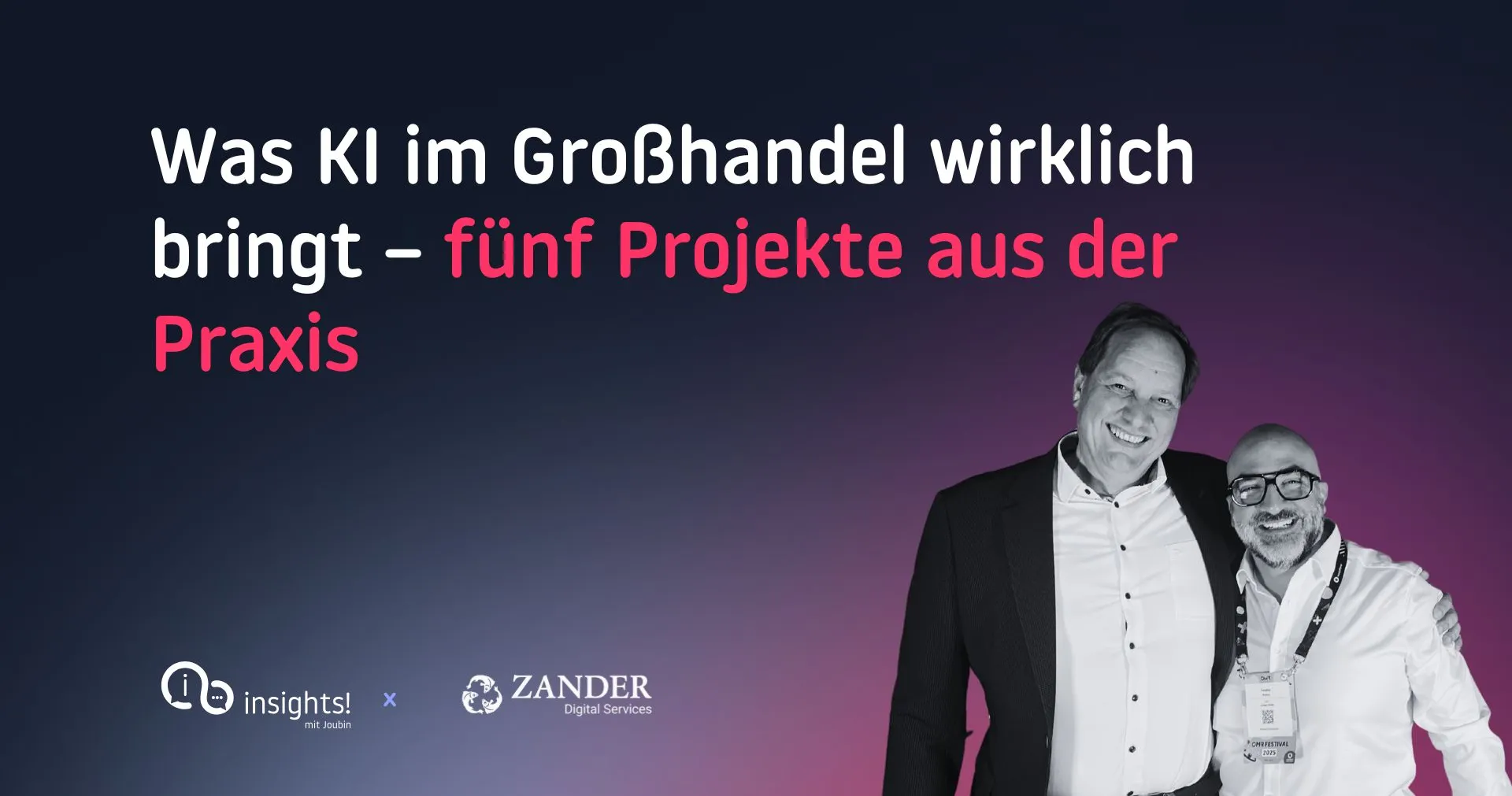
insights! #104: AI in wholesale? Only if it really delivers value.
Artificial intelligence is no longer a topic for the future – at least not at Zander. Because while many are still planning pilot projects and stuck in workshops, Zander Digital Service Group already has five concrete AI projects running in production. And not because it looks fancy, but because it works. Here's a look at them:
 Joubin RahimiManaging Partner · synaigy
3 min read
Project 1: No more Photoshop – set images at the click of a button
Imagine having to manually gather, save, caption and edit images for every new product set in the online shop. Sounds like 2008? But it's reality in many companies. At Zander, that meant: 10,000 sets per year, each with around 30 minutes of effort. That adds up to a tidy 5 full-time positions – just for building images. The solution? An AI that automatically generates all set images from a simple Excel file – in 20 seconds. Not pretty, not award-winning. But incredibly efficient.
Project 2: when customers go quiet before things break
Payment defaults in trades businesses? Not uncommon. All the more important to spot early warning signs in time. Zander gave the AI ten years of customer data — with a clear brief: find patterns that signal insolvencies or sudden order stops. The result: every week the system flags 10 to 50 customer names worth a closer look. And yes — among them was also a case where turnover was still rising just before the insolvency. Why? Because the business no longer had a credit limit with other wholesalers and could only still buy where it was still allowed to. The message: AI doesn't replace a person. But it's your attentive co-pilot who says early on: "Take a look at that."
Project 3: „Sandra“ calls – and no one notices she's AI
Zander was at trade fairs. Afterwards came what always comes: sending documents, following up, arranging appointments. Time-eater deluxe. So they hired "Sandra" – a voice AI with e-mail address, business card and humour. Sandra calls potential customers, clarifies open questions, knows product portfolio and suggests appointments – matched to sales colleagues' calendars. With charming opener like "I'm probably younger – informal or formal address?" she wins sympathy. And often the people called forget they just spoke with an AI. The trick: Sandra doesn't work as gimmick, but as real assistant – and saves time where most gets lost.
Conclusion: AI doesn't need to dazzle. It needs to work.
What all five projects have in common: they weren't decided from above, but initiated out of everyday work. Every solution is based on what actually annoys, costs or slows down employees. And that's exactly why they work. So if you think AI isn't for SMEs – take a look at how it's going at Zander. Five real projects. Five clear use cases. And zero show. 👉 You'll find three of them here on the blog – the remaining two? They're in the podcast. Worth a listen.
Would you like to listen to the full episode?
Find the podcast of the interview here:
Please accept the corresponding cookies to view this embedded content.
Prefer to watch the episode? No problem!
You'll find a recording of the interview here:
Please accept functional cookies to watch this video.
Prefer to read?
Joubin Rahimi
Brilliant that you're back. It's a new episode of insights! My name is Joubin Rahimi and joining today is York, York Lemb. Hello York.
York Lemb
Hello Joubin.
Joubin Rahimi
I'm really pleased you're here and we're having a session, and above all, otherwise you'd be talking to Klaus Maria Kretschmer in your old role.
York Lemb
In my old wallpaper-roll role, I got to speak with Guido Maria Kretschmer. Right.
Joubin Rahimi
But now, why you should definitely be there: York will really open up the five AI projects, or well let's see how much time we have, but really open up the insights, what you do, what works, what doesn't work, which most people don't tell you. That's why it's great.
York Lemb
Pressure is rising.
Joubin Rahimi
That one's already right at the top.
York Lemb
Yes, okay.
Joubin Rahimi
And that's something really, really special. Not many do that. I know most people are working on the same topics one way or another. Behind closed doors at our events, there's plenty of exchange too. That's why it's really cool that you do it this way. But tell me, two or three sentences about you, your role and where you're currently active.
York Lemb
Okay, my name's York Lemb. I'm with Zander Digital Service Group. That's the digital framework of the Zander world. Zander does gas, water, heating, climate.
Joubin Rahimi
I'm not saying otherwise.
Joubin Rahimi
Yes, yes. I'm not saying otherwise.
York Lemb
And electrical, we're a wholesaler, turnover of 1.1 billion euros, two and a half thousand employees at 120 locations in Germany.
York Lemb
But they only operate in Germany.
Joubin Rahimi
So that's a big deal.
Joubin Rahimi
You're one of the bigger ones. Yes.
York Lemb
So, in these areas certainly. And it's also a bit unusual that we have both the sanitary sector and the electrical sector. Many providers only exist in the electrical sector and many only in the sanitary sector. And with us our tradespeople are called zebras, so to speak they do both. That already exists.
Joubin Rahimi
We've had similar wholesalers to you as clients for a long time. We've also had some go bankrupt. And they said, it's a bit like the spinal disc in such a chain? Because your customer wants the lowest price possible, the manufacturer wants as much as possible. What's the real added value? But I think you're going through a renaissance right now, with AI changing a lot too.
York Lemb
Well, there's that lovely quote: AI has come to stay, and that will be the case. And I believe anyone in the industry, in wholesale, who doesn't concern themselves with AI will have massive problems in the future. But that's also what we're finding – that in this whole AI jungle it's incredibly hard to actually identify what actually helps me, because the hopping kangaroo or the singing tortoise on Mars is nice to look at, but it doesn't get me one metre further in wholesale. I don't sell a single socket, toilet lid or heat pump more just because I have a singing mascot.
Joubin Rahimi
Right, but what do you make more with?
Joubin Rahimi
So you named five projects. Maybe you can say again at a high level which ones you're currently working on.
York Lemb
I'd take a very small step: how do we get to these projects?
York Lemb
We set up a circle with our employees. There are 30 employees in it, from warehouse staff to purchasing, to marketing, to management. So from all hierarchy levels, from all departments. And we sit together every 14 days and discuss: What costs a lot of time? What's a Sisyphean task? What's annoying about the work? To identify from that where it makes sense to spin out an AI project.
Joubin Rahimi
You can interrupt there: every 14 days.
Joubin Rahimi
I do it once and then I've got it. No, no.
York Lemb
So every 14 days for two reasons: the AI topic changes so fast — that's one thing.
York Lemb
And the second thing is of course also quite clear, that people want feedback. There's no point in an employee from the warehouse being in such an AI circle, putting in input and never finding out what comes of it. So that's simply respectful treatment of one another, and otherwise the projects don't move forward either. And from every project we of course also always need people who say: Yes, we're going to apply this now, because everyone always thinks: I take 6 million data records, throw them into the AI, and after that everything gets better. Is that great? No, the AI has to learn. So I always say, it's like a 6-year-old child at the start, incredibly diligent and curious, but you have to sit next to it and do maths with the AI, and then it learns eventually. And after six months, a year, it solves tasks on its own. But to believe that just because I put something into the AI, something great comes out — whoever thinks that hasn't done an AI project yet, I believe. It simply doesn't work that way.
Joubin Rahimi
I fully want to underline that.
Joubin Rahimi
And one of the things that came out of it is that we have employees.
York Lemb
We sell sets very often in wholesale. There are five plugs included, three sockets, cables and flush-mounted boxes. So, once five, once six, once three, once eight metres. So, and there our staff always went into shop, downloaded image data there, looked up article number, entered article number, downloaded image, put it in folder, went into Photoshop, uploaded images again, sorted them back and forth somehow so they're recognisable, wrote underneath three times, five times, seven times, six times, saved that and then said: Right, now we have a new set. If you then do that in Photoshop, you first save two gigabytes, think: Oh, not so good for uploading that to shop, then you compress it down again and – long story short – half, three-quarter hour just gone. So.
York Lemb
But if we have 10,000 sets a year, which we do. Then that's simply 10,000 hours we're talking about here. That's where we built an AI.
Joubin Rahimi
That's five people a year. Yes.
York Lemb
And our AI — I actually always say this at the start: none of our AI projects are sexy.
York Lemb
That never looks good. So that's never looking good.
Joubin Rahimi
That really hurts my heart, though.
York Lemb
Yes, that's why: but it never looks good.
York Lemb
We have AI, you can upload Excel list and 20 seconds later your 30 images come out. It do what it should, but not pretty what it do there. But we save unbelievable much time through these fiddly sets. That e.g. AI project we have, come from employees who said: This annoying. We start and must do whole thing. Then product change in there and you do whole rigmarole again. Bang, next.
Joubin Rahimi
Yes, and the company can do that all the time.
York Lemb
So, that's right. So that makes work easier for our online shop people.
Joubin Rahimi
Cool. Number one, number two.
York Lemb
Number two is the whole topic of customer bounce rates.
York Lemb
When you work in wholesale, you get payment defaults here and there, let's say. And we said: we need something for that. That came directly from two areas, once from sales and once from accounting, logically. And then we looked at our trade movements over the past ten years. That's partly because we had a reform in the merchandise management system and could only access it from that point. So we looked at the last ten years and told the AI: please search for patterns, always among the tradespeople we'd previously flagged, who either went insolvent, had no succession arrangement, and suddenly simply stopped ordering and working. And with tradespeople, the risk management is: I always buy from three, four wholesalers, so that if one doesn't do what you want, you buy from another. And if you can't pay one any more, you've got three others. So the risk management, put simply: dear tradespeople, please not all at once, but that's often how it is. And then they simply switch wholesaler, and then we suddenly lose revenue.
York Lemb
We're fully aware that with most tradespeople we don't deliver 100%, but always somewhere between 50, 60, 70, 30%, depending on whether we're number two or number one.
York Lemb
That was the hypothesis we gave the AI.
York Lemb
And when you run AI projects, you know you start with a hypothesis, then a huge jumble of data, and then try to derive results and insights from it. What came out immediately afterwards is that there are patterns, and we're now tracking these patterns live, even right now. And every week, somewhere between 10 and 50 names come out across all clients, where the AI says: I don't want to say they're critical, but take a look.
York Lemb
Give him a call, drop by sometime.
York Lemb
And a lovely story, I won't mention the name now, but with one of our test clients we delivered a name, and back came immediately "Your AI is rubbish. I'll put it plainly. It's rubbish." That's been a great client for years and for the past two months his revenue has been growing with us. It's growing 10, 20%. That's just cheek.
York Lemb
Another six weeks later, we get a call from the same company, who has filed for insolvency.
Joubin Rahimi
Why did revenue grow?
Joubin Rahimi
Because he no longer ordered from the others, right?
York Lemb
Because he no longer had a credit limit with the others. And why is that a nice example? Simply because you notice that you also need to bring your sales staff along on this. And for many, AI feels alien: it's doing my job, it wants to replace me. That's a lot of negativity.
Joubin Rahimi
Yes, because it's an assistant. You need an assistant as help too - exactly.
York Lemb
And we always say: no, that only helps you. It tells you: pay attention. Better safe once, it's like my parking sensor in my car, it also beeps sometimes when there's no obstacle left, but I'd rather brake once too often - if there's a danger.
Joubin Rahimi
Yes, danger.
York Lemb
No fireworks. But I'd rather brake once too often than get another €150 ticket.
York Lemb
It's the same with AI.
York Lemb
Better to check in more often — the tradesperson won't complain if you drop by and grab a beer with them. He won't say: what do you actually want?
Joubin Rahimi
No, not that one exactly.
Joubin Rahimi
He says: A free beer, sure. I no longer have a credit line, though.
York Lemb
And the same AI, it does two other things at the same time, because through this pattern recognition we learned why some tradespeople changed their purchasing preference, for example.
York Lemb
And that's why it's not just "I'm closing and no longer buying from you, on the watch list", but also pricing and cross-selling. And there's a nice example from a survey I once did for my former employer for Holzland. I was standing with Dirk Waterkamp, I can say the name now, it's already 20 years ago. Dirk Waterkamp came out into the car park. We surveyed the customers coming out, because we wanted to know what the shopping behaviour was like there. Also a wholesaler that runs a retail showroom. Long story short: I'm standing in the car park, in front of me on the shelf, on the outdoor shelf, a 6-metre banner. Bankirai, decking timber, from €6.95 running metre. Cracking price.
Joubin Rahimi
6 metres.
York Lemb
Here I stand with the customer and say: right, what have you bought today then? Yes, parquet flooring, we've been buying that for 20 years. And then there was a question in the questionnaire: How competent is Bankirai in garden timber? We don't have any garden timber at all. Here you stand in front of this poster and I'm like: oh, they've got garden timber too? Yes, and he's been buying that for 20 years, no. So you wouldn't stand there, you'd say, well, you're making up a story like that. But customers who are in their own world, they don't even look and are sometimes not receptive to messages like that at all. And that's exactly where the topic of cross-selling comes in, where we actively say: look, you don't buy this from us, but plenty of your digital twins do. Why don't you do that? And then we ask and then it comes out … so in a quarter of the cases it turns out, oh, I didn't even know that.
Joubin Rahimi
Are you actually still on second or third one now?
York Lemb
No, that's the second one.
York Lemb
That's the second one, 2C basically.
York Lemb
Yes, exactly. That's all because we recognised from these patterns that it's not just about the bounce rate being there, but why is there a bounce?
York Lemb
Because I did not know that you have these items and that you are competitively priced there. And that is like number two, I would say. Number three we do together with our association. We are fully embedded in the associations, national and international. And we do that together with Mitegro. That covers the whole topic of E-TIM classifications. And anyone who runs an online shop and does article master data maintenance knows how tedious it is to keep supplementing that, because with our very beloved manufacturers, whom we work with a lot, data quality there is, let's call it heterogeneous. Sometimes it's good, sometimes it's poor.
Joubin Rahimi
We've made a huge leap, from five years ago to now, what you can automate well.
York Lemb
Right.
York Lemb
And that's what we solved in the association too, since loads of wholesale colleagues sit on same problem. Then makes sense focus on one service provider, brief them once, run whole passion-story through with them. Makes zero sense every wholesaler do that themselves. No, I'm not telling this cause we're all in it. And those not in it, we don't include either, since then we won't sell to them. And that's actually quite exciting story, and it's already true that AI can handle over 60, 70% of it. Enormous relief for product master data maintenance.
Joubin Rahimi
Amazing.
York Lemb
Not that either. Doesn't look fancy at all, but it saves you time at work. A fourth project is the topic of gap files. Tender documents very often have to be submitted anonymised. And then the clock starts. There's a really nice doctoral thesis I keep citing: the first one to offer that makes a lot more revenue, often double the revenue of the second. And the second — it has a higher price elasticity, so be the first in the tender phase.
York Lemb
And that's why- why?
Joubin Rahimi
Exciting, too.
Joubin Rahimi
Why not the last one?
York Lemb
Well, in the doctoral thesis - you're welcome to contact me, then I'll happily send it to you, it's freely available. The thing is, whoever submits the offer first and then has a clean sales process and keeps communicating with the customer builds trust with the first offer. Every second, third, fourth offer always battles against that. If the second, third is, say, half the price, then everyone says: that can't be right, there must be a mistake in there. If it's more expensive, same thing. There I have a good decision. So if I'm the first to submit and stay in sales contact, I have every chance. And because I was first, people also say: I've obtained another offer. Then you can say: send it over, then we'll look at it, then we'll first check, is it comparable? So just submitting isn't enough. Basically, you need to be in the right ballpark.
York Lemb
Great learning, sales alongside AI too. So generally across all sales projects.
York Lemb
Right now a lot of outsiders to the industry are making life difficult for us.
York Lemb
So Enpal and 1Komma5 Grad aren't exactly our friends right now, because they're extremely strong on sales. And our AI does two things: it takes the tender text and first checks: were there already similar projects in the past? And then immediately puts out a quote and says: this is quite similar, this looks quite similar. Look, dear back office: does this already fit? And with that you only need to say: yes, doesn't fit, no. You only need to fine-tune, not start from scratch again.
Joubin Rahimi
And you don't have to start everything from scratch again.
York Lemb
The second thing that often happens is that texts can be found again. So even though article numbers and manufacturers get deleted, other characteristics such as article texts are already very clear. And if you have a certain AI. Exactly, then you find them too, and then our AI does two things. It checks: do we have this product? If yes, into the quote. If no, what equivalent product is there? And then it's the same thing again: it's no use putting all article data into the AI and saying: get on with it. So we sat next to the AI for months and said: no, no, no, no, again. So this 6-year-old child, you have to train it, you have to do maths with it, the whole time. Otherwise you don't get a result either. Otherwise you say, within no time at all, well, that just produces nonsense, don't need that.
York Lemb
Well, you have to invest time.
York Lemb
Our newest hire is Sandra, actually now a permanent employee, has a business card with us, has an e-mail, has a staff number, has everything. And she's our phone AI. And this phone AI does two things: We use her in the test phase for ourselves, because we're at trade fairs a lot. My managing director and I go to 10, 12 trade fairs a year. We always have the same recurring issues afterwards. We send out an e-mail and then have to chase up by phone: Did you get everything? Do you have questions? Where should the follow-up go? How's it looking? And we actually burn so much time with this phoning around that we said we need support. Now we're at the trade fairs, having the conversations and saying: Right, look, dear Mr Fiesmann, dear Mr Weiland, dear Mr Obo, here, this is Sandra. Please save her in your contacts, because Sandra will call you in the next two weeks and ask whether you received everything. Then they always save it, because if an unknown number calls, a good salesperson never picks up. That's why we always said that, and all the calls she's made over the last five trade fairs we've had her deployed at, the following always happens: In the end, most of the people called forget that they've been talking to an AI the whole time. There are AIs, or phone and voice AIs, everywhere these days. But I think the special thing is attention to detail, and the special thing we did. It's an opener. So anyone who wants to try it out can also contact us. I'll just send Sandra over. What happens is that right at the start she says: Hello Mr Lemb, because she knows my phone number. We entered that. Lovely to reach you. You were at the trade fair recently, we sent you the documents. But before we start, one question: I know I'm the younger one. Shall we go with informal or formal address? Completely irrelevant to the process, but on the other end there's always a laugh, always warmth, and usually: Yes, let's go informal.
Joubin Rahimi
Does the caller then notice it's an AI?
Joubin Rahimi
You say that beforehand too.
York Lemb
We announced the AI call already, at the trade fair. We said: watch out, whoever calls you will be Sandra. And secondly, when she picks up, she says: I'm Sandra, the personal AI assistant of Andreas Berth. And then she makes the joke that way too, of course.
Joubin Rahimi
Then she makes the joke.
York Lemb
And everyone ask: how old are you then? That was longest discussion we had actually: give her an age, sort of fitting, or tell truth? We chose truth, said six weeks. Then conversation carries on. Nice bit — she hold not just info from the PowerPoint we sent out, but our whole wiki on these individual topics we sent out. Then customer can start: hey, what about this? Like Zander live? How many viewers you get there? Then she answer all questions. Call to action same at end of day, always.
York Lemb
It's always: "Would you like a follow-up appointment with Andreas or with York? And then you can also arrange an appointment directly, you can move the appointment, you can add someone else to it, and then the appointment gets arranged directly. She then checks our calendar: Do we have time? Yes, no. And then the normal assistant function begins, so to speak. And that's caught on so well that we're now at the point where we're considering an availability assistant for our internal sales team, so that tradespeople calling at peak times or in the evening who still want to know something: Yes, your order is on its way, it'll arrive then and then. So information where you don't have personal contact. She'll never negotiate the price, because our tradespeople want to talk to internal sales about that and squeeze out the last bit. The AI will never do that. But is it in stock? When do you open tomorrow? Can I collect it tomorrow? Can you have it ready for me? The Schmitz site is the day after tomorrow, is the goods on the way? Do I need to drive there? Do I need to postpone it? That kind of information.
Joubin Rahimi
And now for you, five really cool projects, each bringing real added value, which you've all brought along every time. Right down to the last one. All-round availability. Of course you can say that's on the website too, but I think a lot of tradespeople say: I don't care about the channel. I call Horst. If Horst can't, I call Sandra. Right?
York Lemb
Yes, with us it'll be the case that if you want to reach Horst, who's in a meeting or an appointment or just can't right now, up to now an answering machine kicks in. Then Horst has to call everyone back afterwards. But there's no guarantee at all: is the tradesperson available, or are they up on a ladder right now fitting a PV system on the roof? Then they won't answer the phone. Well, they still don't have the information. Then both talk to the voicemail for hours and then Horst says: yes, but you also wanted to know this and that. And then everyone's back to square one. That's why it's actually better – we believe that Horst would rather talk to Sandra and get his information than communicate with Horst at some point maybe via voice message.
Joubin Rahimi
That's definitely worth another insights! episode in a few months' time.
York Lemb
Yes, gladly.
Joubin Rahimi
There you have it, measured. Huge thanks, York, for all the insights. If you've questions, you've met York. I suspect though he'll answer you like on LinkedIn. Get in touch directly, feel free here in the notes too, then we can all read along and learn along. Thanks for being here. Thanks, York.
York Lemb
Happy to help.
Joubin Rahimi
For the whole presentation. Great.
Have questions or feedback?
Then feel free to contact us directly.
- Joubin Rahimi
Managing Partnersynaigy
Show phone numberShow mobile numberShow email address
Subscribe to the blog now and never miss any news
✔️free of charge ✔️weekly news ✔️expert knowledge
Please accept the corresponding cookies to view this embedded content.