



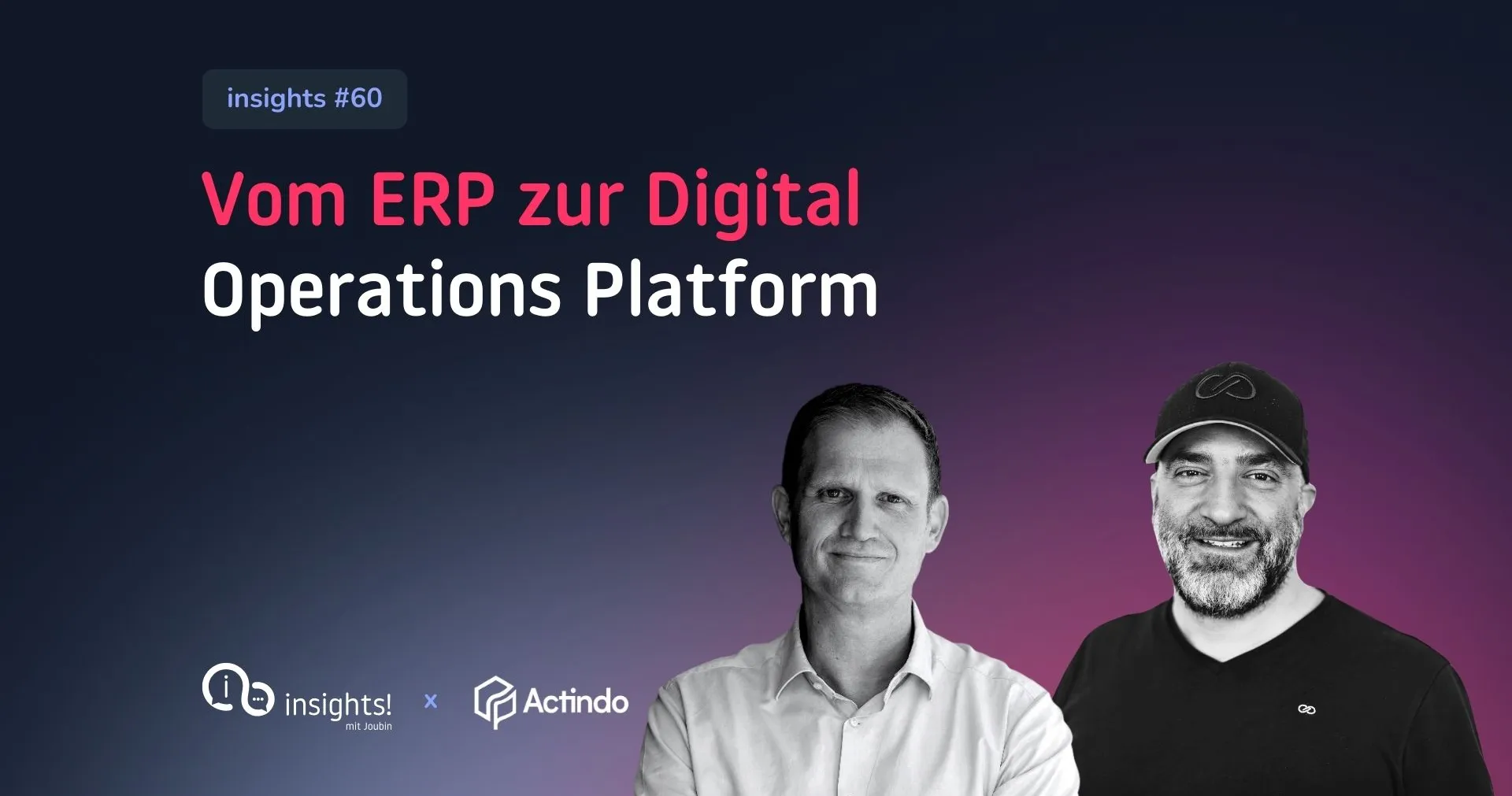
insights! episode #60: Rationalisation, automation and centralisation – from ERP to digital operations platform
Actindo, the API- and cloud-based Digital Operations Platform (DOP), is the only fully interlocking solution for building valuable customer relationships while digitalising key business processes. In the new Insights! episode I speak with Sven März, Vice President of Sales at Actindo, about their solution.
 Joubin RahimiManaging Partner · synaigy
6 min read
We see ourselves as the spider in the web for omni-channel sales: presenting all processes correctly and making them flexibly manageable.
Was ist Actindo und warum solltest du es kennen?
Actindo is more than just another business software provider. With their Digital Operations Platform (DOP), they've created a solution specifically designed to master the complex demands of modern omni-channel e-commerce. But what does that actually mean? Actindo's DOP acts as a central hub that links and orchestrates all your relevant data streams and business processes. Whether it's managing stock levels, processing orders or integrating new sales channels – Actindo ensures everything runs smoothly and you always keep an overview. The platform is designed to integrate seamlessly into existing systems and gives you the flexibility to adapt your digital infrastructure quickly and efficiently. This means you're able to respond quickly to market changes and continuously optimise your e-commerce strategy.
Why not just keep using the old ERP system?
Many companies already rely on tried-and-true ERP systems and wonder why they might need a platform like Actindo in addition. The answer lies in the flexibility and adaptability that traditional ERP systems often cannot provide. A traditional ERP system is good at managing basic business processes, but when it comes to quickly integrating new sales channels or managing complex, dynamic business processes, it reaches its limits. This is where Actindo comes in, complementing your existing system with a solution specifically designed for the demands of modern omnichannel retail. Actindo enables you to seamlessly connect new channels and systems and design your business processes flexibly—without the time-consuming and costly customizations often required by traditional ERP systems. This ensures that your company remains competitive even in a rapidly changing market environment.
Flexibility Meets Efficiency: The Benefits of Actindo DOP
A key advantage of Actindo lies in the platform’s rapid adaptability and flexibility. Companies operating in e-commerce must be able to respond quickly to changes in the market, whether by introducing new sales channels, adapting existing processes, or integrating new technologies. Actindo lets you manage all of this through a user-friendly, graphical interface. You can integrate new channels, manage data streams, and customize business processes without needing in-depth programming knowledge. This “no-code” solution saves time and resources, allowing you to focus entirely on your core business. In addition, Actindo offers high scalability, so the platform can grow alongside your business. Whether you’re a medium-sized company or a global corporation—Actindo provides you with the tools you need to be efficient and successful.
Success Stories: How Actindo Supports Businesses
Actindo has already helped many companies optimize their e-commerce processes and expand their digital presence. One outstanding example is Alpha Trading, a company that was able to efficiently manage multiple online stores despite using an older AS/400 ERP solution. With Actindo’s help, Alpha Trading was able to continue using its existing systems while leveraging the flexibility and efficiency of Actindo’s DOP platform to enhance its e-commerce strategy. Another example is the collaboration with Nintendo. Here, Actindo plays a central role in managing both physical products and digital content, such as license codes. Nintendo benefits from Actindo’s ability to manage complex business processes and ensure that digital and physical products are delivered to customers on time and reliably. These examples demonstrate that Actindo is the ideal solution not only for medium-sized companies but also for large, internationally active corporations.
Why Actindo’s Roots in ERP Are an Advantage
Actindo began as a provider of ERP solutions and has evolved over the years into a highly flexible Digital Operations Platform. These roots in ERP are a real advantage, as they enable Actindo to draw on a comprehensive range of features that goes far beyond what many other providers can offer. If you’re already using an ERP system and are looking for a solution that integrates seamlessly and is flexibly expandable, then Actindo is the right choice for you. The platform lets you expand and customize existing systems without having to compromise on functionality. This means you benefit from the advantages of a modern, cloud-based platform while maintaining the stability and reliability of your existing ERP system. This combination of traditional ERP expertise and modern flexibility makes Actindo a particularly attractive option for companies that want to succeed in the digital world.
Composable Commerce: The Future of E-Commerce
Another key trend that Actindo supports is the composable commerce approach. This approach enables companies to build their e-commerce platforms in a modular way and select exactly the components they really need. Instead of relying on monolithic systems, which are often cumbersome and inflexible, companies can use composable commerce to build their digital infrastructure step by step and adapt it flexibly. Actindo is certified by the Mach Alliance, which means the platform can be seamlessly integrated with other modern technologies. This is particularly valuable for companies that need to remain agile and respond quickly to market changes. With Actindo, you can design your e-commerce strategy flexibly and efficiently without having to compromise on performance or scalability.
Conclusion: Actindo – The Perfect Solution for Modern E-Commerce
If you’re looking for a solution to help you take your e-commerce strategy to the next level, Actindo is the right choice. With its Digital Operations Platform, Actindo offers the flexibility you need to succeed in an ever-changing digital world. Whether you want to integrate new sales channels, optimize existing processes, or expand internationally—Actindo has the tools and expertise you need. The platform allows you to design your digital infrastructure to perfectly align with your business’s needs, while also giving you the flexibility to respond quickly and efficiently to changes. We’d like to thank Sven März for these fascinating insights into the world of Actindo, and we’d love for you to share your questions or thoughts in the comments. See you next time on Insights!
Would you like to listen to the full episode?
Find the podcast of the interview here:
Please accept the corresponding cookies to view this embedded content.
Prefer to watch the episode? No problem!
You'll find a recording of the interview here:
Please accept functional cookies to watch this video.
Prefer to read?
Joubin Rahimi:
Great that you're here for a new episode of Insights!. Today it's about Actindo, or rather the software manufacturer and SaaS provider Actindo, and I'm glad Sven März has taken the time to dive with me into the depths of Actindo, the benefits and the added value. Hi Sven.
Sven März:
Hello Joubin.
Joubin Rahimi:
Thanks again for joining, but perhaps you could first say a word or two, a sentence or two about yourself before we get to Actindo.
Sven März:
Yes, many thanks for invitation. I'm pleased about exchange too. I'm responsible for sales and marketing at Actindo, so I can certainly tell you plenty about our solution and how we go about supporting customers. My background is that I've been working in content management, digital marketing and e-commerce for 20 years. That means I started at Siemens, did quite a bit in content management and e-commerce there, but then fairly early on, I think around 2008, moved into cloud software with e-commerce provider Demandware. Back then I think there were still around 80 employees worldwide, mainly across Europe and America. And things went pretty well from there. The wave kept moving towards the cloud. More and more people became interested in the cloud. In 2008/2009 it was more like: my e-commerce system gets hosted somewhere in a data centre? How's that supposed to work? But we rode that wave well from 2010/2011 onwards, and were then acquired by the major cloud provider Salesforce, where I was specifically responsible for the e-commerce topic in the DACH region, and I was pleased to get in touch with Boris now. One of the founders of Actindo, who thought it might be quite exciting to stay involved in the e-commerce space, though not in the storefront area — we'll probably come back to that shortly — but rather in processes, background operations, data orchestration and so on.
Joubin Rahimi:
Just a small side note: we very nearly became colleagues. In 2009 Stephan Schambach called me because I was looking for a job, but that wasn't widely known. He'd called me personally, and I found that genuinely impressive — it's shaped me to this day, that he as managing director would call me himself. I've carried that forward: for important roles, I say I'll call personally, because that really has a different tone altogether. But I no longer wanted to be in sales. I wanted to found a company and leave a footprint.
Sven März:
Perhaps a bit more on the background — that really was an exciting time, because Stephan founded Demandware in the US while also always being active here and maintaining networks here. That's why it was always a very exciting time for all employees in Europe too, because it wasn't the typical American company approach of, yes, we've got the satellite office somewhere in Germany, somewhere in England, but it always felt international, because there was an international audience involved right from the start.
Joubin Rahimi:
Yes, I think so, and I still think it was a wonderful time today. But it is different now. How did we come across Actindo? That was about two years ago, and we have implemented e-commerce projects for many clients and we still implement e-commerce projects and often build add-ons, a call centre solution, an order management system, sometimes on a standard system, sometimes written ourselves, sometimes more the orchestration of data flows and so on. And at some point I saw an image of yours and it said in big letters DOP. Digital Operations Platform. That stuck with me, because I thought, and I still think, that is exactly what customers need who perhaps do not yet have all the systems and say, okay, I need to build add-ons and link them together, but who have gaps. That was our thinking at the time. Is that part of Actindo, but maybe you could briefly go into what Actindo offers in this area and what it actually is?
Sven März:
So you've already said it: Digital Operations Platform. Digital. Very clear. It's about current e-commerce omnichannel processes. And then? Operations means for us: how do we get the right data for these digital businesses to the customer? And how do we then orchestrate the processes? So everything in the omnichannel area. How can I manage my store properly across my various channels and steer it well? And that's where we try to be, so to speak, the spider in the web, bringing all data together, to compile a unified data set, also to properly consolidate processes, and then be able to decide, so the customer can then decide, how do I now supply my marketplaces, my online shop, and so on. That's what the term operations means for us. The term is shaped by the evolution of ERP, where you'd say I have my merchandise management system here, I can manage my, as you already said, orders, so order management. But what does that actually mean now in the digital age? And the idea there is, it's now about orchestrating the whole thing, building the operations around it, to simply manage a wide variety of processes again and again and set them up efficiently. And that's how we see ourselves, as this spider in the web for omnichannel e-commerce, properly representing all processes and making them flexibly manageable.
Joubin Rahimi:
Now we have a customer situation where customers say again: I have an SAP, it does everything. Or I have my System i ERP application. Yes, it's a bit old, but it still runs great. Why do I need something in between now? Can't I just build an interface? What's the added value you, as a DOP, bring to these other companies and situations?
Sven März:
So earlier we talked about the experiences and where we'd been, and what we're seeing is that many companies have invested in e-commerce. They then built large e-commerce solutions. That usually means a technology stack. There was a large storefront, and then a few more things were built onto it, and they connected it to their ERP. But now they face the challenge that new channels are being added. What do they do now with my physical store? How do I handle social media? What do I do with the various marketplaces? So, we just had an article about niche marketplaces and everything that's emerging there, and I simply have to note, each time, adapting the processes in my existing ERP system is just too much effort. The flexibility simply isn't there, because these systems are, of course, built to support things at scale and sustainably. But for me to say, now a new channel is being added, I need to quickly figure out how to handle the approval processes and so on, ERP systems aren't designed to offer that flexibility, and what we also see with customers is that many data streams come together. So it's not the case that, sure, 80% comes from the ERP, but I also have partners supplying things and so on, and bringing all of that together, and providing that speed and flexibility, that's what DOP can offer as a further development beyond the ERP.
Joubin Rahimi:
Okay, so the question is, why can you do that? Why are you faster and more flexible? That's exciting too, of course. SAP has hundreds of developers, or thousands. Why can't they do that?
Sven März:
We started with this approach, saying: yes, we know there are different channels, there are different systems in the background that we need to connect, and from that we specifically developed a data hub. Always with the thought in mind of how I can offer this to my customer so that they can, so to speak, configure the interfaces themselves. Various data streams come in. How can I now configure them so that a data stream results that I can pass on to my channels? So on one hand the focus on the data hub, and on the other hand also this orchestration of processes. Again, the assumption is not to implement and programme processes in a lengthy way, but to move it up a level and have a graphical overview where you can say: okay, what happens here with the approval process, what happens from an order value of X or when the whole thing comes in via channel B. The focus was there from the start, it's geared towards that, and accordingly we believe we're quite a bit faster than existing ERP.
Joubin Rahimi:
So are you a low-code platform? That thought crosses my mind, or no-code, low-code platform. Are you something like that, or is there still a distinction? Because it sounds a bit like the customer can configure things in the interface, which is great. Much, much faster than having to write and map objects myself.
Sven März:
So no-code, I'd say, is a graphical interface where I configure things. Now of course the question is, if I enter and store my data fields together in such a data hub, how do I map them to each other, then for many that probably already moves into the area of programming in the sense of low-code, so somewhere in between. But the goal, of course, is that I can configure things together with my mouse and a normal keyboard, and don't start defining or programming any functions.
Joubin Rahimi:
Great. The next question is, where do you use this successfully? Which customer cases can you name? What were the challenges there? What did you solve? What was the added value? Maybe you have one or two examples.
Sven März:
Yes, two examples I like to mention, or perhaps even three, to capture the aspects we've just discussed. For instance, we've been working successfully with Alpha Trading. Back then, they had an older, more ERP-oriented solution running on an AS/400. Accordingly, they said their processes run in the background, meaning the AS/400 can do exactly what they need. But when it comes to managing different online shops externally, they face the challenge that the flexibility and speed simply aren't there. That's why we're working with them very successfully. We provide the logistics in the background for different brands, but that also means we constantly deal with this multi-shop topic and support them there, and we were able to address exactly the issue we discussed earlier. Yes, my ERP is already in place, and I don't necessarily want to replace it, because I've already invested a lot of time and effort in it. Another example would be Nintendo. With Nintendo, it's not just about standard e-commerce with shipping products and so on, but also always about supporting the digital solution aspect, such as licence codes. Especially with Nintendo, there are always plenty of events and special game launches, so they need to be able to fine-tune things very precisely. How do my processes run? What happens with a pre-order? How do I handle the dispatch of licence codes? At what point, or if I promise my customer that the collector's box will be in their letterbox on day X, does that actually happen? These are all topics where you'd say, well, this is now detached from the technology, these are all business processes, how can I simply implement them? Because of course I can achieve this with any amount of programming, but it shouldn't take three or four months every time to get there for the next event that's happening in six weeks.
Joubin Rahimi:
So Alpha Trading shared customer. Different from each other, became shared customer of ours. So found quite nice we met again there.
Sven März:
It's just round the corner from us, well I live in Munich.
Joubin Rahimi:
Right. Nintendo is also a big name, which means international projects are fairly normal for you too. Standard practice and not a challenge. So you're not just there for the small scale, you can handle big too. Is that right?
Sven März:
Exactly. So internationally, definitely in that segment, meaning support with things like tax, languages and so on, the product is designed for that from the outset, and that's also our goal. If you think about which customers take advantage of the flexibility, it's the larger customers who then also need special processes. So I might have a different backend system in Italy, say, that simply has to take orders differently. How do I get there? Those are exactly the topics where I need this flexibility. Data Hub, which we discussed earlier, and accordingly it fits really well for the larger customers too.
Joubin Rahimi:
Now here's a challenging question. You come from the ERP environment. So SaaS, ERP, that's what you did before and that's what you started out with. Is that a ball and chain or an advantage that you come from this corner?
Sven März:
So from my point of view, in interaction with customers and when we talk about projects, it's an advantage for me, because of course you have a large range of functionality, if you now also look at our website. What features are behind it, and so on. Can I also map my warehouse with it? Can I, for example, also map a point of sale with it, and so on. All the features are there. And I believe I, and the whole team, will always say there are specialist solutions in every area that are definitely better. But if a customer says, I still have a gap here in my toolkit, my ERP still needs something extra, then we can close that gap, because we simply offered, and offer, a complete ERP. And accordingly I can then pull out the functionalities I need from there. But of course, the focus is clearly on saying DOP is about orchestrating processes and integrating data. But of course, if there are then functions that still need to be covered, that can also be implemented with Actindo.
Joubin Rahimi:
Well, I think it's a huge advantage, because back then you already didn't set it up to be blocking, but always flexibly manageable. And that's also what I always tell our clients when they're researching, and it's actually an ERP. No, wrong. They come from that, yes, but all the gaps you have or things where you say, for example, I now suddenly want to sell into Switzerland, but my Alpha system, my System i, I'd need to adapt that so the invoice even comes out right. Relatively simple, you already have that in-house directly. You also have a small PIM. If you don't have a PIM and don't need the biggest requirements, you've definitely already got that in-house. And you understand the topic. So that's something where we see the difference between, say, Talend or classic data giants and you, because you're simply present in this business environment. That means you don't do other things, but this you're really great at, and the data objects can be products.
Sven März:
Exactly, and I always like to add data integration for omnichannel to that. Just to make the point. It's not a platform where I start from zero again, coding, first having to teach the system. Yes, there are variants, there are products and there are different product groups with different customers and partners, and also the discussions around variants in the fashion sector, where I then say no, the PIM has to bring that from the outset at that point, the DOP system, so I know there are fashion products that have colours, that have different sizes, so I can map that, and that's the exciting part from my point of view, where I say yes, data integration, but always with a focus on omnichannel. That means I open the box and things like an order, a customer within the product are simply already there, and the system knows what it actually needs to deal with here.
Joubin Rahimi:
Yes, we see that as a real advantage too. If you say, okay, I have an e-commerce strategy, I'm expanding, internationalising, moving into other channels, I'd also choose Actindo. Then you're a data octopus, a spider in the system. That's always seen as a bit negative, but you're the link between all these areas, the flexible link. And naturally customers quickly ask themselves: Is this stable? Is the software stable? That's one thing, but is the company also big enough? You have Nintendo as a customer now, they will certainly have vetted you. Are you stable enough that we can still work together sensibly tomorrow, the day after, and the day after that? Maybe you could say a bit about Actindo's basic parameters, because if you've never heard of it, you wonder, are you one person, 5, 50, 500? What are your plans?
Sven März:
Definitely, we're a German company, a German company from Munich, also a public limited company. That means you can get insights into the financial situation. That's accordingly public, and of course that makes the discussion easier. If you say you're a private company, it gets correspondingly difficult, then with NDAs and so on. As a public limited company, it's initially easier. We have 100 employees, we operate in different countries. We speak many languages too, and the goal is to keep growing internationally now, not just serving the DACH market of Germany, Austria and Switzerland. That was our past, but now it's also about attracting more international manufacturers and brands. And we're definitely geared towards growth. But we also have many customers on the platform who provide the corresponding security, and when we talk about security, for many of our customers the topic of data protection, data law and so on is also important, where we're very well positioned, because it's all hosted in Germany. So it's a cloud solution. We take care of performance, we provide the corresponding computing power, server capacity, but all in Germany with corresponding backup systems and so on.
Joubin Rahimi:
That's certainly an advantage if you say you value your data protection. Great, thanks again. We're gradually coming to the end, but what haven't I asked that I should have?
Sven März:
What we haven't touched on at all yet in this whole orchestration topic is composable commerce. We talked a bit earlier about the monolithic structures. That is, I build myself a big storefront, I connect that to the ERP, so what we see, where the future is heading, is to set the whole thing up a bit more modularly, there's also the MACH Alliance for that. We're the only DXP platform certified by the MACH Alliance. That means API-first, very quickly combinable with other technologies, and that's really the core trend we see there, because simply a lot of people say I now need to move away from this big system. It became too slow, there are a lot of teams behind it. How can I dissolve that? And that's where it makes sense to take out individual functional building blocks step by step. And we see ourselves there, so to speak, as this orchestration platform in turn. So what happens for example if the next person comes around the corner and says I'm building my e-commerce chat with ChatGPT. How does the whole thing work? That's a new technology, but it needs to be integrated into the processes. And we're very, very proud that we're part of the MACH Alliance, that we're certified there too, and that we're the only provider offering a DXP in that environment.
Joubin Rahimi:
Great, wonderful point MACH and Composable Commerce topic that affect some of our clients too. Is there cluster where you say, if you as client in omni-channel or here or there MACH right thing for you, because MACH also not simply quick and cheap. It built for flexibility, but you not get that for free either. So question, which clients, types or which client industries typically need that? So you see pattern there somehow?
Sven März:
Yes, as so often with these questions, how much do I want to invest in my storefront, in my digital experience? That's why the answer depends on the brand manufacturer. How important is my brand to me, including communicating the brand on the internet? The advantage of this composable commerce is, for example, I have an e-commerce engine, I have a search, I have content management. I can play out the whole topic of experience quite differently. That's the advantage. But as you rightly say, there's of course also the investment. Who does this pay off for now? So A, if I'm active in several countries and I have to pay attention to which local conditions I need to take into account. But of course also what kind of experience do I want to offer altogether? How many videos, how many channels, etc. And that's where MACH plays a big role. And I just like this approach of saying, I'm not setting up a big e-commerce project now to switch everything off entirely, but I can really approach it step by step via composable, to build a new infrastructure.
Joubin Rahimi:
Okay, cool. That's a lovely closing statement. Step by step and stay flexible. I think that's important for all of us. And I'd like to thank you warmly for your time. And we'd also agreed: you're offering to respond to comments and questions here in the chat and in the comment fields. So a call to everyone to do that too. We'd love that. Because we all thrive on the exchange of knowledge and learning from one another.
Sven März:
Exactly, LinkedIn definitely, you can reach me directly there or leave comments right here under the video, and they'll be answered accordingly.
Joubin Rahimi:
Thanks so much then, Sven. Thanks for the time. And wish everyone good business and a step forward.
Sven März:
Until next time. Thank you very much.
Joubin Rahimi:
Until next time. Gladly.
Have questions or feedback?
Then feel free to contact us directly.
- Joubin Rahimi
Managing Partnersynaigy
Show phone numberShow mobile numberShow email address
Subscribe to the blog now and never miss any news
✔️free of charge ✔️weekly news ✔️expert knowledge
Please accept the corresponding cookies to view this embedded content.