



insights! #124: insights with Dietmar Dahmen: future strategy for brands in the AI era
You can already feel it: AI isn't just changing marketing's toolbox, it's changing its operating system. Instead of an "all-in-one wonder tool", you need an orchestra of specialised agents and a conductor with a feel for timing, tone and audience. Reach becomes automated, emotion remains handiwork. The core stays the same: top of mind and top of heart. But the way there is different. AI agents analyse markets, write copy, generate images, edit videos – fast, precise, scalable. Events, experiences and genuine encounters, on the other hand, deliver what machines can't: connection, depth, and that one hormone that creates fans.
 Joubin RahimiManaging Partner · synaigy
4 min read
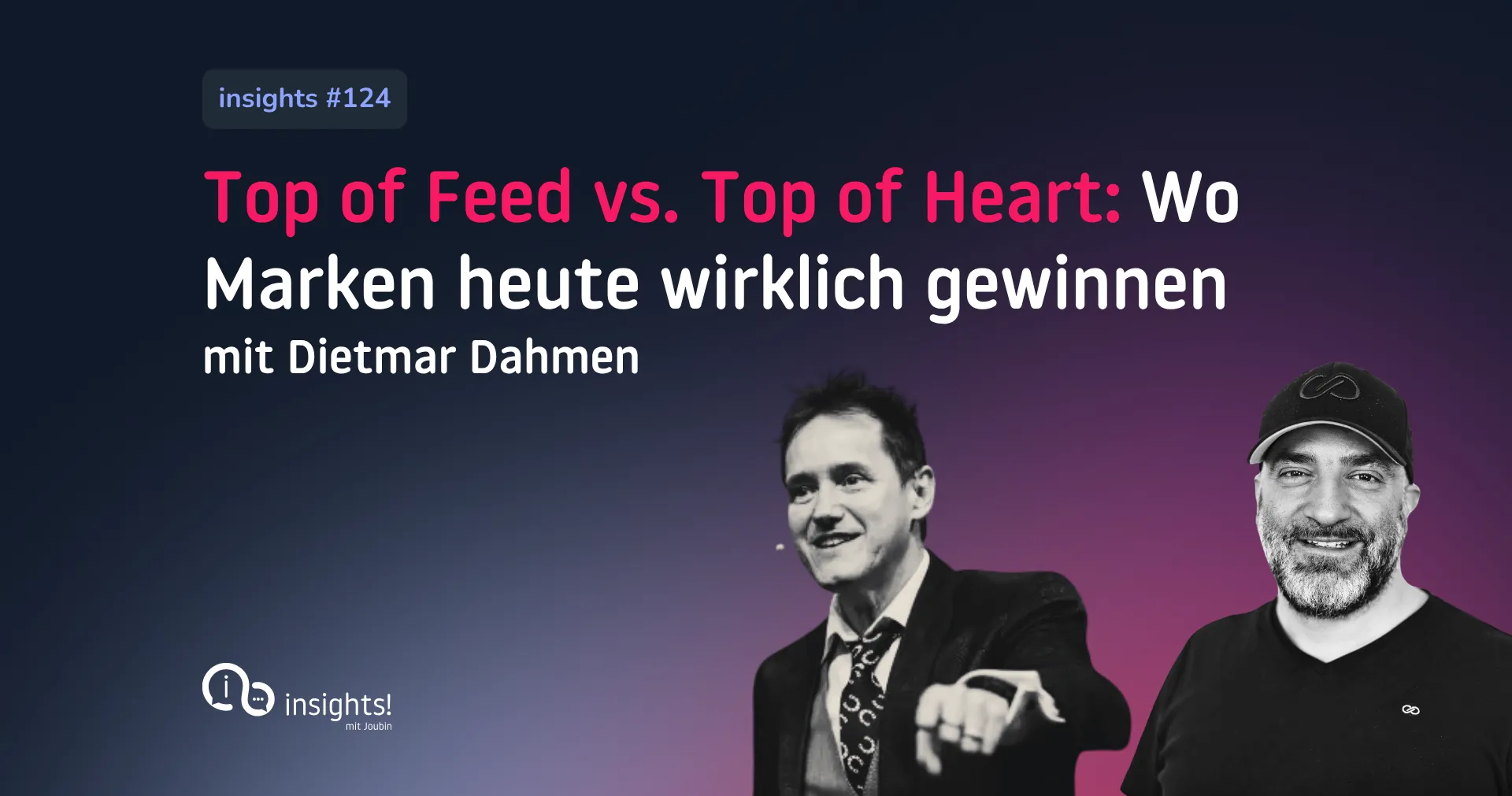
AI makes you visible, but only emotion makes you unforgettable.
Agents instead of all-rounders: how to set up AI correctly
Forget the myth of the one super agent. In practice you work with roles: analysis, creation, visual, distribution. Each role solves a defined task better than a generalist. Above that you set up a "control agent" that orchestrates handovers. This creates a flow from insight to output. This has consequences for your process. Where trend scouts once flew out, agents now crawl; where weeks once passed, minutes now suffice. In tests, agent "copy" performed massively better than human copy - reach x55, higher CTR included. Speed becomes a competitive advantage, consistency a brand airbag.
Top of mind vs. top of heart: why reach isn't enough
AI reach machine. Build visibility, vary creatives, prevent ad fatigue, keep message afloat in scroll storm. There it's unbeatable. Hearts it won't win. For "top of heart" you need oxytocin — brain releases that in company: stadium not stream, public viewing not private mode, real event not endless feed. So every digital format needs real-world counterpart: workshops, festivals, conferences. Magic happens in the mix.
Your new target group: people and their agents
Decisions are shifting. Increasingly, we're not asking Google but an AI – with up to nine times higher conversion than classic search. When an agent recommends something, people trust it. For you, that means you're now also playing for machines. Findability, structure, clarity – otherwise you won't even be suggested. At the same time, emotion still has the final say. The machine's advice is strong, but not infallible. Where people feel passionate, they decide against the advice, for the brand. So you need to run on two tracks: be "advice-ready" while also building fan moments. Rarely, but importantly: use variation to guide customers. Same content, new wrapper – limited edition, seasonal design, "topic hijacking" around current conversation topics. That way you stay relevant without bending out of shape.
From yoghurt to titanium screws: any product can become a fan brand
High interest isn't a product feature, it's a perspective. Socks become cult, screws become performance, yoghurt becomes a statement as soon as a community imbues it with meaning. You amplify that by recognising your target group's underlying motivation (weight, performance, style) and then curating variation, collector moments and a sense of belonging. The great thing: AI helps you read the signals. Which micro-culture is talking about what right now? Which terms are catching on? From that you develop individual messages without descending into "one-to-one" overkill. AI provides the map, you plant the flags.
Beat the pace: trend-hijacking and avoiding the middle ground
When everyone's talking, you listen – and hijack the trend in your direction. Brands like Sixt show how 'topic hijacking' works: fast, witty, surprising. For that you need radar (agents) plus courage (brand management).
Important: AI is inherently "average". Leave prompts uncommented and you get solid average solutions – exactly what gets lost in the feed. Your job is to push the machine beyond the average: bolder, sharper, more striking. Only then does efficiency turn into impact.
Scrolling economy: visible in 2.5 seconds
We scroll hundreds of metres of feed daily – enough to tower over the Commerzbank Tower. In this world, milliseconds count. AI "remixes" motifs, varies hooks, refreshes sequences and protects you from wear-out. The brand appears more often, more fittingly, more freshly. Just right for the two seconds of attention you really have. But: visibility is the ticket, not the finale. The click is the start of your work, not the end. Experiences, community and real encounters take care of the rest.
The new role of the CMO: orchestrator instead of silo expert
Don't build an AI silo, build an ecosystem. Your most important task is an environment where AI drives reach and your team simultaneously creates 'top of heart': events, communities, formats that bring people together. That's how you turn Pareto customers into genuine loyal fans – fast in outreach, deep in bonding. The team of the future is interdisciplinary: agent orchestration, creative leadership, event design, data literacy. Not everyone needs to master 'the best AI' – but everyone needs to understand how they play in the overall ensemble. That's how you get what AI alone will never deliver: meaning.
Would you like to listen to the full episode?
Find the podcast of the interview here:
Please accept the corresponding cookies to view this embedded content.
Prefer to watch the episode? No problem!
You'll find a recording of the interview here:
Please accept functional cookies to watch this video.
Prefer to read?
Joubin Rahimi
Great to have you back for a new episode of insights! My name is Joubin Rahmi and today joining: Dietmar Dahmen. Hi Dietmar.
Dietmar Dahmen
Hi, Joubin. Hello, everyone.
Joubin Rahimi
Yes, and Dietmar is really well known, not just for the AI topic, but also for marketing in that context. And we have a shared past. We both worked at IBM. I have to say Dietmar had it a bit easier, because he was simply the free bird within IBM. I was a normal employee and always rubbed people up the wrong way. So chapeau for that. And you were in the marketing environment then.
Dietmar Dahmen
Yes, exactly.
Joubin Rahimi
But now with AI the game is completely different. And you were just at a conference on the topic: how is marketing changing for companies, in B2B but also B2C?
Dietmar Dahmen
There are now huge, huge changes, which every company actually implements differently. The tasks of marketing haven't changed. Marketing's tasks are essentially, on the one hand, to be top of mind, the brand needs to be known to people, and then to be top of heart, people need to like a brand and be passionate about it and so on.
Joubin Rahimi
Probably even more than before, right?
Dietmar Dahmen
Yes, competition slightly up, but I'd say general goal stayed same. Question of how you reach that goal and the path you take to reach it has changed radically. We've always done competitor monitoring and we used to have, I'll call them Human Trend Scouts, who travelled to Asia to report on what's happening there right now. Still exists today, you just did it yourself. But you can obviously now do this in a sensationally digital way too. This digital work gets done in a perfect analysis, I find, by AI agents. And AI agents have certain roles, for example: "Do a competitor analysis. AI agents do "Do a market analysis. AI agents can also do: A competitor analysis. What are my competitors doing right now? Turn it into a nice chart, prepare all that for me. AI agents can find trend words and so on and so forth. That's an agent with a specific task: Analyse the market, my competitors and trends for me. That's the first agent. Then you pass that information to a second agent and you tell that agent: Take the first agent's information and turn it into copy or an advert. Then maybe you give that to a third agent, turn it into a nice image, turn it into a video, add sound and publish it and so on and so forth. What matters in marketing is to understand this: these are all different agents. That is, if you're a farmer – we're fairly rural here –, you have one animal that lays an egg, another animal gives you wool, the next milk and then you've got a sow as well. It's exactly the same with agents. Those are four different animals. You don't have the egg-laying wool-milk-sow. So you can't take one agent that can do everything, these are different processes. But you can basically put a controlling agent on top that does that. These agents will operate extremely successfully in this mix. What does "extremely successful" mean? There are lots and lots of tests. One test we ran, around May, was having a human write copy and an AI agent write copy. The human had a reach of 12,000, not bad, AI 660,000. A bit better Right, 55 times more, so really huge. Click-through rate. The AI was about three to four times better. So the AI operates better because it can implement more relevant topics perfectly. What AI can also do is recut, change and permanently update existing things. We all know we eventually go ad-blind. We've seen it. Ad fatigue, that's the English term. And ad blindness sets in incredibly fast. After just a few weeks your advert already stands out only half as much as before. And AI can help enormously there. That is, AI can build reach, AI can build Top of Mind and AI can do all these things. What AI can't do is Top of Heart. AI won't make you burn for the brand and be a truly passionate fan of the brand. You still need other things for that. Psychologically that's down to a hard-wired fact of our brain. And that is, for our brain to become Top-of-Heart, you need oxytocin. That's a specific hormone, this happiness hormone, love hormone and so on and so forth. And oxytocin only gets released through other people. We all know this from football, for example when we watch football: alone in front of the screen oxytocin isn't released, in the stadium full.
Joubin Rahimi
A completely different game, isn't it?
Dietmar Dahmen
But even if you have a digital space, like Public Viewing for example, with 10,000 others, it also gets diluted. Meaning, group does this thing and then you're top on heart. And it's basically about always making a mix. On one hand you can use AI to maximise reach. You should definitely do that. On other hand you can use money saved there, so to speak, to run events and bring people together and let brand be celebrated. You did that sensationally with INSIGHTS. Thanks. That was exactly the point. Meaning, on one hand we now have digital formats like this podcast for example. On other hand you have real events, like INSIGHTS. And these things in mix come together. Only one or only other is considerably weaker than when both come together. That doesn't work.
Joubin Rahimi
I found it incredibly impressive at the event, by the way. Felix Binsack went back on stage and asked: „Do you want the event again?" Yes. Standing ovations. Wild, right? Where do these emotions suddenly come from among the rather reserved IT folks? But they were fired up and full of enthusiasm.
Dietmar Dahmen
Yes, absolutely. Because you get an oxytocin release, an excitement release. You have that too. So real experiences are simply full throttle. The whole body, all senses, everyone's excited. And that's a really, really important point. You mustn't neglect that. On the other hand, you mustn't neglect reach either. So you simply have to do both.
Joubin Rahimi
Now let me play devil's advocate. If agents are already doing a lot in marketing, on the other side there will also be agents that consume and consider: where do I buy? Where do I prepare things? Oxytocin means nothing to them at all.
Dietmar Dahmen
Exactly, that's absolutely correct. And in brand theory there are also the following things: something you're completely indifferent to can be replaced, for example by a supermarket's own-label product. However, the supermarket's own-label product will never have the emotional depth of a brand you're really passionate about. Let me just take Henkel as an example, Persil. There are quite different emotions attached to that than to some white label. That's just how it is. With white-label products, I think people let themselves be talked into buying elsewhere, or buy elsewhere, much more easily and quickly. The main product you want to buy yourself. That means you essentially want to be in the driving seat, because there's a lot of emotion involved. And it's certainly the case that a great many products that are purely factual in nature are also bought by agents. There are two things worth bearing in mind here. One is that for the agent to buy you, the agent has to be able to find you. That means your target audience used to always just be a human. Today your target audience is certainly also an agent. That means you need to think about: 'What do I need to do for an AI agent to find me?' The second point is, now a lot of people think: is my product a high-interest product or not? And I can absolutely guarantee you, every product can be a high-interest product. You can be just as passionate about a yoghurt as about a watch or a car. That means it depends on your target audience. Every product can achieve it. I have plenty of examples when I think of young brands: our son likes a particular sock brand, because skaters wear them and so on. He's passionate about his socks. That means you can be passionate about underwear, you can be passionate about anything. So even things that aren't really visible can still be things you're passionate about, and then say: 'I want this and not that.' That means every product actually has the potential to become a fan brand, and these fans need to be engaged too. If you don't do that, the fans simply leave.
Joubin Rahimi
The target group. I was just thinking of screws, where you say, where is the screw actually a target group, because I bought very light screws for my road bike, in red. Yes, yes, exactly. There you are somehow, you want something very specific, but that's not the mass market.
Dietmar Dahmen
Exactly, that is … But margin.
Joubin Rahimi
With screws, for example, it really does depend. There are a few things … Or let me start from the beginning. When you look at a screw, the question is always: why are you buying this screw? What happens if this screw isn't good? There are several possibilities. You just mentioned road bike. There it's about performance.
Joubin Rahimi
Weight.
Dietmar Dahmen
Yes, then suddenly weight becomes very important and so on. I'm pretty sure that people who build an atomic submarine or a spacecraft pay extreme attention to which screw they use. That's a very clear thing. There it's about performance. On the other hand, with you it's about weight. Once it's about weight, you say: right, now I can make two different versions, either in metal or in red. Or in titanium. No, no, no. You can stay within the weight, but you can then add one more thing on top. The collector would then think: right now it's red, and maybe next year blue, and so on. That means, once you're sensitised to a particular topic, no matter why you got there, you can in principle turn that dial and lead the customer. That's leading the customer. How do I turn a normal customer into a long-term customer? And variation, for example, is a very important point there. That's why Coca-Cola has special bottles or special prints on the cans for every World Cup, every Olympics, and so on. The brand varies. The content stays the same, but the brand varies. AI can also help enormously here. AI can, for example, work out what the top trends are right now, what everyone's talking about, and how I can then manage to capitalise on these trends somehow. In marketing this is called trend hijacking or topic hijacking. Sixt does that sensationally, for example.
Joubin Rahimi
That's great.
Dietmar Dahmen
So basically, you have some topic that everyone's already talking about anyway, you hijack it and just attach your message to it.
Joubin Rahimi
Sixt has actually already reached the point where the brand is the hijacking.
Dietmar Dahmen
Yes, exactly. And you can do this hijacking if you know the trends and react fast enough. And agents, for example, can now help enormously with that too.
Joubin Rahimi
And my original question was whether emotion isn't that important for AI at all. Do you see it same way, or do you say: No, the target group … ? You still see the human strongly in this decision process?
Dietmar Dahmen
We all know that when you're now searching for information and deciding based on information, there are two main routes. One route is googling and the other route is asking an AI. So let's take ChatGPT or Perplexity or Claude or some other one. The conversion rate of AI is much higher than Google's, namely nine times higher. That means, if the AI says, this is the best screw, you trust the AI. Why? Because AI is seen as advice. That is, I know what I'm talking about and my advice is: take this screw. Google is more, here you can find marketing or app pages or search yourself and so on and so forth. And advice is already fairly important in some way. The doctor tells you: take this and so on and so forth. But then, if you like the brand, an emotion comes along, and an emotion is at the end of the day stronger than knowing what the advice is. The doctor tells you, for example: don't drink that beer. Then you see the beer, the emotion kicks in and then you say: you know what? I'll do it anyway. And it'll be the case that AI agents increasingly give you the advice and can also react to that advice. They can then also buy. But the things you burn for, those will keep deciding. Let me give a really simple example on AI again. AI in general is goal-oriented. That is, AI for example brings you a meal. The human themselves, or the analogue world, is path-oriented. If we cook together, we have much more fun than if we just eat a ready-made meal. The same thing happens in education too, for example. That is, if you have external expertise, you don't have the inner journey, the inner emotions. When you're at school. You learn a Goethe poem about autumn. What does Goethe mean by this poem? And you ask ChatGPT, you can show the teacher the external answer, but you haven't had the inner journey. You haven't reflected, you haven't had emotional conversations with people and so on and so forth. And the easier the external becomes, the more valuable the inner journey becomes, because it becomes rarer. That means brands suddenly have the opportunity, as there's more AI, to focus more on inner values, more on emotions. That's the first point. The second point is that AI, generally in the way AI operates, will at first surely always suggest a middling solution. And you have to, at the very least, similar to a creative director or a chief marketing officer, say: bolder, wilder, blah blah blah blah blah blah. You can't settle for the middle. That means you have to keep prompting further so that AI basically gives you a good solution. But even if everyone does that too, marketing isn't built to have predictable averages. Marketing has to stand out, be different. That means the more people use AI, the smoother and more similar everything becomes, so the less it stands out as a result too, and the more you basically have to push. What AI can do sensationally though, I mentioned this earlier, is build this reach and this Top-of-Mind thing on media where we're not Top-of-Mind anyway: scrolling. The new figures say we scroll 325 metres a day. The tallest building in Germany is the Commerzbank Tower in Frankfurt at about 250 metres. We scroll another 100 metres past that and more. And there it's no longer about having a deep inner journey. There the brand just needs to appear and it needs to rock somehow, because you're gone again two and a half seconds later anyway. And for things like that, AI is a thousand times better than a human.
Joubin Rahimi
So that means marketing is fundamentally changing on two levels, de facto. Firstly: how do I do it? So the CMO has to put the team together completely differently, the skills are different. And secondly: what I do has to be much more personal. Absolutely, yes. So the topic of events, bringing people together, then takes on a whole new significance in this context. Do you see it that way too, or?
Dietmar Dahmen
Yes, personalisation is of course also possible through AI, as AI can observe which media you usually click on and so on. A really simple example: what are they called? Labubus?
Joubin Rahimi
Yes, Labubus. We bought twelve of those too, when we were in Asia.
Dietmar Dahmen
Labubus. Let's assume. I, for example, didn't quite know what they were called, but of course I know they exist. AI finds Labubus, they're everywhere now, so you ask AI: does synaigy actually have Labubus too? And suddenly you're essentially in trend-hijacking territory and so on and so forth, even if you don't know the trends at all. That's important for people who might be into Labubus. Others might like road bikes. That means you can then deliver personalised messages there. AI can do that too. But it's still, staying in the digital world, still about reach and top-of-mindness. And top-of-mindness, in my view, the competition is fierce, of course, but it's generally being raised. Generally, you're being bombarded with even more information, with even more brands that are even more top of mind. That means, as they say, it's a red ocean. There's blood in the water, so to speak, and everyone else is there too. It's much better if you say, okay, if everyone's fighting to be top of mind here, of course we'll join in, but now we're looking for something that's truly unique. And that's the event, where you suddenly go deep, where you create inner journeys, where you create emotions. And this thing is an overall concept. One needs the other, and that needs the next. Without these two things, it won't work. The event alone only generates top of heart, but not top of mind. AI alone only generates top of mind, but not top of heart. You need to think much more holistically. That means your role changes more. And the next point is that the customers you then have, meaning what used to be called the Pareto principle, that 80/20 thing. You need to make sure you can quickly build genuinely deep experiences. Namely, the customers you have, the Pareto customers, the regular customers, they want depth, they want engagement. And that's why brands increasingly need to build this depth and this engagement.
Joubin Rahimi
Well then let's get on with the insights! Yes, already something proper. Exactly, absolutely. Yes, thanks for the insights on that. Even if you as CMO still have more questions, post them below. Ultimately it's about the job of tomorrow and the day after, what it looks like and what staff and set-up we need.
Dietmar Dahmen
Yes, what's really important with personnel here is that CMOs don't necessarily need to hire someone who's best at AI – rather, CMOs need to ensure an environment is built within the company that fosters the use of AI. The general mindset must be: AI can help with topics like reach, top of mind. But I also need to foster top of heart. That means: don't rely on what I'd call silo expertise – machines can probably do that far better – instead try to build an overall universe of the brand in which all the planets appear.
Joubin Rahimi
Now that's lovely close. I'm already thinking myself: next INSIGHTS, we're already planning that plus concept and so on. Whether we shouldn't just do hackathon, two days, and then say: two days come, what more can we squeeze out of it if we think completely differently?
Dietmar Dahmen
Yes, absolutely. So really pushing boundaries, thinking differently, stepping up and going deep.
Joubin Rahimi
So thanks for that. It gave me something directly. I hope it did for you too. And tune in for the next episode too. But once again the call to action: ask questions, comment. That's what keeps this alive. Releases oxytocin, as you learned.
Dietmar Dahmen
Exactly, absolutely. Thanks.
Joubin Rahimi
Bye. Thanks, Dietmar.
Have questions or feedback?
Then feel free to contact us directly.
- Joubin Rahimi
Managing Partnersynaigy
Show phone numberShow mobile numberShow email address
Subscribe to the blog now and never miss any news
✔️free of charge ✔️weekly news ✔️expert knowledge
Please accept the corresponding cookies to view this embedded content.