



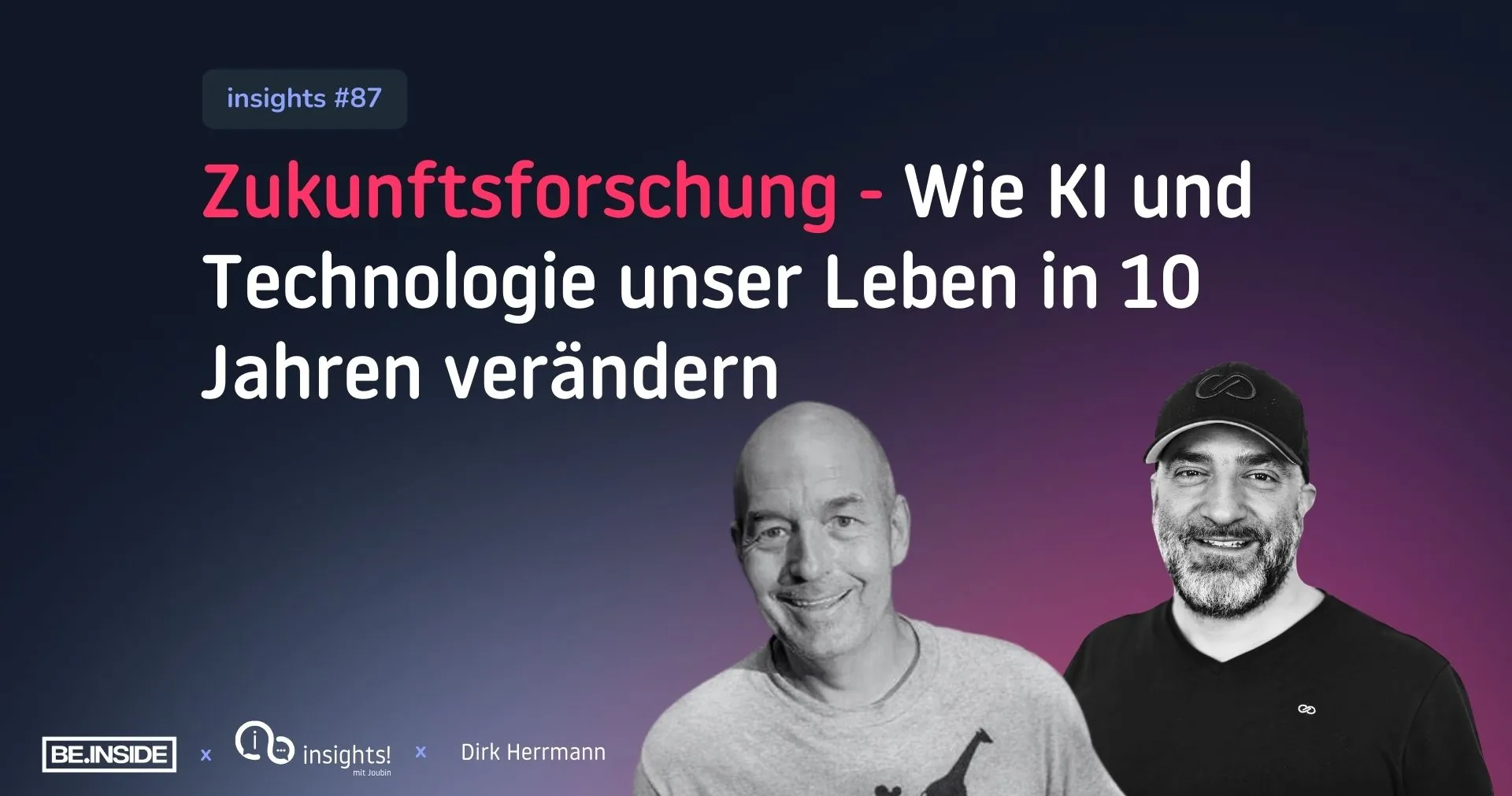
insights! #87: Futures Research: How AI and Technology Will Change Our Lives in 10 Years
Futurists aren’t clairvoyants. They don’t simply gaze into a crystal ball, but use scientific models, studies and trends to forecast what awaits us the day after tomorrow. While many of us only think about the next day, the futurist digs deeper into the distant future – how will we live, eat or get around in 10 or 15 years? A huge topic here is technological progress. From AI to the effects of climate change – all of that is part of a futurist’s everyday life. But don’t worry, it won’t be dystopian!
 Joubin RahimiManaging Partner · synaigy
3 min read
Artificial intelligence will change the world, just as the introduction of electricity did.
AI – as much a revolution as electricity was back then
Routine tasks that still cost us time and nerves today could be taken over by machines in future. You'll no longer need to laboriously write e-mails or endlessly review contracts – AI will do that for you. Particularly interesting: even "white-collar workers" such as lawyers or tax advisors will need to reorient themselves. An AI can already draft contracts or analyse rulings today.
Sure, that sounds like sci-fi, but look at how quickly ChatGPT crept into everyday life: within just a few days of launch, it already had millions of users. In five years, the world as we know it won't be the same. Exciting, isn't it?
What does that do to us?
Technology change not just our work-world, but our life too. And as with every advance, question arise: "What happen then to the people?" Futurologists look back into the past to find answers. When the car was introduced, carriage builders and horse keepers surely had similar worries. But no fear: new jobs will emerge, we just need to keep learning and adapt.
A major problem is the arrogance and ignorance of many industries who believe they're untouchable. Banks, car manufacturers, even Nokia – none of them expected how fast the world could change. Ignorance here would be fatal. Instead, we need to listen to the signs of the times and adapt.
A futurist spoke about a talk he gave to bank executives, where he predicted the impending insolvency of many automotive suppliers. The reaction? Stunned silence. Today, years later, we're seeing exactly these insolvencies weekly.
Germany in international comparison – time to act
And how does Germany compare to rest of world? While we often live in our own bubble, other countries like China make rapid progress. Forward-thinking decision-makers should definitely take a look at Shenzhen to absorb the technological spirit. The future, then, is not a distant utopia, but something that catches up with us daily. Waiting is not an option. Time to act now – whether in politics or management.
Would you like to listen to the full episode?
Find the podcast of the interview here:
Please accept the corresponding cookies to view this embedded content.
Prefer to watch the episode? No problem!
You'll find a recording of the interview here:
Please accept functional cookies to watch this video.
Prefer to read?
Transcript of the episode:
Joubin Rahimi:
Great to have you back for a new episode of insights! My name is Joubin, Joubin Rahimi, and today my guest is Dirk Herrmann. Dirk is a futurologist. Hi Dirk, great to have you here.
Dirk Herrmann:
Joubin, thank you very much on this beautiful day, at this lovely place.
Joubin Rahimi:
Ja, danke, dass du so spontan Ja gesagt hast.
Dirk Herrmann:
Yes, thanks for letting me be part of it.
Joubin Rahimi:
Yes, gladly. We're at BE.INSIDE, our event here ahead of DMEXCO and Digital X, and we've already had a great talk. But before we get into that, what does a futurologist actually do?
Dirk Herrmann:
Yes, well, futurists, perhaps to break this down directly. Futurists aren't clairvoyants. We look at scientific models, we look at trends, we look at papers and try to depict the future in a genuinely predictable form. So we look at: what isn't tomorrow? We all know that. Tomorrow is perhaps known to everyone, but what actually is the day after tomorrow? And very few people think about the day after tomorrow. What impact do technological developments have in 10 years or in 15? What does that do to the population? How will we eat? What will the trends be there? How will we get around? How will we live together? How will we live? These are all topics for futures research.
Joubin Rahimi:
So really, how do people tick, or how do people change their lives in the day after tomorrow?
Dirk Herrmann:
Once from the human side, but also from the environment. What does climate change do to us? What does climate change do to entire regions on earth? So we have the inside and the outside and try to fit that into a model.
Joubin Rahimi:
And technology is probably also in the environment. How is technology changing? AI is on everyone's lips. What do you say about AI? How much will it change us?
Dirk Herrmann:
AI has been present in my world for ten years already, but of course the broader public only saw what generative AI can do once ChatGPT came along. And I think it will change the world the way electricity changed the world. And it will arrive with a force that many still can't quite estimate.
Joubin Rahimi:
You say that so quietly, like electricity. That means, if I picture electricity, a lot has changed. Suddenly you had machines doing things for you, you didn't have to do anything yourself, compressed air, no more pickaxes.
Dirk Herrmann:
Yes, today there are so many routine tasks that I can now have carried out by an AI. That means today, of course – you just mentioned it – electricity, machines, compressed air, we have those. These blue-collar workers experienced total relief through electricity. We're going to see white-collar workers – well, nobody wears ties any more, but quite a few still wear white shirts – having to take a good look around. So entire industries, such as lawyers, tax advisors. Those are all business models that say today: we'll always be needed. No, they won't.
Joubin Rahimi:
Not in that form though, right?
Dirk Herrmann:
Yes, far less will be needed. Far fewer lawyers will be needed, far fewer tax advisors. Just drafting the contract alone takes a long time. Today, artificial intelligence can do that much faster, and perhaps with much greater legal certainty. And when a dispute arises – say I have a large, complex case today – I'd probably have to study 40 file folders, review them and then still remember where the real sticking points are. Today I scan it all in and ask the right questions, and then the AI has already done the legal preparation, perhaps even with rulings that have already been made on this case.
Joubin Rahimi:
I'd say that's almost tomorrow already. Not that lawyers or tax advisers are being replaced now, but that the technologies can already do this. We've already seen that in our projects too, medical approval processes and so on. But then what do the people do? Is that also a topic as a futurist?
Dirk Herrmann:
Yes, totally.
Joubin Rahimi:
What the next step then is.
Dirk Herrmann:
Totally. If we go back in time again, with the introduction of the automobile, coach builders, farriers, horse handlers, everything that was state of the art in mobility back then, naturally asked themselves: what do we actually do tomorrow? And everyone found new professions. So nobody was really left behind. And I believe that today, to all these professional groups: train yourselves, invest in education, you'll have to do what others will have to do. And the day after tomorrow might come sooner than we think.
Joubin Rahimi:
And faster, I think, is a good keyword. ChatGPT, I believe, only took 3.5 days or 5 days to reach a million users. Now they're probably well beyond billions, two, three. I can't say exactly, but it'll be in that region. In what timeframe do you think something like that could happen?
Dirk Herrmann:
Five years from now the world won't be the same any more, and five years is probably already a long period there.
Joubin Rahimi:
And I think that's first of all an appeal to everyone to engage with it: what's changing?
Dirk Herrmann:
Total.
Joubin Rahimi:
Don't stay the coachman, become Mercedes in this case, or the taxi driver. Or are there already forecasts of where lawyers might end up?
Dirk Herrmann:
I believe that the professional groups affected always believe they are not affected. I have a dear friend who is a tax advisor, and he's already quite digitally engaged, but deep down he doesn't believe he could be replaced tomorrow. And if you look at these professional groups, they never believed it. If you had asked Nokia… They never believed it either.
Joubin Rahimi:
They didn't believe it either. Everyone knows the 3210.
Dirk Herrmann:
Yes, yes. Yes, Nokia 3210. And people often approach it with a certain arrogance too, and say: This will never hit us. And that's wrong. I think everyone will be hit by it in one way or another, and for some it will be devastating. I remember a talk I gave in Stuttgart in 2019, in front of a large number of bank board members. That was just the time when there was discussion about what would happen to the automotive industry. And I read a post that the 14 biggest insolvency administrators in the world were all currently renting offices in Stuttgart. And I dropped that quite casually into the talk. You could have heard a pin drop in that hall. And what's the situation today, five years later? We read about a supplier's insolvency every week. So that means you really can forecast and predict things. And today we have to look closely. We have to genuinely respond to the messages we hear and see on all sides. And ignorance would be completely out of place here.
Joubin Rahimi:
You travel a lot worldwide too. How do you see Germany and Europe compared to other countries? And where should a decision-maker travel to in order to take in the spirit, the perspective, the ideas?
Dirk Herrmann:
So for a while everyone made a pilgrimage to Silicon Valley. I've also spent quite a lot of time there. Today I'd look towards China. I'd go to Shenzhen. I'd really look at both sides, and above all I'd travel a lot. Alexander von Humboldt once said, or at least it's attributed to him, the most dangerous of all worldviews is the worldview of those who have never viewed the world. And in Germany we tend to judge things from within our bubble, our own bubble. But those things are completely irrelevant in other parts of the world. So that means we really need to get out into the world and look at it. And if you ask what will happen to Germany, deindustrialisation is a big topic. We're feeling it now. I mean, when the water level in a river drops, you see the sharp stones, and the water is low, and we're seeing the sharp stones now. And we simply have to ask ourselves whether we're currently making the right decisions, both in management and in politics.
Joubin Rahimi:
And I think that's a really lovely closing statement, this question, because we can all work on it, whether you're a leader in the company or politically active. Deciding is what matters, not waiting.
Dirk Herrmann:
Yes, and now to decide. Thanks
Joubin Rahimi:
Thanks for the time. That was really educational for me.
Dirk Herrmann:
Thanks.
Have questions or feedback?
Then feel free to contact us directly.
- Joubin Rahimi
Managing Partnersynaigy
Show phone numberShow mobile numberShow email address
Subscribe to the blog now and never miss any news
✔️free of charge ✔️weekly news ✔️expert knowledge
Please accept the corresponding cookies to view this embedded content.