

Google AI Overviews
Google AI overviews: impact on CTR - what SEO managers need to know now
6 min read
AI Overview: classification and initial findings on CTR
With the introduction of Google AI Overviews (AIO) in search results, a lot is changing for SEO and online marketing teams. The new AI overviews present users with summarised answers directly on the results page, based on third-party content – without a click to a website necessarily being required. For many companies, this means a change in visibility within search results.
Our SEO evaluations and analyses since the introduction of AIOs demonstrate concrete effects on organic click-through rate (CTR): for informational search queries, there's a noticeable decline in organic click rate – despite improved ranking positions.
Other studies confirm this trend too. According to research by ahrefs, the appearance of AI Overviews in search results correlates with a 34.5% lower average CTR for top-ranked pages.
Briefly explained: What are Google AI Overviews?
AI Overviews are AI-generated answer boxes that answer a search query in condensed form. The information comes from:
Indexed websites,
Google Knowledge Graph,
Trusted sources according to Google's algorithms.
Websites are often named as sources in the AIOs, but don't always appear prominently. That means: visibility yes, clicks no – at least not to the previous extent. This changed function of search results should be taken into account in content strategy.
The official Google blog states that AI overviews are meant to help especially with complex queries by giving users quick, well-founded summaries. Google highlights user-friendliness in particular as a central function.
Analysis setup: how was the study conducted?
For our analysis, only top-10 keywords were included, to avoid "CTR noise" from lower ranking positions. The basis was a combination of SEMrush data (including search intent clustering) and data from Google Search Console, merged via a data blend. CTR measurements were carried out in a consistent and transparent manner, so we can rule out distortions.
Key findings from our study
We regularly analyse data from Google Search Console and SEMrush in the context of our client projects. The analysis is based on real usage data from a client whose website has achieved stable rankings for relevant industry keywords for years. The results show:
Informational keywords are hit hardest.
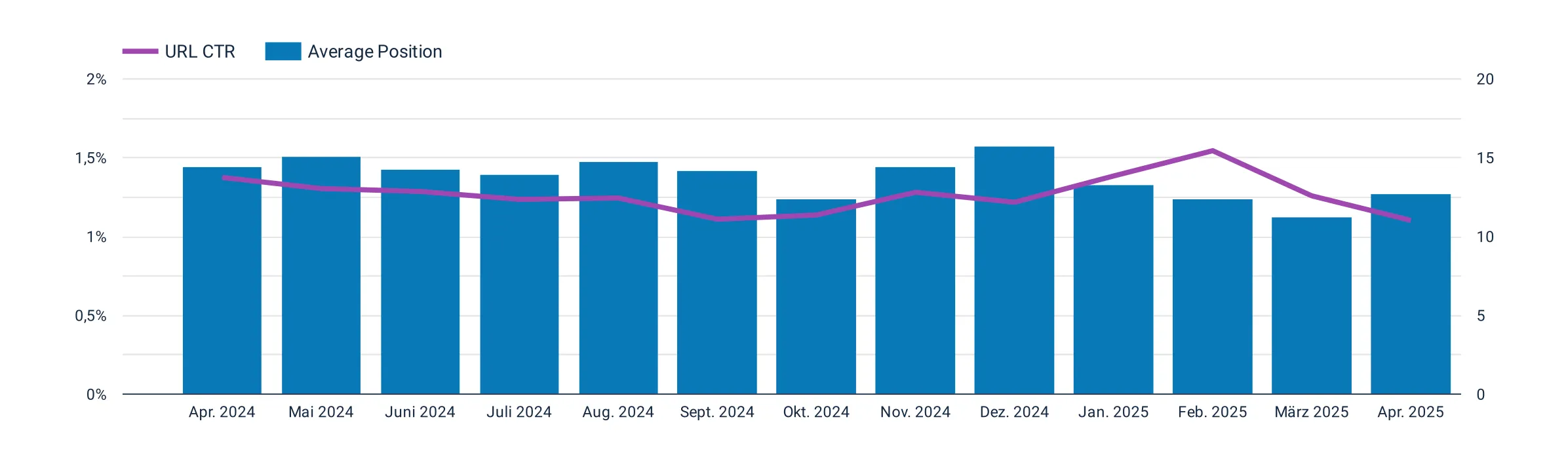
Clear CTR decline from January to April 2025: for informational search queries, average CTR dropped from 2.65% to just 2.15% — an 18.5% reduction.
Average position improves at the same time from 8.2 to 7.4 – an indicator that the drop in CTR can't be explained by worse rankings.
Overall CTR dropped from 2.61% to 2.2%, i.e. by 16%.
Current figures show a further decline: the average CTR stood at 2.9% in 2024, but only 1.72% in April — a dramatic 40.7% drop.
According to a SEMrush study, around 80% of all search queries where AI Overviews appear are informational in nature. This exact type of search intent was also the most affected by CTR losses in our own study.
Our hypothesis: users already get their answer via the AI overview and therefore often forgo clicking on classic search results.
Impact on SEO and website traffic
Fewer organic clicks despite top rankings
Notably, even top-10 positions no longer guarantee the usual click-through rate. Especially for informational queries, the likelihood of a website visit is declining.
Changed user expectations
Users are increasingly used to getting answers instantly in the SERPs (Search Engine Result Pages). Long content or walls of text are losing relevance.
Challenge for content strategies
SEO and content teams need to design content that is optimised both for classic organic search and for integration into AI Overviews.
Despite the decline in CTR, there are signs that Google will make AIO output more selective in future – so those responsible for SEO can hope for stabilisation. Targeted optimisation of content for AI can help continue securing visibility.
Where does Google source the content for AI Overviews?
Google uses various sources to create AI overviews:
Content from websites that are indexed (with a focus on quality, freshness and authority)
Structured data (schema markup)
Wikipedia and established knowledge databases
Google's own information from the Knowledge Graph
Recommendations: how to optimise your content for AI overviews
1. Offer concise answers:
Short, clear paragraphs
Place important information at the beginning
2. Use structured data:
Rich snippets (e.g. FAQ and how-to schema)
Regularly check the currency and quality of structured data
3. Strengthen EEAT signals:
Expand author profiles
Linking trustworthy sources and studies
Provide transparent information about your own expertise
4. Optimise content for W-questions:
Focus on typical W-questions (AIOs are often triggered by W-questions)
Structured FAQs for the target group
5. Monitoring and adjustment:
Track CTR development and visibility precisely (e.g. Via Google Search Console, SEMrush)
Continuously adapting content to new search intents and AIO integrations

Conclusion: SEO in the age of AI overviews
Google AI Overviews are currently still part of a large-scale test, but their long-term place in search results is considered likely – a full U-turn isn't expected. It's still unclear how Google will monetise AIOs, and the higher computing cost compared with classic SERPs also makes widespread rollout expensive. All the more important, then, to keep a close eye on developments around AIOs – and respond flexibly to changes. Companies that want to secure organic visibility and traffic in the long term need to understand how usage behaviour is changing – and consistently align their SEO strategy with experience, expertise, authority and trust.
Optimising for rankings is no longer enough. What will matter is being present with your own content wherever users expect their answers: including directly within the new AI overviews.
Sources:
Own analysis based on GSC and SEMrush data
Your contact person
Would you like to know if - and to what extent - you are affected by Google AIOs?
Then contact us!
- Moritz Schmitz-Justen
SEOsynaigy
Show email address