



insights! #93: From Bundesliga star to social media phenomenon: Hans Sarpei opens up about self-discipline and success!
Success not end with career change – it often only begin there! From structured pro everyday to self-responsibility and constant readiness to keep learning – he prove real success need courage for change and inner strength. We talk today about his path from professional athlete to entrepreneur and social media pro, with focus on self-responsibility, role of AI and data in sport, value of humour in dealing with challenges and importance of societal responsibility.
 Joubin RahimiManaging Partner · synaigy
4 min read
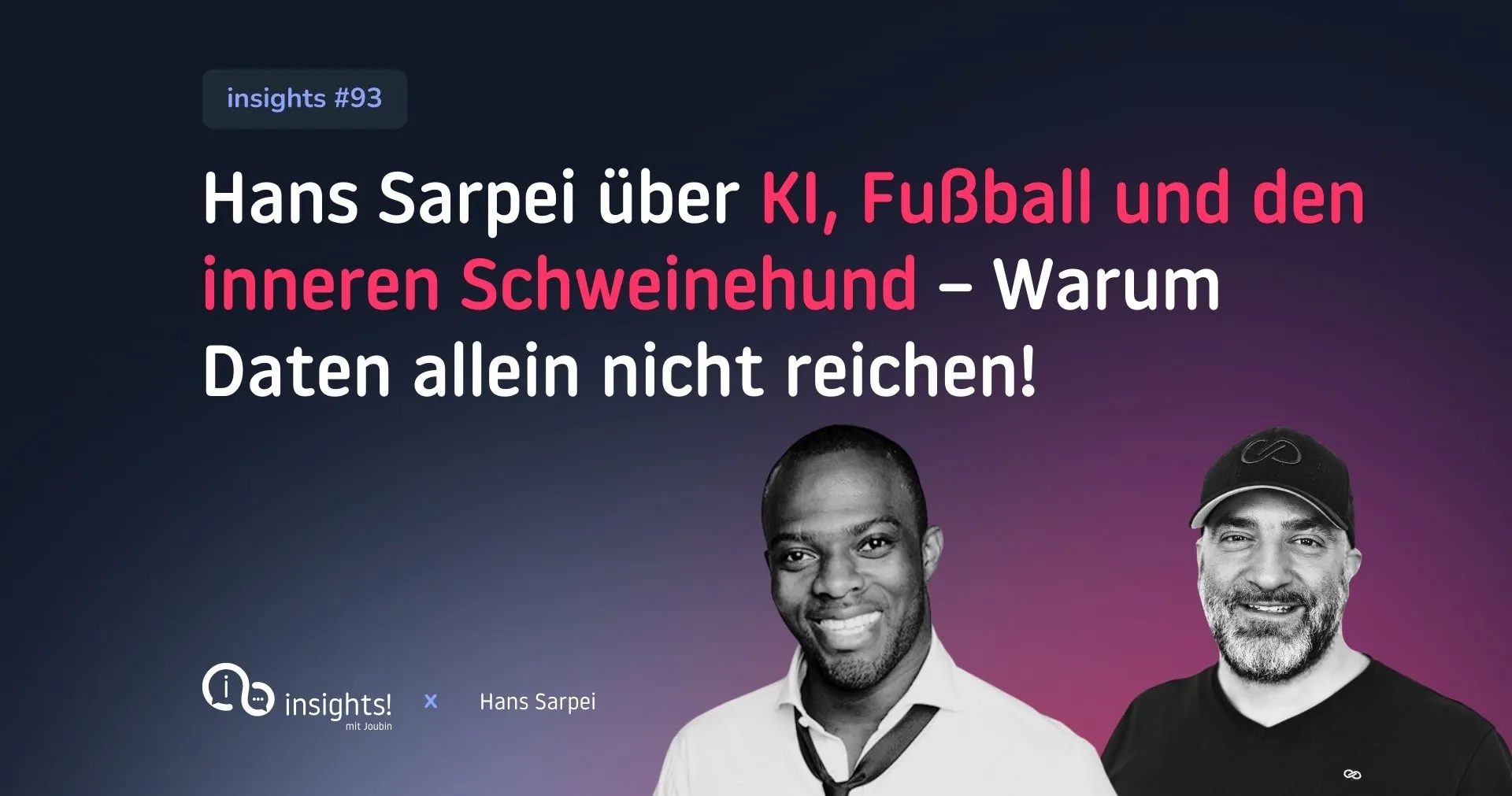
Data analysis in training is all well and good, but when it counts, it's the person that matters, not the numbers.
Many of us know Hans Sarpei as the ever quick-witted ex-Bundesliga professional and social media star. But his story is more than that of a footballer. In conversation with Joubin Rahimi, he offers insights that are valuable for both sport and career alike: on the transition from the tightly scheduled life of professional sport into an independent working life, the role of AI and data in sport, and how humour and an unwavering will to learn can be a lasting driving force for success.
From playing field to self-employment: structured path to success
Hans describes his career as a professional footballer as an almost completely regimented existence. Training sessions, physiotherapy and even mealtimes were determined by the coach. "The coach tells you when you can go on holiday," says Sarpei. For many professional athletes, the transition to "normal" life therefore leads to a structural and identity crisis: suddenly they have to develop their own goals and schedules. Instead of remaining in this disorientation, Sarpei decided to do what had always been important to him – staying hungry and continually learning new things.
After his time on the pitch, this approach led him into the world of social media. He began deliberately working on his skills, built a new career for himself, and thereby showed that a reorientation can indeed be successful – even if that means starting „from scratch“ once more.
Artificial intelligence, training data and inner resistance
Technological advances no longer thinkable away from sport either. Today data and artificial intelligence analyse every movement of players: sprint distance, endurance runs and load values – all recorded. But for Hans, one decisive aspect missing: „Data cannot replace inner drive to go beyond own limits.“ Idea of training optimally and within „green zone“ sound tempting. But in critical match situations, it's often about giving more than 100 percent – and that must be practised in training just as in match.
For Hans, this „inner resistance“ is the real challenge, in sport as in professional life. AI can support and optimise, but success still relies on human will and the ability to overcome limits.
Humour as an attitude and approach to challenges
Racism has been a topic for Hans Sarpei since early childhood, but he has found his own way of dealing with it — with humour. Even as a teenager, he often met discriminatory situations with a touch of irony. "Sometimes humour is the only way to defuse a difficult subject and create attention," he explains. For him, humour is a tool that gets others to listen and makes sensitive topics accessible without coming across as preachy.
On social media he uses his reach to address topics such as racism deliberately, always with humour and without raising a moralising finger. This attitude has given Hans a remarkable connection with his followers and a role-model status that goes far beyond sport.
Success factor work-life balance and the importance of resilience
Sarpei is aware that his success is due not least to a careful balance between work and leisure. He emphasises that work-life balance isn't just a buzzword for him, but a necessary basis for long-term success and wellbeing. At the same time, it's important to him not to take his prosperity and freedoms for granted. Through his involvement in projects such as "Abgestempelt – Hans will's wissen", he gives a voice to people caught in difficult life situations and makes clear that looking beyond one's own horizon is key to personal development.
What we can learn from Hans Sarpei
Hans Sarpei shows that change and continuous learning aren't one-off projects but ongoing processes. The ability to take on new challenges and learn from the best sources still drives him today. For him, technological innovations such as AI are important tools, but it is his own motivation that brings true strength in life and work. And sometimes it's humour that helps us stay on course and master things with a lightness that carries us forward. His story is an example that success is a matter of attitude: stay hungry, even as conditions change, and follow your own path with confidence and openness to new things.
Prefer to watch the episode? No problem!
You'll find a recording of the interview here:
Please accept functional cookies to watch this video.
Prefer to read?
Transcript of the episode:
Joubin Rahimi
As I promised you, once you hand me the microphone I never give it back. But today I'm not even the main person either – Hans is the main person. It was brilliant having you here as Hans. Hello and a warm welcome to our show.
Hans Sarpei
Yes, thanks. Thanks first of all. Thanks for the invitation, and I'm glad to be here.
Joubin Rahimi
Personally I'm a mega, mega fan of yours, not from your football days, but from time after. And I know from pre-call: not everyone of you is football-mad or from the Pott and knows Hans. Maybe you'd like to say two, three sentences about yourself so everyone can place you first, since we'll reference that later.
Hans Sarpei
Yes, I'm Hans Sarpei, I come from Ghana, came to Germany at the age of three. The most important question is always: "Why are you called Hans?" That's always the very first question. And why am I called Hans? My parents, before I was born, were in Hamburg back then, worked in import-export, always travelled from Ghana to Hamburg by ship, brought a few things from Ghana, sold them in Germany, and back then lived with an elderly gentleman who taught them German culture, German life, and his name was Hans. And shortly before I was born, this man unfortunately died, and as a thank-you to the family and so on, I was given the name Hans. And that's how it all comes full circle. And then I grew up here in Cologne, Chorweiler, was lucky enough to become a Bundesliga professional at Fortuna Köln, MSV Duisburg, VfL Wolfsburg, Bayer Leverkusen, Schalke. Then I decided to play for Ghana, played for Ghana at the World Cup in 2006, for Ghana at the World Cup in 2010, and made about 200 Bundesliga appearances. After my football career I slipped into social media back then. What does slipped into mean? Back then there was Facebook and Twitter, Instagram, and all the other nonsense that's there now didn't exist yet.
Hans Sarpei
And there was such hype about me, like Chuck Norris back then: „Hans can do anything. Hans can do all the press-ups and so on. And I took that hype and ran with it, did a lot in the social media space, also did quite a bit on television. Some of you have probably seen me on Let's Dance, I danced on Let's Dance too, and I won. Otherwise I wouldn't have taken part. Yes, and now I'm here. We're sitting here chatting about lots of other important topics still to come.
Joubin Rahimi
What impressed me massively about Hans... As an athlete you have a tightly scheduled life, you told me. Maybe you could repeat that, how tightly scheduled this actually is for such young people and what that actually means.
Hans Sarpei
Yes, I don't actually know if everyone wants to introduce you like that. I turned professional relatively late, and at some point, once I'd turned professional, the coach basically determines your whole life. He says when training is, when you can go on holiday, when and what you eat, everything. And at some point a week is always mapped out like this, where they say Monday you're off, Tuesday is training, training is at 10am, you have to be there an hour beforehand, so 9am. Be there at 9am, you're already preparing for training, some need a bit of a rub-down at the physiotherapist. Training at 10am, you train until around midday, and then the coach also decides whether there's a communal lunch, where everyone eats together, where cooking happens. And then you eat together, rest a bit. One or two go and lie down, sleep for an hour or an hour and a half, then you're already preparing for training again, go to the gym, do a few exercises, then it's training again at 3pm until 6pm, and then one or two go to the whirlpool, sauna, cold plunge, and then you're home by around 7pm.
Hans Sarpei
If you've still got energy, you get a few friends together, chill with them or game at home on your PlayStation. And that's basically every day. Not every day is training twice. Sometimes it's just the morning or the afternoon. Then you've got a bit more time. But basically, you don't determine your own life. The coach determines how things happen, how everything works. And you're actually relaxed about it and just say: "Okay, the coach says when I need to be there, so I do that and that's it". And that's the difficult part for every professional, this switch from "I was a professional and now I'm stopping and now I have to determine my own life". That's the difficult part.
Joubin Rahimi
And I think that's something that definitely got me really hooked, because the bridge to it is: with AI, an awful lot will change. So for us in the digital tech world quite a bit will change, for programmers everything will change. In management too, the markets are changing drastically, are mega volatile. And we, those of us who run businesses, we're kind of... No one tells you how you have to eat or what you can eat, but you're in a certain rhythm and we have to break through that. From one day to the next it'll be different. And that's my bridge too, and what I'd like to give you, what Hans experienced. Because, how did you manage to say, now from that daily supervised life, I'll call it that, to being totally independent? You could have done anything. You could also have said, I'll become a Mercedes salesman, or Boris Becker bought his Mercedes there too. The world is open to you: what do you do then? And how do you not lose yourself? That's also a really important question.
Hans Sarpei
Yes, that's really difficult, because I played professional football for 15 years and then you're in this kind of bubble. I call playing football a different world, because everything is arranged for you there. And now when you stop, you have to organise yourself. Of course you can also stay in this bubble by becoming a coach, sporting director or something, then you stay in there. But if you want to do something else, whatever it is, self-employed, whether you, I don't know, buy up Mercedes dealerships or something, then you have to do that yourself. Or you have certain people around you who support you with that. And I think what's really important, and it certainly was for me, is that, just as on the pitch before, you're hungry or always want to look ahead, always need to learn the next thing, always want to try to learn something new, stay greedy. And for me it was simply that I slipped into the social media field and found that really exciting, and I had a friend who was managing director at Jungfermanns Sports in Hamburg, and I flew there every Wednesday morning early, worked there, on into Thursday as well, and flew back to Cologne Thursday evening.
Hans Sarpei
I did that for about two years, simply to learn. Many people always asked me: "Why did you do that?" I did something completely different for 15 years. Now I've done a lot in social media, but I still had to learn it. I had to learn how it works, how advertising works. And I did that for two years, very intensively, on the two days I was always there, looked into it, because they worked with the DFB, worked with Karstadt, all sports sectors, and I took a lot from that, learned a lot from it. But you have to be structured. You have to want it yourself. You have to be ambitious and also say: "Okay, maybe I'm no longer on the stage the way I was before, and I'm on a new path and trying to present myself there." And that was my path. I was very, very, let me tell it this way too: I'd never had anything to do with computers before either. And then at some point I was at home and said: "How does Excel work? How does Word work? How does that work?" And then I just looked on Google and checked: "Where can I sign up?"
Hans Sarpei
How can I learn this? And then there was a course somewhere near me and I went there beforehand – I don't know, I went for two weeks or so – and did basic courses there and learned it for myself, just to get further. And I think it's really important that, even though you've earned some money, you keep learning new things to progress, because I was also self-employed, still am, and had to say to myself: "Can I do this? How does it work? How do I write an invoice? How do I do that?" And I naturally had to learn all of that myself rather than hiring someone and saying they'll handle it.
Joubin Rahimi
I find that mega exciting. I'm taking away two things and one question: one, you learn from the best, the sports director from Jungfamad, that you go along directly and learn. I think that's what I personally took away too, really learning from the best and looking at who's there. There are loads of the best here. I won't say now who's where – you can all find that out yourselves – but the best are simply here, and that alone is mega, learning from the best, and second, learning it yourself again. So doing that, asking Google or ChatGPT now. I think, before AI, we all have to learn that. But the question I still have is: how did you stay hungry? Is it actually in here, or did you have to push yourself?
Hans Sarpei
How did I stay hungry?
Joubin Rahimi
Or sometimes you're just always hungry, then it's nice, right?
Hans Sarpei
Yes, I think that has to do with my background too, from sport, the 15 years. I always wanted to win and then somehow you stay hungry, I think, afterwards too. Then you always want more, always the next thing, because that one chapter was over and then the next chapter comes and then I wanted to win again there too, I wanted to progress further there too. And this hunger too, I think, from my childhood, where I grew up, it's still somewhat in me, that you dreamed, had big goals. And these goals didn't fade away just because I stopped playing football, but I thought: okay, I've achieved something great for myself there. I'd never have thought that. And now the next goal is simply to get the maximum out of it, and I think everyone needs this hunger somehow, when you... Or these dreams too, these dreams of having big goals and then getting there peu à peu, step by step. And as you already said, learning from the greats, that's always important. But that's also something I've carried with me in my career.
Hans Sarpei
I've always had great coaches and learned a lot from those great coaches too, not just as a footballer but also in what I'm doing now.
Joubin Rahimi
I'm always hungry. That's what connects us, by the way. We came to Germany from Iran at age three, and at the beginning of the year, and then again at Easter, we were in Vietnam, Malaysia and Thailand. I think we definitely have that hunger because of how we grew up. That's good and, for me, a challenge at first. That's why I'm mega proud of Marie, who just spoke, because in kindergarten she never wanted to go on stage.
Hans Sarpei
Me neither.
Joubin Rahimi
And at some point she started with: 'I'd like to have a four-day week' and Greece is now introducing a six-day week, but where's the hunger? We're doing very, very well here. Right now we're doing very well. How can we pass that on to the children? And that's the bridge to the Hacker School again. We'll bring out a pink box in a moment. That was actually Mel's and my wedding box, we'll bring it up to the microphone stand. The Hacker School supports schools in teaching IT lessons, AI lessons and robotics lessons. And everything you put in, we double, because we believe it's just mega, mega, mega important that our children learn IT and learn technology and learn digital teamwork.
Hans Sarpei
I can still learn that too.
Joubin Rahimi
Yes?
Hans Sarpei
Well, we could also come to my place, or I'll come to yours.
Joubin Rahimi
Yes, definitely with social media you can teach us all a thing or two. So you could certainly ask Hans in a moment how he did something. I do have a question on that too. But I think this is a really important bridge we have. How do you stay hungry, and how can we somehow maintain the prosperity we have, not by being fearful, but by being bold in today's world. On social media, this topic was also discussed. Racism was also a point, and you addressed that too, in a very particular way. And not with a wagging finger, but with humour. And that's also a topic again right now. But how did you manage that with the humour? Was it easy or was it difficult? What were your thoughts on that?
Hans Sarpei
Yes, that's a very difficult question, because, as you said, racism has accompanied me my whole life. And sometimes more, sometimes less. It's always different. And you always have to know, every person is different, and every person deals with racism differently. There is, because as you said, like with your daughter, she might not be so good at talking, or the other one... Everyone is better at something different. And then there are people, for example with my brother it was like this: if someone attacked him racially. He used to stutter back then, and he defended himself by hitting them, because he couldn't do it any other way. He couldn't talk. And with me it was more that I got through it via humour. And that started back then. Back then, my brother was also a professional and was at FC Köln, a professional at 1. FC Köln, and back then it was still the Deutsche Mark era, and we went shopping somewhere. I was 15 and he said: "Come on, I'll buy you something." And we went shopping, got some things, and then we were at the till, and my brother paid with a 100 Deutsche Mark note, and the shop assistant looked at the 100 Mark note, left, right, turned it over again.
Hans Sarpei
She couldn't believe that my brother had 100 D-Mark as a black man, looked at it, and my brother was already annoyed, and I was like: "I whispered in his ear, 'shit, hopefully she won't notice it's fake.'" That was my sense of humour, dealing with it. She looked at it again, turned it, examined it, but found nothing. Then they had to give us the change, and then we left, and I said: "Brilliant, she didn't find out it's fake. We made some cool money there." That was just my way of dealing with it through humour, and back then social media didn't exist yet. Then, once I got into the social media space, I worked a lot with humour first, in football, about matches, about players, but then also in the area of racism, because if you present it very dryly, nobody reads it. Nobody pays attention to it, and I tried to weave it in with humour somehow, and then people take it in and try it out. Then everyone talks about it, and that was my way of dealing with it, and I tried to handle it that way too. And I think what's really, really important is that, regardless, we understand that we need to be a unit, a united front together, somehow make that work, and not have anyone, whoever it is, pointing fingers and saying: "Hey, that group does this and that, the other group does this and that."
Hans Sarpei
And that's very, very crucial for me, that people think about it together and look at how to change it, but also that we… It's a difficult time right now too, so we try to simply understand the other person as well and look: what's the background? What's happening there? Why are they annoyed? What's going on? What's making that person annoyed? Why? I don't understand it. Then maybe ask questions too, not just judge and fail to understand the other person.
Joubin Rahimi
And those are wise words, to say: "I understand the other, to look behind the scenes." That's always, always important. I want a change of subject, but from a heavy topic it's always difficult. But it's still no easy topic either. Let me go back to football once more. Thanks, Hans, for the insights. I think that was quite exciting for everyone here too. In football you've trained a lot and said, all that gets prescribed, and now the data is slowly coming in.
Hans Sarpei
I'm not entirely sure. We haven't trained that much. It always just looks that way.
Joubin Rahimi
Shit. But now you train efficiently, or the young people now train more efficiently, with data. So in the past it was: "Then run another lap if you can't sprint fast enough. But now you play more like professional football, don't you?
Hans Sarpei
Absolutely. Everything has changed. It used to be that you did a lactate test, took blood from the ear and analysed how quickly lactate builds up in each person's body. To change this lactate level, so that someone has better endurance or faster recovery, the players had to run at a certain pace to improve. And back then, we did a lactate test, ran round the track and afterwards the results came in, and the coach would say: "20 players, all the same pace, run up and back down." Nobody was interested, it was completely uninteresting. You just had to do it. You had the values. And now, of course, with all this data available, it has completely changed. Every individual in training has a chip in the back here, and then you analyse how much they ran in training, how many sprints, how many endurance runs, how much they walked. And based on that, you pay even more attention to: "How do I train the professional player, but also the youth player? How much do they need to run? Have they run too little?" There's just so, so much data.
Hans Sarpei
I think they don't actually need that much data, or aren't currently using it to really evaluate everything. Because I think there's one analyst and then he has 26 players and then he has to evaluate so much data. That can't all be evaluated yet, really, to make the player even better. And I think, as you said, artificial intelligence will change quite a bit in football too, and help the analysts further, to make the players even better. But you can just tell how times have changed for the players. The players are suddenly like machines, robots, all sorts of things are …
Joubin Rahimi
You already have a chip in there, right under the skin, the chip.
Hans Sarpei
No, no, no. You always get a vest like this and then you get your chip for every player in here. Not operated on yet? Not operated on yet. That'll probably come too, so they don't have to put that in here anymore. But that's how everything in this area is changing right now. But I was still lucky that it wasn't like that for me.
Joubin Rahimi
With the data, with the trade fairs, we pick up on everything. I believe you probably also get training plans tailored to the person at some point.
Hans Sarpei
Yes, actually there are already training plans for every player, especially during summer or winter breaks, where person then has to do their runs or their strength exercises... But what artificial intelligence doesn't yet know is that when players are in Brazil or Africa or Europe and have to do their runs, they let their brother run, or let someone else run. That's why it's sometimes quite difficult. It doesn't work with the data then either. That was already the case back then and now it's even worse, because lads are of course clever enough to alter this data with their phones too and send fake data to their trainers. And that's why in end it's always good to have data, but ultimately you have to look at pitch and see what actually happens.
Joubin Rahimi
And if now... Funny when little brother has to run. If you always train nicely on this data, then what you told me, one thing you don't train then, because you always try to train optimally, namely going beyond 100%. Do you unlearn that from your view, or does one have to revisit it?
Hans Sarpei
Yes, that's exactly it. The data you have, and you train someone to run so and so much, run fast, do endurance training. That's all well and good, but in football, I think in every other sport too, but also in every other profession, this has nothing to do with sport, you have to overcome your inner weaker self now and then. You have to push past your limits, and that has to be trained too. You have to be able to go past your limits in training so you can manage it in the match too. And if in training it's always just about the data, someone sometimes stands there and says: he's in the red zone, he needs to train less, we need to take him out. Is it nice to take him out? But in a match, if he's in the red zone, you can't take him out. And if you haven't learned to push even harder in that red zone, to see blue while in the red zone, then it gets difficult. And if the other player can do that, then you'll lose the match in the end. A coach once said: in training you need to see stars, see blue, as if you're about to collapse, so you can pull it off in the match too.
Hans Sarpei
And that is true, because there are situations in the match, but also in training, where you have to put in a sprint, ten metres to the left. Then you lose that duel. Then you have to run back again, have another duel. And then you might have the bad luck that the ball does not go out of play but stays in the situation, and you are actually already exhausted. And now it comes down to: who can push through their inner resistance more to win that duel? And that is then... You can have as much data as you like. If you cannot do that as a person, then it does not work.
Joubin Rahimi
And that's a really nice closing statement too. I think you're all now facing change, even if not everyone feels it, and we all have to push through or get past this inner resistance and train it.
Hans Sarpei
But right now we're in the work-life balance bit.
Joubin Rahimi
Yes, you have to rest sometimes too.
Hans Sarpei
That works too. It always depends on where you do it, when you do it. I don't know, it's a generational question really, this work-life balance thing at the moment. I was talking to someone about this recently, and apparently the generation that insists on it, the less they work, the same money or more money they want to earn. If that works, then it's fine, but I think sometimes... We're now in an area where we're at such a threshold, and I think we need to be careful there too, that we don't only have life-balance.
Joubin Rahimi
And anyone who'd like a bit more work tomorrow is welcome to join the teardown too. Physically it's always a nice thing to do either way. But thanks also for the work-life balance pin, because I think that's also something we perhaps need to be aware of - that we're doing very, very well.
Hans Sarpei
Yes, absolutely. I think we're doing very, very well. We sometimes forget that because it's all normal to us, which is why we should occasionally look left and right beyond our own borders and see what's happening there, and then remind ourselves that we already have a really, really good life and that we should try to help and support others too, to take them by the hand a little so they can make their life better as well.
Joubin Rahimi
I considered whether to digress now, because you're also currently doing something on television about exactly this. I'll take a short detour. I don't even know if everyone knows this. Actually, I hardly watch television.
Hans Sarpei
I do so much and I don't even know myself everything I'm doing. Hans is experiencing a lot right now too, from scenes we typically don't have.
Joubin Rahimi
And I live in the complete bubble too, just like you. So you're seeing the people who have it much, much harder right now. Drug addicts, homeless people, I think too. "hans hilft" is the name of the series, I believe, isn't it?
Hans Sarpei
Stamped - hans wants to know. At the moment I have, or two features have run, one was about the drug crystal meth and one about youth crime. And with crystal meth it was simply about showing how many people take this drug and how it can destroy someone. And many also think they take the drug to be pushed, to be able to carry on with their work. And simply the people who were there, that was one part, I accompanied them for about a year, to help them, to support them, also to help the young people, to support them. There were young people who had simply been shifted from one family to another throughout their whole lives and then actually no longer trusted anyone. And I was on the road with them for a year, trying to support them. Very, very difficult. And all I can say is that was just one part of it. There were always two or three people I accompanied, but there are many, many more out there and they all need some kind of support, help from all of us, and everyone can contribute their part.
Hans Sarpei
You always have to look. Of course, some people are hard to help, you can't help them anymore, but you have to - we should all just keep our eyes open. That's, I think, really, really important.
Joubin Rahimi
Well, thanks. I'll leave it there as a closing point. Thank you, Hans, for your time here. Thanks for all the insights. Thank you. My pleasure, and I hope it's given you a few impulses, something to think about. Great that you're here and have been listening. Enjoy the evening. And Hans wanted to stick around a bit in case anyone has a question or two about it. I think that's fine, right?
Hans Sarpei
Yes, definitely. Definitely, gladly. I always enjoy exchanging views, always up for any mischief, having a bit of fun. We can also, I know, we can also talk about Let's Dance, about dancing. No problem, but I can't dance any more. So you don't need to play any music.
Joubin Rahimi
That would've been the last straw. Thanks for being here and great that you listened in.
Have questions or feedback?
Then feel free to contact us directly.
- Joubin Rahimi
Managing Partnersynaigy
Show phone numberShow mobile numberShow email address
Subscribe to the blog now and never miss any news
✔️free of charge ✔️weekly news ✔️expert knowledge
Please accept the corresponding cookies to view this embedded content.