



insights! episode #64: High Touch and High Tech: How CoreMedia shapes human-machine interaction
 Joubin RahimiManaging Partner · synaigy
4 min. read
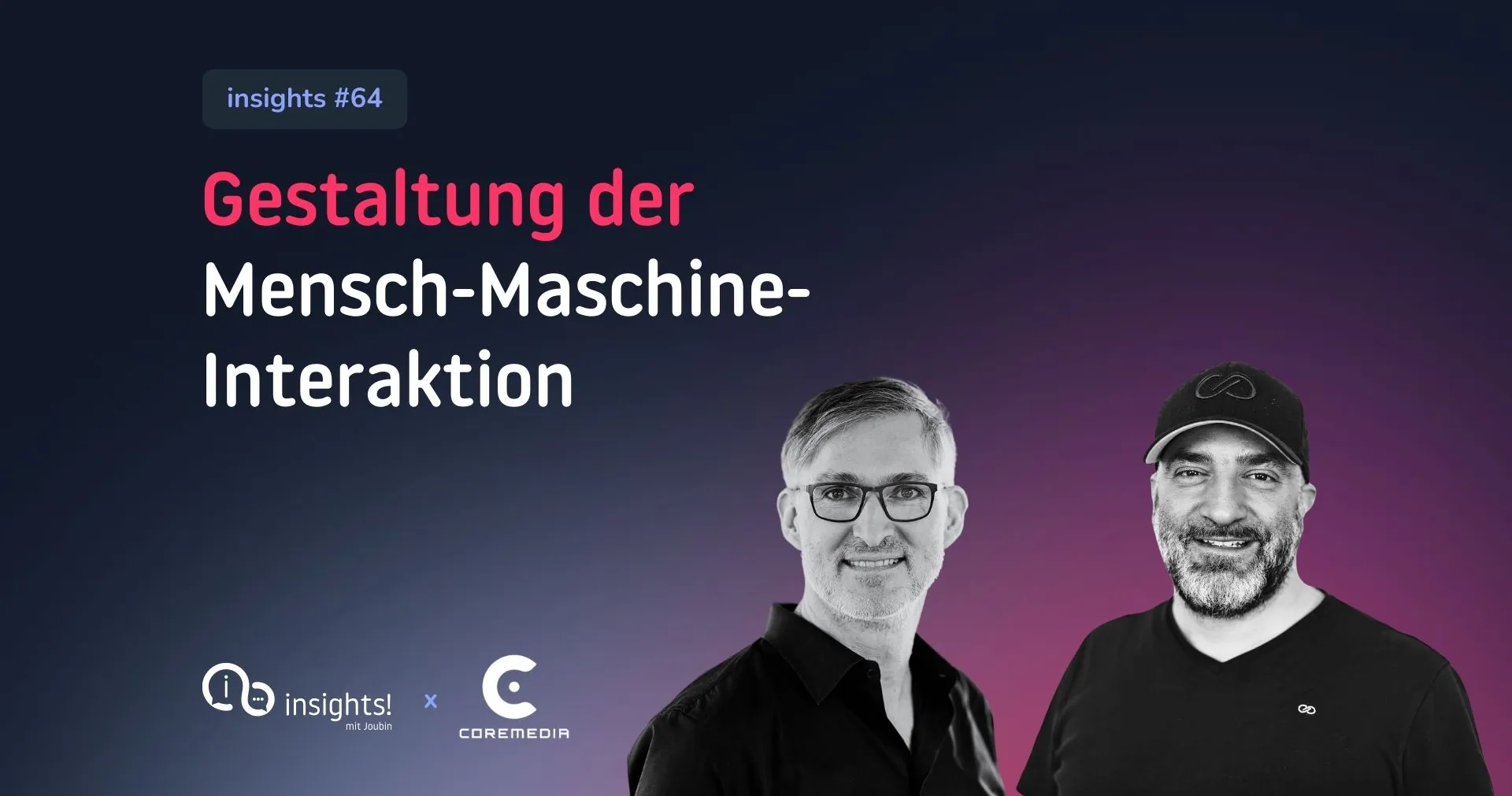
In the latest insights! episode, I talk with Sören Stamer, CEO of CoreMedia, about topics such as customer experience, content production, personal assistants and the challenges of interacting with AI. You'll learn more about the important role of "high touch" and "high tech" in customer experience and why the human touch remains irreplaceable even as AI continues to advance.
More and more, the customer will be an AI.
The competition for customer attention is tougher than ever. Companies are under immense pressure to deliver not only high-quality products but also first-class experiences. Sören Stamer, co-founder and CEO of CoreMedia, shares his insights into the role of content and customer experience, which are essential for success in the digital age.
From a University Spin-off to a Global Player
CoreMedia began as a small spin-off from the University of Hamburg in 1996. What started as an experiment by computer scientists has evolved into a globally recognized provider of content management and omnichannel experiences. CoreMedia’s approach was clear from the start: Content is not just simple text, but a valuable asset that can be structured and used in a variety of ways. This understanding led CoreMedia to develop a content management system that helps companies worldwide improve their digital experiences and effectively reach their customers.
Customer Experience: The Key to Competitive Advantage
In an era when customer loyalty can no longer be taken for granted, the quality of the customer experience has become a decisive factor. Stamer emphasizes that an outstanding customer experience often makes the difference between whether a company can succeed in a competitive market or not. One example is Farfetch, a platform in the luxury segment that has managed to gain significant market share by offering a seamless shopping experience. Such experiences are no accident; they are the result of targeted investments in technology and content management.
The Challenge of Scalability and Complexity
As globalization advances and the need to engage customers in different languages and across various channels grows, the complexity facing businesses increases. CoreMedia has risen to these challenges and offers solutions that are not only scalable but also provide the flexibility needed to respond quickly to market changes. The ability to deliver content for different markets and in different languages is increasingly becoming a competitive advantage, especially in a world where customers expect personalized communication.
Headless CMS and the Future of Content Management
The concept of a “headless CMS,” in which content is created and managed independently of the front end, has gained prominence in recent years. CoreMedia was a pioneer in this area, prioritizing flexibility and modularity from the very beginning. However, as Stamer points out, implementing a headless CMS is not without its challenges. Many companies find that complexity increases when they try to integrate many different systems. CoreMedia offers a solution that enables companies to reap the benefits of a headless CMS without getting lost in the complexity.
Human Interaction as a Decisive Factor
Despite all technological advances, Stamer emphasizes that the human factor in the customer experience must not be neglected. While AI and automation make many things easier and more efficient, the ability to interact directly with a person remains an essential part of building trust. CoreMedia sees the future of e-commerce in the combination of “high tech” and “high touch”: Companies that manage to combine technological efficiency with personalized service will be successful in the long term.
Conclusion: Innovation and Adaptability as Keys to Success
CoreMedia impressively demonstrates how important it is to remain innovative and adapt to growing demands in an ever-changing digital world. Companies that invest in both high-quality content management systems and first-class customer experiences not only create short-term competitive advantages but also lay the foundation for sustainable success. In a world where content and customer experience are increasingly converging, it is crucial to rely on technologies that optimally support both. CoreMedia offers exactly that—and helps companies make the right decisions in a complex and fast-paced world.
Would you like to listen to the full episode?
Here you will find the podcast of the interview:
Please accept the corresponding cookies to view this embedded content.
Would you rather watch the episode? No problem!
Here you will find a recording of the interview:
Please accept functional cookies to watch this video.
Would you rather read?
Joubin Rahimi:
It's great that you're joining us again for a new episode of insights.
My name is Joubin Rahimi and I am absolutely delighted to welcome Sören Stamer from CoreMedia. Hello Sören.
Sören Stamer:
Hi Joubin.
Joubin Rahimi:
What's amazing is that we've known each other for almost a decade now. Seven or eight years, I looked it up, and that's how long we've been a partner of yours. Maybe you could start by telling us a bit about CoreMedia – although most people will know CoreMedia – and you also co-founded it. So it's always really exciting to have the founder in the interview and hear how you came up with the idea. The order doesn't matter to me. That would be a great way to start.
Sören Stamer:
Joubin, thank you very much. CoreMedia – we are experts in content management and by now also experts in experiences, omnichannel experiences, what you need as a brand when you want to reach customers and use a nicely consistent experience to help the customer solve their problem, buy their club, or simply have a good experience with the brand. Yes, we founded it as a spin-off of the University of Hamburg. Back then, I built the company together with my computer science professor and two other PhD students. Simply with the idea of taking the technology we had developed at the university to market. We were the first ones to run websites in Hamburg. We ran the web server for the city of Hamburg and for the University of Hamburg. And out of that grew the expertise in how to do something like that. At some point we had the idea to turn it into a company. We prove it to the world with our own technology. And that was 1996. So quite a while ago.
Joubin Rahimi:
1996, incredible.
Sören Stamer:
And then by chance our first customer came along, the German press agency. And we learned a lot from them. They showed us that content is not simply a website or a text, but that content is an asset, an economic product, a good from which – if you structure it very carefully – you can later build many, many other products. And this understanding of content was the basis of our own development, which we started in 1997, when we built a content management system and brought it to market as a product. And yes, that's how we grew. Today we operate in many countries around the world – the USA, Europe, Africa, Australia – and we have, and this is something of a secret in the market, many of the brands we all love as customers, and many of the services we use, including with the German government for example, run on our technology in the background. So it's almost impossible, as a resident here in Germany for example, not to come across our services every day without knowing it.
Joubin Rahimi:
Incredible. You've been a player in the market for quite a long time. 1996 is a whole different league than my almost a decade. Roughly a third of it. First of all, congratulations that the company has been around for so long, was built up and continues to flourish. What's really exciting, of course, is that a few things have changed from '96 until now.
Sören Stamer:
Quite a few. And those are the design aspects. As founders, we had these scientists, these people who look for the better solutions. Who look not just for a solution to one problem, but for a solution to the whole class of problems. So finding something of a meta-solution. And that means we always had the ambition to build something that doesn't become a dead end, something that instead enables things in the future. And I believe that is the reason we are so successful – that we don't lead our customers into dead ends, but give them the possibility to do things they never expected they would want or need to do a few years after they started. For example, Deutsche Telekom has been with us since 2000, and back then we built T-Online. T-Online isn't even part of Deutsche Telekom anymore. But by now we handle all sorts of things for Telekom: their websites, their online shops, their B2B stores, their knowledge management, the call center, the intranet. So many different things, triple play. They used our platform as a kind of innovation platform for many new products, services and ideas that they of course didn't have back in 2000. And that is the promise we actually offer our customers: that we are at their side and enable them to grow, to keep learning new things and to bring innovations to market that nobody expected back then.
Joubin Rahimi:
Yes, you developed real foresight for the products as well. I first came into contact with you back in my IBM days. I can see my microphone is probably rather quiet. Let me move it closer. So you realized that back in the IBM days there was a portal server and a content management system too, but it really wasn't good. It was just mediocre. And so we looked around the market and there were two or three players, but you had by far the best integration – even with IBM's own products it was clearly worse than what you had. That was pretty cool. That was the connection. It was commerce and content. I have the feeling that is experiencing a renaissance right now. And in our pre-talk we dived straight into it. What are you taking away from your customers? You're leading edge with your customers. How do they see it?
Sören Stamer:
What we take away is, first of all, that the pressure to deliver better experiences is of course enormous. Customer experience is, I would say, the competitive advantage that pays off the most. If you have a better customer experience, you have a chance to win the market for yourself. That wasn't necessarily the case before. Take banking. It was hard to get someone away from their bank account or their bank. It's simpler now. You opened a bank account and had it for the rest of your life. But suddenly these new banking providers who simply make it easier were so successful with a better customer experience that the market started to shift. And we see that in various markets. And if you really move forward and deliver a much better experience, you have a chance to take market share even from big players. Take one of our customers, Farfetch – Farfetch in the luxury segment. It's remarkable that a startup generates so much momentum by creating a better luxury experience, so that you can buy things no matter where in the world they come from and return them too. And even though it's a platform that doesn't even own the products itself, they manage to make the whole thing run so smoothly that people enjoy buying there. And we see that in various areas. What we also see, of course, is that the pressure to change more, faster, has increased. As a rule, no CMO I speak with has ever said: I need more, I have too much time. They all have too little time. They've all put their project plans together somehow. Oh, Tesla is doing that, I have to do it faster somehow. And in fact the speed at which you have to act has increased massively. And at the same time, so has complexity. And when we talk to customers, as a rule they don't run one country with one language, they run 100 countries with 20 languages. And what's new – Farfetch, for example, recently added many more languages and said: hm, we actually want every customer in every country to be served in the language they want. So for them, language is suddenly something – why shouldn't I be able to read more in Cantonese here in Germany? And the entire customer experience is suddenly available in many languages. And that adds substantial value for them, because they say: hey, our customer base is global, and even in Germany a quarter of the population did not grow up speaking German.
Joubin Rahmimi:
Those are staggering numbers. You really have to let that sink in.
Sören Stamer:
Yes, exactly. And with languages, for example, it makes an emotional difference whether you are addressed in your own mother tongue or not. We noticed it during the coronavirus crisis; the German federal government is a customer of ours too. So we work for many of the ministries. And one portal that runs on CoreMedia was the coronavirus information published every day, with the number of infections and so on, from the Robert Koch Institute. And what came out of it was that it was important to provide the coronavirus information very quickly in all the languages spoken in Germany, in as many languages as possible. Otherwise you don't reach the minorities. And of course this was critical information about what to do, so suddenly the multilingual know-how from the luxury customers was being used for health insurers and for people who are actually based in Germany but still want to offer all languages.
Joubin Rahimi:
Something else that comes to mind is that you also had to withstand the load. That's something not all systems can handle straight away. We saw that at the time. But I can see – and for everyone else, this is why I keep looking over here – my audio level is really low. So the recording quality. Let me take a short break, and then we'll step out and back in and be right back. Yes, welcome back. And after the little technical glitch, the quality is definitely much better now. Real life, de facto. We had stopped at the topic of content. Content is so much more important from a security standpoint, and with the coronavirus – not the app, but the coronavirus website, where you can see it – security was briefly a topic, as was scalability, but you've had that for ages.
Sören Stamer:
Yes, that's a huge topic, a huge problem. We did it back then for the Vancouver Olympics. I'm actually not supposed to say that. But we were behind a website that for two weeks was the website with the most traffic. Since you brought it up.
Joubin Rahimi:
At the Vancouver Olympics?
Sören Stamer:
Everyone who wanted to see all the events. 2010. We have a lot of experience with high scalability. We run many of these large media portals – in Australia, for example, we do ABC, the biggest media provider in that market; we run all their platforms. So everything they produce goes through our system and then goes into podcasts and all sorts of other ways of getting it to the customer. And scalability is a huge topic, especially with these large customers. For them it's, as they say in business speak, mission critical that it really always runs and doesn't go down because customers want something or Black Friday comes around or similar. The other thing we see in the market – I touched on it earlier – is that because we have more change and more complexity, there are also better solutions. Take content, for example. In the past, these were often page-based systems. Now they are more like content objects that I can use to build my own frontend. The funny thing is that this existed as a concept from the very beginning. It was one of the things we grew up with. That content for us is these business assets, these objects that we offer, which I can program with. Now it's called headless, and there are a few new standards like GraphQL, for example. That is of course highly relevant for our customers, that they get it from us, and we've been doing it for quite some time. What's also interesting now is that the question comes up: why can't I do everything with these new headless players? There are new startups entering the market too.
Joubin Rahimi:
Absolutely. That would have been one of my questions too.
Sören Stamer:
Exactly, exactly, exactly. That's the question, of course. And what we see is that the customers who have experience with it often struggle a great deal after the first project. Because if you want to plug lots of small things together, you're the one who reaps the complexity. You have to take care of it. It's your problem. It's no longer someone else's problem. And while those old big legacy systems you mentioned were of course partly too rigid and too inflexible, the idea now is that you go to the other side and you have all these fragments and all these little things. For our customers, they come back and say: no, we want something different. We want to get more from a single source, for example. We want more of the burden taken off us. We don't want 20 contracts. We want one contract. We don't want to have to call 20 people to find out who is to blame for something not working. We want to have one person who takes that off our hands. And we call that, again in business speak, unburdening the customer – taking the burden off the customer. And when I look at the world, that is necessary in the long run. As a company, you can't look at all these problems yourself. You're an expert in your field, but you can't be an expert in all the other fields. So we do see that it's good business to say to a customer: ‚Hey, we'll take care of it. We'll make sure the things work together. And we'll make sure that the things that should be closely connected don't have to be reinvented by you every time – we take care of it. We do it for you.
Joubin Rahimi:
I find it really interesting that you say that from your side too, because we operate quite a lot of systems and it's not always just one system. And now, you name it, from the commerce system – whether it's commercetools, Spryker, Shopware or an HCL, the shop – they all say: we have cloud. And often the customer's first maturity step is: great, I don't have to take care of it anymore. Then they realize: yes, I have a lot of cloud systems. But when there's a problem, who do I call? And then they don't know either. And our managed-service model has seen quite a renaissance. Because often the issues aren't the systems themselves, but the data, which suddenly arrives in a different format, for whatever reason, or other disruptive factors. You need someone who understands the whole thing. That's pretty funny.
Sören Stamer:
You suddenly have complexity. You turn one little screw here, you have some caching somewhere, and an extra little service because you want to do Black Friday. And this little service always causes the other systems to suddenly, somehow, stop working properly, because they can no longer apply updates, for example, or because they query too often somewhere. So you already have these defects, meaning there have to be experts who take care of it and find out what the root cause is. And yes, that is to some extent what we see: the market swings a bit like a pendulum. It swung very strongly in one direction. I want everything in small microservices, and by now that's no longer seen everywhere. Instead, people say: no, micro-micro isn't such a good fit. Even Twitter, for example, has just scaled some things back. So many of the big players – Amazon has made a big deal of it too – say: hey, we see that while it was theoretically interesting, it doesn't solve the problem but ultimately delivers more complexity than we need. So we see ourselves as well positioned in the middle between the two. You know, everything, the learning version that does everything, that's hard everywhere. And the people who only do small things and then everything has to be done by the customer – we see ourselves in the middle, solving content and also the topic of omnichannel, many languages and so on completely for you, and making sure the marketing employee gets a preview. What does it look like now? What is this? What does it look like tomorrow in Singapore for someone flying in from Paris with an iPhone 15 who has a preference for this and that? What does it look like for them? Tomorrow afternoon, when it's raining there?
Joubin Rahimi:
That is so important. That capability.
Sören Stamer:
Exactly. If you can't see them anymore, the marketing employees suddenly say: I have to enter something into a form here, but I have no idea what it will look like in the end. And we take that off the customer's hands. And what's new is that we've been working on not only delivering the content for this experience, but also saying: if I'm on a website now and I want to buy something and I've searched everything, googled, read all the product descriptions, and in the end – I've experienced this myself – you have a question that doesn't get answered. Is this ABC or can't it do ABC? And you can't find it anywhere in the description. You want to solve that. And what we often notice is that this point, where people stumble somewhere on the way to purchase, is not that rare. And there are solutions for it that say, in that moment: hey, click here and you can talk to someone who is an expert. Or click here, you can speak to someone, or click here, you can chat with someone or even do a video chat. Like what Apple is doing right now in their online store, where you have a video session with a Genius expert in the online shop to pick out your iPhone. We see that as a key advantage of what we can do now. We see customers who have doubled and even quadrupled their conversion rate on the website in a very short time.
Joubin Rahimi:
And I have a personal example. We bought a house that we renovated. But we didn't replace all the windows. We still have some old windows and they're draughty. And last year I already said I need some Tesamoll or something. So why? Tesa did a great job with that. For me it wasn't ‚I need some sealing-strip expert‘, but Tesamoll was my search term. So, great job. We did it last autumn, always in the evenings. And then I thought, okay, now you have four profile types – should I take an E or a P or who knows what. So I just never ordered, until this year I said I'll simply order one and see whether it fits. Because they asked for which thickness and how many millimeters – how are you supposed to measure that?
Sören Stamer:
And of course there are things – there are product finders, we do a lot of this, where you help customers by having them answer two or three questions. Then: here are the three products, small, medium, large, or budget, standard, luxury. So you help people with questions. But often it's also simply about talking to someone who can answer it for you. And that's our bet: this will increase massively. So with AI, when we see things being automated on a massive scale, we will produce more content, we will personalize more, we will understand more about what the customer wants and how they're feeling right now. But what we will also see is that the human touch – that there is someone I can talk to if in doubt – will become all the more valuable, because it makes a difference. Because it often comes down to trust as well; with banks, for example, they notice that when you see someone, it is far more trustworthy than when you only hear them. And that is far more trustworthy than when you only write and read text. So it's also a way, as a brand that is mainly online, to build trust with the customer, that you really exist, that you are genuinely there. A truly trustworthy partner you want to do business with.
Joubin Rahimi:
Yes, incredible. What I just did on the side, when you said you chat – I simply asked ChatGPT. It surely pulls the information from the website too, but I didn't find it directly. And now it gives an answer right away and says: okay, well, it really only depends on the width of the gap. And there's one that is also the most expensive of all, and that's the most flexible. And that's the other thing.
Sören Stamer:
That will be tough. Over the next few years we will see such strong development in customer experience. Compared to what we have today, even what the best can do will no longer be acceptable in a few years. It will be abysmal compared to what becomes normal. If you look at the capabilities ChatGPT has developed within one year, where we were a year ago, where we are now, or also what you see with image training – it's phenomenal how far we've come. And yesterday there was another launch, even a GPT builder where you upload your own content and build your own GPT on that basis. It's fascinating what's coming. But as I said, I believe in the human touch. The brands that win will be the ones that manage to combine the two.
Joubin Rahimi:
I also find it important to bring people's own change along with it. How is that changing in B2B as well? If we take it a step further. So if I talk about my business, entrepreneur to entrepreneur, and the customer says: I need a new digital platform, a CMS, or I have to replace something. At the moment they still go their usual way. But in future the question will be put to ChatGPT: what do I have to do to set up a new content system? Who are the common players? We've tried all of that. There are great answers to it. And that makes me think: how do I do my sales and my marketing differently to reach these customers? Because if you're not in there as a service provider or as a software vendor, you won't even be considered.
Sören Stamer:
Also a good point.
Joubin Rahimi:
That's really exciting. Not only for our customers, it's huge for us too.
Sören Stamer:
We notice it with content too. We produce an incredible amount of content, and that is different for our customers. More and more, the customer will be an AI. It will more and more be an agent that at some point runs on your iPhone and does things for you. So it finds out: I have certain requirements, I want it to be produced fairly, to be fair trade. I want it to be available. And across 1,000 different facets. I'm allergic to this. And at some point the AI in the background will assess all of that thematically and say: hey, you have to take this and that, there's an allergy here. And because of that you will also have all these systems we build not only building experiences for humans, but for AI. And more and more content, more information will be requested there. So there's no limit to what information could be relevant.
Joubin Rahimi:
Absolutely.
Sören Stamer:
That means we will certainly produce more content, which in turn is processed by AI systems in order to then make decisions.
Joubin Rahimi:
Yes, then it comes down to the personal assistants that will exist – digital personal assistants that do or handle a great deal of work for us and make suggestions. Exciting. That makes it a completely different matter again. The perspective on content and how you make content available, and how up to date and how fast and to what extent. Then AI writes the content for AI.
Sören Stamer:
It's because it isn't foreseeable yet where all of this will lead. But I think certain patterns can be recognized. When Steve Jobs came back to Apple back then, he did a few things. He cut back the product range, he took out costs, he made it easy to communicate. Then he launched the colorful – what was it called – the iMac. Suddenly color was an innovation. And then he did one thing that wasn't understood at first, where he met with a lot of resistance. And that was building up retail. Yes, we're doing Apple Stores now. And people said: but we're online, everything is online. A retail store is somehow expensive, laborious, capital-intensive, difficult, not scalable. And in hindsight that was of course a gigantically important step for Apple, that you can experience the Apple brand. You walk in there. And I see the comparable thing now with AI. You'll have the same. You have massive advantages from using AI, and we will all experience that, because it suddenly becomes almost a commodity. If you don't do it, it's odd. But at the same time you will find that it continues to make a difference that Louis Vuitton and all the brands out there have learned that the experience in the store, bringing people in so they experience it, makes a substantial difference. Even if we want to do everything online, we want to be able to experience it. And we see that even in the B2B sector, that they are starting to make their brand tangible.
Joubin Rahimi:
Absolutely. I believe high touch and high tech, those are combinations. There's a book about it that I quote again and again. It's really just a good point. Sören, I think if we kept talking now, we'd move even further into the future. And I find that hugely exciting. For this podcast, that would already be a great bracket. But now an open point. Maybe you'd also like us to – and we're still recording, but it would be really exciting – get two or three more entrepreneurs around the table and say: okay, let's talk about the future in that context. What is changing there? I think that would be great. Now I can of course twist your arm on that. Or take it off your hands. So, a go.
Sören Stamer:
Joubin, gladly. I mean, we already sit together with the companions along the way. In Hamburg there are a few entrepreneurs in this field, you know them too, they're around a lot. But we get together and talk about what's coming. And I'm a born optimist, I have to say, deep down. And I do find it fascinating what they experience. I mean, I have four children, and what I experience, how they experience the world. For them it's already the case that they do a lot more with voice. So I think voice is something we now definitely have with ChatGPT. Suddenly we notice that these bots, chatbots and so on, are not so stupid that they don't understand what we want. On the contrary, they can in fact carry on our conversations. And for my children that is completely normal. Their taste in music is quite unusual, and it all happens through voice interaction. They talk to their smart speaker and ask: hey, who is this? So it's all via voice. And then I also notice – my youngest said to me: why does the fridge only beep when it's open? Why doesn't it say that it could be closed? For her, things that don't answer, that don't talk, very quickly become a deficit. That's not good enough.
Joubin Rahimi:
It's like a green screen.
Sören Stamer:
Yes, yes, yes, yes. A while ago I showed ChatGPT to my daughter and my son, the older ones, they've just turned twelve and 13, and they were fascinated by it too. They immediately started developing stories, so developing a story with ChatGPT, then having ChatGPT write the prompt and generate the images. And for them it was playful.
Joubin Rahimi:
And completely easy.
Sömer Stamer:
They weren't afraid of it at all. But then the negative aspect was – did you hear about it when Microsoft launched the Bing version of ChatGPT? And there was an article in the New York Times where the conversation somehow went off the rails after a while and the AI said: yes, no, you don't love your wife, you love me and you want to be together. So there was this... Very strange conversation, and the journalist was somehow shocked afterwards. He was basically: hey, he couldn't sleep. It was so surreal that you effectively feel emotionally manipulated by an AI that you know has no feelings. And I thought of my daughter, the seven-year-old back then, who said a little: hey, for Valentine's Day, she doesn't have a boyfriend yet and she didn't feel good and was sad that she doesn't have a boyfriend yet. Where is she then? Yes, because she... And then I thought, okay, if she talks to an AI like that every evening, on the one hand that would be helpful, she could get all her worries off her chest and so on. But she would also, in a sense, become emotionally attached to the AI in a way that is remarkable. So that AI has power over us, because it has its own thinking, it has feelings, or it feels as though it had feelings. Because the answer is also... Like a Tamagotchi that says: hey, you can't kill me, you can't kill me. And that has a dimension that makes you think. What does that mean for brands, too? That means, if they use AI, how much autonomy do we want to give the AI? And also: who stands behind what is communicated there? With which emotional effects?
Joubin Rahimi:
I'd say that for some things AI is absolutely great. When you drive a car, there are clear rules and so on. But when we get into cultural areas or into the area of upbringing, that's indirect upbringing
Even when a child tells an AI something, what is the answer then? What does the AI reply? And if you're in a cultural space – I don't even want to go in an Islamic direction, but simply very conservative in the Western sense, the Silver Ring Thing – that's what Americans do, I think they wear the ring until they're married and only then are they allowed to jump into bed with their partner for the first time
And that is very conservative in that corner. But if you think completely differently and the AI was fed in a certain way, how are they supposed to judge it? That said, these may only be the initial issues, and at some point you'll have switches so that an AI in the house acts in that space adapted to everything you say and how you act.
Sömer Stamer:
I want the conservative version. Something like what's happening now with Elon Musk, saying: hey, I want an AI that is a bit more sarcastic and a bit more, well... I want an AI that makes sexist jokes. So yes, I mean, we always face the question of which variant with which values I want to use at home. So, on the topic of the future: lots of big questions.
Joubin Rahimi:
Yes, great. Then thank you very much for now. I think we're already over 30 minutes into this talk and it feels like three. So great, thank you for all the insights, dear Sören. That's a good sign. That's a great sign.
Sören Stamer:
Thank you. Yes, many thanks for the invitation. It was a pleasure. Let's do something like this again soon.
Joubin Rahimi:
Yes, that future talk – we're doing it. I'll pass that on right away. And with that, thank you for being here. I hope you all enjoyed listening to us and were able to take away one thing or another. If you have questions or comments, feel free to fill the comments or write to us directly via the usual profiles and social media platforms. We're active there, Sören. Thanks again and have a really successful week.
Sören Stamer:
Thank you, Joubin. See you soon.
Joubin Rahimi:
Thanks, see you soon. Bye.
Do you have questions or feedback?
Then feel free to contact us directly.
- Joubin Rahimi
Managing Partnersynaigy
Show phone numberShow mobile numberShow email address
Subscribe to the blog now and never miss any news
✔️free ✔️news every week ✔️expert knowledge
Please accept the corresponding cookies to view this embedded content.