



#157 - Hamburg Hochbahn vs. Google Maps: why public transport is suddenly taking on tech giants
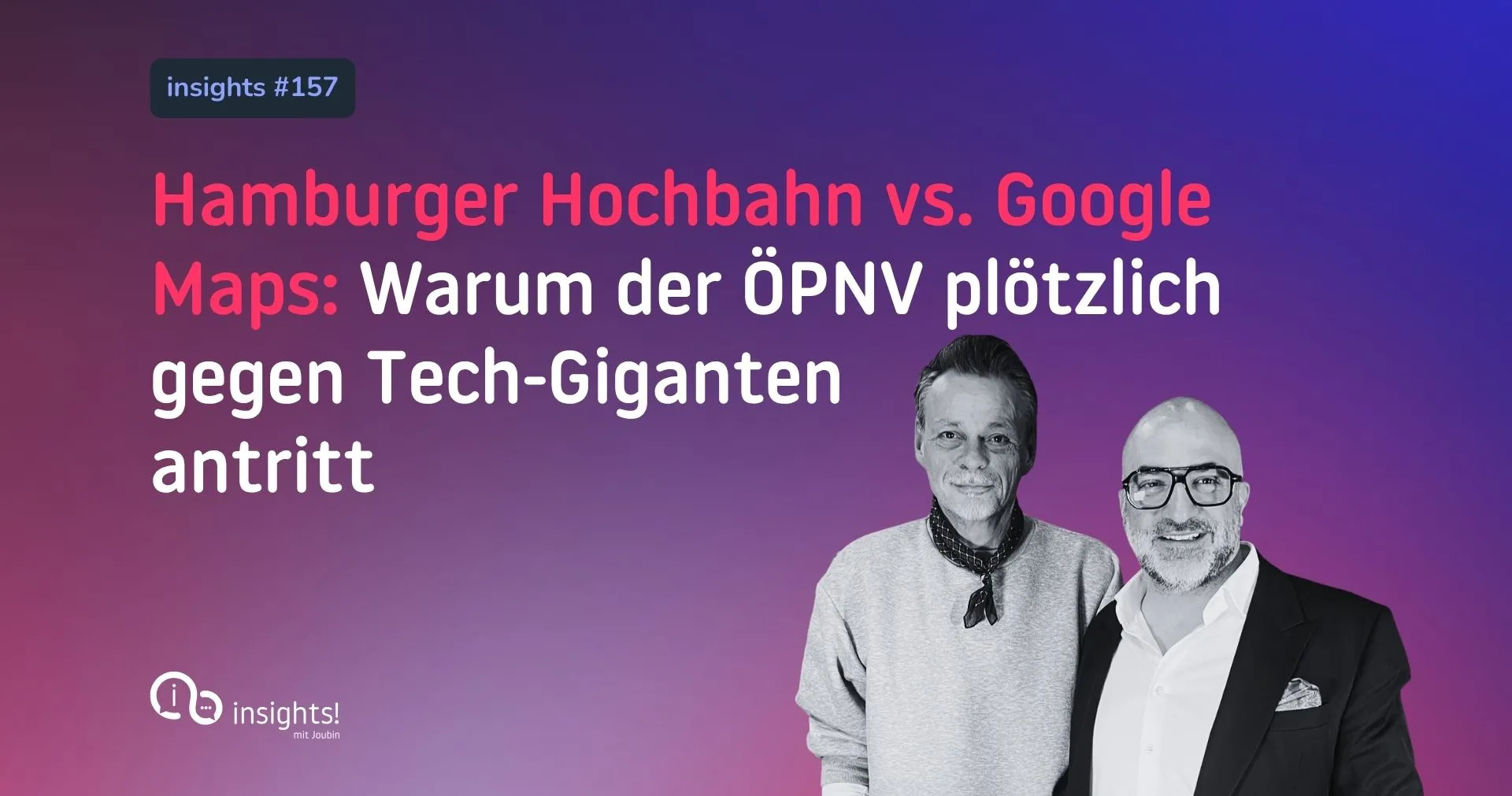
At OMR, Joubin Rahimi meets Marcus Schulz from Hamburger Hochbahn for an honest conversation about the reality of the HVV Switch mobility platform. It's about the real competition in the public transport market, which isn't Deutsche Bahn but Google Maps. And it's about Germany's first autonomously driving underground train, which is currently being built in Hamburg.
 Joubin RahimiManaging Partner · synaigy
7 min read
This is a nationwide issue in Germany, when it comes to digitalisation, we lag far behind. And I believe the willingness to digitalise, i.e. really the readiness to try it out, isn't simply there in everyone. We notice from examples like this that the willingness to digitalise is there for many people on one hand, but the inhibition threshold for using such services is still very high.
Mobility-as-a-service in Hamburg: why Switch is different from the rest
If you're looking for a truly integrated mobility platform in German public transport, you can't get past Hamburg. Berlin has Jelbi, which is built on Trafi. Munich has MVG GO, Leipzig and Dresden use similar white-label systems. Only Hamburg decided to build the platform itself. HVV Switch has been live since June 2022 and integrates public transport, car sharing, e-scooters, Moia, and soon Stadtrad and Voy e-bikes too. Everything via one account, everything deeply integrated.
This decision was strategic and bold. White-label solutions go live quickly, but they give you no control over customer experience, data and innovation. Hochbahn recognised this early on and, at the same time, accepted that in-house development takes longer and costs more. It's precisely this longer breath that pays off today, because new mobility partners can be integrated without limitations and the product is developed further iteratively.
Forget public transport: your real competitor is Google
One of the most provocative statements from the conversation: Hamburger Hochbahn doesn't measure itself against FreeNow, not against Uber, not against other transport operators. It measures itself against Google Maps. And that's a sentence that has never come up in many German mobility strategy meetings.
The reason for that is logical and uncomfortable at the same time. The customer journey of a city dweller doesn't begin in a public transport app. It begins in Google Maps. You type in your destination, you see the comparison between car, bike, public transport and walking, you click straight through. Any mobility provider who only enters the customer journey once the user is already in their app misses the decisive moment. The conversation makes clear that this insight hasn't landed everywhere yet – which is exactly why it's so valuable.
Dead despite great features: what HVV Any reveals about German digitalisation
HVV Any was one of those products strategists dream of. You board the bus or underground, the app checks you in automatically. You get off, the app checks you out. At the end of the day, you're automatically charged the best price. No studying tariffs, no wrong purchase, no complexity. In Oslo, Stockholm and many other cities, that's a given.
In Hamburg, HVV Any was discontinued because, despite two major campaigns and massive communication, it simply wasn't used. And now comes the twist: after it was switched off, complaints suddenly came in. Why did you discontinue that, it was great. This exact loop is symptomatic of the state of digital adoption in Germany.
What you as a digital decision-maker can take from this:
Adoption isn't the same as enthusiasm. People might love a feature in surveys and still not use it.
Communication effort alone doesn't create behaviour change. You need friction reduction and triggers.
Killing a product is a valid strategic option. It frees up resources for what actually works.
Only after switching off does it often become clear who was really engaged. Use this insight for future product decisions.
Autonomous underground and shuttles: Hamburg builds the public transport of the next decade
The U5 will be the first truly autonomous underground line in Hamburg, with glass walls on the platforms like in Dubai or Tokyo. Autonomous trains mean shorter intervals, because the trains communicate with one another and distances are automatically adjusted. The glass walls provide more safety and faster train dispatch. This isn't science fiction, it's concrete engineering currently being implemented in Hamburg.
In parallel, Hochbahn is testing autonomous shuttles with OLAIC. These are meant to reactivate routes that are unprofitable under classic driver-operated line service. That's a completely new logic for public transport. Instead of running fixed routes with fixed intervals, traffic can respond dynamically to demand. Moia is also testing autonomous driving, and in a few years the interplay between classic public transport, autonomous shuttles and shared mobility will fundamentally change the city.
Brand doesn't matter, as long as you use it: why this attitude is rare and healthy
In an industry that sometimes invests more energy in its own brand name than in real user value, Marcus Schulz is refreshingly pragmatic. Agencies have spent years trying to make "switchen" a verb in Hamburg's everyday life. His answer: nice, but unimportant. The main thing is that people use the app and get from A to B with ease. That's a stance many brand managers find hard to accept, but it's honest and strategically sound.
The brand emerges through use and trust, not through advertising alone. If your product works in everyday life and solves problems, you get a brand loyalty that's superior to any campaign. That's what Marcus Schulz took from his 18 years in digital agencies and translated into the corporate reality of Hochbahn. The mix of creative advertising background and strategic clarity is exactly what many German corporations need in their marketing departments today.
Cash, Apple Pay and the German digital soul
A small but very telling detail from the conversation: in Madrid you can simply hold your credit card up to a rather outdated underground ticket machine and it works smoothly. In Germany we're debating whether a ticket machine should support Apple Pay. Hochbahn has installed modern machines that look like a giant iPhone, but they're not available everywhere and cash remains a key payment method.
This discrepancy between what's technically possible and what's culturally accepted is a core theme of German digitalisation. Hochbahn does its homework on the tech side, but adoption doesn't just depend on technology. It depends on habit, trust and generational questions. Marcus Schulz himself says he's in his late 50s and does everything on his smartphone, even banking. But he also knows he mustn't assume others are like him. That's a humility often missing in the digital sector.
Conclusion: lesson in honest mobility strategy
This conversation is a rare mix of concrete insights, strategic clarity and the willingness to voice uncomfortable truths too. Marcus Schulz names where German public transport digitalisation is falling short, and at the same time shows how Hamburg's Hochbahn is tackling these topics. If you work in mobility, customer experience or digital platforms, these are the key takeaways you should keep:
Measure yourself against the best customer experience providers, not your industry competitors.
Accept that products are allowed to die, even if they're technically impressive.
Invest in a genuine customer journey instead of polishing your brand name.
Plan for the long term: autonomy isn't hype, it's a concrete infrastructure decision.
Adoption is the true discipline of digitalisation.
Hamburg isn't an outlier here, it's a benchmark. If you hold responsibility in a German mobility company or a traditional group, it's worth looking north. Hamburger Hochbahn shows how a company with over 100 years of history can think and deliver digitally without getting lost in marketing platitudes.
Would you like to listen to the full episode?
Find the podcast of the interview here:
Please accept the corresponding cookies to view this embedded content.
Prefer to watch the episode? No problem!
You'll find a recording of the interview here:
Please accept functional cookies to watch this video.
Prefer to read?
Joubin Rahimi
Brilliant to have you back for a new episode of insights! My name is Joubin Rahimi. Today at the VTEX stand at OMR. Day one, last session with Markus Schulz from Hamburger Hochbahn. Hello Markus.
Marcus Schulz
Hello.
Joubin Rahimi
And before you say 2, 3 sentences about yourself, or more, I wanted to put in a good word for Hamburger Hochbahn, because it's not that well known. Hamburger Hochbahn, if you're from Hamburg, is the company that runs the underground and most of the buses. As a Hamburg lad myself, of course it's something close to my heart, because I grew up with it. I still remember the bus, the 112, that I used to take, and the U3, though I don't think it's called U3 any more where it runs now, well, U3 still exists, but I think they run something else on it now. And for a while we got to do a lot of work for Hamburger Hochbahn, and those were really wonderful, emotional years, and I'm really glad, Markus, that you're here today, because we never actually worked together directly in that context. By the time you arrived, we'd more or less moved on, but it has to be said, it's exciting that you're head of digital business models at Hochbahn, coming from an agency background originally.
Marcus Schulz
Right.
Joubin Rahimi
And I'd like to dig into that a bit, because it's really unusual in that context.
Marcus Schulz
Well, first of all thanks for the invitation. I hope your exit had nothing to do with my entrance.
Joubin Rahimi
Can you say more than we can?
Marcus Schulz
No, no.
Joubin Rahimi
I don't think so.
Marcus Schulz
Well, before that I worked in digital agencies for about 18, 19 years. I originally come from the film and television field and at some point in 1998 felt this wasn't getting me anywhere any more, and then actually went into advertising as a copywriter and construction. But exclusively digital. Back then I worked at the usual suspects, Kabelmedia and so on. At some point I moved into consulting, because as a creative I was often sitting in meetings with customers and noticed that consulting was somewhat lacking in strategy. Back then it was also more classic project management. Sometimes things were proposed that you as a creative already knew would be tricky. Not impossible, but, and then I moved into consulting to bring in that creative, conceptual perspective as well. And then in October 2017 I moved to Hochbahn.
Joubin Rahimi
And Hamburger Hochbahn had, that was a new role back then, I know, Switch was set up, I'd say, 2, 3 years earlier. Wow, that's a long time ago, well, over 10 years ago. And we were involved back then too. But Switch is something that in Hamburg – is that unique? I don't even know if that's the case in other cities too. I don't know it from NRW.
Marcus Schulz
So when I started at Hochbahn, it was still a subscription card model, very classic. You basically had a credit balance you'd acquired through a subscription, and could then use it exclusively with the card. And then, with the first switch points, unload or park the cars.
Joubin Rahimi
And bicycles were part of it too, I think, weren't they? Or did they come later?
Marcus Schulz
No, we've never had bicycles, those are only coming next time round. And well, at some point, this was also before my time, came the idea of digitalising this sharing model with public transport. Because through this digital platform you can integrate more and more business partners or mobility partners, and nowadays access to many things happens digitally too. And I was involved from the start, but more from a marketing perspective. So I built the whole brand with a design agency, Karl Anders from Hamburg. And that's where we started developing brand history, a communication strategy. Then we launched in June 2022.
Joubin Rahimi
Why was that so important for Hochbahn? Because it's rather untypical, HVV is well known, after all Hochbahn already plays quite a prominent role here.
Marcus Schulz
So the Hochbahn, many Hamburgers don't often know this, many people who aren't from Hamburg.
Joubin Rahimi
Which in turn is unlikely.
Marcus Schulz
Yes, Hochbahn is the largest company in the Hamburg transport association, and also handles the largest share of sales for the Hamburg transport association. And the HVV app as well as HVV Switch are developed by Hochbahn. So the transport association essentially manages and organises mobility. We're the operators. And it was important to us to develop a platform that looks beyond the normal public transport horizon. Because on the one hand certain gaps in the transport system can be closed better through sharing services, of course depending on the business area, or for example the last mile can be closed through e-scooters or e-bikes. And public transport isn't just rail, underground, bus and ferry anymore, but you have to understand mobility holistically. And for us, sharing is part of that. That's why we said we need a platform where everything can be used in a deeply integrated way through one account.
Joubin Rahimi
And that's the movement, the mobility. When I look at that, digital signage, is that also part of what you do, or do you outsource that?
Marcus Schulz
I briefly had— digital signage, what do you understand by that?
Joubin Rahimi
In the end, is the advertising completely in the relevant stops, or do you have it entirely via tax? There are displays in the underground trains themselves too.
Marcus Schulz
So it's a bit of a mix. Within the vehicles themselves, that's our own advertising allocation; around the stops it's more of a mix. So we have our own advertising allocation that we draw on under a fixed agreement, and the rest goes to classic advertising or other advertising partners. To come back to the other question, in Berlin, for example, there's Gaby, which is a similar platform, in Munich there's MVG GO, which is also a similar platform, and in Leipzig or Dresden I believe there's one too. Although we're the only platform that was developed in-house. Berlin built on Trafi, and Munich, Dresden and Leipzig are on the white-label system too. We developed our platform, the technical platform, entirely ourselves.
Joubin Rahimi
And early on too, right? I think we were ahead of the curve there. What other business models do you see in this space? Or are you mainly, is it Switch, or, well I always say Switch, I'm not even sure if that's still correct.
Marcus Schulz
Main thing is switch, but most say switch.
Joubin Rahimi
That's end-to-end chain, door to door delivery. Is that only area where you're actively thinking digital business models right now? Just working out where I'm drilling into with these questions, hence asking at this level.
Marcus Schulz
I always found the term digital business models very misleading, because with the app we're essentially the access point to mobility in Hamburg. The business model behind it is of course that you can sell tickets, that sharing bookings are made. That's the monetary business model. The actual model behind it is that we reduce private car use. So we're not against the private car, but we offer people the option of largely doing without their own car. Digital business models – there are of course other systems too. We have brand new ticket machines that look like a giant iPhone, touch display, where you can pay not just by card but also by phone.
Joubin Rahimi
Respond noticeably faster too, right?
Marcus Schulz
Yes, the year before last, I think, we also abolished ticket sales on the buses, to bring people increasingly into these digital sales channels, and because selling tickets on the buses simply costs time.
Joubin Rahimi
Sure, and you have a much faster cycle too in some ways, right?
Marcus Schulz
So we, we'd already decided on Hamburg-Takt with city of Hamburg before Corona. Kept expanding business during Corona too, so we didn't restrict or reduce services, we kept expanding them. Right now it's bit harder, but we're actually working on further expanding offering and we're really trying to shorten frequency.
Joubin Rahimi
For all non-Hamburg folks: what is the Hamburg-Takt?
Marcus Schulz
The Hamburg-Takt was originally the idea that you can access a transport option of your choice within 5 minutes. Whether that's a bus, an underground, a suburban train, or also an e-scooter, car-sharing or a city bike. We're integrating city bikes now this summer. In autumn the e-bikes from Voy will also be added, so that wherever you are, within a few minutes you really have an option you can use immediately, without having to run somewhere and check the timetable to see what's coming next - instead you look in the app, that's my surroundings, I can go there right away, I'll use that.
Joubin Rahimi
And how does Moia fit in there? Moia is Volkswagen, I think, isn't it?
Marcus Schulz
Moia is from Volkswagen; Moia was the first mobility partner we had in the app.
Joubin Rahimi
Really great buses by the way, my kids absolutely love the buses.
Marcus Schulz
Really great design, really very, very well done. And Moia is very closely linked with the city of Hamburg, it was also a condition that Moia allows deep integration with us in order to get into Hamburg, and you can book Moia through us, now with a lot of comfort features, and Moia is now allowed to use most of the HVV stops.
Joubin Rahimi
Okay, that's super valuable too, of course, because otherwise you're always looking for where the virtual stop actually is, right? Was a change in the law necessary?
Marcus Schulz
To be honest, I don't know.
Joubin Rahimi
But I once asked myself that question. Why don't they stop there, but 300 metres further on, and then, well, maybe because then it's not a bus stop, and, well, it really has to be a point where you don't obstruct traffic.
Marcus Schulz
Regarding the stops, I don't mean that a change in law was needed for that, but I don't know.
Joubin Rahimi
Now we have an Uber — let's look at Uber, also mobility- but delivering with a different twist now, with Uber Eats and so on. How do you perceive Uber simply in an urban setting? You also offer end-to-end, and many say „I went by Uber“, but nobody says „I went by Switch“, do they? Or is that changing, and I'm just too rarely in Hamburg.
Marcus Schulz
So when people travel with us, they either say I came by public transport, or I borrowed a Miles, or I took an e-scooter.
Joubin Rahimi
I gave myself miles. Sorry? I gave myself miles.
Marcus Schulz
Yes, and nobody says either, I'm travelling with the HVV, I came by underground. As a brand, it's not that important to us that we're constantly mentioned by name. We had so many creative proposals from agencies on how to bring Switchen into the everyday vocabulary of Hamburg residents. I always said, folks, what's the point? People should just use us. What they call us isn't entirely irrelevant to me, but the main thing is that they use us.
Joubin Rahimi
Do you, or do you also cooperate with Uber, or is that more—
Marcus Schulz
Not yet, anyway. To answer your question, I'd also say I don't notice Uber in Hamburg at all.
Joubin Rahimi
Free Now?
Marcus Schulz
FreeNow a lot, they're already something of a competitor too, because alongside taxis they also have car sharing and other sharing offers. I use FreeNow myself when I really need a taxi. We do notice them, because we once had a bit of a culture clash with Miles, because Miles had FreeNow advertising on the cars. You can now also book Miles via FreeNow. As I said, we pass all bookings on to you 1:1. Why aren't we on the door? So FreeNow is somewhat of a thorn in our side at times, but if we're honest, we're competing more with services like Google Maps, because they're simply that good. That's really the benchmark you have to measure yourself against.
Joubin Rahimi
And Google Maps is more about how do I get from A to B? And that's not the question. And then, how do I choose my means of transport?
Marcus Schulz
Well, but Google Maps already chooses in the interface, when you enter a route, it tells you how long by car, how long on foot and by bike or public transport. That's already a good service, and Google Maps is very accurate in route planning. We can't quite do that 100% yet, because we sometimes have, well not data problems exactly, but the data quality isn't always available in real time. But Google Maps is certainly a service you have to keep in mind when orienting yourself anywhere. And if you're setting a benchmark somewhere, it's certainly set by Google Maps.
Joubin Rahimi
Well, I would never have guessed you'd say Google Maps is basically a market competitor, but it is, because the customer journey is different, right? You open Google Maps and see what you're doing, and you don't switch, and Switch shows you what you could do.
Marcus Schulz
That's the crucial point. The customer journey starts the moment I think, no idea, I still need to go to football later, I checked earlier, right, because to get to the meeting point at the pitch, at the club pitch, Zu Lange, how do I get there? Our journey planner is currently still public transport only. Google Maps tells you, you can take this route, take that route, take another route. And if in doubt, you can even book the service via Google Maps. And that's the approach, giving people suggestions. What's the better option?
Joubin Rahimi
And that exactly where you are. And that's next click too, everyone know from themselves. You don't switch. Looking into future now, Hamburger Hochbahn do lot for mobility, for more liveable cities. Can say too, fewer cars really in city centre core, nicer it be to linger there. You want get there simple, but cars bother you again. You allowed drive, but drive there yourself, then somehow not anymore. But what you think, what still change? You surely have 2040 plan or 2050, guess. But what you think, come in near future? And maybe Hamburg City role model in all this?
Marcus Schulz
So I hope what will definitely come is an extension of the U4, we're building the U5 new. On the one hand, that's of course a big burden for the city, because we're opening many construction sites. On the other hand, this way we're connecting, I believe, again, I don't want to give a wrong figure now, but roughly around 100,000 people really better to public transport. We're shortening connections, that's one thing.
Joubin Rahimi
Let me put in a word for something here. Hold that thought, but you build quite a lot, don't you? And there are the Elbe bridges down there, where Deutsche Bahn built a bridge, and Hamburger Hochbahn built a bridge. And we did this tourist bus tour with an amphibious vehicle, and the guide told us, well, take a look at the bridges. And you know what, yes, two bridges, they look the same. Well, one was twice as expensive as the other, and the one that was much cheaper was finished much faster. That was Hochbahn, the other was Deutsche Bahn. At that point I was really pleased I got to be part of things with you for a while. But I found it really striking that both were commissioned, both got something, yet how different it can turn out.
Marcus Schulz
Well we are, well I'm not denying Deutsche Bahn construction expertise there, I can't judge that.
Joubin Rahimi
Could have other reasons, but that would be for starters—
Marcus Schulz
I can only say for Hochbahn, we're very experienced when it comes to construction, you know. We've been building since 2011, so since I joined Hochbahn, so to speak, and we're really experienced in construction. We're also genuinely developing further in how we build, we've now developed sustainable concrete material for swamp construction. We're already a very, very strong, reliable partner when it comes to that. U5, that will be the new underground generation, that will be the first genuinely autonomous underground train in Hamburg, which will also enable an even better service frequency. We'll have other, more modern platforms, offering greater safety.
Joubin Rahimi
Why does autonomous driving— does autonomous driving allow a higher cycle rate?
Marcus Schulz
Train dispatch becomes faster and simpler. And because the platforms also have these glass walls, where you're right at the doors, the glass wall opens and you can board and alight, you get a much better, faster flow of passengers. Boarding and alighting become simpler, train dispatch becomes simpler, and the trains are connected to one another in such a way that they run one after another at shorter intervals. A gap is always automatically evened out, and the trains can run and be dispatched one after another much faster.
Joubin Rahimi
Because people then don't have to do that as such, but the trains communicate with one another and say, I always need 500 metres distance or something. And then the sliding doors like in Dubai or Japan mean that, you said dispatch, but that's simply the letting in and out, so not everyone has to somehow find their way only once the train has stopped, but the wording is clear. Okay, understood.
Marcus Schulz
And something that's naturally a major project for us is autonomous driving in general. We ran our first test with Fleet years ago in HafenCity. We're now doing this with OLAIC. This will keep us busy for a few more years yet. But autonomous driving, i.e. autonomous bus shuttles that don't just run simple scheduled routes but also operate on demand, are certainly well suited to bringing back routes that were previously unprofitable.
Joubin Rahimi
So essentially Moia autonomous and then the switch to routes, so then also plus additional route buses.
Marcus Schulz
Moia is also testing autonomous driving in parallel with us. So autonomously driving shuttles, that's a topic. I mean, we can learn so much from so many other countries. We can see that other countries are already much further along. We still have homework to do there, but this is a really, really big topic for us.
Joubin Rahimi
Then I have another question about the payment model, namely, I came here a few years ago too, before that, from 6 years, I'd guess, 6, 7 years I was in Norway, in Oslo, arrived at the airport, then took the train, and then, how do I get to the ticket? Swipe the card, swiped the card, door, gate opened, got on the train, when leaving swiped the card again, and the same card. He then gave me the tip, right, where's the receipt? Yes, online, and I thought that was totally fascinating. Don't know how it is right now, because I've become a scooter rider. Are you heading in that direction too, or is that too complex because you say too much traffic? And Oslo has less traffic, so that's fine there.
Marcus Schulz
Bit tricky, I find. 4 years ago, or 4 years ago we had Switch App HVV Any with us. Meaning app checked you into and out of public transport. Yeah, you walked to stop, said okay, I check in. Stop saw, there's Markus, he's boarding bus, gets off at stop, boards underground, gets off there. Once trip ended, once you got checked out, I got best price calculation. Just didn't get used, even though we ran two big campaigns on it, put lot of communication and lot of effort into making it known. We shut it down last year and, oh wonder, suddenly people: Why'd you shut that down? That was great! Yeah, but benefit was nowhere near effort we put into it. We notice with such examples that digitalisation willingness is there for many people on one hand, but threshold for using such services still very high.
Joubin Rahimi
Or was that too early? Can that be?
Marcus Schulz
Don't think so. Because that's already known on other routes, in other countries. So this is a German issue — when it comes to digitalisation, we're lagging well behind. And it's always so varied. I mean, I'm in my late fifties, I do everything on my smartphone, even my banking. And well, I've worked in digital agencies for 19 years now and have been at Hochbahn in the digital area for 8.5 years. That's why I always think other people must be like me too, but you can't infer from yourself to others. And I think the willingness to digitalise, that readiness to actually try it out, isn't there for everyone.
Joubin Rahimi
Or, well I can say it from Cologne, that exists there too, I think it's called easy. I used it at the start, and I travel very rarely, and I was so unhappy with the UX that now I basically only pay by card at a machine like that. Kids love riding the underground or the tram. But the crazy thing is, in Cologne the ticket machines are a pain in the ass. Very often it just doesn't work, and then they still want cash. No, I don't have cash. And if I do, I've got a note, and how am I supposed to then, I can't put a 50 in. So somehow not thought through. But that's fine here, it's different here.
Marcus Schulz
Yes, as I said. We have the brand new ticket machines, but they're not at every stop, though at many. You can't pay with all digital options there either, including Apple Pay and so on. We also have cash. Germans love their cash, whatever the reason. I was in Madrid for a week at the end of January. Madrid has a great underground. I always take the underground in other cities, because I find that really interesting. The ticket machines were truly like something out of the 80s. But you just held your credit card, a cash card, up to it and it still worked. Interface dreadful, especially for a German, but it still worked well. So I find it extremely varied.
Joubin Rahimi
And a closing question, following on from what you said: you ride a lot of underground in other countries and cities. What was the best experience?
Marcus Schulz
So the best experience, in terms of underground comfort, was still Stockholm. Yes, riding the Stockholm underground is wonderful. The funniest experience was New York. I got on the express train and didn't know it doesn't stop at my station. Honestly, I'd already had a couple of drinks. Got off in Harlem, and that was in the 90s, when Harlem was still like that.
Joubin Rahimi
Did I land that right, the thing, what's different?
Marcus Schulz
And then two police officers came up to me and asked me: right, where do you actually sit? What do you want? Well, this and that. They then very kindly took me back to the underground. And go back now. I found it funny that you, because you don't know this from Europe at all, that you have an underground that doesn't stop at certain stations. If you're travelling as a tourist, you think, why isn't it stopping? Yes, yes, that's hard to understand.
Joubin Rahimi
If questions remain about digital business models or how he monetises it and does UX, just ask questions below on LinkedIn.
Marcus Schulz
My department is now called Digital Marketing. Ah, we changed it based on LinkedIn.
Joubin Rahimi
Okay, were we old-school or did we look in the wrong place?
Marcus Schulz
No, I think they changed that on LinkedIn very, very late. Interesting.
Joubin Rahimi
But everyone now knows what the key topic area is, and I think it's absolutely great for Hamburg. I'm pleased that Hamburg is so modern and forward-thinking in this respect. And perhaps to close, on the bond I mentioned earlier: Hamburg Hochbahn was really something special for a colleague and me. You've also had a huge transition before you arrived, towards much more IT and digitalisation. And there were partners who helped a great deal, and we were photographed together and ended up on the walls. And that made you proud, because it does something to you and you always went that extra mile. Right up to now, I've kept at it, let's meet up sometime. So thank you, Markus, for the time, for the insights. Very welcome, and enjoy the football afterwards.
Marcus Schulz
Wishing you great success at OMR.
Joubin Rahimi
Thanks.
Have questions or feedback?
Then feel free to contact us directly.
- Joubin Rahimi
Managing Partnersynaigy
Show phone numberShow mobile numberShow email address
Subscribe to the blog now and never miss any news
✔️free of charge ✔️weekly news ✔️expert knowledge
Please accept the corresponding cookies to view this embedded content.