



#127 - Cloud comparison 2025: who can, who just claims to? - hyperscaler vs. EU alternative
Cloud long since foundation of modern digital strategies. Applications, data, processes move there, since scaling, speed, availability matter daily. But more providers and services exist, harder the choice, and bigger risk deciding on gut feeling instead facts. If you want keep costs, security, operational effort under control long-term, need structured view on features, certifications, service coverage. Exactly for that a comparison approach built, bringing popular hyperscalers and European providers together on neutral interface. So you see at a glance what's really available and where gaps sit.
 Joubin RahimiManaging Partner · synaigy
4 min read
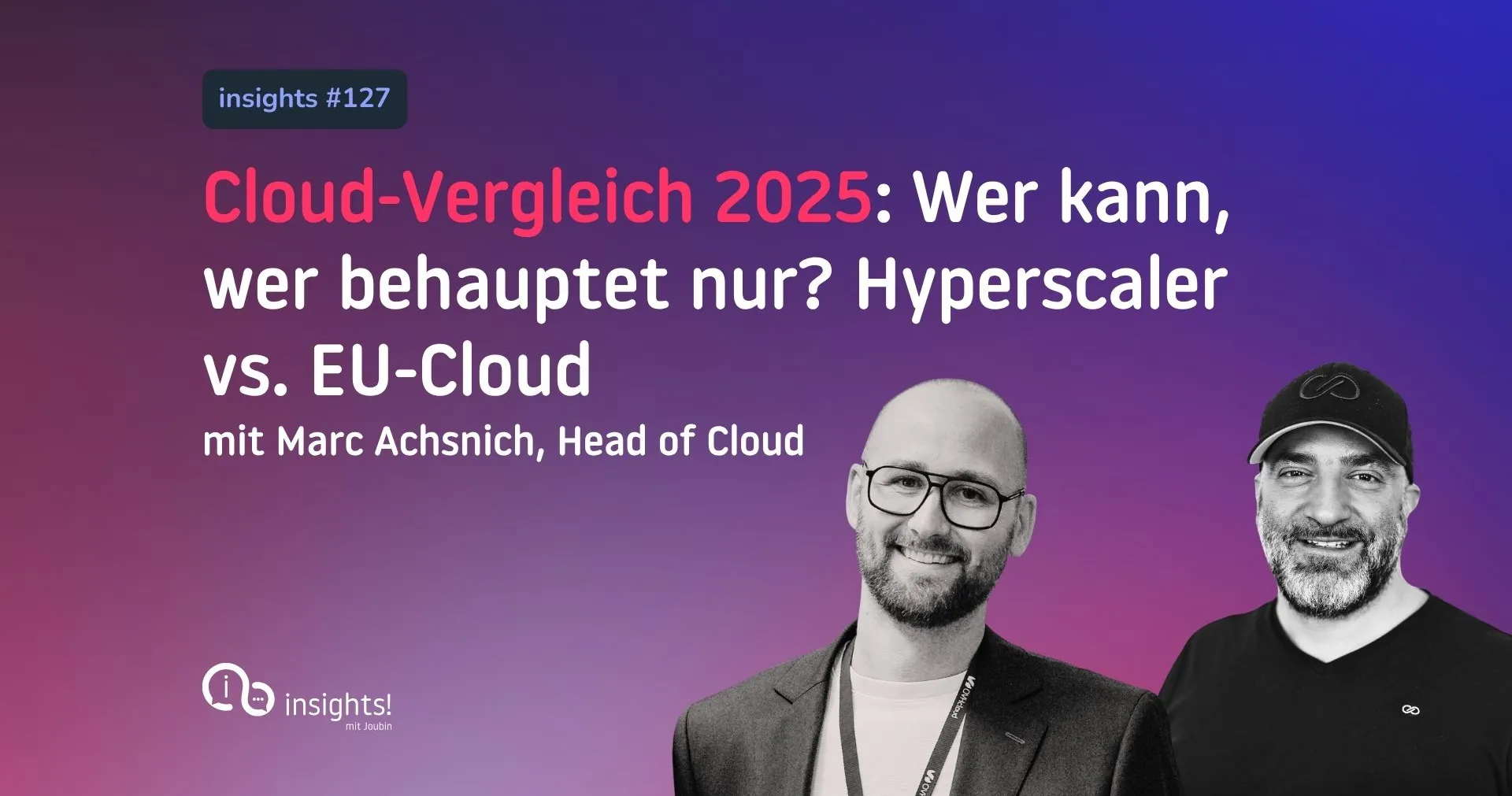
There's no such thing as the wrong cloud. Each has its strengths – what matters is not relying on just one. Diversity ensures everyone moves a little out of their comfort zone, and something better results in the end.
Why you should compare clouds thoroughly
Cloud offerings sound similar but differ in naming, service depth and certification. A “virtual server” isn't called the same everywhere, and identical marketing terms often hide different services behind them. Anyone who doesn't systematically compare here pays for it later, e.g. with migrations, feature gaps or compliance. That's exactly why an objective overview of services per provider pays off. At the same time, portfolios change continuously: new releases, additional certifications, renamed products. A static spreadsheet becomes outdated fast. A maintainable data model behind the comparison interface ensures currency and extensibility are guaranteed, and in future even allows community contributions for change requests and additions.
What really counts in the comparison
Starting point is the sober question: does a service even exist at respective provider and if so, with which basic configuration and certification? In a first development stage, availabilities and standards such as ISO 27001 or SOC 1/2/3 are therefore considered. Deeper quality assessment (e.g. Feature depth in Kubernetes or release cycles) will be added at a later stage. What's important is that you already get objective market transparency about breadth of services today.
For orientation, a service catalogue was built along around twelve categories with roughly 70–80 products. That's enough to recognise patterns: where does a provider cover your core needs, where do you need alternatives, and where is multi-cloud worthwhile? With this basis, you make decisions on solid ground rather than by gut feeling.
Short checklist for your selection process:
Check service availability per category (compute, storage, network, data, AI, security, etc.).
Map certifications to your compliance requirements (e.g. ISO 27001, SOC).
Note terminology differences per provider to avoid misunderstandings in architecture & operations.
Plan depth of evaluation stage (today availability/cert, later feature and release details).
To give you exactly this overview, a publicly accessible website was built that puts services from well-known providers side by side. These include hyperscalers as well as European players such as OVH and STACKIT. Further providers are already in the pipeline. The goal: a clear entry point that shows, without frills, what's possible and what isn't. The platform initially focuses on the question "available or not available?" and incorporates certifications. Thanks to a maintainable data backend, it can be continuously updated; going forward, users will be able to submit change requests and suggestions via a public link. This way the comparison base grows with the market and stays useful rather than nostalgic.
Who it's worth it for
When you make decisions on architecture, procurement or governance, comparing them across several phases helps: from early shortlist creation through to detailed specification of individual workloads. Especially in regulated industries, a quick view of certifications and service breadth is an efficiency booster.
Transparency is also valuable for multi-cloud scenarios. You spot more quickly where redundancy makes sense, where a provider has clear strengths and where you deliberately rely on specialists. This reduces evaluation time and makes decisions easier to follow.
Would you like to listen to the full episode?
Find the podcast of the interview here:
Please accept the corresponding cookies to view this embedded content.
Prefer to watch the episode? No problem!
You'll find a recording of the interview here:
Please accept functional cookies to watch this video.
Prefer to read?
Joubin Rahimi
Great to have you back for a new episode of insights. My name is Joubin Rahmi and joining me today: Marc Achsnich. Hi Marc.
Marc Achsnich
Hi Joubin.
Joubin Rahimi
Marc, you have role within Fellows of TIMETOACT GROUP, but also responsible for Managed Service within synaigy for our customers. Today we talk about something really, really exciting, which came about because we are how we are. And we have many cloud topics. We actually serve almost every cloud floating around out there. And we have lots of emotions and favourites about it, but actually something was missing when you look at cloud. And maybe that's exactly the entry point you can bring in. What did you help build?
Marc Achsnich
Yes, what have I built? As part of our strategy consulting, we regularly exchange ideas, and I thought within the group we simply have individual strong brands that really champion their own cloud. And we simply noticed that there was one thing that essentially didn't yet exist on the market. And that was a simple representation of a comparison, giving you an easy way in to see what's possible and what perhaps isn't.
Joubin Rahimi
About the various cloud systems, right?
Marc Achsnich
Right.
Joubin Rahimi
Which ones are those we currently have?
Marc Achsnich
Currently that's the hyperscalers. We have OVH and STACKIT on board, but already have three more in the pipeline.
Joubin Rahimi
You can see the slight smile on the cheeks.
Marc Achsnich
I find this really exciting, because we started small, deliberately so, in that we ultimately said, time to act. I didn't want to let too much time trickle away in that sense, and simply thought, let's start with what we know and what we're familiar with, because ultimately, we're partners with all the individual brands, and then I engaged with each of them. We had many in-depth conversations, simply to find out, put quite plainly, what's it called now? What's a virtual machine called on Azure? What's it called on AWS? And what's the equivalent on OVH and on STACKIT? And then everyone from the brand simply joined in, and then we built up a service catalogue that's now become fairly comprehensive. It also grew organically and has now ended up on a nicely presented website, which then, I wouldn't say went through the roof, but at any rate caused so much excitement that I'm now in discussions with three further providers to add them to this list too.
Joubin Rahimi
The data keeps changing, or the services keep changing. At what interval is this updated, and how? Maintaining websites can sometimes be a challenge too.
Marc Achsnich
That's right. But we thought that through too. That means it's now grown to the point where there's a data structure behind it that's simply maintainable. In the medium term, the idea is to transfer this into a community model too, so that a public link is then provided through which change requests, wishes, or simply contributions can be made, so that ultimately the community itself can maintain this model.
Joubin Rahimi
Are there already insights you were able to draw from this cloud comparison? Perhaps where the strengths and weaknesses of the individual clouds lie, or other sweet spots?
Marc Achsnich
Definitely, though it's easier to say where the strengths and weaknesses are on the individual service levels in the pricing area, because that's very objectively comparable. That's also where we started. So as things stand now, we've first compared services in terms of quantity. That means we have a selection of, I think, twelve categories with almost, I'd say, 70 to 80 different products that we compare with each other. But at this level, at the moment, we say: is this service there or not, does it have a certification in ISO 27001 or SOC 1, 2, 3. We're not yet going into depth and saying: how well does this Kubernetes run? How many sub-features are available and how many releases are supported. That comes at a further expansion stage. But based on the number of services or where the characteristics currently stand, you can of course still draw conclusions.
Joubin Rahimi
How many criteria are there, how many do you have right now?
Marc Achsnich
We have twelve criteria and 70, 80 services that we compare against each other.
Joubin Rahimi
Tell me, where can I see it?
Marc Achsnich
Comparison. Cloud.
Joubin Rahimi
That's still quite a dream of a name, isn't it?
Marc Achsnich
Yes, I was surprised it was still free.
Joubin Rahimi
Zack, reserved. So, of course I also looked at it, it's really, really great tool, free of charge too, must be said, and quite some time and energy of colleagues and Marc went into it. Check it out, comparison.cloud. And if you're Marc-companion of hyperscalers and others, you've already seen Marc smiling. I believe interest in growing this is there, because ultimately it's about you, about everyone who has to make decision, to see where differences are. Correct. Thanks for initiative, Marc.
Marc Achsnich
Sure.
Joubin Rahimi
That's really time to act like. And if that isn't already an advert for comparaison. Cloud, it's also an advert for us as a company, I'd say, with the freedom to do such great things. Thanks again and thanks for watching. So, cost reduction or costs in general.
Have questions or feedback?
Then feel free to contact us directly.
- Joubin Rahimi
Managing Partnersynaigy
Show phone numberShow mobile numberShow email address

Subscribe to the blog now and never miss any news
✔️free of charge ✔️weekly news ✔️expert knowledge
Please accept the corresponding cookies to view this embedded content.