



#137 - Why Europe is failing at the cloud and how you can do it better in your own company
In this episode I talk with Harald Joos about how you can achieve cloud sovereignty in practice without ending up in black-and-white debates. The focus is on multi-cloud strategies, vendor lock-in risks, standards and interoperability. In this episode Harald shares concrete principles with you on how to reduce dependencies, design smarter tenders and build resilience.
 Joubin RahimiManaging Partner · synaigy
4 min. read
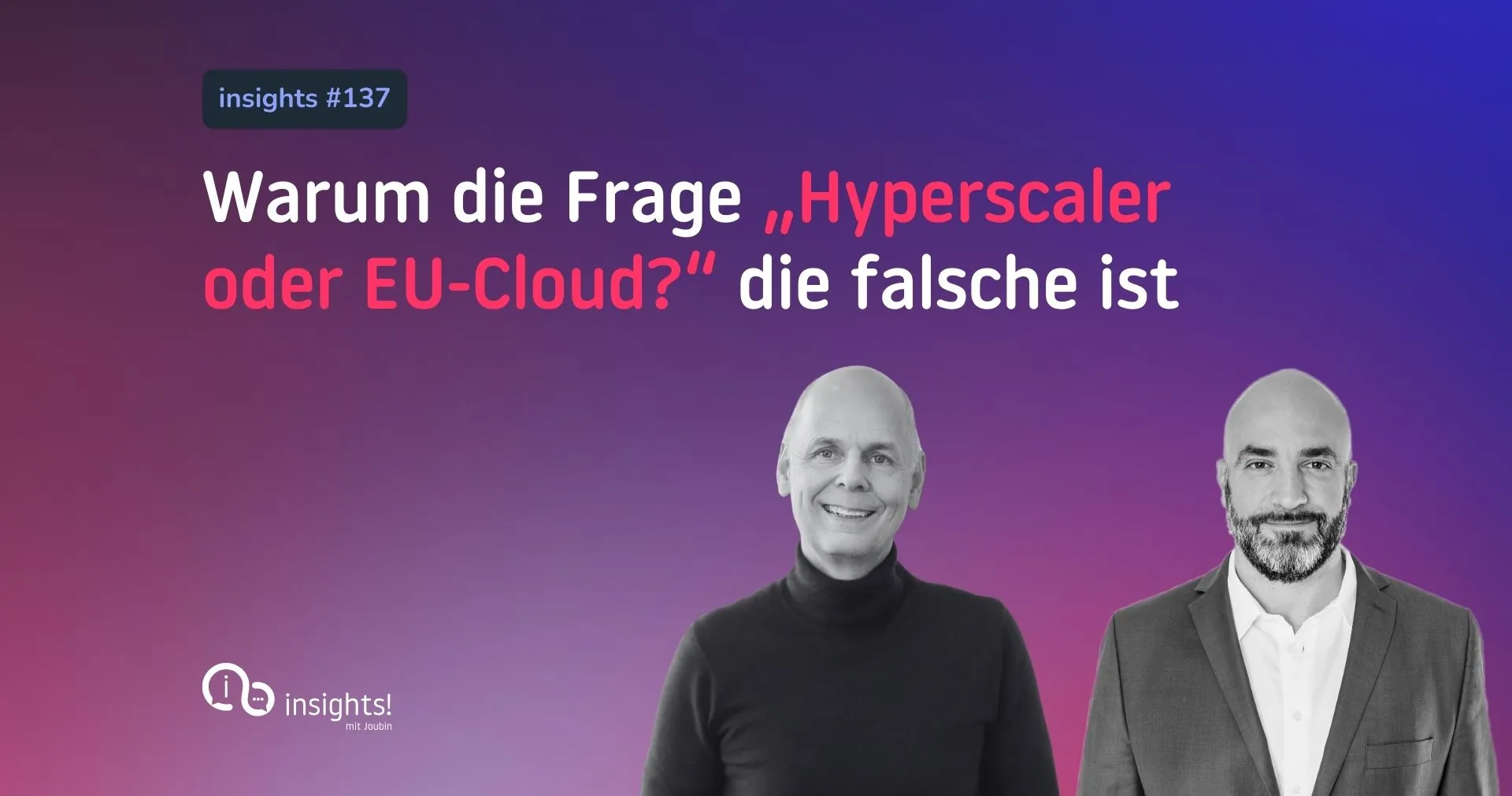
A multi-cloud strategy always has to include at least two clouds, and one of them has to be European.
Cloud sovereignty is not an either-or question
The debate around European cloud providers versus hyperscalers is often polarized unnecessarily. Either Europe-first or full dependence on US providers – at first glance there seems to be little room in between. Yet it is exactly this black-and-white thinking that rarely leads to viable cloud strategies. In practice, this is less about ideology than about freedom of choice. The decisive question is not which cloud you use, but whether you can switch if conditions change. Cloud sovereignty does not come from excluding certain providers, but from architectures that keep alternatives open and deliberately limit dependencies
Freedom of choice comes from architecture, not from declarations of intent
Vendor lock-in is rarely the result of a single decision. It creeps in – through proprietary services, missing portability and architectures that only really work in one environment. Hyperscalers in particular offer technically impressive services that deliver efficiency gains in the short term but create switching costs in the long run.
The decisive lever therefore lies in how applications are built. Business processes and core applications should be designed from the outset to run cloud-agnostically. This doesn't mean sacrificing convenience, but consciously deciding where dependencies are acceptable and where they are not.
A proven principle here is:
Develop your own business applications as close to standards as possible
Use proprietary services only where they deliver real added value
Always plan the exit – technically and organizationally
Multi-cloud does not mean more complexity, it means more negotiating power
Multi-cloud strategies are often perceived as expensive and complicated. Initially they do increase the planning effort. In the long term, however, they create exactly what is missing in many cloud projects: negotiating power and resilience. If you can switch from cloud A to cloud B at any time, you are no longer at a disadvantage in price negotiations. Price adjustments, licensing changes or a provider's strategic realignment lose their sting once a realistic alternative exists. What matters is that at least one European provider is part of the strategy. Multi-cloud is therefore less a technical concept than a strategic one: • protection against outages • protection against massive price increases • strengthening your own ability to act Resilience does not come from redundancy on paper, but from genuine second solutions that can step in when it counts. Two clouds do not necessarily mean double the cost. Implemented correctly, they reduce risks and considerably increase operational reliability. The value of second-source strategies becomes particularly clear for critical functions such as communication, collaboration or data storage. Open source-based SaaS solutions, operated on European clouds, can be a realistic alternative here.
European clouds are not failing because of technology, but because of fragmentation
Performance is no longer the main problem for European cloud providers. Compute, storage and basic platform services are available in sufficient quality. What's missing is genuine collaboration.
Too often providers act as lone fighters, even though interoperability would be the key. Common standards, open interfaces and aligned operating models could create a European cloud ecosystem that is both competitive and sovereign. Initial initiatives show that this is exactly where things are starting to move – especially around open source-based platforms and interoperable SaaS models
Short contract cycles and purely price-driven decisions often stand in the way of sustainable cloud strategies. Data centers, platforms and ecosystems are not built in two years. They need planning certainty and partnership-based collaboration.
Long-term relationships – over periods of ten years, for example – enable investment, standardization and genuine further development. At the same time, sound architectural decisions preserve the flexibility needed to limit dependencies and keep alternatives open.
Would you like to listen to the full episode?
Here you can find the podcast of the interview:
Please accept the corresponding cookies to view this embedded content.
Would you rather watch the episode? No problem!
Here you can find a recording of the interview:
Please accept functional cookies to watch this video.
Would you rather read?
Joubin Rahimi
Fantastic that you are joining us again for a new episode of insights! My name is Joubin, Joubin Rahimi, and joining me today: Harald Joos from Deutsche Rentenversicherung Bund. I hope I got that right, because German pensions are a fairly big topic, dear Harald.
Harald Joos
Yes, you almost got it right, but generally people say Deutsche Rentenversicherung, and Deutsche Rentenversicherung Bund is the largest institution, the one that also coordinates everything and does a lot for the pension insurance system as a whole.
Joubin Rahimi
And as Cloud Officer you are responsible for direction and strategy. Is that right?
Harald Joos
Yes, although I am not involved in day-to-day operations – you could rather say it goes more in the direction of cloud evangelist. And I also appear outside Deutsche Rentenversicherung and try to work very closely and extensively with the entire social insurance system, so accident insurance, health insurance. And a very, very good network has built up there.
Joubin Rahimi
Yes, and I had the pleasure of seeing you at one of these events, and we were on a panel together. The question there was also hyperscaler versus non-hyperscaler, and we were at the event of a non-hyperscaler, and I had assumed you would wave the flag for moving everything to local non-hyperscalers, but you had a very differentiated view on the topic, especially non-European providers versus European providers and the challenges in the market. To put it bluntly, I would have thought you would simply hold up the OVH flag and STACKIT and the like. And you said we have to approach this quite differently. And that showed me even more clearly that the challenge is not only sovereignty, but is very, very multifaceted – which is also what you are facing.
Harald Joos
Yes, in principle it is always about keeping all your options open, having freedom of choice and picking the solution that is best for you. And that depends, among other things, on the classification of the data, it depends on the conditions you have in your organization, because you can do a great deal in your own data center, you can do a great deal with national European providers. And there are still use cases where it makes sense, or where there is no other way, where you have to fall back on the hyperscalers. And that is why I do not like this black-and-white discussion – we have to be able to use everything, but we must not end up in a situation where we all have to use one particular thing. Vendor lock-ins are something we should somehow try to avoid.
Joubin Rahimi
And I am sure you do not have a small footprint at all at Deutsche Rentenversicherung – it is probably quite large. We know AWS pretty well too, and Azure and GCP. They also have many of those great proprietary services, you have to admit. How do you see the risk of lock-in when you say I will just use their services, which are then quite proprietary? Or do people say that is fine, because it is more at the application level anyway? How do you approach points like that?
Harald Joos
Well, that always depends on many things. Let me give two examples. One example outside the pension insurance system. I know an institution there that built its business applications entirely with Microsoft. That means there are 20 years of Microsoft development in there. You cannot get away from that overnight. That takes time, five to ten years until you manage to detach yourself from it. The will is there, but you simply cannot flip the switch. Things look different for us. Sure, the Office products are still widely used internally, but we have few business applications that depend on Microsoft. So I would postulate the following: when we develop business applications, we should develop them so that they run on all clouds. Then we have freedom of choice, and then you can also … And for self-developed business applications, in my view your own data centers and European clouds are a good fit. That is the first choice. There are no dependencies there either. That works well. I can also develop something on AWS without any problem and then operate it on OVH. You can combine things in various ways. You just have to make sure you find the best solution for yourself.
Joubin Rahimi
And the European clouds are gradually changing. Or I always get the feeling that one step forward is taken and then two steps back, because they do not … Well, they do not work together. It is a bit like small principalities, everyone trying to be the hero of Europe, but if people joined forces more – that is my impression as a customer – you could achieve much more in this context.
Harald Joos
Yes, this is being published in the press right now. We have just set up a project funded by the Ministry of Economic Affairs, and we managed to get a SaaS application, open source, that runs everywhere. And then we brought in three cloud providers, three from Germany this time, three big ones. And we want to get interoperability working. We already tried something like that in the cloud test lab together with OVH and IONOS and Plus Server and STACKIT. Our goal is for the European national champions to work together more. Then every country can do its business, and let me take the opportunity right away to define such a national champion. And the big ones have to lead the way. And to throw a number into the room, let us say you would need revenue of around one billion euros, and then you are part of the league of national champions, and they have to work together in Europe. And OVH is part of that, STACKIT is part of that, IONOS is part of that too, and others as well. So you already have a manageable number of players. If they link arms and work closely together, something could come of it.
Joubin Rahimi
And how do you see Telekom in this environment?
Harald Joos
Telekom is also part of it. Telekom, or T-Systems, is of course – given that they are also very big in the network area, and that they have now invested a lot in their AI factory in Munich, 10,000 GPUs with Nvidia. They also have revenue of more than one billion euros. So on our side STACKIT is involved, IONOS is involved, and T-Systems of course as well. And you must not overlook them.
Joubin Rahimi
For me STACKIT is something of a surprise candidate – well, not so much anymore, because they have been active for a while and made their ambition known early on. That is nothing special in itself, but really, as a discounter, to take these steps into this verticalization of all these activities, and that they then want to become the AWS of Europe. I think I read or heard that at some point.
Harald Joos
Yes, I first dealt with STACKIT at the beginning of 2021, when I was at the Ministry of Finance. And what they are doing is simply consistent. If you are big enough, it pays off to build your own cloud. If you have enough customers of your own, and STACKIT does, then it definitely makes sense. You have to operate it anyway, and once you have built it, the idea is obvious – why should you not also offer it to all the companies you work with who are looking for such an infrastructure. So they have a very smart business model. And I am glad that we have someone in Europe who says: All right, I am going to put real money in first so that we become visible. And 11 billion euros for new data centers that have been announced, that is quite something … That is quite a benchmark, that is impressive.
Joubin Rahimi
I think Telekom said one billion, didn't they? Something like that, that they want to invest?
Harald Joos
In terms of magnitude you have to picture it roughly like this: Telekom with its data center in Munich with 10,000 GPUs from Nvidia, I would say roughly one to two billion in that order of magnitude. The AI gigafactories that are supposed to exist in Europe, which Telekom applied for, which IONOS applied for, which STACKIT applied for and several others as well – they cost around 5 billion euros and are then meant to house 100,000 GPUs. That is ten times as much. Those are of course orders of magnitude that are … I find them impressive and I also find them sufficient. It does not always have to be 100 billion euros or whatever, dollars, the way things are thrown around in the US.
Joubin Rahimi
You lose touch with reality a little, in my view, when you look at the US and everything they want to invest or the commitments they make. And on the other hand there is also the question: how are you going to finance it? That carries weight too. Another important point.
Harald Joos
Well, in the US I am skeptical about how long that will hold up. They sell each other their services, rent them, buy them back again and so on. You cannot even tell whether any real business is being done or whether they are simply selling services back and forth. That is why I am a bit skeptical there. What we are of course missing: with Mistral we have a really good provider when it comes to artificial intelligence. I use it from time to time myself. But if you want to generate images or something like that, that is not offered for free. And so an enormous number of people end up with these free offerings, and those are the US offerings. Europe is missing something there – something that offers this to citizens as well, because we could do it, and for that you need computing capacity.
Joubin Rahimi
Yes, and the money … It still costs energy, electricity. Someone who then finances it, your image request.
Harald Joos
Yes, but it would work if we joined forces in Europe and if we worked on these things together. And you do not even have to package everything into one grand company, one corporation or anything like that. It is enough if you really agree on open interfaces and then actually use them. So ORA, or let us say Gaia-X 2.0, 3.0, meaning what has developed out of it – something is slowly emerging there that is being used more and more. I think we have a chance to build a good cloud edge continuum in Europe, where we are sufficiently resilient, very resilient, and have good performance, so that we are not dependent on the Americans. Definitely not.
Joubin Rahimi
Standardization, I think, is a really big topic. We have seen that in history too. Mechanical engineering companies in particular drove the standards forward. That was always an advantage we then had in Europe, that based on those standards we could do more and more. Do you also see – you said a lot is happening. Do you also currently see the will for everyone to really want this? Or? Well, with Gaia-X I have to say that at the very beginning it was all about sovereignty, Europe first. And then, from my point of view – maybe I am wrong, feel free to correct me – it somehow got watered down, so that I no longer have the feeling Gaia-X represents Europe, but that it has actually become a buzzword for the hyperscalers, who now have a stamp of approval. I am putting it really pointedly. But I do not know whether that is accurate. I want to draw you out a little.
Harald Joos
No, I think that does Gaia-X an injustice. I think the vision of Gaia-X is good. Of course you also have to operationalize something like that, and then you have several workstreams, and one workstream should have been that the big European players said: Okay, let us build this. Let us link arms. And sorry, that is where European providers always start working against each other. Competition is good. Market competitors, market companions, all fine. But when people then try to work against each other, that is not good, because in the end the other big players simply win, and those are the Americans.
Joubin Rahimi
Okay, so in the end that was the crux of the matter, that people looked too much into their own sandbox and said don't take my little shovel away, instead of looking at the bigger picture.
Harald Joos
And a few big players have to work together, they have to lead the way. And how does that work? Well, when the CEOs get along. So when two people do not get along, when they – I don't know – when they meet on the tennis court or wherever, when they have common interests, when there is a human connection, when the trust is there. I believe trust is important. Then they will also work together.
Joubin Rahimi
Yes, and that is the question. That is a good point. Are there platforms for that? I have no insight into whether that is really being actively promoted. Because I think – and this is why I find the question interesting and important – if we want to drive digitalization forward in Europe, the cloud is a very, very important point, and so is cloud capability and being able to scale things in the cloud. In my view we are still very hesitant there. Our customers are also rather hesitant.
Harald Joos
Well, in my view there is … You need metrics. You need metrics. You have to know how the cloud is being used. Let me apply that to the public sector. We do not know. We do not know who uses which cloud. That means we have no metrics. We need metrics. You have to set targets and say a share of one third of the cloud market is the absolute minimum. And if that is not reached, then you have to intervene in the market so that this share is achieved. Very clearly. Then you also have a chance to win more market share, but if you just let it run, it will not work. That is why I think we will also have to make sure we buy more European. Only, in my view, no major adjustments are needed for that. You can already do all of that today. Maybe we simply have to – I had this discussion this week in other places, or yesterday – in many things, and not only with the cloud, we always demand a solid 100%. More than 100% is not really possible. Many say 130% or something, but we always demand the absolute maximum, and in doing so many providers get eliminated because they do not fulfill individual parts of it. And if we come down a little from these 100%, then we already open up the market. In our tenders we sometimes set requirements where I think the people writing the tender are not even aware that this excludes European companies. So we have to write smarter tenders. We have to come down from our requirements so that we really have a broad range of providers who meet these requirements, so that many are included, and not attach special requirements that in the end can only be met by really huge companies, because they are the individual ones who may already have it today. We will have it tomorrow, but we have to do this differently. It can be done.
Joubin Rahimi
Is that a German phenomenon in your view, or is it a European phenomenon? The Italians do not usually tend to always want 100% … Although, I do not even know whether I am being unfair to them, probably I am, but we Germans, you would rather say, are quite often the ones who want it perfect and over-engineer.
Harald Joos
No. We Germans also have to think a bit more protectionist. Otherwise it simply will not work. And we have enough options. When I think of our social data – our application runs in our own data center. There is no need to transfer it from our own data center to a cloud platform now. But you can imagine that your own data center fails, and then you can be glad if you have a platform where you can spin it up again. And for me those are of course European platforms, national platforms. Otherwise you cannot explain it to anyone, and they are sufficient for that too. I think it is important that we start building long-term partnership-based relationships, because it makes no sense for me to run a cloud tender every two, three, four years and then someone else comes in again. I need partnership-based relationships, and in my view they have to be geared towards a longer period than four years.
Joubin Rahimi
Yes, decades rather, right?
Harald Joos
Actually we are talking about ten years. Decades might be going too far, but a ten-year cycle or something, where you say within that period you work together in partnership and build something. After that you can still make sure you do not end up in a vendor lock-in. You can also do it with two partners. You can spread it out a bit. But that kind of planning certainty, a horizon of ten years, I think that is what it takes for it to pay off, for data centers to be built not just on spec but actually used, and so on. That is something to think about – how to get to longer usage contracts.
Joubin Rahimi
We also often have the comparisons we can draw when we make offers involving AWS, Microsoft, Google. For me it is often OVH, but within the group we also have STACKIT and the like. What is striking is that even when it is cheap – you have to say OVH does not have the full range of functions that AWS has, for example. But often you do not even need that for certain cases, if you say I have an application and it is then … I really only need compute. I just need a huge amount of compute in the first place. There are big differences there, as we have found. But we are … And this is really my question: we are so hesitant about saying „let's just take a European provider“. Can you explain to yourself why that is? Even when it is sometimes 30% cheaper, where I say it is completely obvious. The same performance.
Harald Joos
The assumption is as follows: So you are cheaper. We once … „You“ in this case means OVH, for example, S3 bucket or whatever. If you only compare that component, it is cheaper in price. The question is always: what does the customer need? What does he have to build on top himself? How high is the total effort for him in practice if he really only needs storage to put something away, or something like that? That is not an issue at all. The demand – when geodata is stored or things like that – we have enough of that in Europe. Where you really just need a data bunker, it is not an issue at all. That works. So compute works. However, we have too few cloud applications. They primarily run in our own data center. We simply have to look at what can sensibly be run somewhere else. One example we are currently using is the Office alternative openDesk. The idea there is as follows – there will also be a press release about it. In the social insurance system we are set up so that we said: let us put this alongside our current setup as a second source – Microsoft is the first source. Then it is already there. The use case is that we buy it as a SaaS solution from a national cloud provider. Specifically for the case that our own data center is disrupted and you cannot communicate. Then you practically have a second communication solution. And the advantage now is that if we manage to bring this SaaS solution, openDesk, into use in Europe and everyone develops with it, then France can say, all right. But in my case it does not run on STACKIT, IONOS or a T-Systems Telekom cloud. In my case, in France, I offer it via OVH or via Scaleway. Italy can do it via Aruba or whatever they have, Austria can do it via Exoscale, and then every country in Europe can offer office communication software through its national champion that is uniform across Europe. That is exactly how the Chinese did it to get away from Microsoft. Okay. They have Kingsoft, WPS, they introduced the software. It is used across the board, and they simply had a plan: 5, 3, 2. That means within five years we want to have replaced it. After three years 50%, in the fourth year another 30% on top, and in the fifth year 20%. And they pulled it off. But we also managed to ensure that this open source, this Chinese open source software, can be used by anyone – though it is largely developed further out of China – so that it is used everywhere. And we need SaaS applications and solutions that run on European clouds. Another idea: we are also working on this in the background – when we run tenders for SaaS solutions, that we require that they must not only run on the US clouds, but must also run on a European cloud. There are very, very many SaaS solutions that are really, really good, but they only run at Microsoft, Google and AWS. And that means with this use of SaaS solutions – so not the self-developed business applications but the purchased ones – German and European cloud providers cannot do any business. That is why we have to make sure we get such SaaS solutions onto German and European platforms.
Joubin Rahimi
What I find exciting is that the American ones support all these platforms enormously with development funds, with ramp-ups or marketing funds. With the … I do not have the full overview, but I do not really see that being supported so strongly by everyone. That struck me again just now. We are also often active in e-commerce, and we have a partner from Brazil. They have a really great product, but it only runs on the American AWS cloud. They are also one of the biggest AWS customers of all. We have customers who said at the beginning: No, not interested, because it is a North American cloud. But then the product was so good that we still made it to the end. And then they said after all: No, not this. And I find that discussion exciting.
Harald Joos
Exactly. That is where we have to bundle demand. When we say we really have … We are now facing the challenge that Atlassian only runs in the cloud anymore.
Joubin Rahimi
And AWS is the obvious choice then, right?
Harald Joos
Yes, and Jira, Confluence, and at the moment it only runs on the American clouds. And we really do use the Atlassian products very, very extensively in Europe. And if we managed to tell the company: as for cloud usage, you have to offer it on a European cloud as well. Then you also have a chance that your product will continue to be used in Europe. That is the direction we have to go in. The charité recently purchased its hospital information system, I believe. One of the KIS systems rated best by Gartner is Epic. And where does Epic run? And there we are back to this topic. We have to make demands, but it is not enough if only Germany makes demands of Atlassian. It would be good if two or three states linked arms and said: Okay, we would use that. But that means you also have to make a certain commitment and say: That is fine. We will then also actually buy it to a certain extent. Because they will not do it purely on spec.
Joubin Rahimi
And what I find exciting is that the US hyperscalers then say okay, I will support the whole thing on top of that. They also use marketing funds to support Atlassian and Atlassian partners in being active. And only now have I understood why. It goes to the hyperscaler either way. They would not actually have to do anything. But through this collaboration they do two things that are so smart. They say: If there are problems, we are in the background helping Atlassian. That makes you feel well taken care of. And the second thing is: Oh, and by the way, what about all your other things? And then they have the customer contact. That is so smart.
Harald Joos
Those are all the training programs they have. We have to look into that. I would be glad if we created standards for cloud operations, on our side, on our European clouds, and arrived at joint training programs, so that you have an academy or something like that. So that if someone has learned on an OVH cloud or has their certificate, they can immediately continue working on a STACKIT, IONOS or T-Systems cloud or you name it, whatever it is. Amazon does that incredibly well. And they also promote it. That training is free of charge and so on, and of course that pulls everyone onto their cloud. Which means everybody knows how it works. That is something we have to tackle. And as you rightly say, they also support customers with a lot of support services, however those support services may look. A lot gets funded there. If we managed the training part as a first step, that would already be really good.
Joubin Rahimi
What would you … We are just before Christmas. We are broadcasting it after Christmas, but you can tell from the star in the background. What would you wish for in the coming years in this context? To boil it down?
Harald Joos
Well, that we see it through once as an example of how it can work. We are doing that right now with openDesk. For me openDesk is one variant where I say this is an open source solution where many can contribute their products and also earn money with it. Nextcloud runs inside openDesk. Which means you can French … We have to build an ecosystem. I would like as many people in Europe as possible to use Nextcloud, for as many as possible to contribute development, for there to be a real community, for an ecosystem to grow and for it not to be just individual companies developing something, but for there to be a real open source community for it. That is what I would like, and then I would like it to be used widely by the public sector, according to the principle I described to you: every state can do its share of the business by saying: I offer this on my cloud and have thereby supported my national cloud provider. It does business in France, in Spain, in Italy, wherever. So the value creation stays in the countries. That is what I would like. And then I would like what the EU is driving forward with its projects, IPCEI CIS, IPCEI AI, Important Project of Common European Interest – solutions have been built there – for them to manage to connect the clouds bilaterally so that they back each other up. Because we have seen what happens when the AWS cloud fails. But AWS saw it too. And what did they do? They very quickly teamed up with Google and now back each other up. And I find that principle smart, and I could also imagine it for OVH with a German provider – I will not say which one, it does not really matter. And then in Europe you could actually build an ecosystem with no more than 20 cloud providers that really is sufficiently resilient. That would be a cool thing. So one cloud fails and another can step in. So resilience is becoming incredibly important. That is what I would wish for, that people work together on that, that the trust is there. And I would wish that the open source community does not start working against each other again because everyone wants to sell their own products. That somehow ruins it. We have to agree on a few products so that we can scale. Then there will be a market for much, much more afterwards, and then everyone benefits.
Joubin Rahimi
That is a great, great closing – I do not want to call it that yet, but what you said, the shovel story. Google does not say: my little shovel and I have to do it myself, but actually goes to its biggest competitor, or with its biggest competitor, and says: come on, let us do this together, because then we both have more. That was also, as you say, a smart move by Google.
Harald Joos
Yes, but then they become even more powerful. Yes, exactly. And they simply have … The products are good. Google Workspace is good because they have a huge ecosystem. Microsoft Office is good because they have a huge ecosystem. Our solutions are there, they are sufficient for many things and they can also become really, really good if we support this ecosystem. And then we have to agree on one ecosystem. It is no use if one does a LibreOffice, another does who knows what. Or everyone does something different again and builds their own open source solutions. Then we have a thousand open source solutions that are all good, and none of them scales. You cannot really earn money with any of them. We have to find smart solutions for how money can be earned with open source and how we build this open source system ourselves. China has its own Android. They went ahead. Europe, on the other hand, nothing. On mobile there is Android and Apple. We could build something like that too, but you only manage that if it is built once for everyone. And the state has an important function. You cannot earn unlimited amounts of money with the state, but it can set the guardrails and point out the direction things should go in.
Joubin Rahimi
The sense of togetherness is missing a little. From my point of view at least. Sure, everyone has to look after themselves, but bringing the bigger goal more into focus, which in my view is more sustainable because afterwards the pie simply gets much bigger if you are successful – that is somehow still hard to bring about. That is what I take from your words.
Harald Joos
Yes, you have to start with „How do standards come about?“ A few big players have to join forces and say: „We are building it this way now“, and then that becomes a standard. That only works with a few big ones. In Europe we have more than 10,000 data centers. That is great, but it will not work to connect these 10,000 data centers. They are also not sufficiently resilient at all, be it in terms of information security requirements. The EU report on data centers stated that you have 17 data centers with a power capacity of more than 50 megawatts. They are all far too small. They do have to be a bit bigger. They do not have to be as big as the AI gigafactories or anything. Maybe not that big, but they do have to be a bit bigger than today. There are too many of them. That does not work.
Joubin Rahimi
Let me summarize. So setting standards is really important, and building on that, thinking about the ecosystem collectively. You said much, much more, but what everyone can do, and everyone who runs cloud tenders, is to work towards not being dependent and, ideally – and I found that a really smart idea, what you are doing there – to make sure that if you have applications, they can or must also be able to run on a non-hyperscaler going forward.
Harald Joos
So with a multi-cloud strategy you always have to include at least one national, European cloud provider. And you actually always have to plan from the outset how you get from cloud A to cloud B. That can be your own data center, it can be another European cloud – then you have two European ones – but it can also be an American one. We have seen it: some have now switched back from AWS to other providers in Europe. It can be done, you always have to factor it in. You have to factor it in architecturally, and of course only the large IT companies, IT providers, IT service providers manage that. Small ones do not manage it. The effort is simply far too great. But you have to factor it in. And what is mandatory in a multi-cloud strategy – I told the Dutch this recently and they took it on board immediately – is that there always have to be at least two clouds and at least one of them has to be European.
Joubin Rahimi
That would also counteract something else, which is my closing question. At the moment we are seeing prices rising in many, many places. I do not want to say specifically that hyperscaler prices are shooting up. That is not meant to be my statement at all. I cannot assess that. But I also see it personally here in our group, that we are on the platform and then the price goes up by 80, 90%, 120%. We have had that a few times now. And when you then have your cloud strategy … And that is the fear I have. You are then with one provider, you have a lock-in effect. What you used to have in your own data centers also came with a lot of costs, of course, but they were spread across many suppliers. Here the electricity supplier, there the hardware maintainer, there the database IT company. But now you have it with one, and they simply say bang, 30% more – not on a small footprint, but on a huge footprint. That can ruin entire industries, because then we can no longer cope with the costs. Actually you have already given the answer to this question. Make sure you have an alternative.
Harald Joos
Yes, you have to be able to get up from the negotiating table at any time. Back then we locked ourselves in pretty badly with mainframes. You had the IBM mainframes, the Siemens-Fujitsu mainframes and so on. And it took a long time, a very long time, until we got rid of these dependencies completely and moved to pure Linux with our applications. And back then we were completely dependent, and they were not cheap. OS/2, 2000, the operating systems, the costs were immense. And now we simply have the choice. Now you can run it on all machines, and we have to have that choice.
Joubin Rahimi
And is that actually repeating itself? Is history repeating itself? The computing systems were really great back then. You could do a lot, but then a company typically always took one single vendor.
Harald Joos
That is changing right now, because back then … today we have a completely different level of penetration through digitalization. That means the dependency is immense. And today, as the BSI also says, you actually always have to think in terms of two solutions. And not only with the cloud – you actually always have to make sure you have two solutions.
Joubin Rahimi
Above all.
Harald Joos
So that you are sufficiently resilient. That runs through everything, really. That is why it also works with openDesk and Microsoft Office. You have two solutions. You always have to have two solutions, because one can very quickly be compromised, fail, and then you have to have a plan B – and that plan cannot be, as with the mainframes, let us make a 5 to 10-year plan for how we get away from it. Instead you have to be able to say, okay, I can get there … You probably cannot get away from it within an hour, but with manageable effort I can spin it up. That then takes weeks, months, but no longer than half a year until I have switched over completely. That is where we have to get to, and we have to think about that much more. And there we also have a chance to bring in many European solutions today already. They may be the second source today, but tomorrow they might be the first source and the US solution is the second source.
Joubin Rahimi
Yes. I really like that idea. Let me put myself in the shoes of the IT manager, the managing director of a private company, who says: Yes, I get it, I buy into it, but if I do that it is surely going to be considerably more expensive. And that is now my question to you. Does it really cost more money to always keep this second option available? Or are there also savings effects or negotiating effects along the way? What is your assessment?
Harald Joos
Yes and no. So there is no completely clear answer to that. If you do everything in your own data center on your own with your own operations teams, it gets more expensive. But let me give you a different example. In 2010, where I was IT manager, we already had two – an Office solution on Microsoft and an open source solution. All operated in-house. I had an incredible mess, because the two programs are not completely compatible. They are 98% compatible, but there are differences. Something disappears here and there, or things are not always displayed correctly. So I had the situation where at some point everyone needed an Office solution, and I could not avoid it – we could not avoid it – buying a corporate license for Office. So I had double operations teams, still had to buy a corporate license for Office, it was expensive. Today I can do the following: today I can say, hypothetical example: 25,000 people. 5,000 people will still need Office because they work internationally, are networked, work in projects where many work on SharePoint, where Teams is used. Okay, but for 20,000 people, for 80%, another solution is completely sufficient. So this other solution I can operate on premise if I want, and the Office solution I could actually use as a SaaS solution, because then I do not have this licensing problem. Then I can really align it with actual demand.
Joubin Rahimi
And you can get up from the negotiating table at any time and say: let us do it differently.
Harald Joos
I can also scale it down. I always have the option of buying 100 Office licenses, 200, 300. I will not get away from it entirely, that is my personal opinion. But for the lion's share I do not need Teams. If employees want to do video calls among themselves, want to communicate, then an OpenTalk or something like that is enough, no problem at all. What we have to solve is agreeing on common solutions there too. And if you operate them centrally somewhere and arrive at a hybrid scenario, then suddenly everyone can do video calls with each other, which does not work today. Because of all the network boundaries you have, all the firewalls, nobody gets in, nobody gets out – we still have a big problem there. You could solve that with this. The hybrid scenario, where you say you have one part that I operate on my own in my data center because it is more secure, I trust it more, but at the same time I have the same solution on the outside, can go out with it and can communicate with others through it. That can be done intelligently. I had a call this week where it was again about two large companies not being able to communicate with each other. Different solutions, and one solution does not get into company A, the other solution does not get into company B. They have nothing they can use to do video calls together within their networks. And I think that can be solved intelligently. There is an opportunity in that too. And honestly, there I would consistently go for open source solutions.
Joubin Rahimi
A bit crudely put, it is like the telephone. We can call each other worldwide too. It took a while until we had the standards and it worked.
Harald Joos
Yes, but with the telephone it works, though not encrypted. And with video you have this issue: we want it secure, we want it encrypted. And then with video you have the issue of all the files that get uploaded on top, that can be exchanged, and so on. But it can be done.
Joubin Rahimi
Yes, great. Thank you for all the insights. I can see we have been at it for 45 minutes. For me that went by like … Really? Yes, I just had a look. Let us see whether we end up around the 50 minutes. I have never had that before.
Harald Joos
I really have not … Well, but nobody watches it anyway. No normal person can take 45 minutes.
Joubin Rahimi
Not watch, but listen, yes. So the factor is roughly 1:50. Many listen on the way to work, in the morning on the way to work or sometimes at the weekend, in the afternoon. And I think, judging by my own consumption habits, sometimes it is like this: I hang up the laundry. Then I quite like listening to a podcast.
Harald Joos
Yes, the Google solution, Google NotebookLM, is amazing, where you can drop in your document. They create the podcast about it for you. Really well done. It is unbelievable what they made out of my documents, out of my articles, and then you can even say you want the podcast to be three minutes, five minutes, ten minutes, 20 minutes. Sensational.
Joubin Rahimi
Absolutely. Sensational. That is why I listen … How many people do that?
Harald Joos
Yes, I think there is still a lot more to come.
Harald Joos
Well then, over to you.
Joubin Rahimi
Great. Harald, many thanks for all the insights, and I am really looking forward to seeing you again at INSIGHTS.
Harald Joos
I will drop by.
Joubin Rahimi
Where we can go into more depth again. So thank you, and yes, happy holidays, once again in reference to the star in the background.
Harald Joos
Yes, thank you. Joubin, merry Christmas, a peaceful Christmas, a good start into 2026. It was a pleasure getting to know you this year, and I believe Europe will make it. It takes a bit longer, but the water is rising and that is good.
Joubin Rahimi
That is exactly the right attitude, I think. Great. Thanks, Harald.
Harald Joos
Take care, Joubin.
Joubin Rahimi
Bye.
Harald Joos
Ciao, ciao.
Do you have questions or feedback?
Then feel free to contact us directly.
- Joubin Rahimi
Managing Partnersynaigy
Show phone numberShow mobile numberShow email address
Subscribe to the blog now and never miss any news
✔️free of charge ✔️news every week ✔️expert knowledge
Please accept the corresponding cookies to view this embedded content.