



insights! episode #10: individual customer engagement
Any entrepreneur wanting to stand out positively from tech giants and competitors must deliver a good customer experience. The path to the customer's heart ultimately runs through so-called empathetic personalisation.
 Joubin RahimiManaging Partner · synaigy
1 min read
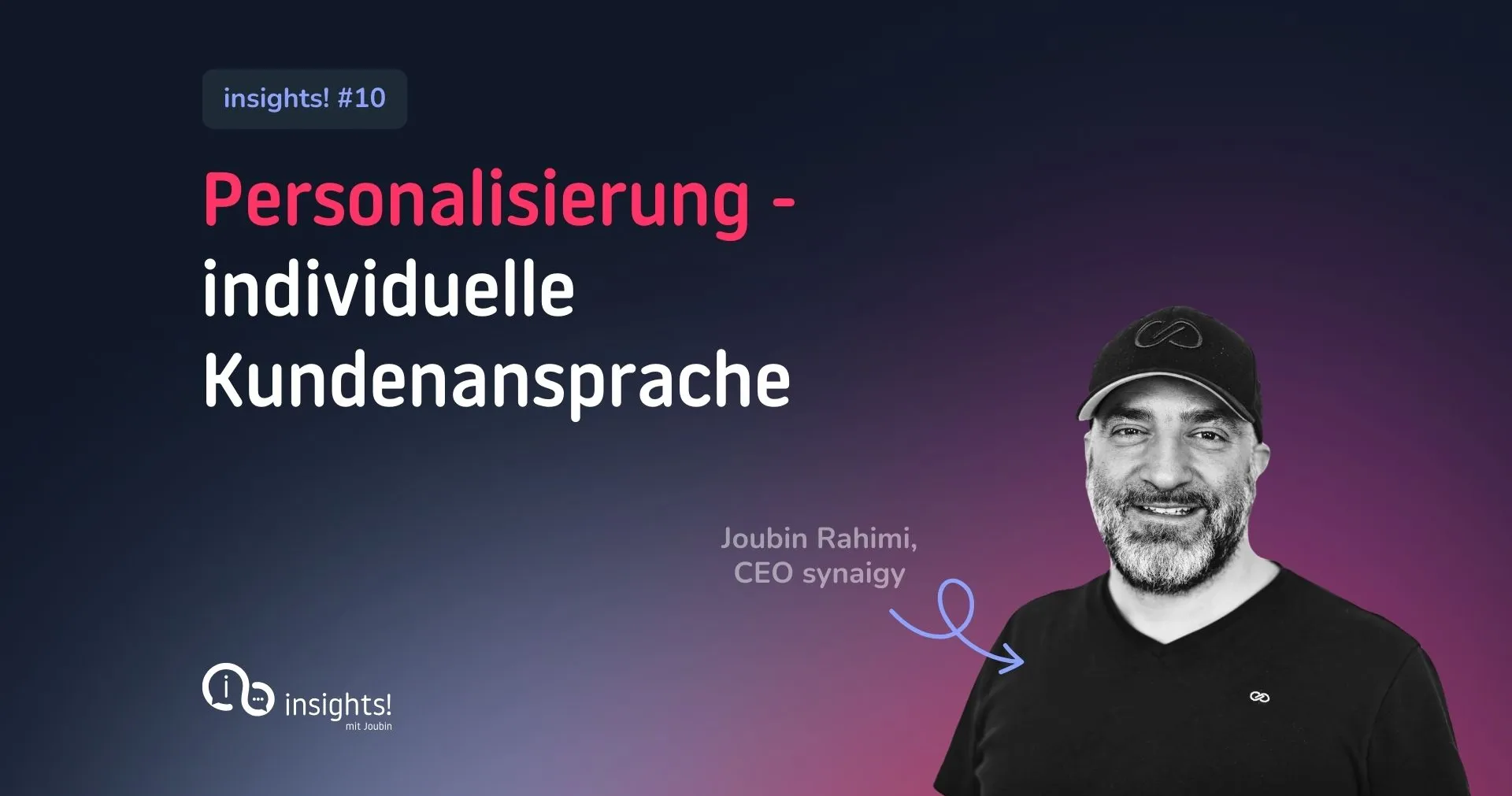
I believe in customer love, not customer loyalty.
I don't believe in the term customer retention in this context, sounds like coercion; I believe in customer love, in the fact that the customer voluntarily chooses to endure queuing at minus ten degrees to get their hands on the latest iPhone.
If customer feels well looked after and addressed, they're ready to commit to company long-term. Applied to internet, this means companies shouldn't only take care of technological part of their presence, I need to work with a customer experience department right into that. With help of psychographic sales models and artificial intelligence, there are numerous ways for businesses today to appear empathetic to customers.
Benefits of this effort and investment are obvious: "More revenue, more satisfied customers and differentiation from competitors."
Would you like to listen to the full episode?
Listen in directly and find out more:
Please accept the corresponding cookies to view this embedded content.
Prefer to watch the episode? No problem!
Here's a recording:
Please accept functional cookies to watch this video.
Prefer to read?
Why is personalisation the topic here?
We believe personalisation is one of the key elements for a good customer experience.
And good customer experience is a key element for setting yourself apart from others, not just from the GAFAs, but also from competitors, in order to ultimately earn customer trust.
We don't believe in customer loyalty, because loyalty sounds like compulsion, something fixed you want to lock down. We believe in customer love, that the customer decides for themselves, isn't forced, but voluntarily waits in an extremely long queue for the new iPhone even though no one is forcing them to. Or goes to Abercrombie & Fitch, or to Moncler, and waits there in a queue at -10° in New York to be let into the store.
But what's special about these companies? And above all, how can that be represented digitally on the internet? That's personalisation, specifically empathetic personalisation. Why empathetic personalisation? Very simple example, imagine you walk into a shop, here in Germany, and the salesperson greets you the way it's simply customary in America: welcome, lovely to have you here! Can I help you?
We've got five special offers here, come straight to me, I'll help you! That's too much.
Or as is often the case in Arab countries, which are notably more sales-intensive. They say, come, how can I help you, and don't leave your side at all. Then I say, I feel hemmed in. That's already a cultural difference. But we also behave very differently depending on the situation. I can sit on the sofa and, yes, I love Tatort on Sunday evening, and alongside it - second screen - I look at something for my bike, I love road cycling, and there on one of our clients' sites, for example, I look into the right cycling gear. I can spend hours on that.
On the other hand, my wife says we need light!
Right, I had it on my to-do list to get lighting for the children. I'm the same person, but in different situations. On one hand I like to browse and be entertained, on the other hand I want to tick off the lighting topic as quickly as possible.
But how can I personalise the system and make it empathetic enough that I enjoy it?
We believe there's a crucial point in there for our customers. Because applying purchase pressure with a voucher alone doesn't do any good.
We know all practitioners – 20 percent off everything, except pet food! Did that work? No.
We believe in situational recommendation. We believe in the boutique business. We believe in the situation when I walk into the shop, you s
Reminds me of itself in a pleasant way and advises me sensibly without applying pressure. Then I keep coming back, then I bind myself as a customer to the company. And this core, this empathetic personalisation, is from our point of view a really important building block. How can I achieve that? On one hand I need to understand how a purchase works, what psychographic models exist. Sounds like theory, but can be packaged relatively simply. That's one part.
Second part is, which situation, which place, which manner? And that too can be read, namely from body language. Just as I, when I stand here like this, come across quite differently than when I stand like this. Or like this, quite openly. We see all these elements in digital environment too. And that combined and paired with artificial intelligence gives us ability to respond empathetically to customers. Why should you do something like that, invest time and money there? For us there are really three reasons:
The first one, it brings me revenue — that's totally important for any finance person, any business;
The second point, it makes customers, your customers, much more satisfied, and that is of course something long-term; the third point is that you differentiate yourself from competitors, which in turn feeds into points one and two.
That's why we believe companies need to work not just with technology but also with a customer experience department, right into that empathetic personalisation, that customer experience. Because that's what makes the difference for your company.
Thanks for listening, have a great day or evening!
You can subscribe to this podcast via all common channels.
Erzähle auch deinen Kollegen und Freunden davon. Je größer die Community wird, desto mehr Inhalt undDiskussion können wir für Dich transportieren und erstellen.
Have questions or feedback?
Then feel free to contact us directly.
- Joubin Rahimi
Managing Partnersynaigy
Show phone numberShow mobile numberShow email address

Subscribe to the blog now and never miss any news
✔️free of charge ✔️weekly news ✔️expert knowledge
Please accept the corresponding cookies to view this embedded content.