



insights! episode #16: modern organisational structures in online retail
 Joubin RahimiManaging Partner · synaigy
2 min read
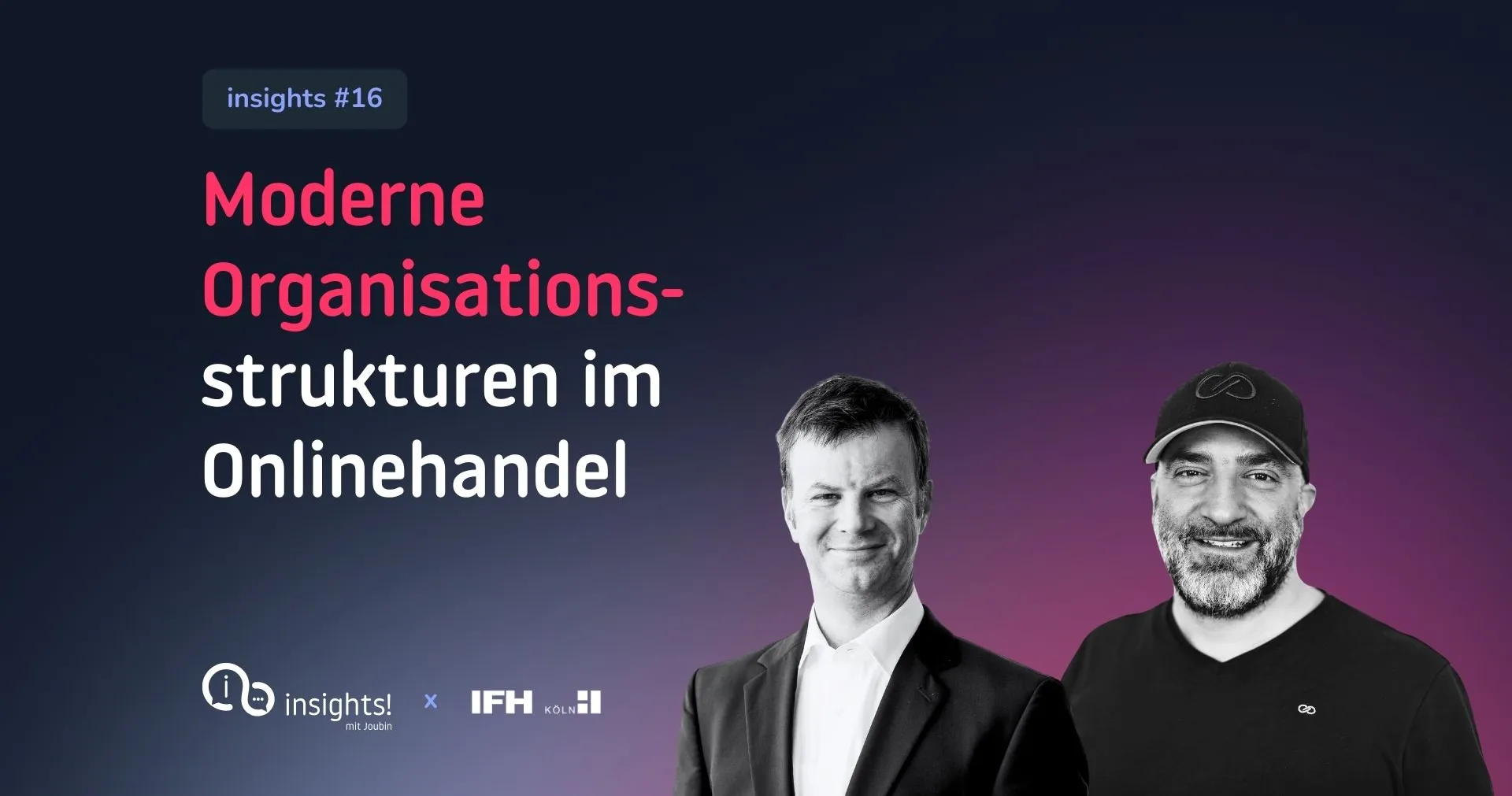
In the previous insights! podcast, retail expert Dr Kai Hudetz gave us a glimpse into the future of retail and online commerce. Now he's back in front of the microphone for a second round of questions. This conversation is all about how online retail can be structurally organised to meet the demands of a rapidly changing market.
Now many are realising they can only fully exploit their potential through new sales concepts.
Dr. Kai Hudetz has been managing director of the Cologne Institute for Retail Research IFH since August 2009 and a founding member of the E-Commerce Center ECC. The economist and guest lecturer at various universities has spent decades studying how retail and the digital age come together.
For 26 years now, Dr Kai Hudetz has been advising IFH companies that are hitting their limits when implementing modern organisational structures. If anyone has an eye for new trends and developments, it's him. And he certainly claims to have spotted some: "Manufacturers are increasingly interested in thinking from the end customer's perspective, because the end customer has suddenly become relevant." This marks the gradual end of an era in which manufacturing companies were solely concerned with the wellbeing of retailers and wholesalers. The economist working for IFH claims to have observed that "the boundaries between B2B and B2C are partly blurring". Fewer and fewer companies can resist the appeal of platform distribution. However, switching to this more direct sales channel comes with pitfalls and difficulties. "Now the question arises as to who the customer belongs to and who determines access to them," says Dr Kai Hudetz.
Established businesses in particular would have problems adjusting to the retail of the future – which had actually already begun long ago. "They don't want to unsettle or alienate existing channels," says the IFH managing director. Often companies had grown together and been successful over decades. "And now people realise that they might have to set it up differently after all, in order to exploit the full potential. That it isn't conceived from the customer's wishes." A multi-stage sales approach only led to an attractive customer journey for very few customers, and in the worst case, after countless clicks through confusing websites, they'd be redirected to an external retailer where the search would start all over again. "We need to think far more consistently from the end customer's perspective," is the industry expert's verdict. And that starts with gaining information about customers. "In most cases, companies know too little about their end customers."
Would you like to listen to the full episode?
Find the podcast of the interview here:
Please accept the corresponding cookies to view this embedded content.
Prefer to watch the episode? No problem!
You'll find a recording of the interview here:
Please accept functional cookies to watch this video.
Prefer to read?
Joubin Rahimi:
Fantastic that you're joining a new episode of insights! My name is Joubin Rahimi and today's guest is Kai Hudetz. Hello, Kai.
Dr Kai Hudetz:
Hi there, Joubin. Thanks for the invitation!
Joubin Rahimi:
Yes, gladly. You're from the Institute for Retail Research, you also helped set up ECC. But your customers aren't only retail customers, but also industrial customers. It'd be great if you could introduce yourself in that context.
Dr Kai Hudetz:
Yes, my name is Kai Hudetz. I've been at the Institute for Retail Research, or IFH Köln as it's now called, for what feels like a hundred years but is actually 26. For 14 years as managing director. And in 1999 I founded the ECC brand, now also ECC Köln, with which we got e-commerce, e-business, omnichannel, superchannel, whatever-channel, platforms and so on off the ground, and, as you rightly announced, increasingly interesting for manufacturers too, and of course manufacturing companies, who are increasingly keen to really think from the end customer's perspective. So not what does the tier I supply to want, wholesale or retail? But actually the consumer, the customer, the end customer, the one who in many cases significantly influences the purchase decision. And that's of course very, very exciting for us.
Joubin Rahimi:
That would have been my question, why industrial customers are approaching you now. But you've answered it: because the end customer suddenly becomes relevant. Why is that?
Dr Kai Hudetz:
We do quite a lot of projects in the construction-related sector, now also for manufacturers, companies, where it's always about not just understanding how the one placing the order thinks — that's normally the wholesaler or the retailer — but how the tradesperson who buys from the retailer or wholesaler thinks. How does the end customer think, perhaps, since the boundaries between B2B and B2C are partly blurring too? How do they actually think? And that has become extremely relevant for these companies. What's more, there's hardly a manufacturer left — and we're in close exchange with many from the consumer goods sector too — who can resist the charm of platforms. So sales via platforms is of course also a very important question, and there are always issues there that aren't entirely straightforward, involving channel conflicts, involving who actually owns the customer now, who determines customer access and what that means for me. So many, many exciting questions. Of course we can benefit from the fact that, fundamentally, we've often already been working on these topics at a retail level for many years.
Joubin Rahimi:
And with that, straight to a question, more of a personal example, and I'd like you to benchmark it for me, whether it's an isolated case or not: it's about Gardena. I'm a Gardena fan, and we have a garden at the new house in Remscheid. I know, not Cologne any more, but that's a story for another day. And there we have a garden where I'm planting a hedge that I'd like to water automatically. So all fairly simple. Where was I? I was on the Gardena homepage and first had to wade through the information. That's when I noticed they had actually thought about the UX. But more as an example, because all the information I needed was fairly tedious to find. And then I had it all together and couldn't order it anywhere straightforwardly. There were links off to other retailers, but it wasn't a great journey. I found that somehow difficult. Do customers tick that way, that they go straight to the manufacturer's site when they have such a need? Do they already know which brand they'll take?
Dr Kai Hudetz:
First of all congratulations on decision for automatic irrigation systems, we have that too and it's really a great thing. Second, I'll of course pass this specific case on to colleagues at Gardena. They're ECC club members too and discuss things. And third, what you actually see here, what it really comes down to, is turning whole topic around. Way it's handled here, it's clearly run from a supplier perspective, driven by existing sales channels they have. It's driven by not wanting to unsettle or alienate existing channels right now. But it's not thought through from customer's wish. Customer of course wants a much simpler customer journey. If I'm specifically interested in a Gardena product, then I want, on one page, and we see, especially in B2B that's often the manufacturer's page, to have necessary information and at end of day be able to order with few clicks too. Worst case, you still have drop-off points to retailers and then you have to enter again what you were actually looking for. That's of course a pretty shameful UX, if parameters aren't carried over. That's driven by wish to bring these retailers along on the journey. That's well meant, but in many cases well meant is opposite of well done. We need to think this much more consistently from end customer's side in many, many areas. But that's of course new territory for these companies that built multi-tier distribution over decades and became very, very successful with it. I mean, Gardena's a great example, super brand, great, I can well understand you're a fan of it. Very successful with its trade partners. Now people notice, might have to do it differently though to unlock full potential. And that's not quite easy and it ties back again to what I like to raise, in vast majority of cases we have too little information about end customer. I simply know too little. And that's especially true for manufacturers who feel like they're delivering into some black-box trade and get no information about customers at all. That's particularly difficult for them, because in many cases they're only just starting out. And organisations aren't built for it either, they're built for multi-tier distribution. Got to be fair, it is difficult, but fact it's difficult doesn't mean you have to have an experience like the one you had.
Joubin Rahimi:
That's great, because you can pass on the knowledge of dealing with the customer and the experience of putting the customer at the centre, since you do it for retail every day, effectively to the relevant industrial companies.
Dr Kai Hudetz:
Yes, absolutely, for us and our customers that's a huge advantage, that we've been developing these questions from the customer's perspective since 1999, that we've done countless customer journeys here. XXX in particular have done a great deal of this, because we're fortunate to count almost every major DIY chain among our customers. And these are of course experiences for manufacturers that you can build on. Sometimes the questions get a bit more specific and perhaps also more difficult, because we're often dealing with companies that have a retail division for their products, and then a separate division specifically for specialist trade. So it's become quite complicated indeed. And if we're honest, some companies actually didn't fare too badly living off a lack of transparency, you simply didn't know exactly. But the internet has of course, in B2C anyway, but increasingly in the B2B space too, ensured there's much more transparency in the market. And that's definitely challenging.
Joubin Rahimi:
Bringing up transparency again, or rather the lack of it. And again my example with the house in Remscheid, which is also getting a full renovation. And there's the question, KNX versus other smart home systems. The electrician said KNX is simply a proven system, the big manufacturers in Germany or in Europe use it. You can also handle almost everything with it. But then the tradesperson does that, and I'm rather left out of it. But I would like to have a bit of a look at what I'm doing. But I also don't know exactly where everything ends up, because it isn't fixed. And now I've noticed that Google, Amazon and Apple have forged an alliance, called CSA, in which they define two standards – Matter and Thread. And I find that totally exciting. There the GAFAs show us once again that they have the power to establish a standard in order to genuinely take a step forward. And I'm coming at this from the customer's corner. Do German companies really have a chance to actively move forward in that environment? Purely theoretically there are plenty of large electronics manufacturers in Germany who could also have done something new, rather than KNX version 285.3 or whatever.
Dr Kai Hudetz:
Yes, that's of course a difficult question, where's the sticking point there? We've already seen earlier that the thing with standards is of course also difficult, because it's not always the best standard that prevails, but rather the one that's marketed best. That has a lot to do with size, and other companies are of course far, far away from the reach effects that the GAFAs can achieve. Still, what I also find particularly exciting is that in the B2B sector Germany is teeming with world market leaders. So we're incredibly strong, have such great brands, which then perhaps actually also react to and implement changes faster. And I also find it a shame, and that's not just a question of manufacturers and standards, but generally, how do we get technology to the customer and how do we attach services to it? And so with the smart home topic we actually have very few intelligent overall concepts. Most people have a bit of something here and there, but it's all still a bit very, very rustic. There you could do a lot more. And then there's also the issue that you have the service component, you could also advise there, but instead people are working away at telecommunications contracts, where it's about cent amounts.
Joubin Rahimi:
That's exactly right. One company comes to mind, although it's not a manufacturer, Lampenwelt. They offer services to take a holistic look at things. Because it's not just about a bit of smart electronics, but whether things fit together. What about the lamps, do they fit in there and are they bright enough? They position themselves around that. From the manufacturers you get very, very little there, they tend to feed rather playful content into their YouTube and Instagram channel, some of you may know it. I think it's really well done, that suddenly becomes the source. One person, an influencer, who then promotes the things they like or are allowed to advertise for.
Dr Kai Hudetz:
You're already well on your way to becoming an influencer.
Joubin Rahimi:
Still far from it, Kai.
Dr Kai Hudetz:
From the manufacturer's perspective, I understand it a bit like this. Manufacturers are still very much driven by the feeling that they simply have brilliant products that work brilliantly and that's Made in Germany and top-notch and in demand everywhere. And once you can export to China, you're the biggest and made it anyway. But we also need to get better at thinking in terms of combinations within solutions. That's something other sectors have internalised more or less, that it's about solving problems. Think of DIY stores, where we're now finding that, okay, it's really not about a single product, it's about the fact that the customer wants to do something with the drill, not just drill holes in the wall. If you consistently think about it differently, away from the product and towards a solution, that leads to really interesting effects.
Joubin Rahimi:
Your project, today the quote from someone who ...
Dr Kai Hudetz:
XXX, it must be said, implemented this very early, including in advertising. Of course you then also have to act with great consistency, right through to a Hilti, who then say, we're creating new business models, you pay per drill hole. There you really can set up completely new things.
Joubin Rahimi:
Obi is in Wermelskirchen, not far from here, and through the job adverts we see, we noticed early on that they invest a lot of expertise in the area of 'How can I advise customers on individual topics?' and 'How do I build guides like that?' And here I'd like to draw on your knowledge for the listeners, and in a sense tap into the swarm intelligence of successful industrial companies. This is above all an organisational topic. You said that so far industrial companies never had to deal with this. And now, well, of course you do that by hiring the right people. Are there any guidelines you can share regarding organisational structure and size?
Dr Kai Hudetz:
Yes, that's almost the holy grail. But of course it starts with location, which is why Obi set up Obi Next on Schanzenstraße, and Obi Digital before that. The Cologne location is simply more appealing to young people than Wermelskirchen. No offence to Wermelskirchen, but that's quite understandable. And the other question is always how closely it can be linked to the core business. We've seen all sorts of things, everything from being built up entirely within a department in-house to organisations that were completely detached. I think it has big advantages if you build it outside the organisation, at least at the start, because discussions about resources are always unpleasant when you're the one at the table contributing the smallest revenue. "Stop with your online channel, we do it the way we've always done it." It's easier to scale up if you do it outside the organisation. At some point the time comes, and we've seen this with some companies, think of Douglas for example, where you have to bring the strands back together. One brand, one customer experience. Fully stand-alone - that used to be a trend too, think of Mediamarkt - it doesn't make sense, because you simply don't develop a consistent customer understanding and experience across channels. So I don't think there's a blueprint for it. But the successful ones do it outside the organisation first and then merge it more or less quickly.
Joubin Rahimi:
Ultimately building your own organisation.
Dr Kai Hudetz:
Yes, a different culture too. You see that with Rewe too, that naturally makes it easier too. Many retailers in particular are still very rustic, very shirt-sleeved in their approach. And young talents don't feel comfortable in such an organisational culture then either. So that they even stay, winning them is one thing, but retaining is another thing entirely. They then expect a certain kind of culture too. Now you have to say, that's all developing too, that's developing at traditional retail companies too. Ties are disappearing, trainers are here, xxx culture is spreading more and more strongly. So it's blurring, but still you find it easier culturally if you're not coming from your own bubble from the start. You won't get far there, you have to make too many compromises too often and won't get speed right.
Joubin Rahimi:
Yes, great, thanks for these insights today. Suppose you surely have studies on this too, or ECC circle, where industry companies exchange with each other.
Dr Kai Hudetz:
We've actually done fewer studies, I think, I'd have to dig around for that, but we now have three roundtable formats dealing with this, i.e. B2B, where we have fluid boundaries anyway, plus one for consumer goods manufacturers. They meet three times a year, and after this exchange you always leave the room smarter than you came in. The exchange, even between the companies, is in my view almost priceless. And the entry barrier with the ECC Club is so low. But it's really worth it, because this development is happening across categories, no one will escape it. And understanding where end customers want to go is more important than ever.
Joubin Rahimi:
Great, thanks Kai. Thanks for your time!
Dr Kai Hudetz:
Thank you very much for the invitation, Joubin.
Joubin Rahimi:
Gladly, always gladly. For all listeners, you can of course leave comments below, or see the links in the notes to the ECC Club, to the roundtables. We look forward to having you with us again next time!
Have questions or feedback?
Then feel free to contact us directly.
- Joubin Rahimi
Managing Partnersynaigy
Show phone numberShow mobile numberShow email address
Subscribe to the blog now and never miss any news
✔️free of charge ✔️weekly news ✔️expert knowledge
Please accept the corresponding cookies to view this embedded content.