



insights! Podcast episode #18: workation - a working model with a future?
 Joubin RahimiManaging Partner · synaigy
4 min read
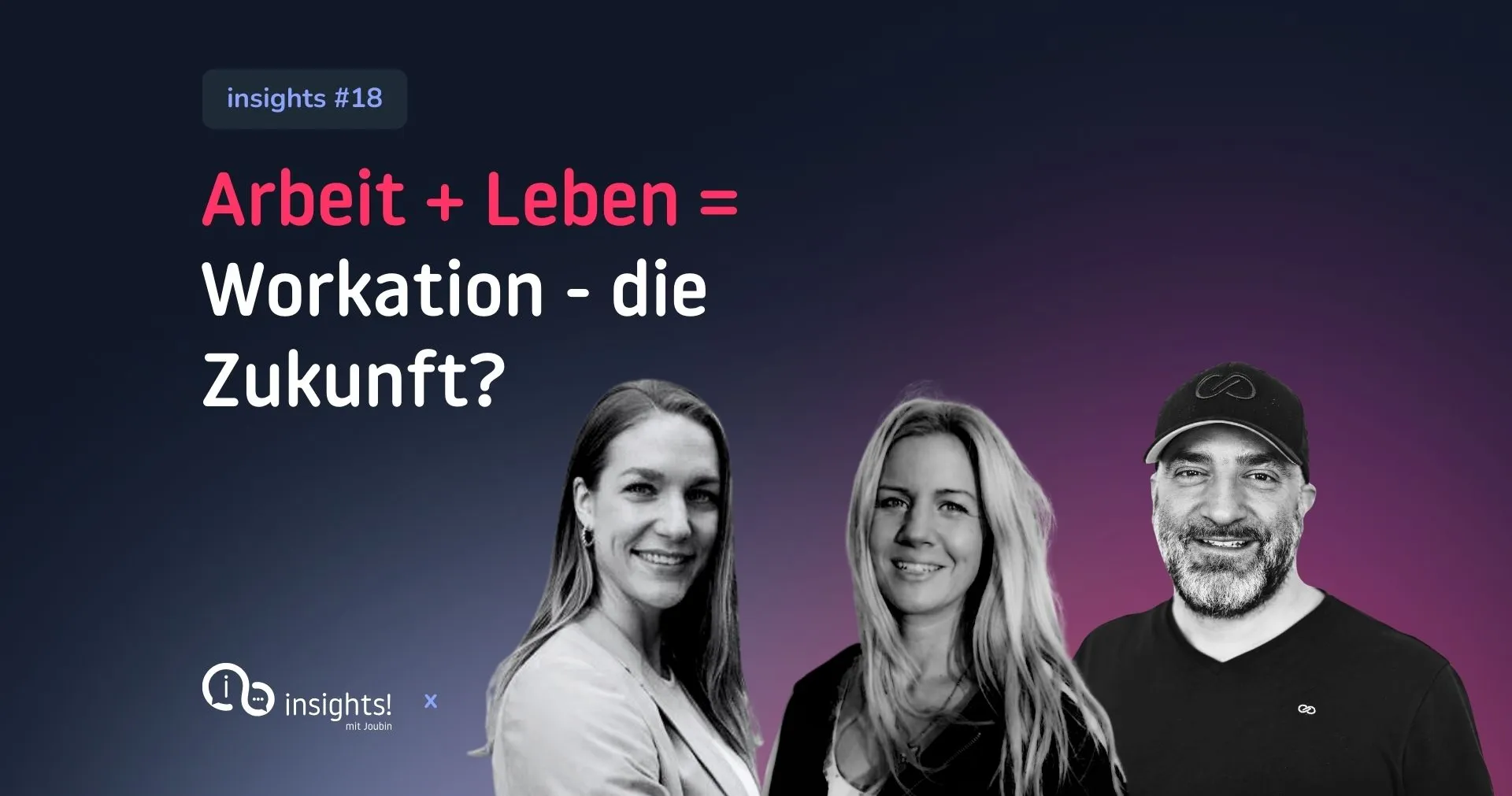
In the second insights! episode of the second season with entrepreneur, author and keynote speaker Ruth Cremer! This time Joubin Rahimi is joined by marketing expert Anna-Lena Lüderitz. Together, the three of them exchange thoughts on the possible working model of the future, the so-called "workation". Is the idea of merging work and holiday feasible without companies coming off worse? And if so, what needs to be considered when implementing workation?
Work and life should be merged more closely.
For anyone not yet familiar with Ruth Cremer: the Rhinelander is also a university lecturer and became known above all through her book "Die Höhle des Löwen – vom Pitch zum Deal".
For Ruth Cremer, it was clear from a young age that a nine-to-five job wasn't for her. She tried it twice, "I felt terrible doing it, was totally unproductive". So she adapted her work rhythm to her personal life rhythm. "Basically I'm a fairly unstructured person, I have so many different projects that my daily routine is always different". Now she works from all sorts of places around the world and claims to have quickly realised, "that it does me a lot of good to be pulled out of the everyday routine a little".
For employees, the benefits of remote work are obvious. Not only can you work from a location that office staff can at best dream of in connection with their annual leave. After all, there has long been fast internet on the Riviera Maya or on Koh Samui too. Work would thereby also gain more meaning, and motivation would get a huge boost. "Work and life should not be so separate," says the entrepreneur and author, "then I can identify with the job much better". In her view, employers still clinging to traditional structures face a massive rethink. In the coming years, a generation is pushing into the job market that brings entirely different values with it. "Money no longer means everything to them, they want a positive work-life balance." Companies that close themselves off to these fundamental wishes should brace themselves for problems finding staff.
But the companies themselves could well benefit from workation too, Ruth Cremer believes. It offers the chance to recalibrate a dusty mindset for the future. "Meetings are a huge topic," said the entrepreneur from her own experience, "many simply achieve nothing, pure waste of time". Less is often more, but above all, more expensive specialists could then be put to sensible use and wouldn't waste valuable time "sitting around and discussing". Start-ups are leading the way here compared to large corporations. "They simply can't afford it, they have to work efficiently," says Ruth Cremer. A certain degree of trust extended by managers towards their employees also reflects a modern way of organising work. Employees should simply be allowed to get on with it, "it worked during the pandemic in the home office too, after all". Especially since control also comes with a time cost. "If I were to occupy myself with something like that, I'd never get anything done."
When the employee or freelancer sits on the other side of the world, fixed working hours are usually ruled out automatically, if only because of the time difference. And that puts the traditional pay model of time for money under scrutiny too, says Ruth Cremer. She herself hasn't been able to work with time for money for a long while, instead she relies on outcome-based fees for her clients. Her prices are based on the value of knowledge she provides to her clients. "Sometimes I charge completely different flat fees for the same time spent," says the Rhinelander, "because I say, if I run a workshop, there's an enormous amount of condensed knowledge behind it." Some clients had trouble understanding her pricing policy at first, Ruth Cremer admits, "then I list out what they get in return." You have to appeal to people's willingness to think it through, but where there's a will, there's a way.
Would you like to listen to the full episode?
Find the podcast of the interview here:
Please accept the corresponding cookies to view this embedded content.
Prefer to watch the episode? No problem!
You'll find a recording of the interview here:
Please accept functional cookies to watch this video.
Prefer to read?
Joubin Rahimi:
Wonderful that you're joining us again for a new episode of insights!, today with Anna-Lena Lüderitz and Joubin Rahimi. Today we have on the call, in the interview, dear Ruth Cremer. You've been with us before, hello, Ruth.
Ruth Cremer:
Hello. Great to be back on board.
Joubin Rahimi:
We've already talked a lot about Die Höhle der Löwen, but in this conversation you also mentioned that you travel a lot, work remotely from anywhere in the world. Many companies now face certain challenges in that context, let's look at that. And second topic is, how can organisations improve the way, the how, within the company? So those are the two topic areas, and I'd like to start with the topic of workation and working remotely. That's definitely something I find highly exciting. At our company many employees wish for this, and now I'm facing the question, how could I do this well? I could of course also ask colleagues, we do that too, but since you're here right now. What were your best workation experiences?
Ruth Cremer:
The best experiences - that's quite a complex question. I think for me the thing was, I just started. Now I'm self-employed and largely alone, or with a student assistant or employee. That works really well. I don't have a company that then sits empty. It's always given me a lot to be pulled a bit out of the everyday routine. Of course you also really have to want to work in a nice place. I always find it lovely when people say, you work where others go on holiday. Oh, how wonderful! And then I always say, yes, I WORK where others go on holiday. You have to want that too. You have to figure out for yourself how that can work, so that you actually do it and don't just lie on the beach. And yes, I've found for myself that I can also be very productive in such environments. And over the years I've found that there are actually more and more companies, including larger companies, that enable this for their employees. So it does seem to work somehow. Especially in typical office jobs, let's be honest, for what we do you usually only need the internet. Usually you don't really need any infrastructure from the office or any documents. Or you have them, you can have them digitally. There are definitely usually very simple solutions for the classic office job. And it also does many companies good - I experienced a lot of this during the coronavirus pandemic. This discussion about meetings - it also does many companies a lot of good to reduce meetings extremely to what's really necessary. And lo and behold, you suddenly have higher productivity because you're not constantly sitting around with other people discussing things.
Anna-Lena Lüderitz:
I found that a really exciting point just now. At the start of the pandemic I also started working from home, for two full years. At the beginning it was quite hard for me, because I first had to find my way into it. It was suddenly a completely different focus. Today I can say I really enjoy working from home. You just mentioned that you need the will to work where others go on holiday. Do you have any tips you could give listeners on how to combine being somewhere beautiful while still keeping the focus on work? And of course still seeing the beautiful country, finding that balance.
Ruth Cremer:
I think for me it was above all that I always tried to make it clear to myself that it's a privilege that I can be there, and be there for longer than just two, three weeks, namely also six weeks or longer if you want to. And that this comes at a price, that it's not an Instagram life, but that you also have to do other things there. It comes down a lot to mindset and motivation. On the other hand, what helped me a lot at the start was always setting myself topics, saying, okay, I have a certain amount of operational work that I obviously have to do, and I have coachings that I run. I mean, that's relatively easy when you have fixed appointments like that, because then you have to be online. On the other hand, though, I then tried to take on certain work blocks or packages that I wanted to have completed by the end, and then review each week how it's gone so far. Have I actually already worked on it, or how far am I with it? So I basically always went away with certain goals, in order to hopefully come back with certain results.
Anna-Lena Lüderitz:
I don't know your working day in Germany, how structured it is, and whether you start at eight every morning and close the laptop at a certain time in the evening. But what I find interesting is whether you also carry that into the workation, i.e. whether you project your everyday routine from Germany onto the workation. Or whether you actually find something new for yourself there, in how you start the day.
Ruth Cremer:
One of the great privileges of self-employment, of independence, is that I can follow my own rhythm. You can try calling me at eight in the morning. It won't work, because my phone stays in sleep mode until about nine o'clock.
Anna-Lena Lüderitz:
That's commendable.
Ruth Cremer:
That said, it doesn't come back on until eleven at night, that's simply my personal rhythm. I've never felt comfortable with this getting up at six, seven and then finishing at five. I can't do that, because at five, six, seven I usually have an extremely strong flow going and that's not a time for me to stop. But equally, eight, nine in the morning isn't a time for me to start either. In the end, it's not about squeezing the maximum out of yourself, it's about living and working with your own rhythm. And that's naturally easier for many people working from home than in companies, I think, because there's no fixed working hours and so on. That never worked for me, I tried it twice for about eighteen months each. I felt terrible doing it. I was terribly unproductive and eventually had to accept that it simply doesn't work. That's obviously a huge privilege, working from home or remote working. But to come back to your question, what do I bring from home into the remote office? I wouldn't even say my rhythm at home is that different, because I don't really have one. I'm a terribly unstructured person when it comes to daily routine, because I also have so many different projects and things going on that my day is actually never the same. It's always different. And when I'm on a shoot, I sometimes have to get up at 4.30am, that's completely different again. I always try to set myself goals for the day. That's also relevant when we get to the difference between start-ups and corporates in a moment. I think what start-ups really have to learn, in order to become anything at all, is this goal-oriented way of working, rather than time-oriented or task-oriented. And that's also what I try to implement for myself, and to track too. And it doesn't matter where you are. If I say I want to achieve at least this today, ideally this, and it would be a dream if I could also pull off that, or get that result as well. That can simply be applied wonderfully anywhere.
Anna-Lena Lüderitz:
I found that a very interesting point just now, that you say don't orient so much around working hours, but around a to-do list. I find that a very exciting point, one I've often wished were lived out much more, also in corporate culture in Germany, generally everywhere. I don't know how you see it, Joubin. What's your take on working hours?
Joubin Rahimi:
So, being goal-oriented is great. But you have to differentiate a bit between the work in my area, or also in sales and marketing. That's goal-oriented, there time is really irrelevant. When we have certain orders, then it's time for money. That's totally daft. There the employee doesn't really have the chance, because they get time for money, just as the employment contract essentially is: time for money, so the basis there is already daft. I don't want to say there are no possibilities. The question, of course, is which construct you're in. If we provide a service for a customer for 160 hours a month, then that time unit is already like that, because the customer doesn't even know yet what they want. But we also have services that are service-oriented. And there it's different, there time doesn't play a direct monetary role. We want to move more in that direction too, because on the one hand it's more scalable, and because the work becomes more valuable when you build things so that you can scale, it becomes more valuable. And then, of course, you also have the opportunity to offer more attractive jobs and thus get better colleagues who have more to offer. And we're in a bit of a shift there. Ideally I'd like to tell everyone, organise your time however you want, and just make sure things work in a way that we all have enough to live on together, can grow, can keep learning. That's my heartfelt wish, but it's not that easy to bring together. I think for a large corporation it's even harder.
Ruth Cremer:
I can totally understand that. I just need to jump in briefly. At first I also always thought, okay, time for money, there's not much I can do about that. But I try to orient myself very strongly on the value and what's behind it from my side, for example when it comes to my prices. Sometimes I charge completely different prices for the same amount of time, because, for instance, I say that if I run a workshop, there's an enormous amount of condensed knowledge behind it. If someone books me for coaching for a certain period, for a day or so, I like to work with flat rates. We have a goal, and once we've reached it, that's it within that framework. It doesn't really depend on when my time is up, but on when the client has received the value from me that they needed. And that's what I try to orient myself by, and that's how I've structured my prices. It actually works quite well. Some people say, especially with workshops, that it's expensive. And then I list what they get for it and why I believe they won't get it in this form anywhere else. And then it usually works. You have to appeal a lot to people thinking it through, but it's possible if you're willing.
Joubin Rahimi:
Depend on business model, we see that too. Story with engineer called to ship because engine not work. He was last one they could ask, all others already failed. After ten minutes he done, and then they get bill for 20,000 and say, you only there ten minutes, I want different bill. Then he send bill and say, ten minutes work time 50 euros, and remaining 19,950 euros for 35 years experience.
Ruth Cremer:
Exactly, that's always my argument too.
Joubin Rahimi:
For some things we can do that brilliantly, especially coaching, software selection and so on. But if we tell a corporation they need six software developers because they have 500 software developers, you're not going to make a dent. The question is, do we want in or not?
Ruth Cremer:
But it's the customer who doesn't accept it, right? But that doesn't mean it's impossible.
Joubin Rahimi: I think the setup here is fundamentally different. The customer says, I have my own staff, I have external staff, and I simply need human capacity, and it's measured in hours, and we can't even say what it's worth to us.
Anna-Lena Lüderitz:
This is the point where the mindset generally needs to change, not just for us, but generally across all sectors and companies, so that it can work as a whole. Sure, you can do that internally, but if you then go external and effectively sell staff capacity while the company doesn't yet live that way itself, it's understandable that it's extremely difficult.
Joubin Rahimi:
It’s definitely exciting, because now we’re having a discourse, wonderful. But from my point of view, either we don’t do this business area and simply do fixed-price or works contracts and try to place them that way, or you’re in this time-for-money territory, because it’s not clear what they’re doing. We do have colleagues who end up at the big corporation, and there they don’t know what they’ll be doing in week two, three or four, because it’s part of that overall project plan. That’s a bit unappealing, also called body leasing, a horrible term for it.
Ruth Cremer:
I completely understand that. But then it's the client who also doesn't want to see it any other way, who has these entrenched structures and simply can't rethink them either. But I still believe that if everyone wanted it, it wouldn't be impossible either. And I also believe that overall it would benefit not only employees but also companies to look at whether this couldn't be defined in terms of results.
Joubin Rahimi:
Ultimately you want results, and agile software development also moves in this direction, measuring by results. That's totally good. I'm glad that corporations are now increasingly saying not everyone needs to be in one place. Sometimes that's fine, but if you do it remotely, you naturally have the option of workation, doing it from some completely different place that better suits your stage of life. We notice companies becoming more open, saying colleagues don't always have to be on-site, that's not so important. We've become a remote company, and that is indeed nicer.
Ruth Cremer:
It's quite exciting how this is shifting. In the past, on my travels I mostly met freelancers and entrepreneurs; now I'm increasingly meeting permanent employees too. Quite exciting.
Anna-Lena Lüderitz:
Yes, that's also something we could take as a positive out of the pandemic – that at a certain point there was a necessity to work remotely. And companies noticed the work still got done, which perhaps they hadn't expected beforehand. The trust may not have been there enough to simply let employees get on with it. I very much hope this will keep growing in future, and that now the pandemic is coming to an end, it won't be scaled back again, but that we'll keep moving forward with it.
Ruth Cremer:
Then I'm curious too.
Joubin Rahimi:
Exactly two years ago I had a call with a customer, who'd introduced Teams, they'd had Office365 rollout, then Teams rollout, and I spoke with head of department about how it was going. And he leaned back and said, I've hit my goal for this year in last two weeks. What was goal then? Rollout of Office365 and Teams for all staff. They'd planned a whole year for that, and because they had to, it flew through all those committees – works council, HR and co. Biggest problem was procuring enough fast, mobile devices, laptops and co. They managed that too, and since then they're still fairly strongly remote. But I'm curious how that changes now, if we might fall back into old structures. At us we won't do that. How can companies still learn from start-ups?
Ruth Cremer:
This HOW is always the big question. I think task-orientation is one thing. Start-ups simply have a much stronger necessity to reduce any form of excess, to get rid of it. And through this necessity they're quite a bit more brutal about it. Meetings are a huge topic, LinkedIn is also full of it, how to reduce meetings, reduce the time. I know this myself from my time in a company, that I often thought, today there are three meetings again, you won't get anything done again. And then I came out of the third meeting and thought, what a stupid day! Because somehow it achieved nothing, my presence wasn't necessary at all, or I could have just come in for my point. It was simply completely pointless. And that's just something start-ups can't afford for long. Often it's the case that you can just about pay the staff. It's a difficult consideration, I urgently need someone else here, but can I afford them? And if so, then of course I also have to use that person as sensibly as possible. It would be practically suicidal if I sent that expensive new employee to meetings the whole time. That's already a point, this efficiency, this having to be efficient. What's also a point that I really see as a problem with bigger companies is choosing the tools that work. You then have a hugely elaborate Office-or-whatever roll-out, and if after two weeks you notice it's totally inefficient, it doesn't work properly, or people don't use it and nobody's keen on it, then I can't just easily reverse it. There the question would be, can you try it out first in smaller groups, are there any options there? I'm not an expert on that at all, but I see it again and again. Every time I've worked at a company, I had to work with tools that genuinely held back my productivity, because it either didn't work properly or was badly set up, not thought through, whatever. And that's of course something that's much easier in start-ups, where you're also not quite as sensitive about security and so on, which isn't always good either, but where you can just try something out more quickly and also switch more quickly if something doesn't work. Error culture is also a huge thing. Do you dwell for a long time on this 'whom to blame', i.e. who was at fault? Or do you say, okay, how do we proceed now? That's also something start-ups simply can't afford to spend endless time on. And then trust in the employees is another really important point. A start-up doesn't hire anyone it can't be totally sure about, someone who absolutely fulfils their task, someone we can trust in that area and don't have to constantly check up on. You can't afford that. And I've often experienced in large or larger companies that this 'you must be in the office' thing also has a lot to do with control. Honestly, if I were to dwell on that with my employees, I wouldn't get anything done at all. It's so far from my mind to look at any hours or records to see whether they've done their hours. What counts for me is that they do their work, that they send me their results and then I see, I can carry on working with this. If not, then it goes back and you think about how you might communicate better or whatever. That settles in over time and at some point it runs smoothly, then I don't need to look at any timesheets.
Anna-Lena Lüderitz:
I fully agree with you on error culture. I've experienced that from two sides myself in my younger years. I don't have quite as much work experience as you two, you've both been in business much longer. But still I got to experience that you move forward very slowly, always get everything signed off, run through lots of correction loops before implementing anything new, maybe some tools. I think that's not just matter of lost time, but also big point of employee motivation. Cause if everything drags on very, very long, new things being introduced take lot of time, you gotta collect five approvals before you're actually allowed to implement something, then next time you think twice about whether you really want to push something again. On one hand time aspect, that you really make progress and implement things very quickly in start-up, which large companies can learn lot from. And also keeping employees on board, keeping them motivated, bringing them along.
Ruth Cremer:
That's another point, the length of decision paths and the effort involved, also incredibly important. At a start-up there are hardly any decision paths.
Anna-Lena Lüderitz:
In some ways they're two separate points, but in other ways they also flow into one, I think. Very long decision paths are a certain degree of security to prevent mistakes. Whereas a start-up would say, okay, let's just do it now, and if it doesn't work, we'll correct it afterwards. So in that sense they might go hand in hand a bit after all. Do you see it differently, Joubin? You're sitting there quietly listening.
Joubin Rahimi:
Yes, I think it over and reflect on how many options we have and what we can still do better. I think compared to your previous employer we've already made a leap forward, but for me it's always too slow. It's also exciting, not just to learn from start-ups, you have to be faster. I don't know whether start-ups per se have better leaders or not. They're under different pressure and perhaps lead differently as a result. Perhaps also face fewer consequences with decisions. But the core is to hand over more to colleagues. And if you want to do things better or have ideas for how to bring that across appropriately, so it's supportive and doesn't lead to, next time you ask, because you don't want to get told off. And that's a story that within the corporate group, and I did live within a corporate group for a while too, was absurd. I had a personal minder within the group who accompanied me through the processes, because I, like you, Ruth, wasn't easy. I wrote emails like, you're all managing-director-preventers. That's not possible, that's totally undiplomatic. But that was the frustration.
Anna-Lena Lüderitz:
There's one thing I'd like to pick up on again here. You mentioned, or were reflecting on, whether leadership quality might be different in a start-up than in a corporation or larger company. I think this brings us back to talking about hierarchies. I'd also like to put the question to you, Ruth – you have more experience and better insight into how far that might differ. I can't imagine that start-ups hold more qualifications or knowledge. It's certainly hard to judge what's better or worse there.
Ruth Cremer:
Overall my experience is that hierarchies in start-ups are considerably flatter, that people work together differently there, or the higher hierarchies aren't put on display so much. It starts with small things, that if there's a back office organising travel, it does so for everyone and not just for the managing director. Those are the kind of small things where in many start-ups, often for cost reasons too, there are no status symbols for the different hierarchy levels. On the other hand, the leaders maintain a different style and are more cooperative, perhaps listen a bit more too. It's all very generalised, but perhaps also appreciate a bit more in some way. I know I wouldn't feel at all comfortable as a boss saying we're doing it this way now. Because I simply want everyone to understand it. Of course, ultimately I have to make the decision, I do carry the responsibility after all. But I do want it to be understood why I'm deciding it this way, so people can somehow come along with it. So far I haven't had a situation with anyone where I felt they were totally against it or anything like that. Instead, in the end, more or less a consensus is reached, and it doesn't feel to those involved as though one person is making the decision. It's important that everyone feels they have some say, even if push came to shove and one person would still make the decision in the end. But I think that rarely happens in reality. And that has a lot to do with appreciation.
Anna-Lena Lüderitz:
And probably in the course of that also with communication, so that everyone is involved. That brings us back to the shorter paths, that's where the circle closes.
Joubin Rahimi:
I have a theory: start-ups have it much easier, because most start-ups have a 'why am I even here?'. They think about that. Employees start there not because they get the best-paid job, but because they identify with the why. And when I'm at Ford in Cologne, I'd guess that most people don't identify with Ford's why. I don't even know if Ford has a why. BMW doesn't have a why either, I think it's really only Tesla and Elon Musk who build a bigger why around it, that he wants to offer holistic sustainable mobility.
Ruth Cremer:
I think Ford also had a why at some point. They just somehow forgot it along the way to making money.
Joubin Rahimi:
Yes, that could well be.
Ruth Cremer:
That got left behind somewhere, the why.
Joubin Rahimi:
Then it's also much harder to bring colleagues along if you don't really have that why. That would be my thesis.
Ruth Cremer:
I find that really exciting, because I think that actually closes the loop back to workation. Remote working is becoming more and more of a trend among employees. And for many who became self-employed to gain more freedom, that's where it originated, in a way. Work and life shouldn't be so separate, but rather the two should merge more. And that also means I need my 'why' at work, so I can fully identify with it. This working to live, and then somehow the two weeks' holiday a year, that's not enough for many, they want that extra bit more. And then it makes total sense to merge work and life to some extent. And workation, this concept, reflects that quite well, in a way. Because I can do my work somewhere else too, I can then spend more time in that beautiful place. On balance it's perhaps not really that much more time, because I'm still working, but somehow it feels to me as though the two genuinely fit together, rather than my life running parallel to work and only starting once I drive home in the evening or whatever. And I think a generation is now entering the job market for whom this is even more pronounced, having this 'why', wanting to have this feeling that work and life aren't parallel worlds but fit together. And that will give employers a lot to think about still.
Joubin Rahimi:
It's not even about why I work. Okay, I work because that's how I earn my living, not because work is the centre of life. But in today's world, especially in Europe and particularly in many professions in Germany, the question isn't why do I work? But why do I work there? That's really the question. Everyone at our company certainly has the option of working elsewhere. So the question is, why do I work there now? I don't know if the answer is mixing work and career (probably should rather be LIFE or LEISURE, I assume, instead of career. That's a logical error to me), but perhaps blending one with the other in such a way that you get more positive impressions around it and can move more of your leisure time into quality time. That's definitely, I think, totally valuable.
Ruth Cremer:
Not for everyone. For some it's solution, for me partly too, to somehow mix that, because I definitely live for what I do, and get incredibly excited about every start-up, especially when themes are in sustainable area, that I can help move forward. Then I really notice, okay, there was loads of reward there, that lies far beyond money. But that doesn't need be for everyone. It's simply strong trend, that it's not so mega clearly delineated, but perhaps can be intertwined a bit. Workation is sort of this rather loose intertwining, there's much stronger stuff. But I believe this model of drive-there-at-nine-and-back-at-five-and-then-start-living and save-all-year-for-holiday-and-then-come-back-and-it-starts-over has simply had its day, that companies resting on it working will get really big problems. Or already have.
Anna-Lena Lüderitz:
I'd actually sign off on that. I agree with you there. I see that coming very strongly too. And you just spoke about the generation now entering the workforce and perceiving working life a bit differently. I'm right on the border of that generation, maybe two, three years above it, but not much more. So of course I notice what values are important there, what people place emphasis on. And I can really understand and agree with that, that money is worth less and less, so to speak. And lifetime, quality time, as we just nicely called it, is gaining more and more value. And that's why I strongly believe this will change, or has to change, in the coming years, in order to bring the younger generation on board. To create meaningful jobs for the younger generation, so to speak, where there's also the desire and motivation to do the job in the long term.
Joubin Rahimi:
I think your last two paragraphs from both of you are brilliant. Great closing words, I learned a lot from both of you, and it was certainly totally exciting for our listeners too. Thank you! Anna-Lena, thank you for co-interviewing Ruth Krämer.
Anna-Lena Lüderitz:
Thank you so much for having me!
Joubin Rahimi:
Gladly, and thanks again, Ruth, for your time.
Ruth Cremer:
Very happy to, a hugely exciting topic.
Joubin Rahimi:
I do hope this sparks communication and discussion in the comments below. Because I believe it's fundamental for all of us. Thanks again.
Have questions or feedback?
Then feel free to contact us directly.
- Joubin Rahimi
Managing Partnersynaigy
Show phone numberShow mobile numberShow email address
Subscribe to the blog now and never miss any news
✔️free of charge ✔️weekly news ✔️expert knowledge
Please accept the corresponding cookies to view this embedded content.