



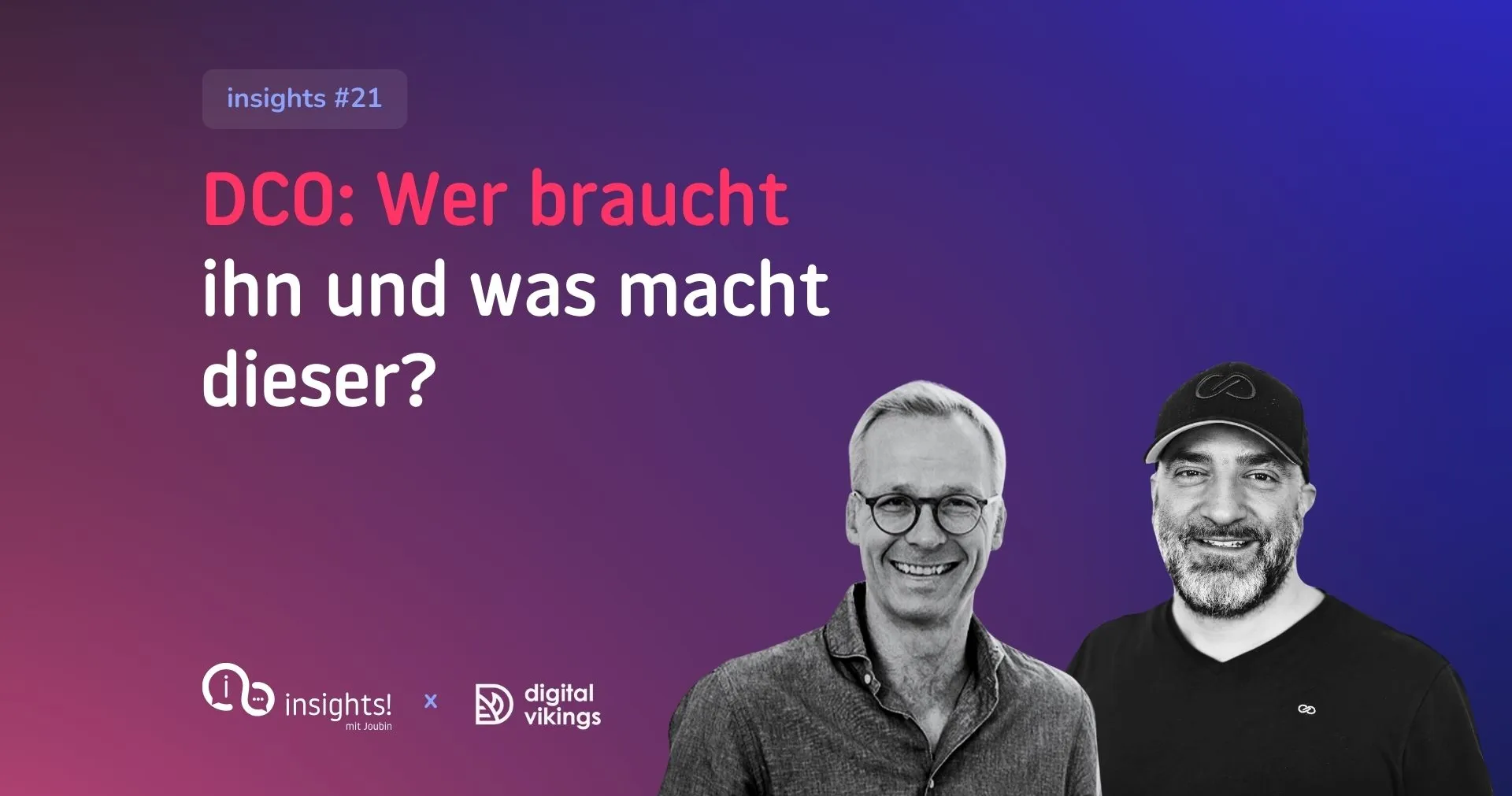
insights! episode #21: who needs a Chief Digital Officer and what do they do?
In their meeting, Joubin Rahimi and digital vikings co-founder Lars Rabe discussed modern organisational structure in the digital age. Now the two entrepreneurs have met in front of the microphone a second time. This time, the Cologne native and the Viking explore the question of what a Chief Digital Officer, CDO for short, is actually good for. A question some companies still ask themselves today, because in the hierarchy of organisational structure, the CDO didn't have it easy in the early years.
 Joubin RahimiManaging Partner · synaigy
3 min read
The CDO of the first hour was a toothless tiger.
Perhaps it's because the job profile of the CDO is considerably younger than the iPhone, believes Joubin Rahimi, host of the conversation. In the early years, roughly three years after the launch of Apple's success story, the odd forward-thinking company started hiring Chief Digital Officers. "They wanted to somehow get into the topic of digital business models," said Lars Rabe of digital vikings. But this first-generation CDO, as he calls them, was mostly filled merely as a staff role. In the traditional organisational structure there was no place for this role. "It was a toothless tiger," recalls Lars Rabe, one with plenty of great ideas but without any bite.
In the following years the tide turned; the once toothless tiger has since developed into a contender for a seat on the board. In some places the CDO mutated into a Chief Information Officer (CIO) and further into a CIO with a D, i.e. a Chief Information & Digital Officer. "That's a clear statement," says Lars Rabe, "you're not just responsible for IT, you're the CEO's sparring partner." Indeed, nowadays almost everything revolves around business understanding in the context of technological possibilities. Or, as Lars Rabe puts it: "These two areas are growing together." Even the CEO is now expected to have a certain digital competence. "The CEO of the future has digital DNA," Lars Rabe is certain.
Companies and organisations today expect a CDO aka CIO aka CDIO to understand their role as a "digital architect", says the Managing Partner of digital vikings. Ideally they think "in digital possibilities" and serve stakeholders as an advisor. They ask the right questions as much as possible – "What do we want to achieve?", "How customer-centric are we?" – and simultaneously come round the corner with the corresponding solution approaches. "As a rule, digital business models developed in collaboration with the various areas of the company," says Lars Rabe. Ultimately e-commerce is no magic trick, "technology has to fulfil a very specific purpose, such as competitive advantages and customer centricity".
Would you like to listen to the full episode?
Find the podcast of the interview here:
Please accept the corresponding cookies to view this embedded content.
Prefer to watch the episode? No problem!
You'll find a recording of the interview here:
Please accept functional cookies to watch this video.
Prefer to read?
Joubin Rahimi:
Great to have you back for a new episode of Insights. My name is Joubin Rahimi, and joining in studio today: Lars Rabe. Hi, Lars.
Lars Rabe:
Hi, Joubin.
Joubin Rahimi:
This isn't the first time we've had Lars with us today. And Lars has a really exciting career path. For one, Lars comes from the marketing tech environment, you founded your own company 20 years ago, Demandware, not Intershop.
Lars Rabe:
Intershop were kind of beginnings, then Demandware.
Joubin Rahimi:
Then Demandware.
Lars Rabe:
Then Demandware, and then we went public with Demandware, got acquired by Salesforce. Today it's called Salesforce Commerce Cloud.
Joubin Rahimi:
And you've also advised retail companies there. Actually the forerunner to the topic we have today: What makes a good CDO? What is a CDO? I already smiled at that, today we understand Digital Office to mean...
Lars Rabe:
...exactly, exactly. First off, one generally understands the CDO as the Chief Digital Officer. But there are also companies where they're the Chief Data Officer or Delivery Officer and so on. It's one of those topics – I think the CDO always gets dragged through the village a bit like the pig, so to speak. And if we look at the whole thing a bit historically, shall we go into that?
Joubin Rahimi:
Yes, absolutely.
Lars Rabe:
Yes, that's a job title or job description that came up about seven eight years ago.
Joubin Rahimi:
Shortly after iPhone, so three years after its launch.
Lars Rabe:
Exactly. And it was often the case that companies without a high degree of digitalisation, who hadn't yet mapped business models digitally but wanted to get into this topic, and the managing director or CEO at the time had relatively low digital exposure, would say: I need to bring someone in who knows their way around this.
Joubin Rahimi:
And actually they'd first asked the IT manager, so not the CIO, but the IT manager.
Lars Rabe:
Then the IT manager said, let's build a shop. And then he realised, the IT manager or the CIO, that he had no business competence at all. At least back then, so seven, eight to 10 years ago.
Joubin Rahimi:
They should actually always have that, even with the SAP implementation, ERP and co. I always took that on board. But then the new thing comes on top anyway.
Lars Rabe:
Exactly. How do you deal with web technologies? How do digital business models work? What's on offer? What can I even do? What actually makes sense in my company? And that's when many CEOs back then brought in a Chief Digital Officer as a staff position. So someone who comes from the business side, highly innovative, but usually not so strongly developed in the IT nitty-gritty of how you actually build such a thing. And the big challenge back then was actually that this role was always set up as a staff position, because how am I supposed to fit them into my traditional organisation? I have someone who does sales, marketing, then I have the IT lead, then I have project organisation. The Chief Digital Officer doesn't really fit in there. It's a bit of an overlay on top, but a bit of a toothless tiger. He brought in many ideas, many great models, and the organisation said...
Joubin Rahimi:
...thanks, take a biscuit and move along.
Lars Rabe:
What does it cost, not what does it bring? And that's why CDO 1.0 — there are still many companies operating that way, unfortunately — had no power. They basically advised the CEO. That was good for the CEO, who needed digital competence, otherwise he wouldn't have got anywhere. But mostly these CDOs, who also wanted to move up, stopped after two or three years.
Joubin Rahimi:
They went elsewhere.
Lars Rabe:
Exactly, very often. Because they simply couldn't do anything. The root problem was actually that the structure underneath couldn't handle it at all. You start from the top, try to push something in, and from below they say, what do I do now?
Joubin Rahimi:
We've actually already said the organisation is changing. So when I think about CDO, you've certainly already mentioned the technology. But if the organisation is changing, it also has to be part of the change.
Lars Rabe:
Totally, totally. Actually, the CEO nowadays has to be a kind of CDO. This role is actually moving out of this purely business context into a holistic context, into the context of technological possibilities. That means I also have to speak the language of IT and the language of software developers. And so this new CDO, as I'd call them, has a very clear technical competence and a very clear business competence. So they can come from the CIO corner, there are some really great people in the market. A woman was also just named CIO of the Year by CIO Magazine. She has the title CIDO – Chief Information and Digital Officer. That's a very clear statement: you don't just have IT, meaning boxes, software, cloud, security and delivery of digital business models, but you have the D, that you're the CEO's sparring partner. The CIO used to be tied to the CFO, classically, because they just burn costs, so the CFO has to control them. And the CDO was like a butterfly, saying, I have new business models here, and couldn't be caught by anyone. And now, this is totally exciting, these two areas are growing together. And that's when it all comes together.
Joubin Rahimi:
I'd like to take a step back. That point is totally valid, and I think it underpins the point I'm making: companies used to be built like clockwork. You have rigid processes that are relatively fixed and robust over a certain time frame. Now, markets change quickly, so they're much more volatile. I'm getting at the speed of change. So a company doesn't need to be set up as a fixed set, like a factory, but more like a city. Regardless of the fact that a city is much bigger than a factory. But I have various stakeholders who then do things and also demand and want things. On one side, you have to bring that together – the customer, the partner, the employees. Sometimes it's harder to get employees than customers. And I always say, you need a city planner. And that city planner, for me, is the CDO. Can you do something with that image, or would you say no, you'd see it completely differently?
Lars Rabe:
No, that resonates with me, definitely. I quite like that. I quite like the analogy too. I think the CDO has to think in possibilities as well. Even as a city planner, I have to understand where I actually want to go with it, what's the long-term goal of a company? City planner then moves a bit into the territory of architect too, he's a bit like the digital architect of success, you could say.
Joubin Rahimi:
He has to bring everyone together too, like urban planner.
Lars Rabe:
That person must bring people together. Must bring IT together, bring business together, must understand requirements and above all must understand what's happening in market. Because you just said there are companies that get overrun. You see what's happened in electric vehicles field. Everyone laughed it off, then bam, Tesla was suddenly there. Oh god, what's happening now? Then within two years they stamp out second-largest vehicle plant in Europe from ground up.
Joubin Rahimi:
And whoosh, now we have no chips left and the largest investment since '49, with €17 billion near Magdeburg.
Lars Rabe:
That's incredible, that's amazing. If you think about it on a smaller scale, that also happened in the digital space. Many companies simply ignored digital business models completely at first. eCommerce was obvious, because Amazon sold books and then everything else followed. And then companies said, damn, I now also need to sell digitally. So that's where the rethink first took place, because the companies that only operated in bricks-and-mortar all lost out. And they still have problems today, just look at companies like Galeria, for example. Great intentions, but they're still struggling so heavily with their legacy issues. And that's why you have to anticipate these things somehow, and that applies to every industry. What happened in financial services, insurance, banks, all the FinTechs and so on? I need this architect of success. And either it's the CEO who can really do it, who really has this 'digital first' mindset. Or I bring in a CDO who also understands the technology and doesn't just think in business models.
Joubin Rahimi:
That's point too. You mentioned Signa Group in effect. They'll all hit me now if I say that. But I think, because they actually come from real estate industry, that still resonates. And I don't see them as successful ones in market. And when I see figures and so on, I don't get feeling they're pushing forward. And on other side companies that then say, I'll put techie up front, they suddenly change great deal. I don't want to say now, techies to power, not that. But someone with technical understanding, we see that with our customers, they have significantly higher growth rates.
Lars Rabe:
Totally, I agree with you a hundred percent there. We always say the CEO of the future has digital DNA.
Joubin Rahimi:
So now you don't actually need a CDO, you need a CEO who can do digital.
Lars Rabe:
Yes, one can indeed combine these things, that the CEO then actually is the digital architect. But he must have his stakeholders, he needs a strong IT and he needs a strong business. And either there's a structure underneath that can do this, then you don't need a CDO either, then you simply have a CIO who also includes the D, so a CDIO, that makes total sense. And you have a strong sales arm and perhaps a strong production and logistics arm, if I sell products. And then I bring all this together into a sensible structure and then I can also manage the stakeholders properly, because they all share the same understanding of how to get there in the first place.
Joubin Rahimi:
And I have two questions right away that one or other listener is probably also asking: does a CDO or CDIO belong on the board, or under one of the board members?
Lars Rabe:
I'd actually do it that way, I'd bring business and tech together a bit, think in digital possibilities. And I'd position that directly below the CEO.
Joubin Rahimi:
So he's not part of the board, but under the CEO, and thus has a certain amount of power over other areas too.
Lars Rabe:
I would actually put them on the board, because in the past it was often the case that people reported to the CFO or somewhere else. The CEO has their executive board, and in my view that person needs to be part of the executive board and thus also part of management and/or the board. I wouldn't put them in the second row.
Joubin Rahimi:
With that you've actually already answered my second question: How do I make sure he really has impact? He can't be responsible for the entire business after all, tech and IT perhaps, but not the business. It's a matrix, that's more complex.
Lars Rabe:
Exactly. Also a really important point, matrix. Many people think of the film when they hear matrix, they just don't want to think in these matrix organisations. But today you actually need these people at board level and management level too – highly collaborative, united on shared goals. What do we want to achieve? Not, how much budget am I allowed to spend? But, what do we want to achieve? How customer-centric are we as an organisation? And the CDIO or the CDO or whatever you want to call them, with this strong technological component built in, has a mandate: they must essentially serve the business stakeholders, meaning product, sales and so on, as an adviser. They must be available as a change agent and adviser and say, look, I know what you're planning, here's how we solve it digitally, these are digital business models, can you work with that? And then they work on it together. And then the CEO comes along and says, okay, what does that actually mean in terms of revenue and bottom line? Over 12, 24 and 36 months? And then they say, okay, that's what we want to achieve. Technology isn't a hobby after all, it has to serve a very specific purpose – more customer-centricity, more competitive advantages, and so on. And that's where I see the CDO or the CIDO as a change agent. That's hugely important.
Joubin Rahimi:
The question that probably the CEO also asks themselves in the end is: what needs to go into such a job profile? Who am I looking for? How do I recognise a good CDO? Do you have two, three tips there where you'd say, these are good points? Does he need your profile? You could certainly also fill such a role yourself.
Lars Rabe:
Probably too little I, since wasn't deep in core technology. What must such person bring? Interesting. Actually had a customer recently, similar search. Customer came and said, we're looking for a CDO, responsible for digital business and so on. And what about technology, who's responsible for that? Well, IT lead handle that. Then we said, no, must bring together, must be one person from technology side, from digital side. Someone say, okay, seen something like this before, already built a digital product.
Joubin Rahimi:
I have plan, I have blueprint for it.
Lars Rabe:
I have a blueprint for that. And above all, this high-level understanding of modern IT solutions. Nowadays people say there's two-speed IT in many companies. There's the hardcore IT, ERP systems and whatever else. And then there's digital IT, e-commerce, digital transactions, payment and everything else, moving really fast. And the CDO has to bring these two things together and say, it's one thing, because there's only one customer, and the customer doesn't care whether this turns slowly or thinks quickly. And so, less someone who only thinks in traditional IT systems, someone who's actually been very much involved with cloud topics, who knows modern architectures. Modularity instead of monoliths, headless microservices is always a topic too. But it always depends on where you currently are. But also a very clear understanding of business applications. It doesn't have to be a Head of Sales or Head of Product or similar, but it's quite good if you've also come out of a digital product organisation at some point. We've seen people as CDO who were actually Head of Product, so they helped develop digital products, but also have a very strong passion for software development, cloud topics and so on. What we usually do is sit down with our customers and run a workshop here too, to really understand where the shoe actually pinches.
Joubin Rahimi:
What's the real pain point?
Lars Rabe:
What is the real pain point? What do you currently have in the organisation? And then the job description should really be aligned with that.
Joubin Rahimi:
We're slowly drawing to a close. But I have one more question, which is basically the transition to the next session: what role does a CDO typically hire first for themselves?
Lars Rabe:
For themselves? PMO. Because there are so many projects that need to be delivered. But a CDO actually needs a digital product organisation, and the digital product organisation is really the link between business requirements and IT delivery. That's the first thing I'd bring in.
Joubin Rahimi:
Then let's just talk about that next time.
Hope you enjoyed it. Have to say, I took something away again.
Thanks, Lars. And if you have questions, feel free to leave them below in the comments or as a direct message.
We look forward to entering the discourse with you.
Until next time, goodbye!
Have questions or feedback?
Then feel free to contact us directly.
- Joubin Rahimi
Managing Partnersynaigy
Show phone numberShow mobile numberShow email address
Subscribe to the blog now and never miss any news
✔️free of charge ✔️weekly news ✔️expert knowledge
Please accept the corresponding cookies to view this embedded content.