



insights! episode #22: diversity, equity and inclusion - how can these guardrails be successfully integrated into company culture?
Because the first two podcasts went down unusually well with listeners, synaigy CEO Joubin Rahimi and Digital Vikings co-founder Lars Rabe sat down together at the microphone for a third time. And today, too, the pair have a topic in tow that's currently on everyone's lips: diversity within the company. Not a few initially think of a balanced ratio of female and male employees. Or the introduction of gender-inclusive language. In fact, though, a diversity-oriented corporate philosophy encompasses far more, and far more profound, aspects.
 Joubin RahimiManaging Partner · synaigy
2 min read
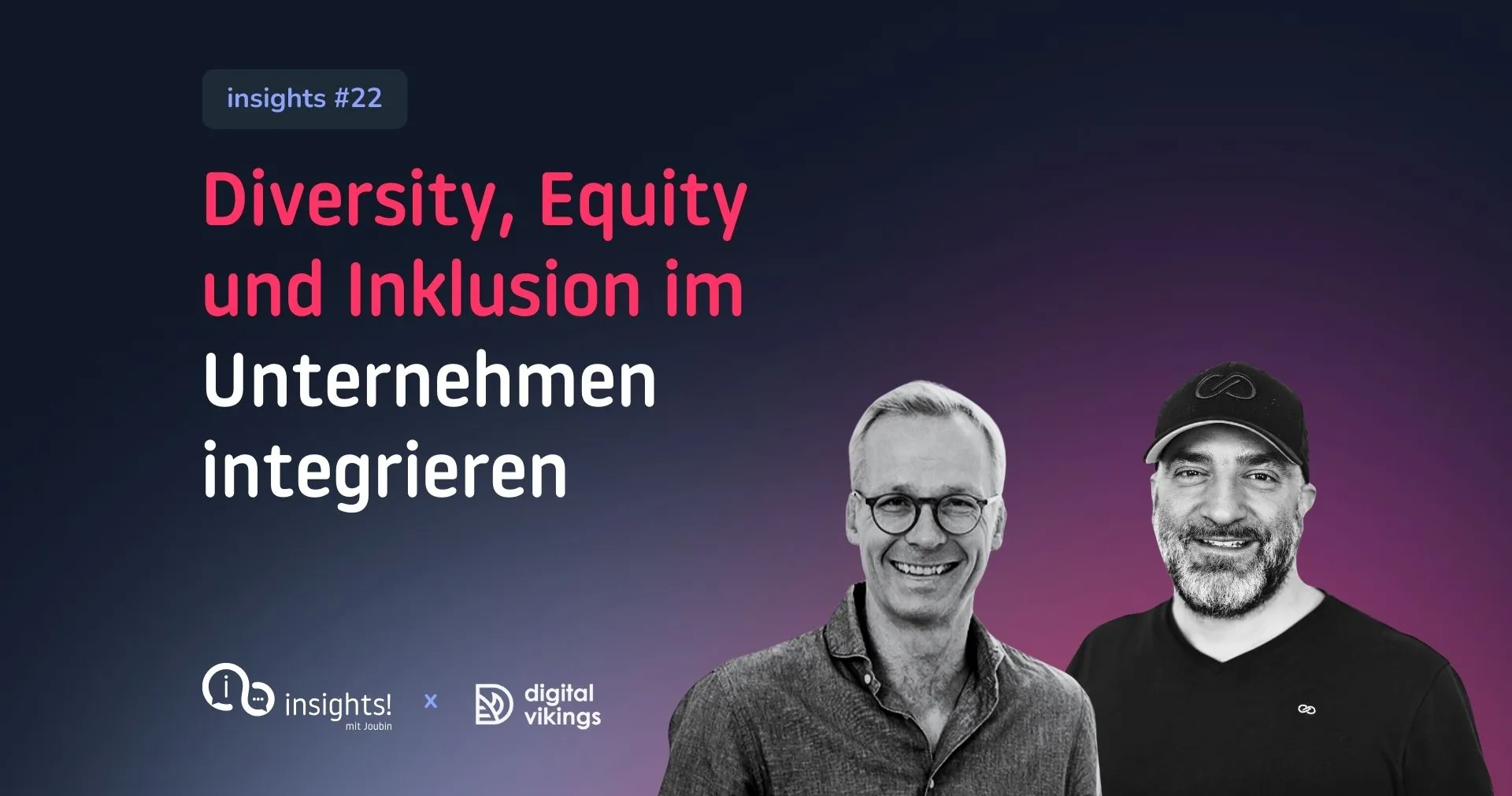
A diverse team should be built out of genuine conviction.
It's just three letters, D-E-I. Three letters that broaden staff awareness at Lars Rabe's HR organisation company. Diversity, Equity and Inclusion. The topic has a huge dimension, says the Berlin manager, so huge that the digital Vikings decided to send an employee on a training course. She came back as a Diversity Manager. "So that we know what can even be done in this area at all." For this year, for example, the company has planned to bring a person with a disability onto the team. "But a disability can also be diverse." Visually impaired? Or rather mobility-impaired? Lars Rabe can only warmly recommend a diversity manager within your own organisation. "Then you have a mouthpiece in the company that really engages with the topic."
However, the transition to a diverse and colourful working life needs to be planned. “It should come from genuine conviction,” says Lars Rabe, “then it's also legitimate if the company becomes more successful as a result”. If purely economic benefit is the priority, he rejects Diversity & Co as “hypocritical”. Companies that make space for D&I out of conviction would “firmly anchor it in their value system” anyway, Lars Rabe is convinced. At the same time, management would do well to create corresponding awareness among employees. “People have to get on board,” says the Berlin native, “the foundation has to be right”. This includes, for example, that organisational leadership sets the framework, for instance also hiring new employees with the aspect in mind “that they're open to such topics”.
Naturally, the economic aspect shouldn't be neglected either — after all, diversity can only thrive long-term on profitable ground. Lars Rabe dismisses the argument that a diverse team is ultimately primarily a cost driver, pointing to various studies. These have shown that diversely staffed teams have more satisfied employees, which usually leads to economic success sooner rather than later. "They're definitely more successful," says Lars Rabe, "and that means both sides win".
Would you like to listen to the full episode?
Find the podcast of the interview here:
Please accept the corresponding cookies to view this embedded content.
Prefer to watch the episode? No problem!
You'll find a recording of the interview here:
Please accept functional cookies to watch this video.
Prefer to read?
Joubin Rahimi:
Great to have you back for a new episode of Insights. My name is Joubin Rahimi, today's topic is D-E-I with Lars Rabe. Hello Lars! So, D-E-I, what is that?
Lars Rabe:
Everyone is asking that now, D-E-I, a topic that is very prominent at the moment, though many organisations do not quite know what to do with it. Specifically, it concerns the three words diversity, equity and inclusion. Translated, it is about the diversity of employees within an organisation. And this has an enormous number of dimensions and is, in my view, a topic that every organisation nowadays has to address in some way.
Joubin Rahimi:
That's why I said, let's talk about it. Diversity is something that moves us across many topics, too. With around 20 people you're a small company, but you already do a lot around it.
Lars Rabe:
So, Digital Vikings has existed for five years. I joined two years ago, and yes, we're a small company.
Joubin Rahimi:
Diversity is on everyone's lips, we often see that in job postings, more women. Everyone was clear on that. But equity and inclusion?
Lars Rabe:
Yes, well actually my dear colleague Gina should really be sitting here today, because she's the one driving this topic forward for us. Really great. I don't think Thomas and I would ever have got so deeply into this topic back then if Gina hadn't pointed us towards it so strongly. Above all, it has so many different layers. It's not just about using gender-neutral language or anything like that – you can do that, it's an important topic. It has so many factors. And it's now proven that if you have a very diverse corporate culture, with a great variety of different ... It's not just about male/female ... It's about the topic ...
Joubin Rahimi:
... Origin
Lars Rabe:
Origin, exactly.
Joubin Rahimi:
That affects me too, precisely.
Lars Rabe:
Exactly, we can talk about that right now. Origin, attitude, it's about so many themes, gender preferences and so on, in all possible areas, that has so many dimensions. I notice that in myself too, how you perceive other people, how you approach other people. In English that's called unconscious bias, that you put people straight into pigeonhole somewhere, completely subconsciously. And we've committed ourselves to being very active there, and Gina for example did training with us as diversity manager, so we know what actually needs doing there. That's also about themes like, how can you for example better integrate people with disabilities into company? And we're firmly convinced, and there are some studies on that, that if you have diverse company culture, a) through diversity you're definitely more successful as company and b) above all also have more satisfied employees, so female and male employees.
Joubin Rahimi:
Americans phrase hiring people with disabilities more nicely: with "handicap".
Lars Rabe:
Yes, absolutely.
Joubin Rahimi:
And then it's not always the same thing either. My mother worked at a care home for people with disabilities, and as children we used to go there and play C64. There was one person I couldn't play it with, he had epileptic seizures. But we have such different kinds of disabilities. That's also a question, are you rebuilding something or not? Or do you say you focus on it? Can we even ask that yet, are you still at the beginning of the journey.
Lars Rabe:
Interesting, we actually had a Lunch & Learn on that at our company yesterday too, we do that every two weeks on a topic that interests our people. Lunch & Learn on the topic of inclusion, particularly of people with disabilities. And it was a very interesting discussion, because disability can be quite varied. Either someone has a mobility impairment, a visual impairment, epilepsy, there are different factors. So we asked, what does it actually mean if we bring such a person into our company? And we've also written that into our goals for this year, we want to bring someone with a disability into the company, because we need equal opportunities everywhere, across all social strata, all parts of the population. And what does it mean, for example, if we hire someone in a wheelchair? Do we need to convert something? Yes or no? We still don't know many things, but the interesting thing is, there are companies that help with that. There's an organisation, for example, called Inklupreneur, we've formed a partnership with them, and they advise us. They help us understand what it means to bring people with disabilities or whatever into the company and how to handle it. That starts with the job ad and job description already. And then, we're a personnel and organisational consultancy, so there's a lot of research involved too. Then, for example, it would make sense if we have someone with, say, a mobility impairment, for them to work from home for us. Because that person can of course fill that job completely normally. I think a company just needs to make that a priority. Nowadays almost every company has its own set of values, what are our values? And we said growth, mindset and transparency and communication at eye level, all these topics. But actually this foundation is missing. And for us, that foundation is called Diversity, Equity and Inclusion. So that we say, we are diverse, we are colourful. Two years ago, for example, there was maybe one woman at our company, we were only five, six people back then. Now we're fifty-fifty. But it's not just about women and men, it's about all these different aspects of life, that we accept every person as they are, he, she or they. And that's always also a question of appreciation towards other people.
Joubin Rahimi:
We also have a slogan for it: Keep the assholes out. It's about simply not having assholes in the company. But question is, how do you recognise someone? There's a really nice American blog that looked into it. They said, if the asshole says everyone's against him, that's a very strong indicator that either he's genuinely swimming against the current, and rightly so, but in an emphatic way. But then feedback like that doesn't come. Or the person is one. Funny either way. But back to the topic, diversity. You'd also said this affects Germans, non-Germans or people who've moved here, refugees. Terminology keeps changing faster too. We also ask ourselves how we can handle it when we say we'd like to work with Ukrainians? So very specifically, there's a language barrier, a particular situation, that has to be accounted for. But also sustainably, in line with whatever comes next.
Lars Rabe:
Absolutely.
Joubin Rahimi:
Do you deal with that too? Do you have topic on that too?
Lars Rabe:
No, don't have that yet unfortunately. Nothing. If you look at Ukraine now, that's very interesting topic for our sector. We're active in digitalisation and Ukraine has huge number of highly talented software developers, data analysts and so on. Normally one should offer these people platform, as long as they can't return to their country because of terrible conditions there. Surely something can be done there too.
Joubin Rahimi:
There are also several platforms we can link below, job platforms. We've also considered whether to build one ourselves or not. Don't know yet. Does the world need another one? That's also a question. Or do we just post about it? But is that then just thought of selfishly? Well, there's talent, now let's see somehow. That resonates, it personally holds me back on this. You've perhaps had that discussion in the D-E-I topic too.
Lars Rabe:
Yes, we actually have that discussion in the D&I space too. And there are companies that are very successful and doing very well in this area, like Salesforce, for example. Salesforce is, I'd say, if you look at the large enterprises, the absolute industry leader when it comes to diversity topics. On the one hand they do that out of genuine conviction, I do think so. On the other hand, of course, there's always an economic component to it too. I also always ask myself personally, does that leave a bit of a bad taste? Personally I find it very legitimate if a company becomes more successful as a result. But if you do it exclusively to become more successful as a company, that's perhaps a bit hypocritical. I think you really have to have that firmly anchored in your value system. Not say, yes, we do this because we can't find software developers right now, so let's just take people from Ukraine. Then we're the great ones and so on. There too, again, the foundation has to be right, the value system, the people in the company have to be on board too. And that's where management is called upon, you know this too as head of a company. You have to bring people along. And there are people who haven't really got that on their radar yet. That's why it's always important to create awareness in the company. Language creates awareness too. How do I address people? How do I talk with people? How do I approach this topic at all? And that's of course where we as business leaders are called upon to lead by best example. And not make a fuss about it, like, we have to look into this and so on. No, you really have to be firmly convinced of it. And we know each other quite well, this is something that's firmly part of you too, this topic.
Joubin Rahimi:
I would say there are employees who are much more firmly convinced of it. We have other topics on top of that too. The whole thing still has to be profitable. So securing the future for our own employees. At the moment no one is afraid for their job, but ultimately I am still responsible for making it work – to those who have put money into the company and to the employees. That is quite a balancing act. But you said something nice: it has to come from the employees. And I believe if we create space in that context so it can be done, then that is good.
Lars Rabe:
I think so too. I believe that's an important point, that as entrepreneurs we essentially provide the framework and bring the right people into the company, people who are open to these topics too. You don't necessarily have to say I'm now the champion of XY. It doesn't matter, people just need to be open. And if we can provide the framework and also the opportunities for people to develop freely within the company, then employees win, and so do we. Because then there's an economic component to it again. Then you have satisfied people on the team, and through that, usually sooner rather than later, economic success follows too.
Joubin Rahimi:
You're at the start with this topic. I'd suggest we gather some feedback, and in six or nine months we sit down together again and you can tell us what steps you've already taken and what the first experiences have been.
Lars Rabe:
Gladly. That's a super exciting topic, I learned so much from it. I always thought, come on, I think in a diverse way and whatever, and then so many topics come up. It's so multi-layered and, in my view, really needs to be firmly anchored.
Joubin Rahimi:
When you say, okay, I don't want to wait for the second interview that might come, but want to get started already. Right at the beginning you mentioned an association that deals with this.
Lars Rabe:
Exactly, Inklupreneur. It's particularly about people with disabilities, because it's very complex topic. It has many, many different facets. We can highly recommend this. And there are also different institutions in this area one can engage with. Training as diversity manager also doesn't cost much, brings a lot, because then you have mouthpiece within company. I believe you need person who really engages with this topic and also helps entrepreneurs create guidelines.
Joubin Rahimi:
We'll just link that in below, so you can go straight to it. And as a note, this isn't paid, it's simply from experience. And we're looking forward to a discussion. Feel free to give feedback too, are you interested in seeing how things went for you in nine to twelve months? What experiences you gathered? What was good, what wasn't good? I'm looking forward to that. Thanks, Lars!
Lars Rabe:
Thanks, Joubin!
Joubin Rahimi:
Thanks for listening.
Have questions or feedback?
Then feel free to contact us directly.
- Joubin Rahimi
Managing Partnersynaigy
Show phone numberShow mobile numberShow email address
Subscribe to the blog now and never miss any news
✔️free of charge ✔️weekly news ✔️expert knowledge
Please accept the corresponding cookies to view this embedded content.