



insights! Episode #23: Head of Product: a product owner or rather a conductor of an interdisciplinary team?
Host and synaigy CEO Joubin Rahimi and the co-founder of Berlin's Digital Vikings can't get enough of each other: today marks the fourth and, for now, final time these two digitalisation veterans exchange views as part of the "insights!" podcast series. This time they take a closer look at the role of the Head of Product. The title is often misleading, since only a few of them are actually responsible for a product in the strict sense. Lars Rabe regards him, in a way, as a conductor and translator within a company's organisational structure. Given such a wide range of facets, it's no surprise that there's no classic career path to becoming a Head of Product.
 Joubin RahimiManaging Partner · synaigy
3 min read
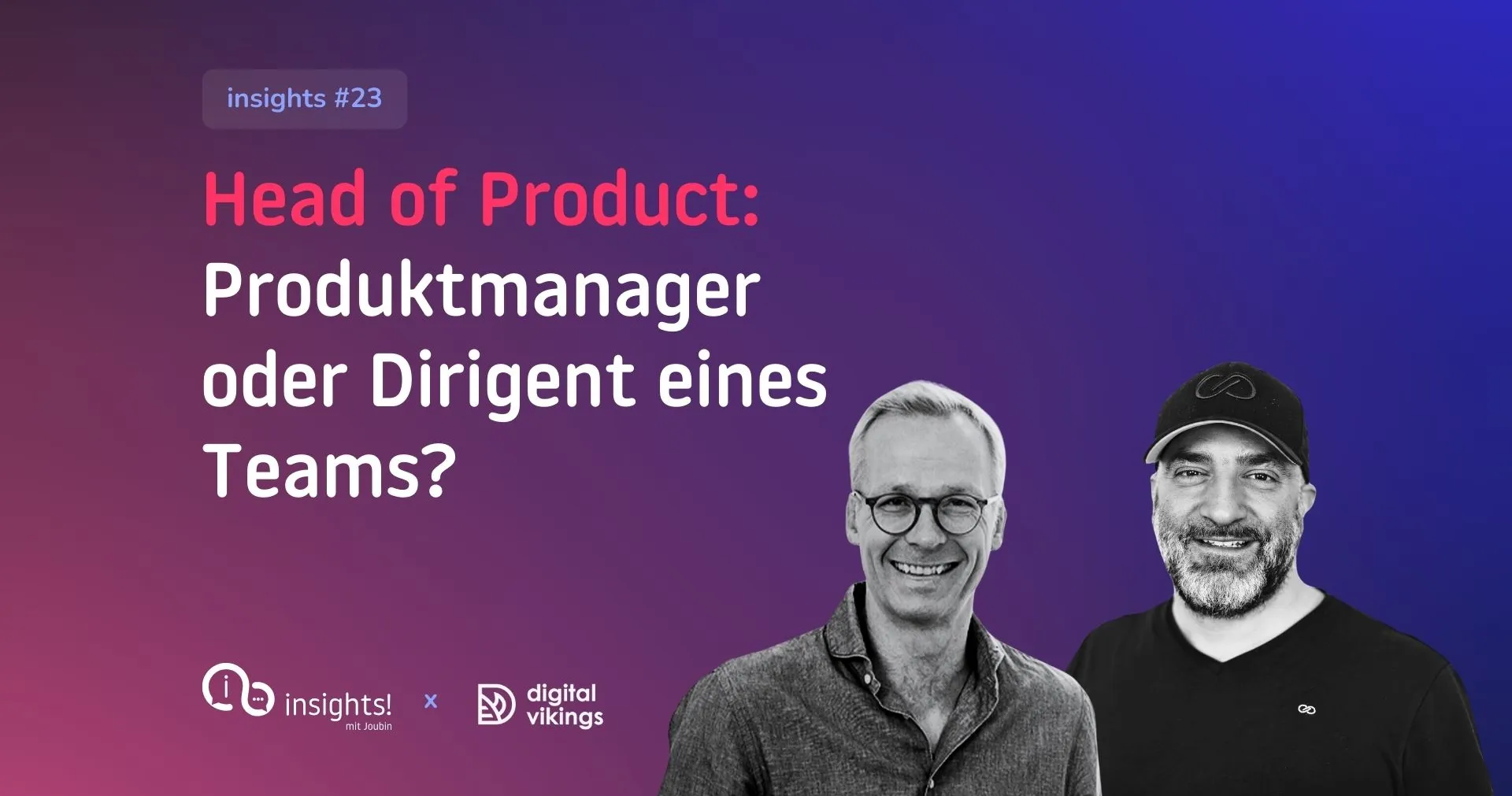
He's essentially conductor of an interdisciplinary team.
The job title suggests a Head of Product is responsible for a specific product that the end customer can buy with a few clicks in the online shop. But far from it, a Head of Product operates behind the scenes, hidden from the customer. "They're ultimately responsible for ensuring the digital construct that is the online shop meets the requirements of customers and the market," says Lars Rabe. And that task has real substance to it. In the early days of e-commerce, the digital Viking recalls, IT usually cobbled the online shop together, "with off-the-shelf software." Marketing would then grumble about the result, new features would appear overnight, and "in the end it was all a total mess." Today, the Head of Product leads a multidisciplinary team of product owners, UX people and software developers, who combine their respective expertise to piece together the complex puzzle that is the online shop. "The Head of Product is the conductor," says Lars Rabe.
And a conductor like that quickly finds themselves caught between many stools. In the internal process, the requirements of sales, marketing and supply chain need to be taken into account, all with their own interests, which are often as different as can be. "The whole thing then has to be translated into individual product strands," says the Berlin-based HR and organisational consultant, "which are later implemented by the software developers". And along the way, it is essential not to lose sight of the customer. They need to be given a good user experience "so that they come back". A successful Head of Product therefore keeps the entire value chain on their radar, "because if I have a great product at the front of the shop, but logistics cannot get it out the back, none of it is any use". Lars Rabe also calls this "the holistic lens": always thinking in terms of possibilities – what is currently happening in the market? What does the customer actually want?
As varied as a Head of Product's tasks are, so varied can their career path be. There's "no typical path" for it, says Lars Rabe. It could be a UX person who wants to get more involved in the product vision, but also a "software developer aiming for more customer contact". Alongside a holistic view of the job, a technical affinity and absolute customer centricity in particular should be present. "And the passion to deliver a great product with the goal that the end customer is happy."
Would you like to listen to the full episode?
Find the podcast of the interview here:
Please accept the corresponding cookies to view this embedded content.
Prefer to watch the episode? No problem!
You'll find a recording of the interview here:
Please accept functional cookies to watch this video.
Prefer to read?
Joubin Rahimi:
Great to have you back for a new episode of Insights. My name is Joubin Rahimi and in the studio with me, Lars Rabe. Hello, Lars!
Lars Rabe:
Hello, Joubin!
Joubin Rahimi:
Lars has quite an exciting background, you've been in digitalisation for over 24 years now. It's terrifying, we're hiring people younger than 24!
Lars Rabe:
Yes, me too.
Joubin Rahimi:
And in my view – and you certainly not – we don't belong among the old, white men, certainly not in mindset. Especially in digitalisation you've picked up on so much that we've already done a few sessions, and today the topic is Head of Product in the context of companies undergoing digitalisation. Head of Product, what is that, I don't just have one product?
Lars Rabe:
Right, that's often misleading too. But I'd also like to say something about the old, white men, because you're absolutely right there. I think we're also the ones who are called upon to build a diverse company culture, so that people come from everywhere, because especially in the digital sector there are an awful lot of men around, white men in fact. And we, as the old hands, are called upon to make the whole thing a bit more diverse, more colourful.
Joubin Rahimi:
I'm pleased to see more female candidates from you, for us.
Lars Rabe:
All sorts of flavours, that's really important, it's a topic close to our hearts too. But Head of Product – right, let's set aside a classic manufacturing company for a moment, because there a Head of Product is probably the person responsible for a physical product. Today we're talking in the context of digital products, so digital products or digital services. And you can illustrate that fairly simply with an online shop, e-commerce. There, the Head of Product and their team are responsible for making sure the digital product "online shop", along with its upstream and downstream systems, works, keeps evolving, and stays aligned with customer needs.
Joubin Rahimi:
So here the term product isn't what I can buy as a customer, but it's the internal product, an intermediate product, you might say.
Lars Rabe:
Yes, exactly. It's really the internal digital product that serves the customer experience across digital channels. Where does this actually come from? That's a question worth asking. In the past, it was like this: online shop, staying in this e-commerce analogy, someone would come along and say build an online shop. Who does that? IT can do it! Then IT would wonder where do we even get one? And then some off-the-shelf software gets bolted in and that's it. So that gets built, and then Marketing comes along: we imagined this completely differently. Then new features get thrown over the fence, total chaos. This all needs to, or needed to, be orchestrated completely differently. And the Head of Product is ultimately responsible for making sure this digital product meets customer requirements and market requirements. That the requirements customers place on the company, and internal stakeholders — sales, marketing, supply chain and so on — place on the product, are understood. And this whole thing, and this is a really crucial function, also needs to be translated into product workstreams that developers later implement. Because often what happens is developers get something thrown over the fence, there's some ticketing system or whatever. And then it gets worked through without making any real sense. That's how it used to be done. These days, there's a Head of Product responsible for orchestrating the internal digital product.
Joubin Rahimi:
This person then immediately faces a new challenge. You're describing a developer who isn't just allowed to be a techie, but actually has to look beyond previous boundaries too.
Lars Rabe:
Yes, exactly. That's mostly why it's not a software developer, because they want to solve one specific problem through software, and they do that really well too, because that's their thing, programming and so on. The Head of Product might come from that area, but must definitely understand how software development works, that's really important. How does software development work, either in a classic or agile environment? But the Head of Product must understand how requirements from the market, from the company, from customers, can be translated into digital products. You could call it a translator role. You also need a vision, the Head of Product also develops the product vision, that's really important. And this product vision needs to be turned into a roadmap. Roadmap means what's my path, which features, functions, which software solutions actually come when? And that person is responsible for that.
Joubin Rahimi:
That's not simply translating from English into German. You had the business requirement, but also the customer. I need to map the process in the transaction, I have my processes behind it and people who still need to give approvals. But on the other hand, I also have the customer who says, I want it to be simple.
Lars Rabe:
Exactly.
Joubin Rahimi:
Meaning, it has to translate various languages into one.
Lars Rabe:
Yes, exactly. And the Head of Product can't do everything themselves, they usually have an organisation beneath them consisting of POs, meaning Product Owners. A Product Owner is then usually responsible for one area of the product. In e-commerce that could be, for example, the topic of checkout, because a checkout is a highly complex construct. As an end customer I say, click, pay, done. But the right payment methods need to be in there. Is it a one-page or three-page checkout? Do I have address verification in the background, credit check? But it still has to be simple. And the Head of Product then says to the Product Owner, listen, our customers say the checkout is too complex. How do they know that? They've done market research, there are NPS surveys, meaning Net Promoter Score and so on. So, then you have to sit down and say, what is this requirement actually? And you always actually have to, as the very first step, and this usually only happens in the second step, bring in the end customer and say, what do you actually need? So, I want to check out via Apple Pay or I want facial recognition, no idea. So first I have to ask the customer, so I need a lab of key users. I have to recruit the people, ask, what do you actually need?
Joubin Rahimi:
Does the Head of Product do that themselves? Or do they have a team? Or do they outsource?
Lars Rabe:
Exactly. A Head of Product usually has about three core functions or three core areas. There's the Product Owner topic; a Product Owner often writes so-called user stories. So, how does the user move within this area? What does that actually mean? What would they like to have differently? From that, a product vision or a product strategy emerges for that particular area. Usually the whole requirements management is tied in there too. Either that's also within the PO's position or it's a separate role called Requirements Engineer, so requirements manager. The Product Owner is responsible for ensuring their area, so within the product organisation, gets delivered. They have to make sure the software actually gets delivered too. But that's usually tied to another organisation, which usually isn't within the Head of Product organisation. It can be, but doesn't have to be. And then, right at the end, which is what I wanted to get to, come the testers. And that's also very often where the UX topic ties in. UX means user experience, meaning how does the user go through the individual steps, in the shop for example? That's why the whole UX areas are often tied in too, because the topic of user experience naturally defines the product in turn. And that's why I often have a PO, I have a UX manager, UX designer, maybe I have UI people involved too, so people who really do the design. And I have a tester at the back end who then tests whether the thing actually works and whether it's even accepted by the users that way.
Joubin Rahimi:
I find that thoroughly fascinating. We have UX people in-house too. But that's the area clients find hardest to accept. Everyone nods, they say, yes, okay. But then we need someone else, that costs 20 days. I'll do it with the little flags. No, that's silly. Can't we just have a few testers at the end? They'll take a look at it.
Lars Rabe:
Then it's too late.
Joubin Rahimi:
That's like an architect for the house. If you bring them in at the end, everything's already done.
Lars Rabe:
Yes, interesting too. I think a UX person is very often much more a business architect. With UX many always think of colourful pictures. No, that's what the UI person does, the designer maybe. But the designer works with what comes out of the UX area, meaning I need to be highly analytical there. I need to look, I need to pull in data, what's happening right now in my online shop? Where do people enter, where do they drop off? Where might they want more information? How can I change that? So UX is very, very, very analytical, and many customers don't understand that, because they always think UX equals colourful pictures and just stick a little flag on it and it'll somehow fit. I have so much data nowadays that I can use it, and the Head of Product orchestrates that with their organisation.
Joubin Rahimi:
For the Head of Product, data belongs to that too. Or is that a sub-area of UX?
Lars Rabe:
It always depends. In UX, data is the basis for deriving recommendations for optimising the user experience. But then again, in the data field you have a lot in the area of transactional data, like how I optimise my conversion funnel, optimise my product range and so on. There's actually a separate data organisation, because it's again very specific. Either it's set up in a matrix way, so I have a BI area or a data analyst, web analyst, maybe also a data scientist who then ... You could do separate sessions on that too ...
Joubin Rahimi:
That's exactly what I was thinking too.
Lars Rabe:
There's certainly more to say about that. And that's actually usually its own organisation, which has different customers. So, one customer of the data organisation is UX, one customer is marketing, one customer is management, one customer is finance. I'd see the data organisation as its own area, as a service organisation that essentially serves the internal customers.
Joubin Rahimi:
Basically just like IT.
Lars Rabe:
Exactly. My customer has to be happy, and my customers are the internal staff, depending on what I'm doing at the time as sys admin or otherwise. And the head of product's task is to say that their business organisation, so for example the head of e-commerce or the managing director, has to be happy because the figures are right. The end customers have to be happy. How do I measure that? Either, for example, if they're guided smoothly and properly through checkout, if we stay with the e-commerce topic. Because head of product exists in other organisations too. But with e-commerce it's just very obvious. So the end customer has to be happy. I also measure that by whether the customer comes back. If I have a poor product in my online shop, the customer won't come back either. But if the user experience is good, the customer will very likely come back. Checkout was easy.
Joubin Rahimi:
But that's not just digital either. This user experience, this Head of Product role, isn't purely tied to digital. It always depends on the system, of course.
Lars Rabe:
Yes, that's true. Actually a Head of Product is committed to the digital product. But he or she has to keep the entire value chain in view. Because if I do something really great up front, in the shop for example, made a great product, but logistics can't manage it on the back end, then that doesn't help either. Then delivery on the back end is just poor. A Head of Product can also relate to other topics, saying, we now have something really great, if you buy three products in the shop, you get another one free or something. But that can't be processed by the ERP at all. That's also poor and doesn't help either. You have to put on a holistic lens there. I think the important thing is really that you keep thinking in terms of possibilities here, look at what's happening in the market. What do the end customers want? I think that's probably the driving element, that you need to know what the customer actually wants. And this product organisation didn't exist ten, twelve years ago. That's rather new, and it's really because companies are becoming ever more customer-centric. There's really only one target group you're always committed to, and that's the end customers, because they buy the products. Or in the B2B sector, the business customers.
Joubin Rahimi:
I'd like to ask now, how do I recognise a good Head of Product? They must be able to understand the customer. That's the first point, being able to put yourself in the customer's shoes.
Lars Rabe:
Definitely.
Joubin Rahimi:
How do I recognise a person like that?
Lars Rabe:
Yes, good question. First I was PO, meaning Product Owner, or I come from the UX field or I come from the classic e-commerce field. This image of a Head of Product can be very diverse, they can come from very different fields. But you always have to have something to do with this topic of customer centricity. There are also Heads of Product who come from the UX field. UX is, in my view, a very underestimated discipline. There are now companies that align their entire IT with UX principles, because it's only about user experience. Many come from the UX field and that's why there isn't such a typical path. I think it's more the passion for delivering a great product with the goal that the end customer is happy. And of course I need a technological understanding. If I don't have that at all, it's difficult, because then I come up with some abstruse ideas, where the development area then says, for heaven's sake, what are you doing there? Or I hand it over to an external service provider, like you for example, then they say to themselves, what has this person come up with, we can't manage that at all. So I always need this holistic view. I need this technical flair combined with this absolute customer focus.
Joubin Rahimi:
And that's already exciting.
Lars Rabe:
I find it a really exciting role. It could be someone coming from software development who says, I want more customer contact. It could be someone from e-commerce who says, I'm more technologically oriented. It could be a UX person who says, user experience is my thing, I've worked a lot with data, but I'd rather develop more of a product vision. So there are different entry points into it.
Joubin Rahimi:
And there's no proper study programme for it, I find. There's of course an e-commerce direction and so on, but that's always only a topic on a professional level.
Lars Rabe:
In my view, the study of business informatics should be given greater standing. Computer science makes sense, absolutely. Business makes sense too. But when you consider what will happen in future, these things really need to be combined with one another.
Joubin Rahimi:
Then straight away with different name: Business Tech!
Lars Rabe:
Exactly, business tech. And in my view that's a good place to file it. But I haven't really seen it mapped out properly anywhere yet.
Joubin Rahimi:
Well, you're aware of it, you're looking for the people after all. And actually you've already described where they might come from, that they're usually people who've already taken one or two steps, so they can even grow into this role in the first place.
Lars Rabe:
Absolutely. And you see that with people who start out as product owner or as UX designer or UX manager, so to speak. They usually have a very tech-affine degree and develop from there somehow. This leadership role really needs to have seen a bit of everything already.
Joubin Rahimi:
Thanks for the insights on that. If you have questions, as always, drop a comment or send us a direct message! We look forward to the discussion. Until next time, thanks Lars!
Lars Rabe:
Thanks, Joubin.
Have questions or feedback?
Then feel free to contact us directly.
- Joubin Rahimi
Managing Partnersynaigy
Show phone numberShow mobile numberShow email address
Subscribe to the blog now and never miss any news
✔️free of charge ✔️weekly news ✔️expert knowledge
Please accept the corresponding cookies to view this embedded content.