



insights! #26: Symbiosis between sales and marketing as a navigator for revenue growth
In the conversation between Head of Sales & Marketing Ali Saffari and Joubin Rahimi, everything revolves around the symbiosis between marketing and sales and how this can succeed in today's digital world. You'll also learn how data-driven working can lead to a full pipeline for sales.
 Joubin RahimiManaging Partner · synaigy
2 min read
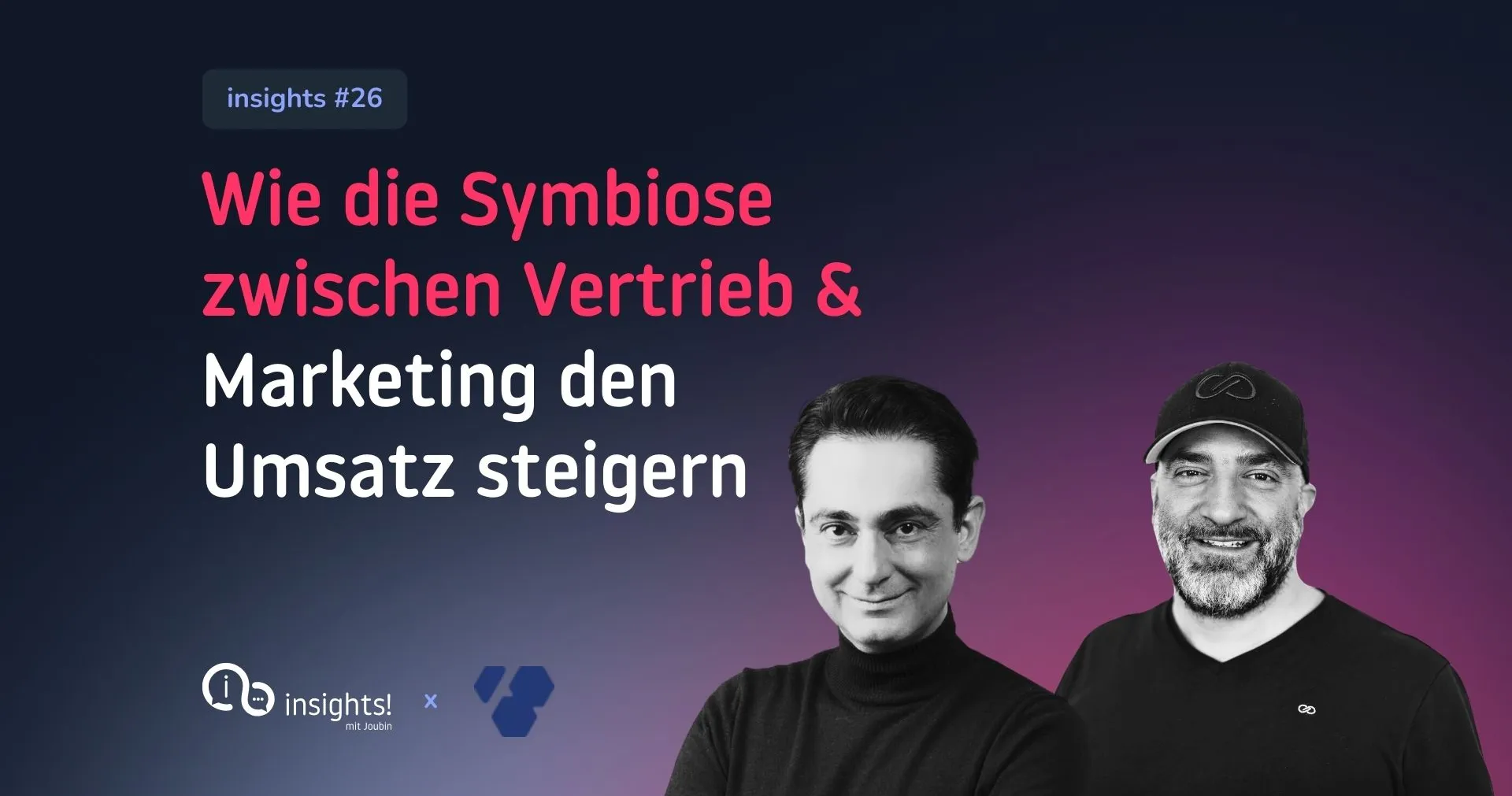
Data-driven sales through the close integration of marketing and sales
At the time of the insights episode, Ali Saffari was still Head of Marketing & Sales at Trusted Shops. He now works at casavi. In our conversation, Ali explains that his earlier training as a software developer gave him the right grounding to now take responsibility for marketing and sales and drive them forward sustainably. His technical understanding helps him especially when introducing software. When he and his team at Trusted Shops wanted to introduce marketing automation software, they found that the organisational structures were inadequate to achieve data-driven working in the marketing and sales team. So before the rollout, they had to take a step back, bring employees on board and train them, and restructure the organisation.
In the marketing and sales team, it matters that both sides commit to working together. While marketing, or demand generation as Ali Saffari calls it, is meant to deliver a certain number of high-quality marketing qualified leads, sales ensures those leads convert. That can be professionalised by digitalising and automating large parts of the sales and marketing funnel. Trusted Shops can now see and precisely estimate the future revenue they'll generate with a customer before they've even spoken to them. They achieve this by cleverly combining data and developing a scoring model for potential customers. Through scoring, the symbiosis between marketing and sales, and strongly data-driven work, his team members have time for the essentials and can respond individually to customer needs.
Would you like to listen to the full episode?
Listen in directly and find out more:
Please accept the corresponding cookies to view this embedded content.
Prefer to watch the episode?
No problem!
You'll find a recording of the interview here:
Please accept functional cookies to watch this video.
Prefer to read?
Joubin Rahimi: Great to have you back for a new episode of insights. My name is Joubin Rahimi and today's guest is Ali Safdari. Hello, Ali.
Ali Saffari: Hello. Thanks for having me here.
Joubin Rahimi: Gladly. You have so many insights on the topic of B2B marketing and sales. But before we dive into that, it would be great if you could say two or three sentences about yourself.
Ali Saffari: Yes, gladly. My name is Ali Saffari. I've been responsible for large parts of sales and marketing at Trusted Shops for over six and a half years. And during that time I've dealt exclusively with our B2B business.
Joubin Rahimi: And you actually come from the tech field. You're not a salesperson or marketer at heart, or maybe you are at heart, but not from the ground up. You're more from a technical background, right?
Ali Saffari: Yes, it's actually true that I started my career as software developer and engineer. But my heart always beat for it. I just didn't know it. That became clear relatively quickly at start of my career, that I somehow have good feel and knack for it. And then my drift kept moving further away from technology towards sales and marketing. But that's something I still talk about today, because sales and marketing keeps becoming more technology-heavy. Digitalisation is on everyone's lips, and it's precisely combination of both that's not only exciting but also very helpful for what I do today.
Joubin Rahimi: That changes marketing too. Sales already nailed it. Being able to understand and speak tech really helps now in the new role.
Ali Saffari: Of course.
Joubin Rahimi: But what's changing then? It used to be that I had the big Coca-Cola campaigns and a salesperson cold-calling or knocking on doors. You probably don't do that anymore at Trusted Shops.
Ali Saffari: No. Well, maybe it's quite good, because basically we do the same thing but differently. Maybe a story about that. At some point I was with my brother. That was right at the start, after his degree. We couldn't afford expensive hotels in Venice and we were staying in this hotel. And then he went out with his girlfriend and we visited these glass-blowing workshops and these lovely shops selling those things. And then he came back and he was completely beside himself and said! Yes, I was in this shop. And then the salesman came up to me and was really friendly, then casually asked which hotel we were staying at. And after he found out where we were staying, he basically stopped looking at us at all, because he practically threw us out of the shop. Sure, because he knew okay, people staying in that hotel probably can't afford these things here. Applied to today, it's that we already have a lot of information, either in our existing systems or external data that we can obtain very easily and that's also publicly accessible. If you link this data cleverly together, you already know very precisely which customer you have. You no longer have this impulse of I have to call every single one, or if I call more, more happens, instead it's far more refined. For us, sales is data-driven. We can now see and estimate the revenue we'll make with a customer, and fairly precisely too, before we've even spoken to them, based on data that we bring together in a clever way.
Joubin Rahimi: That's definitely a session in its own right too.
Ali Saffari: Yes, we could talk about that for hours.
Joubin Rahimi: We do that too. But the topic beforehand, for this to work, you've also done something. Many B2B firms should do this. You're responsible for marketing and sales. Often in B2B firms it's still the case: there's the marketer and there's the salesperson, and often they don't even like each other. But now you have both in one person via Trusted. Was that by chance, because you can do both? Or did that happen by chance? Not by chance? Was that planned?
Ali Saffari: It was actually planned, but that wasn't originally the goal, it simply became necessary. We looked at everything. At that point we wanted to introduce marketing automation software and wanted to develop a unified funnel that, from day one, would take us from the website right through to upselling with the customer. That was definitely the vision we started with. Then we looked at it and said, ideally it has to work like this. And while we were doing this project, I took a look and said okay, wait, let's take a step back. Is this organisation actually even in a position, the way it's set up, to implement this great idea at all? When we looked each other in the eye, we said okay, actually not. Which means what emerged was, actually, before we do a technology project, before we digitalise, we should perhaps first get the organisation fit for it. And that's what we said. First create the conditions for this organisation to be able to work hand in hand. And that's also the case with us, for example. We no longer call the team marketing, but demand generation. It's about us generating demand for our sales people out in the field, so that they're walking around with full pipelines accordingly.
Joubin Rahimi: And the sales team basically get a better pipeline delivered by Demand Generation, right?
Ali Saffari: Exactly. We have a subscription model, that means we now go beyond just asking, okay, is this customer we're about to sign up, even if they seemingly look good and show interest, going to be a good customer for us over the next eight, ten years? And if you look even further ahead, you definitely get cases where we have a customer wanting to sign up and we say, actually we shouldn't take them on board. At first glance that doesn't seem intuitive. With subscription models the world is much more complex, and on the other hand it's extremely important to see the whole thing holistically and not have these silos in between.
Joubin Rahimi: which client would you not want to take?
Ali Saffari: We try to break this down as finely as we can into different cohorts. And what we look at is: how long do they stay with us and for how long do they get the greatest possible benefit from everything we offer. That means we also look at how well we're able to make them successful in their business with their customers. And what matters to us there is which attributes and, above all, which behaviour they show. These can be quite different customers, yet display similar behaviour. These are topics where we're increasingly moving towards data analysis. We tend to talk more with mathematicians these days.
Ali Saffari: Simply because at first glance things that behave similarly don't always look the same, and that's the approach. On this topic, though, one has to be honest, it's one of the newer topics. We started fairly hands-on and pragmatically. We said, okay, we divide our customers into larger segments and look at them differently. But the further you progress, the further you've correspondingly merged things, the systems too, so that you're even able to look at the trodden paths of these different cohorts, the stronger the conclusion becomes that you can also address and work with them in a much more fine-grained way.
Joubin Rahimi: For certain cohorts, then say okay, we're not focusing on that, we don't need to chase after it now, yes.
Ali Saffari: Or we try to serve them with as little human interaction as possible, because we also want them to grow and still remember us fondly. Different approaches. But there are simply things that aren't worthwhile in the long run. We should know that in advance.
Joubin Rahimi: Okay, so on one hand you have an issue depending on the client's cohort. The other question was integration. So you're saying people need to collaborate better. Is there an interface? Very likely. Or do you always have someone who does everything from start to finish? Do you have an interface, or is it more process-oriented with one person accompanying everything?
Ali Saffari: Yes, from experience, above all, when you grow as fast as we do, the more we invested in specialisation and automated for people the things that kept them from their specialist activity, the more successful we were. That means finding someone who can serve every point across the whole chain equally well. That kind of person is hard to find, which is why we actually serve the whole thing procedurally and via interfaces accordingly, and say okay, there are specialists for every role. And then of course we have the topics when it comes to interfaces. Those are different people with different backgrounds and also character profiles, who then get brought in through the corresponding roles. Always having the same level of understanding of someone who's in the other role.
Joubin Rahimi: That's normal.
Ali Saffari: That's why we first try to bring this together at one point at the top, where you also say, at the end of the day we're one team. So that this team spirit is strongly lived out, and also that the goals depend on each other. That way we know we've woven the whole thing together like interlocking gears. That means, the moment we say we want to have so and so many customers this month, we calculate backwards. What input and output does demand generation need to produce for that, right down to the people placing the ads. Is all of that interwoven so that along this chain, wherever something starts to stall, we can see and measure it directly. Then we can step in and also give people support.
Joubin Rahimi: I actually want to get at two cogs. Yes, that was the original marketing, so with you the demand generation cog and the sales cog. Take a trade fair, for example. Marketing does the trade fair and promotes the whole thing. Sales turns up there. But if no appointments are made, that's already pretty daft, even though marketing always addresses everyone correctly. The salesperson needs that too. If they don't talk to each other, it doesn't work. Now you're further along with demand generation than I understood it. So they don't just deliver a trade fair stand and do a bit of advertising and see who turns up, but they actually deliver leads too. So what does your demand generation department deliver and what does sales then take on?
Ali Saffari: Well, the generation essentially delivers a marketing qualified lead and sales quality.
Joubin Rahimi: Where's the difference there?
Ali Saffari: Yes, marketing qualified leads means that this person has some initial interest and brings the basic requirements. Then, in the second step, we look at whether it's a fit, i.e. exactly what we're looking for. Is this a potential customer? Because, for example, we have certain criteria for shops that we simply can't serve with our product at all. Yes, so those are things where we can already say in advance, however much we'd like to, it just won't work that way. That means there's another step where we do an extra qualification and say, what comes out of that is something we assume this customer can be closed and is also sustainable for us. So that's the first step. That's what we're also aiming for with demand generation. The agreement is that it delivers this quantity and quality. We also have this scoring I mentioned. The agreement with sales is that they commit to calling these leads quickly and consistently. One example: we have what we call hand-raisers, meaning the people who then call us and get in touch with us.
Joubin Rahimi: hand-raiser, can you simply explain the term?
Ali Saffari: Yes, of course, these are leads that come to us via the various online channels or call in by phone, or get in touch and say they'd like to get in contact with sales. What we then do is measure the time it takes for this lead to be handed over to sales, and how quickly they're contacted by us accordingly, because at the moment a customer has a corresponding need and also wants advice, how quickly should that advice come? There's an agreement in sales, we commit that these customers are called within a few hours, so less than half a day. We measure that. And we make it transparent to everyone too, because we know that in our fast-moving, highly information-overloaded world, interest fades away fairly quickly.
Joubin Rahimi: Thanks to the KPIs. He knows that. And I do want to tease the next episode.
Joubin Rahimi: Subscribe, definitely. So you're restructuring sales, marketing or demand generation sales. There are various terms and books on that too. Did you take inspiration from anything in particular, or do you have a book recommendation or any tip if someone wants to dig deeper into this?
Ali Saffari: Yes, there are certainly quite a few books that have come out in recent years. One of them is Predictable Revenue, for example, which is gaining traction particularly in the SaaS space. I'm also a fan of certain sales metrics or sales approaches, such as Challenger Sales or SNAP Selling. These give very good impetus, depending on which segment you happen to be operating in at the time. But at the end of the day, you have to build your own world out of these best practices. And I don't think any one of them can be transferred one to one, 100%, into your own world. But they're certainly a great foundation. There are also things offered free of charge by the vendors you work with. One thing I've always been impressed by, for example, is the HubSpot Academy, which provides a lot of genuinely good content free of charge through its certifications. Sometimes you have to be a customer. We put this together from these various scenarios. There's a lot out there. There's a lot of genuinely good stuff.
Joubin Rahimi: That's also a good closing note. Because let me summarise: bringing marketing and sales together. Really good. The interfaces are shifting for you. So more towards marketing qualified lead or sales qualified lead. You have SLAs for the respective teams to achieve teaming. Thanks for that. Great that you were here.
Ali Saffari: Thank you for having me.
Joubin Rahimi: Gladly, gladly, and thanks for the insights.
Have questions or feedback?
Then feel free to contact us directly.
- Joubin Rahimi
Managing Partnersynaigy
Show phone numberShow mobile numberShow email address

Subscribe to the blog now and never miss any news
✔️free of charge ✔️weekly news ✔️expert knowledge
Please accept the corresponding cookies to view this embedded content.