



insights! #27: capturing complex medical regulations profitably with artificial intelligence
In today's podcast, we dive into the world of artificial intelligence with Vysyo founder and managing director Dr Kai Markus. The entrepreneur advises his clients on the development, market entry and approval of medical products. With the ambition to make large parts of his data-driven work more efficient, Dr Kai Markus jumped on the artificial intelligence bandwagon around eighteen months ago. In conversation with Joubin Rahimi, he shares his experiences from those first steps.
 Joubin RahimiManaging Partner · synaigy
2 min read
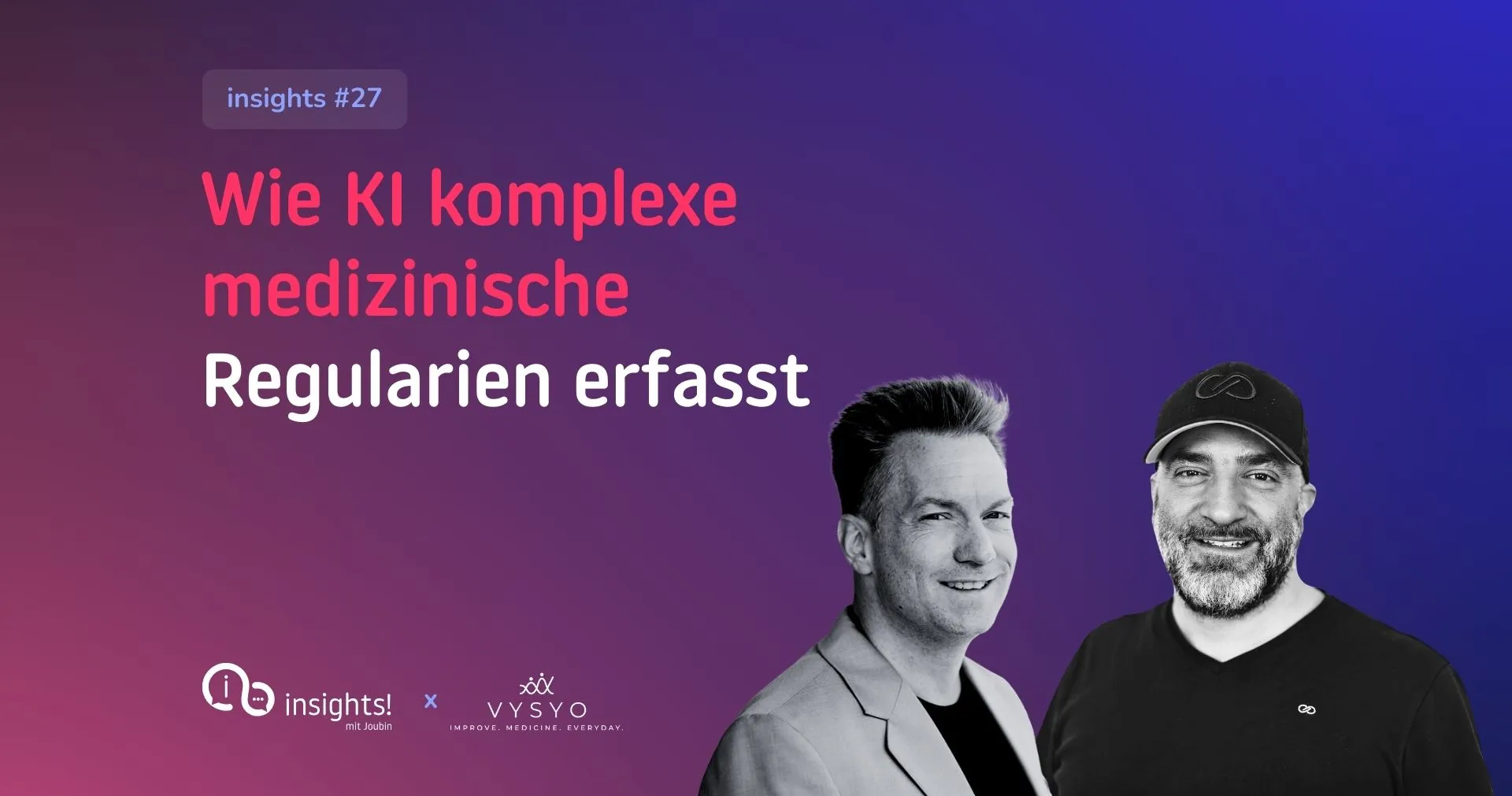
Those who don't digitalise will disappear from the market before long.
At some point the data streams needed for his daily work grew over cardiologist and scientist's head. "Medicine is data-driven science," says Dr Kai Markus, "no anatomy is like another, no illness like another". To still be able to establish regularities, "insanely much data" is needed. And because it's recurring, relatively similar task, automating it came to entrepreneur's mind. "Artificial intelligence should help us capture large data streams and prepare them so we can quickly and reliably draw traceable conclusion in science."
With this brief, Dr Kai Markus approached the synaigy team eighteen months ago. As a small company with just three employees at the time – now there are ten – the financial scope was rather limited, recalls the Vysyo founder. He describes the first result presented to him today as "pretty bare-bones". But a start had been made, and a light, even if faint, could be made out at the end of the tunnel. "I saw that automation could fundamentally work," says Dr Kai Markus. Vysyo has now reached the point where "we can process customer orders using the programme".
The entrepreneur can only advise other mid-sized companies to engage with the topic of artificial intelligence early on. "Anyone who doesn't digitalise in this world", Dr Kai Markus is certain, "will eventually disappear". In an increasing number of areas, data volumes would exceed the scope so much that it would be impossible to find "corresponding manpower to evaluate it". He therefore no longer wanted to do without the help of artificial intelligence, even though to this day he has had to contend with "quite a few limitations". The project with synaigy is therefore not yet complete, "you also have to proceed somewhat iteratively there", he says optimistically.
Would you like to listen to the full episode?
Listen in directly and find out more:
Please accept the corresponding cookies to view this embedded content.
Prefer to watch the episode? No problem!
You'll find a recording of the interview here:
Please accept functional cookies to watch this video.
Prefer to read?
Joubin Rahimi:
Great to have you back for a new episode of insights! My name is Joubin Rahimi and today it's about artificial intelligence and how you can use it profitably. I've brought an interview partner: Dr Kai Markus. Hello, Kai.
Dr. Kai Markus:
Hello, Joubin.
Joubin Rahimi:
First of all, great that you're here. We're connected both through a business relationship and through entrepreneurship. So I'd like to ask you first to say a couple of sentences for our listeners about you, your field of expertise and your company.
Dr Kai Markus:
Hello, dear listeners, my name is Dr Karl Markus. I am a doctor and worked for many years in cardiology, including in maximum care medicine. I founded a company that advises other companies on the approval of medical devices, pharmaceutical products and laboratory products. So we are a classic consultancy in the medical field.
Joubin Rahimi:
And you're not even that big. I think when we started our business relationship, that was a year and a half ago, you were around five to seven people.
Dr Kai Markus:
There were three of us, now we're ten. So it's not a big company, but it's growing.
Joubin Rahimi:
Double digit.
Dr Kai Markus:
But if it comes from small beginnings, double digit is easy to reach.
Joubin Rahimi:
That's true. But going from three to ten, that's already the first leap.
Dr Kai Markus:
Exactly. And not quite so easy in times like these.
Joubin Rahimi:
You came to us with an idea. And that idea was to simplify your work. Would you like to share what part of the work is, without giving away any business secrets?
Dr Kai Markus:
Yes, happy to. In medicine we very, very often have the problem that we have an insane amount of data. Medicine is a data-driven science, precisely because it isn't very precise. So A plus B doesn't always equal C in medicine. No illness is like another, no anatomy is like another, no person is like another. That means, to capture patterns, you need a lot of data. You have to sort out and identify outliers, and you have to be able to compare the various results with each other. Processing these huge data streams is, on the other hand, a recurring, fairly similar task. And at some point I had the idea that maybe you could automate that a bit, at least. This isn't about the machine taking over therapy or diagnostic decisions entirely. But it should help capture large data streams and prepare them for us in such a way that you can draw a conclusion from them relatively quickly and reliably, and comprehensibly, in the science.
Joubin Rahimi:
You're a doctor, had you already had much to do with computers or artificial intelligence before?
Dr Kai Markus:
During my career at the university hospital, I led a project where we programmed what I now know was artificial intelligence. It was about creating a medical expert system that generates warnings from data, meaning that with a certain combination of data it would output information – here, dear doctor, you need to take a closer look. This came partly from the idea that there are many data streams, and very, very often things simply can't be looked at. Who can watch their patient's data 24 hours a day? It was essentially about things read out from devices. And from that a project emerged, and that's where I gained something of a love for this kind of data analysis.
Joubin Rahimi:
I think that's already a secret I'd like to pass on directly. You thought interdisciplinarily, from the medical side, but also from the IT side, from data processing, how can things be woven together? Because you don't just have foundational knowledge, but have already worked with it. And then your thought was, how can I automate something in the process? For you it was clear, in medicine not everything is 0 and 1, but computers are 0 and 1. They can really only do 0 and 1. And artificial intelligence and also quantum computing, if we look really far into the future now, they deal with the number between 0 and 1. In that sense, that plays into the hands of medicine and into your hands.
Dr Kai Markus:
Yes, one has to say, 0 and 1 is the binary system computers use nowadays. In the medical informatics field I also 'got to' deal a lot with fuzzy logic. I don't like it, because in medicine too, in the end a 0 and 1 has to come out. Namely: do you have the condition or don't you have it now? So that famous phrase, a bit pregnant, so to speak, doesn't exist. On the other hand, one has to say it's actually true that everywhere in medicine you don't hang a diagnosis on a single test. So you don't say, I have an X-ray here and that tells us something. Especially serious diagnoses are not tied to a single finding, but are always looked at from different angles.
Joubin Rahimi:
What we did was automate something that took many people a very long time. It was about documents. What was the moment of truth when you said, I'm now investing money in this topic? When did you think the time was right for it?
Dr Kai Markus:
I need to think about that a bit. I have to present it without giving away anything content-related. But there are certainly projects with us where we screen very, very many scientific publications, extract excerpts and see what comes out. One example is a certain topic around some illness, let's say a type of cancer. And there we want to assess the complete scientific landscape, perhaps also the developments over the last 40, 50 years. That means, for that topic, you search out scientific publications worldwide, in several languages, across several decades. That's sometimes a large volume of data you have to process. That means it involves hundreds to thousands of publications. And that's a point where you can no longer do it by hand, you can't read through 5000 publications now. And at that point I thought, maybe a machine can, because it doesn't care, and it's maybe also a bit faster than me at reading. And it's also not about capturing all that blah-blah all the time, but about certain things you're searching for, certain patterns you're searching for. And those are then present and identifiable in the text, at least for me. That's how I thought about it. That in reality it's a bit more difficult, we'll get to that in a moment.
Joubin Rahimi:
From entrepreneurial view did you have feeling, okay, I must start, must invest little bit? Was there that moment where you said, this seems right way? When did you get feeling, even before first step, that you said, there must be something there? Or only after first results, after you saw software and software's results? When did that point come for you, this is right way? There I'm being innovative and forging new paths.
Dr Kai Markus:
I think I need to explain this a bit for the listeners. Allow me two, three sentences around it. I once founded and built up a company, and I believe you did the same with your company. That means you're always looking for things you can improve. As entrepreneurs we're there to create processes, to create structures in which people can do the same thing again and again. At some point we came together on my topic, can't something be automated in medical data analysis? And as a small company – we mentioned earlier how few employees we actually have – our financial structure is accordingly. Especially in times like these you always have to watch where you stand with your investments. You're already a bit bigger, but what I was able to put out to tender as a project is, I think, a smaller fish for you, so to speak.
Joubin Rahimi:
Really exciting.
Dr Kai Markus:
Yes, hugely exciting. But you also have to proceed somewhat iteratively. That is, I naturally want to know: does it work in principle? If it works in principle, you can invest more. But I have no interest in investing a huge sum and afterwards saying, we did that brilliantly, we put a year's revenue into it, but it doesn't work. As an entrepreneur, you don't want that. So there's a case for investing a small sum first, which you kindly and gratefully did with me.
Joubin Rahimi:
The topic is exciting.
Dr Kai Markus:
And then as a customer you mustn't imagine that something super sophisticated comes out of it that also looks great. It was pretty bare-bones, but what I saw is that it can work. I haven't really been able to use it for a project yet. I tried, there were still a few limitations in it, that still needs changing now. But you could see that with little effort you can get past the limitations and start using it. And then we iterated, meaning we came back to you with the project, said we need to rework this, and then we wanted to push it forward a bit further. Then we came back and came back, and we're still doing that right now. That means we have steps we can already work on, on which we're now already processing customer orders. It can get even better, we're on the way there, but we've already been able to automate a few things.
Joubin Rahimi:
That's the classic MVP approach, i.e. minimum viable product, to have something usable with little effort, where you say, okay, I can work with this. And then build on it step by step.
Dr Kai Markus:
Yes, after the first iteration it was very minimum, but after the second it became viable too, a bit at least. We then started generating revenue. It's still the case that it costs us, but it no longer costs us a hundred per cent, because we're now able to cover a few things with the programme, with the software.
Joubin Rahimi:
And what Kai has done with the company is ultimately also the winning way. We've also had big research projects where, after a year, we were told we've got great results, but we can't actually implement them at all. And with you it's exactly the other way round, you move forward in small steps on this topic, in order to then see, well, what do we do? And you don't ask "How do you do that?", but "What do you need?". That's the foundation. Why we do it, you've explained to us. What you need, we know too. The how is essentially our job. And that split is also really important, we see that with other customers too. When the how always gets dictated, it gets difficult. It's like telling a doctor how he should treat me. That certainly happens fairly often in today's internet world too.
Dr Kai Markus:
Yes, that's true. Though I firmly believe that in this world, whoever doesn't digitalise has lost. We won't get the manpower needed for such projects any more – not for the software project, but for the data evaluation projects that would actually be required. You lose against others who use artificial intelligence in this case, but also digital products. I'm firmly convinced that whoever doesn't follow this will eventually disappear.
Joubin Rahimi:
That's de facto the nicest closing word. Ultimately, a lot is changing in the medical industry too, just like in all other industries. And you put it well, Kai, the need is there, the change is there, you have to think differently and be bold about it.
Dr Kai Markus:
Yes, that's true. And all I can say is, we digitalise every smallest bit we possibly can, especially when it comes to carrying out a task the same way again and again. Programs help us with that. We use a lot of off-the-shelf solutions, from the time-recording system to accounting. But also these client projects, where we simply say these are products we can work with very, very effectively. And especially in medical science there's no other way any more, the volumes of data are getting far too large.
Joubin Rahimi:
And thank you for having the courage to take this path with us, this iterative path.
Dr Kai Markus:
Thanks also for your courage towards your co-entrepreneurs and co-shareholders, pushing through such a tiny project.
Joubin Rahimi:
We do believe in it. We believe you have to start with small things. And that's what I'd like to leave all listeners with too: do small things, and don't be afraid it might be too small for the company! Talk to them, because something big can grow out of it. That's how business works these days for us, but also for you – you have to try it out, not everything is clear. And in that sense, talking and doing is, I think, the most important thing. Talking lays the groundwork, and doing is far more powerful than just talking anyway.
Dr Kai Markus:
Yes, that's right. And I think that's also a very important thing. We do it just like you do. We also do small projects with customers that aren't that big, that don't generate that much revenue, that don't have that many employees. You do the same, and something can develop from that. Sometimes not, and that's fine too. But I know many companies that don't do this at all, and I always find that a shame, because some of these are super innovative things, super great things, and also things that really develop into something big. I know it.
Joubin Rahimi:
If you have questions or comments, feel free to post below. If you're listening and don't have the comment option, our contact details are provided again anyway. We look forward to messages and especially the discussion!
Dr. Kai Markus:
Many thanks!
Have questions or feedback?
Then feel free to contact us directly.
- Joubin Rahimi
Managing Partnersynaigy
Show phone numberShow mobile numberShow email address
Subscribe to the blog now and never miss any news
✔️free of charge ✔️weekly news ✔️expert knowledge
Please accept the corresponding cookies to view this embedded content.