



insights! episode #44: successful digital transformation in wholesale – Ehlert GmbH shines in e-commerce
 Joubin RahimiManaging Partner · synaigy
2 min read
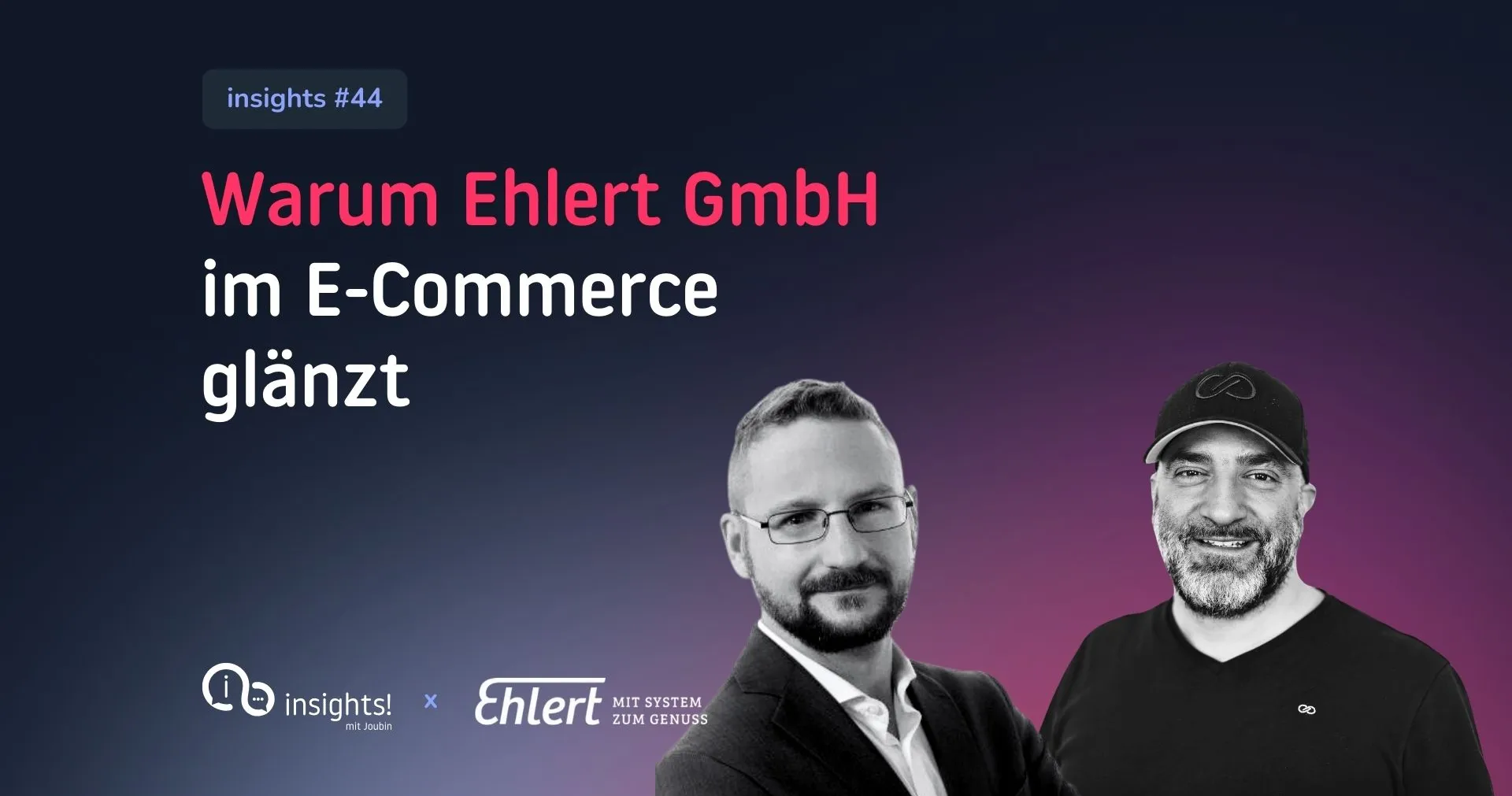
You don't just build the system and that's it.
One of the first points Philipp Ehlert, CEO of Gustav Ehlert, raised was the approach taken to implementing the project. We tackled the project as one big block and tried to integrate all processes, data and requirements at once. This led to increased complexity and difficulties with data structure and data handover. In hindsight, we could have structured the project setup better together and taken smaller steps.
Another aspect discussed was maturity-level measurement both at service provider and at customer organisation. It's important to clearly define which processes and requirements already exist and which still need developing before starting technical implementation. Good communication and collaboration between service provider and customer organisation is decisive here.
We also talked about the decision to choose Intershop as the e-commerce platform. Philipp Ehlert mentioned the core technology that Intershop brought with it, and the ability to map complex customer structures and approval processes. In addition, our competence and service orientation also played an important role in the decision.
It was emphasised that it's important not to see the various sales channels as competition, but to use them as synergy effects. Customer relationships and support take centre stage, while the system handles operations.
These insights into the project at Ehlert GmbH show that there are many challenges and learnings when introducing an e-commerce solution. Clear communication, realistic planning and willingness to collaborate are crucial for success.
Would you like to listen to the full episode?
Listen in directly and find out more:
Please accept the corresponding cookies to view this embedded content.
Prefer to watch the episode? No problem!
You'll find a recording of the interview here:
Please accept functional cookies to watch this video.
Prefer to read?
Joubin Rahimi:
Warm welcome to a new episode of insights. Today together with Philipp Ehlert from the company Gustav Ehlert. Today we get insights into one of our longer-standing customers, so into the collaboration with Gustav Ehlert since 2017, and Philipp Ehlert, co-owner and managing director at Gustav Ehlert responsible for quite a number of areas within the company. But you can dive into that yourself in a moment. Warm welcome, Philipp.
Philipp Ehlert:
Thank you very much for the invitation. I'm glad to be here.
Joubin Rahimi:
We've actually been in a business relationship for five years now, but really only got to know each other personally in November, before that you dealt with many of my colleagues. I'm really happy that happened this way, because we can exchange a huge amount on an entrepreneurial level, and family businesses, and we also built ours up ourselves over a long time. It's still something quite special. But before we get into that, maybe first two, three sentences about you and about Gustav Ehlert. That would be great for the listeners and viewers.
Philipp Ehlert:
Yes, well let me start with myself. Philipp Ehlert is the name, is the programme, is the company, which was founded by my great-grandfather in 1924, so almost 100 years ago now. I'm 43 years old, I'm effectively the fourth generation in the company. My great-grandfather, my grandfather, my father and now me. I run the company together with my colleague, Tobias Ortkrasch. We're both managing directors and we've divided the areas between us a bit. I basically handle everything that comes up internally. That's HR, that's processes, that's warehouse management, that's part of IT. But it's also the entire e-commerce area in the broadest sense plus product data management and so on. So everything that doesn't require direct customer contact. And Tobias handles sales and purchasing for us.
Joubin Rahimi:
Though the webshop's with you.
Philipp Ehlert:
So the webshop is mine. Right, there are overlaps there too. And yes, I'm married, have a child, live in the countryside. So kind of, as they say, down-to-earth and grounded. Although that's actually a Lower Saxony saying, but I actually grew up deep in Ostwestfalen and grew up in the business.
Joubin Rahimi:
And this is already something I find particularly remarkable about the company, which is nearly 100 years old, or next year you'll be turning exactly 100. That's twice as old as the average lifespan of a company. That deserves applause and appreciation, it's something truly special. And you're among the Hidden Champions, the ones people typically don't know but everyone somehow uses.
Philipp Ehlert:
Yes, that's right. So Hidden is actually maybe even the right term — Gustav Ehlert GmbH & Co. KG supplies food manufacturers, food producers, whatever you want to call them, basically with consumables for the production of their products. Sounds a bit repetitive now, but that's how it is — if I imagine, quite simply, I've got a sausage with a curry sauce on a cardboard tray at a snack stand in the city, wherever, then we basically supply the cardboard tray the snack sits on. That could be a curry sausage now, a normal one made of meat, or an alternative. Doesn't really matter. We supply the sausage casing, the skin around it. We supply the spices that make the sausage tasty. And it doesn't really matter either whether it's meat or proteins, i.e. alternative proteins. The little fork you can put in your mouth, and the napkin to wipe your mouth, plus the ketchup and everything else around it, except the actual raw material, i.e. no meat. We can also supply alternative protein sources, so pea proteins for example, or wheat proteins. That topic is slowly growing more and more. We're able to supply that too, but not meat or vegetables either. If you think of salad dressing, the sauce, various spices and so on. So all these things you need so that the food product can ultimately be produced safely and taste good, and ideally, on the topic of food safety culture, contain no more risks for the consumer. A really tricky topic. But that's exactly what we do, and you normally won't find that on the shelf, not in the supermarket. And it doesn't say anywhere who supplied what. That's not written anywhere either. Who supplied the disposable hairnet, or the shoes, or the knife used to cut things. These are all products we've been supplying for a good 100 years, and where of course we always have to keep adapting. Both on the legal side — what new laws come out? What's even still allowed to be used to produce a food product? What's allowed to come into direct contact with it? What isn't? Right through to certain products being phased out. At the moment we're trying everywhere we can to somehow reduce plastic, which of course has a certain protective function for the food. So you can't do without it entirely, but of course quantities were simply needed. I can reduce a film thickness from 90 down to 50 nowadays for vacuum bags for example, or even further, and that already saves an incredible amount. These are the kinds of topics we pick up on and try to meet customer needs as best as possible with. Evidently successful.
Joubin Rahimi:
And exactly, you constantly have to reinvent yourselves. And digitalisation doesn't stop at any industry. And you're also responsible for the shop topic. We started our business relationship with the PIM and the web shop.
Philipp Ehlert:
Exactly. That was almost five years ago.
Joubin Rahimi:
And there I'd like to, as always, take learnings with us too. We already discussed that in an Intershop Talk, what the learnings were. But before we get into that, most people are first interested in: which technology are you using there? So what do you use as PIM? What do you use as shop system, what do you use as analytics?
Can you say two or three sentences about that?
Philipp Ehlert:
Yes, of course. So our core system, the ERP, is Microsoft's Business Central. We've been using it forever. We come from Navision days and then looked for a matching PIM and came across Perfion. Originally Danish too, meanwhile also acquired. Good interface, good integration, data exchange between ERP and PIM works great, and we then use Intershop as the shop, currently the 7.10 version. We're currently considering rebuilding the whole thing on PWA, and have always tried to see how we can do that without major interface issues. There are always some. I always have data handover from one system to the next. But that it works as integrated as possible and can be operated with as little internal staffing effort as possible, let's say.
Joubin Rahimi:
Great. Thanks for the outline. And we went into the project, and as always with a project, there were things. Some things were good, some things weren't. What would you say from your side? And then I'll say from my side what we could have done better. Typical German culture. Not "that was cool" first, but what could be done better. But from your side. What are the topics?
Philipp Ehlert:
We pushed the project through pretty much as one big block back then. We said okay, we want to build this with Intershop now. Coming from a smaller e-commerce solution, moving to the big one, and we said okay, we'll do the shop and the PIM at the same time, and just throw everything else in too — processes, data entry, the whole thing. And essentially we pushed this huge block of a project ahead of us. And naturally, the bigger the block, the more friction builds up underneath as you keep pushing it, leading to problems. We hadn't really thought through the true complexity of this data structure, the data handover. We have nine product categories in our range, with nine completely different sets of important information that need to go into a PIM, lots of different requirements — product information, product specifications, and so on. And we just bolted all that on as we went. It could have been nicer and simpler from the start. And then of course, when we started the project, we wanted everything. We wanted to map every customer structure, every requirement on the shop side too. And that all had to be built by you. And that was another point where we should have started smaller. We had an existing system. If we'd migrated it one to one first and kept going from there and built up from there, the whole thing would have gone much smoother, with far fewer headaches.
Joubin Rahimi:
I went over it with the colleagues who worked on the project with you back then too. And I think there's also a level of maturity among companies and also our market peers. We were of course extremely grateful to be able to do so much. So there are really two topics. One is, can the organisation itself, i.e. the agency, handle it, but can the organisation, the client organisation, can you handle it too? I find that's really valuable, when it's reflected back, when someone also says no. No connects in a moment like that, because then you discuss it and usually something better comes out of it anyway. It's not a no, we won't do it, but a no, we don't think that's good, because... And that was a learning for us, where a few years ago we said, okay, we need a maturity level there. We need a maturity level, a measure for it too, so a maturity meter for the client, but also for us. We actually introduced that for ourselves too, by the way, where we say: okay, are we really in a situation where we can advise, and then also say: yes, for the implementation, for example, you need the processes, you need to have those clear. Are they documented? No, then maybe you shouldn't start with the technology yet, because then you'll put in a lot of effort. Actually it's much quicker to talk it through once and straighten out the processes. Although talking it through once and straightening out the processes also takes a bit longer. But that was our learning from that project. Would you say that fits? Do you say as a client: yes, well reflected, or do you see something else there?
Philipp Ehlert:
No, think that captures it quite well. Well maybe not necessarily the maturity level, because I find that difficult to assess, but fundamentally to talk about it. What does your organisation look like? What do you have clear, what don't you have clear? And then also to say very clearly: Yes, it's nice that you have the idea there, but we need to work it out, otherwise it won't become a plan and then we can't reach a goal either. And I think that's also something I now generally, and particularly with you, enforce a bit better. You provide a service and of course nobody says, no I don't want that, I won't do that. But also telling the client: We can do that once you're far enough along, or once we've worked out the path there together, so that we can then tackle it together. Not to say no entirely, but to say: Not now, but later.
Joubin Rahimi:
As entrepreneurs, we're also always so incredibly impatient. So actually... How is it not finished yet? In my head it was already done. And in my head everyone's already been tinkering with what's possible. But you really don't need it.
Philipp Ehlert:
I think as an entrepreneur you also have to be very clear-eyed about this topic. Especially when I notice this, sometimes in conflict with somewhat older generations than mine, digitalisation is seen as the cure-all. Digitalisation is everything that's somehow efficient and saves time. And particularly in the online shop area, that's not quite true. I'm really just shifting work from my desk and my phone into the shop. But because of that I still have to do the same things first, or other things, just to be able to do that at all. And first I have an initial investment, and I first have to embed new processes, and I initially have extra effort upfront, as is usually the case.
Joubin Rahimi:
But now you can also offer new value, for example the app — something's missing in my storage. So these service functions have suddenly become possible.
Philipp Ehlert:
Definitely. Above all, they've become tangible for the customer. We've always been able to weave that into conversation, on the phone, during an order. But now you can really make it manageable for the customer too. Why is that actually the case? Ah, okay, now I understand why that perhaps shouldn't be ordered, because it's not in stock and so on. You get one step closer.
Joubin Rahimi:
I've still got two questions. Firstly, why did you choose Intershop? That's definitely always interesting for those reading and listening right now. And secondly, why is PWA a topic for you now, tackling this technological changeover? But let's start with the Intershop topic.
Philipp Ehlert:
This was actually a combination of a) core technology fundamentals Intershop brought along by default. For example mapping the buying centre with different customers, approval processes, and so on. The OCI punchout topic, which really helped us with some larger customers, and generally the technical architecture too, future-proof and manageable for a company like ours. And of course the partner behind it, in this case synaigy with the expertise, having a very personal point of contact on your side on this topic became, from the combination of domain expertise and service-oriented provider, meaning synaigy, and technology, Intershop, a good match came out of it. You can clearly say, one without the other, I wouldn't have done it.
Joubin Rahimi:
Yes, from our side, good people need to work with you, otherwise it doesn't work. Our services are service, and that's human interaction and staff competence. And Sascha really does a top job there too.
Philipp Ehlert:
You can only put an exclamation mark on that.
Joubin Rahimi:
Can we also mention right here that he's just so great.
Philipp Ehlert:
And the leap now towards the PWA is simply that we're currently still running with two separate online presences or URLs, so to speak. We have a kind of corporate site for Ehlert GmbH on one side and the shop on the other. And it just doesn't make sense to treat those separately. Content as well as branding, as well as the shop, should all flow into one coherent external presentation, essentially representing one Ehlert platform. And it makes sense to design that as flexibly as possible, and implementing the shop as a PWA is simply the natural fit.
Joubin Rahimi:
And as you say, you probably already have one or two ideas you want to implement as well. Would you like to give some insight, or is that still a trade secret that only gets discussed once it's out? That's what I know from the region. Only once it's there does one talk about it. That's what I know from the Westphalia-Lippe region.
Philipp Ehlert:
So in the first step, it's simply about giving customers an online point of contact for Ehlert, where they can handle all their needs with us. And what comes next is of course clear: we'll expand our service offerings there too. To what extent, and exactly what that looks like, we'll see when the time comes.
Joubin Rahimi:
Great. Thanks for the insights. But it also shows you don't just build the system once and that's it – it's ongoing development, it's part of the whole. And it's interesting that the topic is largely hung on you, which we obviously think is great, because the relationship works brilliantly. But you also have the interface to your business partner, who co-manages sales. How do you handle that? That's always a challenge at other companies too. I don't know if it's one for you, but typically it's with discussion.
Philipp Ehlert:
Yes, I can understand that. We actually have that too. Our discussions are more on the level of: should I onboard the customer in the shop now? If so, what consequences does that have again, if everyone has to see their own little daisy? It's always more about the operational side. Strategically, we've actually never really separated the shop, i.e. the other sales channel, so to speak. We've always said, okay, we want customers to place orders with us. How they come in doesn't matter to us. At the end of the day, our customers eventually end up with some salesperson, and that person gets the revenue, wherever it came from, initially. And by now we no longer have quite such a strong field sales force. So the classic field sales rep who drives out and takes orders and has a bit of a chat with the customer, but rather more key-account focused. And even with them it's the case that if they get a customer onto the shop and say, order it there, do it there, call me, they naturally also get the revenue. We have this classic conflict of, but I have to do sales here in the shop and order there, we ruled that out for ourselves right from the start, which is often much discussed. And my main concern is that the operational side, for the customer and for us, i.e. capturing the order, which is actually totally trivial, is as simple as possible. And that my staff, and especially the sales reps, actually work on and nurture the customer relationship. And that the added value for everyone arises out of that synergy, and not just through an online offering. That would be nonsense, or rather, no.
Joubin Rahimi:
I think that is a great way to close, you said three things that are brilliant. Firstly, you have no cannibalisation of channels because you do not think in channels, and you have also solved topics like incentivisation. So those are already the two points. And the last point was, it is about the customer and the system handles the operational side that needs to happen, and the salesperson is responsible for the relationship. And I think, put that simply, it makes it fairly clear. Everyone plays to their strengths in this, we humans are more geared towards relationships than a computer system. That is certainly not the strength of a system, building a relationship. And I think that is great, because you brought that in with such clarity, almost in passing. But many then take a very long time to take on board that this is currently a really good pattern for moving forward, and moving forward successfully. So, top, excellent.
Philipp Ehlert:
Should I add anything to that?
Joubin Rahimi:
Sure. I can also pull that out, that's fine. But this is great for now. But sure. More insights, Philipp.
Philipp Ehlert:
Yes, or thoughts on that. So one more thought on that — why, for example, if we compare ourselves with other industries, why we, for instance, go through a shop to collect customer orders instead of regularly offering something like EDI, which is certainly also a viable route, one that moves an enormous amount of money, especially in this e-commerce area. I said at the start, we essentially manage CCC articles for our customers. So if we talk about work boots, just as an example, everyone knows this: I have a work boot, then there are various versions with toe cap, without toe cap, with velcro fastening, with laces and so on.
Well I mean, I have a shoe, so a basic version, and have, say, seven basic product variants that exist. And each of those in every size as well. And for a great many of our customers, this shoe just runs as "shoe". They don't know which shoe with which fastening in which size, in which version, with which safety class they'll get, because they don't maintain it in their system. It doesn't bring them any added value. Except that it has to be there so the employee doesn't hurt themselves and can stand properly. That it definitely brings. But looking at the overall picture, the products we supply make up roughly between five or eight percent of costs relative to revenue. So nothing that's relevant. And then they simply don't capture it at that level of granularity. And that's exactly where we need to go and present it visually. And that's also why a shop like this is so nice, because then they see, okay, I have the shoe in the variant with the size. That's what I'd like and not just simply some kind of shoe. And that's also a bit about creating awareness for that. And that's also what provides the added value then. If I don't know as a buyer what I actually want to order, I can't order it. So I have to present the granularity online that the customer would actually need, but that they shouldn't have to do themselves, because that doesn't bring them anything either. It de facto brings transparency to the customer as well. Very important point. So fundamentally, before, so this sounds a bit now like I don't want to. But we started in 2013 selling consumable items online with an open price. We also had, with competitors, we had topics where we shouldn't make that transparent, because that was really the fear, because that destroys my margin. If they all know what it costs, then I can't do it any more. That's of course wrong to say. Of course it has to be a transparent market, so the customer can get a sensible orientation. What does that cost? What are the real costs for a product like that? Typical for the brand. And is my partner perhaps currently ripping me off, or am I fundamentally paying too much somehow and how can I optimise that? Those are very important decision criteria. So the fact that I still see shops being set up today without prices, yes, I still haven't understood that.
Joubin Rahimi:
Yes, it still exists. It still exists. We also always find that quite odd.
Philipp Ehlert:
And the discussion is exactly that. Yes, we always have customer-specific prices, so we don't want to publish them. Yes, then you're doing fine with your current customers, but nothing with new ones. I just need some orientation. I recently wanted to compare forklifts. Forklift prices, industrial trucks here. Available on request only. There isn't even a guide price stated. You could write that down. Costs roughly this much in standard configuration. Gross list prices. Hello, come on. Well. That's exactly why I keep looking.
Joubin Rahimi:
But that's the great thing about it. Certainly for us, anyway. We still have a lot to do in this industry, and I think it'll keep going. Thanks for your time. Thanks for the insights, dear Philipp. Thanks also for the five years we were able to walk this path together. And thanks for the many times we've met up and exchanged ideas. I think that's brilliant. And especially in times like these, talking between entrepreneurs is hugely valuable, being able to assess things better than by following LinkedIn bubbles or that sort of thing, but rather through people. So thanks for that.
Philipp Ehlert:
Thank you.
Joubin Rahimi:
And for everyone who's been following along, feel free to leave questions for Philipp and me in the comments below, or via direct message. We always look forward to the exchange. Thanks.
Philipp Ehlert:
Exactly. Bye.
Have questions or feedback?
Then feel free to contact us directly.
- Joubin Rahimi
Managing Partnersynaigy
Show phone numberShow mobile numberShow email address
Subscribe to the blog now and never miss any news
✔️free of charge ✔️weekly news ✔️expert knowledge
Please accept the corresponding cookies to view this embedded content.