



insights! episode #48: the future of B2B purchasing: how ChatGPT is changing the rules
 Joubin RahimiManaging Partner · synaigy
2 min read
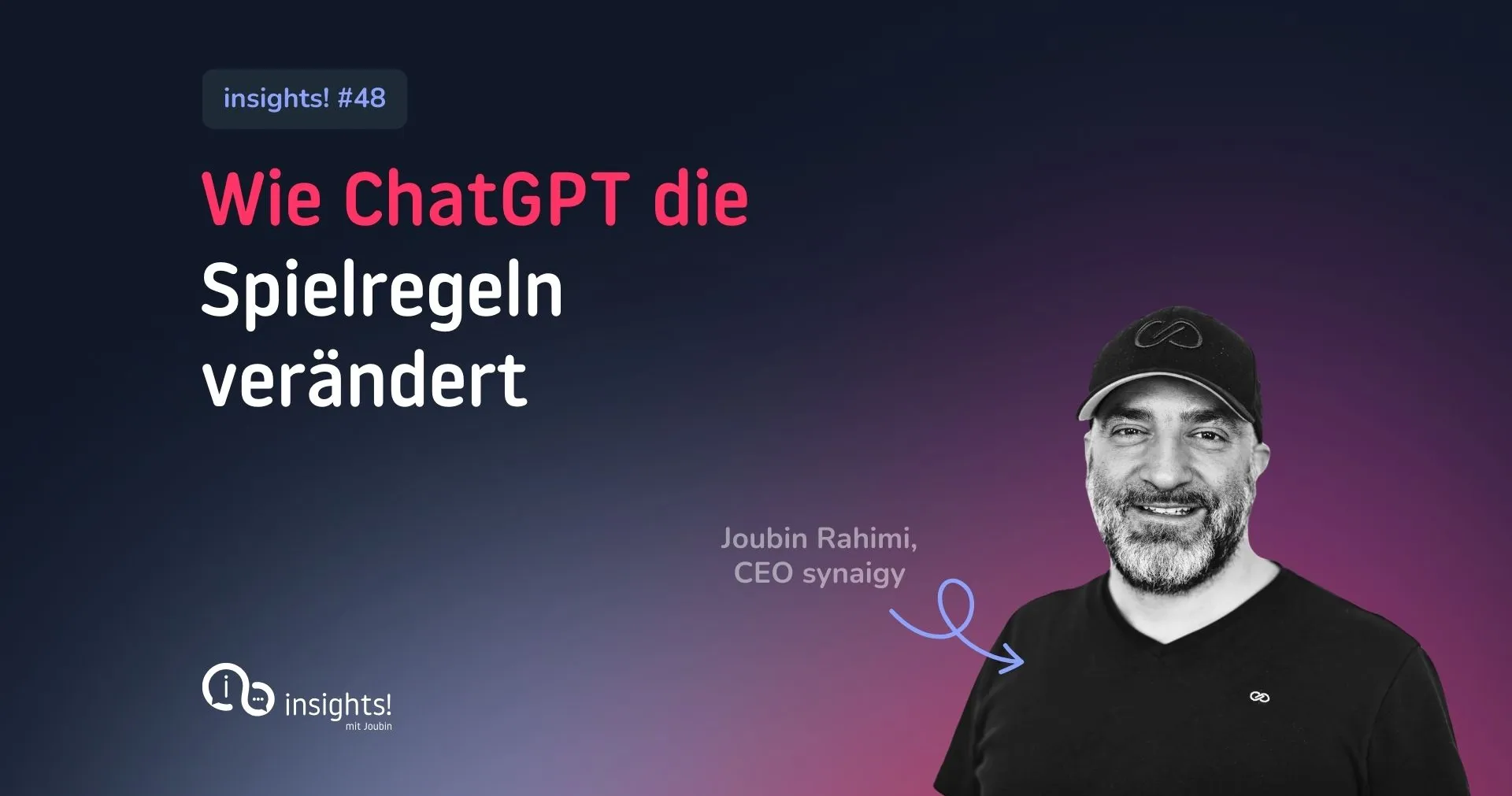
ChatGPT is on everyone's lips. This advanced AI technology is changing the way we search for information, make decisions and interact with sellers – including in B2B. In the latest insights! episode, find out how the use of ChatGPT is revolutionising the B2B buying process and what you need to do to keep up.
Purchasing behaviour in B2B is changing sustainably.
In today's digital world, the buying process has changed fundamentally. In the past, knowledge and information were reserved for privileged circles, but with the spread of books and later the internet, everyone could gain access to knowledge. The real breakthrough, however, came with the combination of internet, smartphones and Google search, which allowed everyone to instantly retrieve information on products and topics.
This led to new buying behaviour, where people research independently. Whether at the local retailer, online or directly with the manufacturer - the customer has the choice. This development has also favoured direct-to-consumer (D2C) sales.
In the B2B sector, however, the buying process for complex topics has so far remained largely unchanged. That's now changing with the introduction of ChatGPT. Unlike a simple Google search, ChatGPT delivers insights and concepts. This means you no longer necessarily need to rely on an industry expert to inform yourself. Customers looking into your core topic can get a good starting point with the help of ChatGPT. So the question now is: is your sales team well prepared to support these customers? Or does it play out like with the classic retailer, where the customer is often better informed than the salesperson?
To do justice to this development, two things need to be considered. First, sound professional training for sales staff is essential. Second, you need unique USPs that make you irreplaceable and incomparable. Because that's exactly what can't simply be copied or learned.
Would you like to listen to the full episode?
Listen in directly and find out more:
Please accept the corresponding cookies to view this embedded content.
Prefer to watch the episode? No problem!
Here's a recording:
Please accept functional cookies to watch this video.
Prefer to read?
Joubin Rahimi:
Great to have you back for a new episode of insights! My name is Joubin Rahimi, and today it's about a topic you won't find in any studies, but rather how the B2B world is going to change completely in the purchasing process.
What will change in the B2B world in the purchasing process? I'd like to draw a wider arc here. A long, long time ago, hundreds of years ago. Years ago knowledge and information was distributed through books written by scribes in the church, in noble houses and so on. Who had access to it? Only the very rich, the very powerful. With Gutenberg came books, which significantly increased the spread of knowledge. But of course there was also a lack of people who could read. That followed in time. So in the 20th century we then had, in the 20th century, a high penetration of language, and of knowledge too, through books. It's no coincidence that many books were burned during the Second World War too. The information and also the knowledge is contained in books and was then accessible to many people.
But a real push, and with very current information too, actually came through the combination of three trends. The internet, the smartphone (mobile reachability) and Google search. Why? Through these three components, it became possible, and still is possible, for every person to acquire information on products, on topics, instantly and ad hoc. That's led to the buying process, as I've often been told, changing from: I go to the retailer, they advise me, I buy a product, to: I go online, inform myself, decide where to source it and buy
There - perhaps at the retailer or online or at the manufacturer. And among other things, this has also given rise to a D2C trend, that this makes sense.
So what's changed now? ChatGPT didn't launch this year, but the breakthrough came, along with massive adoption. And this buying process hasn't changed in B2B for complex topics until now. But with ChatGPT, this is changing. Why? ChatGPT doesn't give you simple information back like Google does. No, with ChatGPT you can work out insights and concepts for yourself.
Imagine you want to set up an office and say you want to fit it out according to the latest home office, workation, or whatever other trends. You can ask ChatGPT. Which topics are important? How do you approach the whole thing? Which areas do you need? What are typical things you buy for that or need for the processes? You then no longer ask the salesperson from a particular office fitter for example, or also our industry. Customers who deal with customer experience. They can simply get a very good starting point via ChatGPT. And then the question is: how well positioned is sales to build on that? Or does exactly the same thing happen as with the retailer, as with Mediamarkt, that the buyer, the prospect, simply knew much more than the salesperson who actually has the advisory function?
For this reason, we believe two things need to be done first. Continuing to properly train salespeople on technical matters. That's one thing. The second: you need genuine assets and USPs that make you truly irreplaceable and incomparable. Because that's what can't simply be copied and learned. Really exciting. We're at the start of this. Stay tuned. We'll keep looking into it.
Have questions or feedback?
Then feel free to contact us directly.
- Joubin Rahimi
Managing Partnersynaigy
Show phone numberShow mobile numberShow email address

Subscribe to the blog now and never miss any news
✔️free of charge ✔️weekly news ✔️expert knowledge
Please accept the corresponding cookies to view this embedded content.