



insights! episode #5: interview with Dagmar Groß-Böker
 Joubin RahimiManaging Partner · synaigy
2 min read
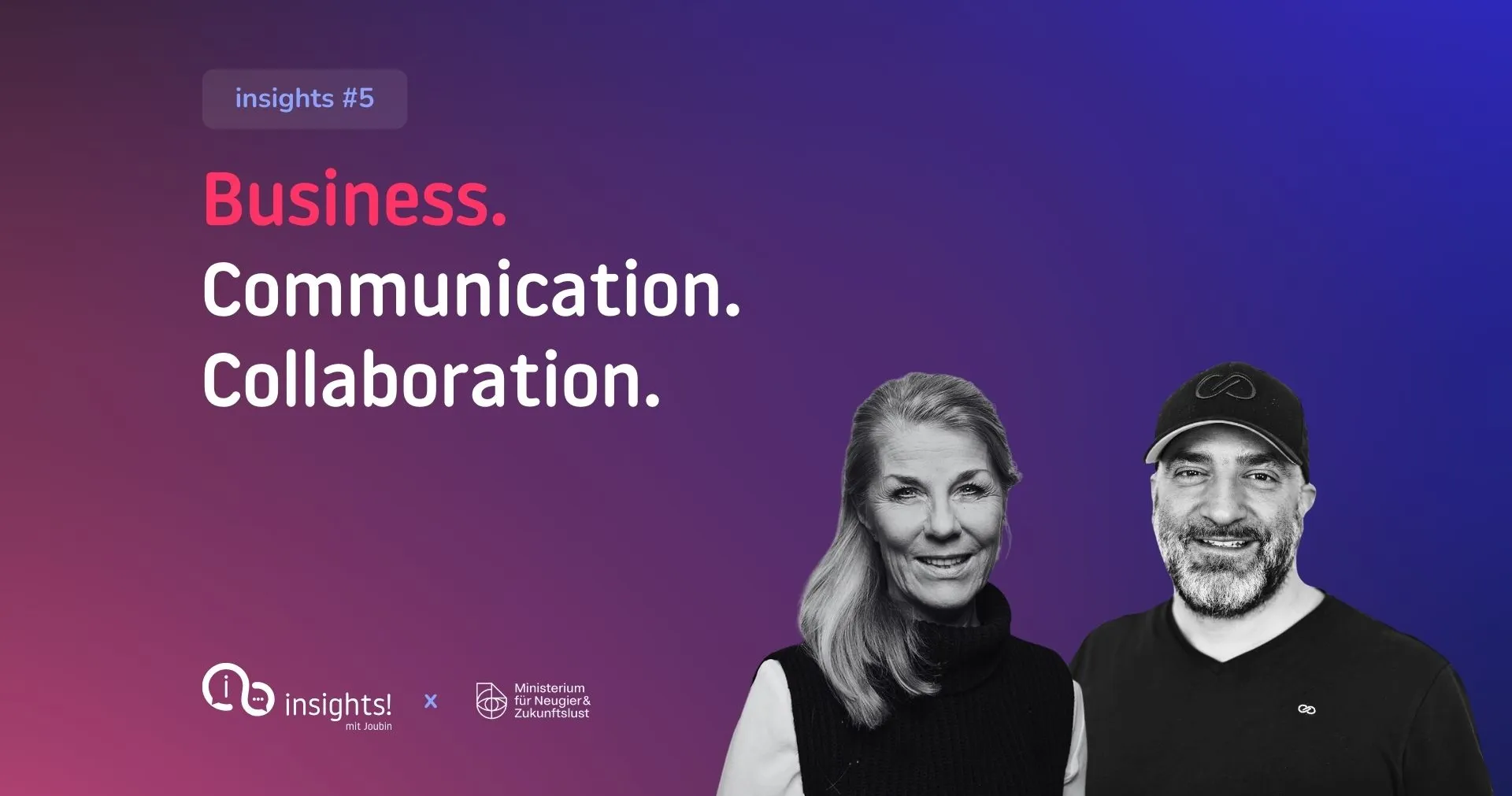
„We have Covid to thank for hybrid working models“ Covid hit a great many companies hard, both from the employees' perspective and from the perspective of organisational leadership. But the pandemic also had its good side, says HR expert Dagmar Groß-Böker. In conversation with Joubin Rahimi, managing director of synaigy GmbH, she talks about what benefit she believes Covid brought for the future of work, and where leaders in uncertain times still often fall short.
Our interview with organisational and leadership development expert Dagmar Groß-Böker
Most people can't stand hearing the word Corona anymore and want nothing more than the past back. Yet Dagmar Groß-Böker can certainly find a positive side to the pandemic. "We managed to finally bring hybrid working models to market, and we have the chance to collaborate differently across all areas of the organisation."
Traditional, entrenched ways of working could now be abandoned in the course of this shift and replaced with more contemporary working models. In Dagmar Groß-Böker's view, a period of self-reflection is coming for managers. They usually know which issues are in demand and which structures and processes need to change. "But in doing so they often forget the topics of leading myself and leading my people." In other words, integrating empathy and mindfulness into their daily leadership style so that people feel included. Because by no means everyone who has been doing their job from home for months feels comfortable in their own skin doing so.
Beyond that, Dagmar Groß-Böker wants leaders not only to exercise reason. Intuition should also find its way into daily processes. "In combination with ratio, intuition simply opens up a whole different world," says the long-standing consultant.
So, away from black-and-white thinking and towards a mindset that also allows for both-and. "This enables a completely different, more sustainable and more open way of working with things we haven't seen before." When entrenched, familiar processes change, this leads to fear and confusion in some people, says Dagmar Groß-Böker. "They no longer understand things, because the world keeps getting more complex."
These changes would have happened even without covid's involvement, though. Experts have long attributed the phenomenon to the acronym BANI – four letters that, translated from English, stand for brittle, anxious, non-linear and incomprehensible. Covid merely pushed BANI further to the surface. She therefore recommends that leaders, looking ahead, "rethink certain things".
Would you like to listen to the full episode?
Listen in directly and find out more:
Please accept the corresponding cookies to view this embedded content.
Prefer to watch the episode? No problem!
You'll find a recording of the interview here:
Please accept functional cookies to watch this video.
Prefer to read?
Joubin Rahimi: Warm welcome, Dagmar! Thanks for coming.
Dagmar Groß-Böker: Lovely, thank you very much!
Joubin Rahimi: On the high mountain, on the hill, our summit meeting. Would you like to tell our listeners a bit about yourself?
Dagmar Groß-Böker: Yes, happy to. As you already said, I'm Dagmar Groß-Böker. I've been self-employed since 2015 as a consultant, trainer and coach, and my main field is supporting organisations through agile transformation processes, with the actual focus being on doing this holistically. So not just simply, we're now making processes agile or transforming processes or structures, but we also take cultures and people along, and of course also look at leadership topics and things like that.
Joubin Rahimi: We've had the chance to work with you a bit over the past years. That has always impressed us as a company. For us, right now during the pandemic, the question is how we position ourselves as a company for the future. And many of our listeners face this challenge too. What does the retailer do? Do you have one or two points from your current work where you'd say, that would be exciting to learn and share?
Dagmar Groß-Böker: Yes, there are of course lots of things. Perhaps first take a step back and say, even though the pandemic of course is now driving us all mad and we want it behind us, it also did a lot that's simply positive. We managed to finally bring hybrid working models to market. And that alone would be one thing you could say became what moved companies forward, regardless of sector. Simply seeing things change, perhaps moving a bit away from the traditional ways that were never particularly settled in the e-commerce space, having the chance to work together differently with all areas of the organisation. Very, very clearly that's an advantage. On the other hand, independent of the pandemic, we'd also have this former VUCA topic, saying we have great volatility, we have complexity. Incidentally, this VUCA has been replaced by the new term BANI.
Joubin Rahimi: What does BANI mean?
Dagmar Groß-Böker: BANI is also an acronym. I actually find acronyms terrible, but it explains so much and sometimes makes things easier. So BANI stands for brittle, meaning we have a fragility. We have the A for anxious, meaning we're anxious about these topics. N for non-linear, we have no linearity. In the past, for example, there was one cause for something and we knew the effect would be such and such. And due to complexity issues we no longer have clarity about what the cause is, what the effect will end up being. And the last letter, I, stands for incomprehensible, we no longer understand things that precisely anymore. And that naturally means we live in a world that will be very hard for us to understand. We need some mechanisms and methods, and that's what the acronym is for, to say, what do we derive from this? How can we now be on a different path? And the nice thing is that with BANI, unlike VUCA, the pandemic got included. So things like suddenly not being able to go to the hairdresser or to a restaurant anymore. Whole sectors are very strongly affected. That means all of us, especially now leadership too, and you just mentioned e-commerce heads, should and could rethink things at certain points.
Joubin Rahimi: what would your top 3 measures be if you were new to a company? What would you look at?
Dagmar Groß-Böker: Sometimes these are things you don't really like to hear. I wouldn't like to hear them either, I have to admit. The point is that we simply have to focus on three things in leadership. And we usually say very, very quickly, leading my business. And we can all do that relatively well, I think. We know what we have to do. We know what's in demand. We maybe know how we need to change certain things in structures and processes. What we often forget in the process is the topic of leading myself — how do I, for example, manage to have mindfulness and resilience for myself? Or how do I manage to get the topic of leading others or leading my people right? And that's where mindfulness and empathy come in too — understanding how people in organisations are feeling right now because of the pandemic, or how they're coping with it. A leader is there for that too. And maybe an example from practice — we'd already talked about this beforehand: hybrid leadership or hybrid working means that a whole portion of people are sitting in some home office, but don't actually want to be sitting there. And why don't they want to be sitting there? Because they miss human contact. And with empathy I manage, for example, to say, okay, who exactly is who among the people sitting there. Not from a control angle, but from the angle that I try to meet the person where they can work effectively.
Joubin Rahimi: And that varies, I think, depending on the type of person. Is there a blanket rule for that?
Dagmar Groß-Böker: If you've been in business long enough, you can already tell whether someone is more focused on the work or more on people. People who work in a very continuous, organised way and concentrate on details tend to be the ones who also like working from home, undisturbed. Whereas for people who need other people to work, who want to cooperate more as a team, that's simply missing. They simply miss contact with other people, having a coffee together in the kitchen now and then. Socialising also makes up a great deal of effective work.
Joubin Rahimi: I want to link two things again — OKRs, which you also do a lot of. And on the other hand, personality analyses. I know this model with the four colours, for instance. Is there a correlation, where those who love detail tend to be the blues in this personality analysis? They'd prefer home office. And the green ...
Dagmar Groß-Böker: ... The green needs harmony. Yellow and green would probably rather be in the office sometimes too, to be able to exchange with each other.
Joubin Rahimi: do you have experience with OKRs, goal achievement and so on?
Dagmar Groß-Böker: I wouldn't draw such a strong correlation there. For me, one is a good method for breaking down goals agilely and adaptively within the organisation, from the vision down to the teams and to the individual. At most you could infer that, for certain personality profiles, there's initially a question: why are we doing this now?
There are people who tend to say, yes, I'm up for that, count me in. While others might say, something new again? That might be the difference.
Joubin Rahimi: How can companies capture these different types of people well? Are there mechanisms that work well here?
Dagmar Groß-Böker: This brings us back to the topic of Leading Others, starting conversations and asking: What do you actually need to work well? People often don't say this themselves, they may not even know it. But if they think about it, they might say, I need a quiet corner for myself, I need my fixed workstation, I need the view out there. That doesn't mean all of that has to be fulfilled. Definitely not. But then I can understand how this person ticks. Someone else says, I need my coffee kitchen every day and I need daily networking with the other departments. Then it's quite clear how you should actually proceed. Just don't rely on always automatically doing the right thing by using the watering can approach. You definitely don't.
Joubin Rahimi: So not enabling everything, but saying we set a model. There are probably two main types: those who tend to work from home, at their own pace. And there are those who need the connected, the physical.
Dagmar Groß-Böker: Right. And something else worth mentioning: even if someone likes working from home, there might be a mother in need of care, ten screaming children, an unemployed father. So if someone wants to work from home, that doesn't mean things are actually going well at home. I know an organisation that gives employees the option to simply set themselves up in a co-working space for as long as necessary. Which is a good solution for working somewhere in peace if it can't be at the company.
Joubin Rahimi: That's a good idea too. Do you have two or three closing tips you'd like to give to leaders?
Dagmar Groß-Böker: I’ve already said a few things. One thing would definitely still be that, because I know that in e-commerce many “blues” are involved, of course. Very blue in the sense of people who go into detail. That these people perhaps also allow themselves to work with intuition sometimes. I’ve had discussions about this forever. No, we have to decide rationally, à la Amazon, which is completely rational at all times. But I think we simply need the topic of intuition in some places too, which is often attributed to women. I’m sure men can do that too.
Joubin Rahimi: Do you believe in us?
Dagmar Groß-Böker: I firmly believe in that. Intuition combined with reason opens up a whole different world. In the past it was always "either or", "black or white", "good and evil" – we should learn to allow "both and", meaning not to lose ourselves on a stage or be afraid when I suddenly allow "both and". That works very well, and I believe it enables a completely different, more sustainable and more open way of working with things we haven't seen before. That was two things now.
Joubin Rahimi: Those were two wonderful things! Thank you very much. I hope you enjoyed it too. We look forward to the next session, be there!
Have questions or feedback?
Then feel free to contact us directly.
- Joubin Rahimi
Managing Partnersynaigy
Show phone numberShow mobile numberShow email address
Subscribe to the blog now and never miss any news
✔️free of charge ✔️weekly news ✔️expert knowledge
Please accept the corresponding cookies to view this embedded content.