



How D2C transformation succeeds with employees
 Joubin RahimiManaging Partner · synaigy
4 min read
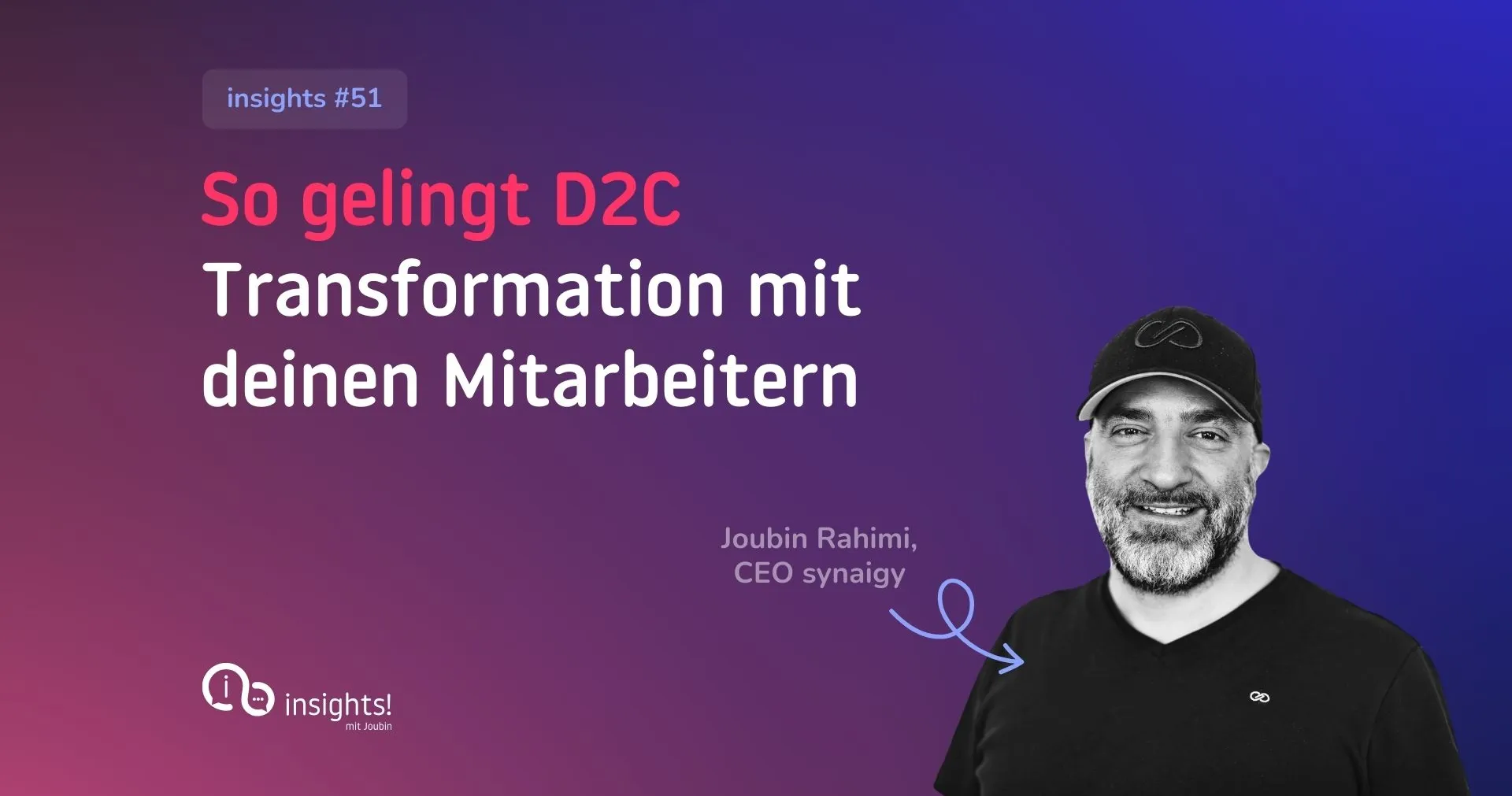
insights! episode #51: change management - how to succeed with D2C transformation with your employees
This episode of "insights" is about the topic "How can you bring your employees along on the D2C journey?" Effective change management is necessary to implement these changes successfully. Find out in the new insights! episode what you need to keep in mind.
Copying the best well gets you to success much faster than a team learning everything the best already know and have built up over years.
Transparency is key: open communication from the start
The first and perhaps most important rule on the D2C journey is open and transparent communication. That sounds simple, but is often trickier than expected. Nowadays employees don't just want to know what's happening, but also why it's happening. They want to understand how the changes in the company relate to developments in the market and what role they play in this. It's therefore essential to communicate clearly and honestly from the start. Gone are the days when instructions were simply followed without knowing the background. Today people expect insight and a rational explanation for every decision. So when you speak as a business leader or decision-maker, remember: the clearer and more transparent you are, the more acceptance you'll gain for the change.
Right timing: communicate early, but not too early
Another important aspect of communication is the right timing. When should you inform your employees about planned changes? The art lies in finding the perfect moment: early enough to pre-empt rumours and gossip, but not so early that uncertainty arises because plans might still change. Early communication gives employees the feeling of being taken seriously and included in the process. Of course, it can also trigger fears or concerns, but these are exactly what you can address and reduce through timely and transparent conversations. It's about being brave and admitting to uncertainties too. Say clearly that things can still change – that's part of an agile process. The earlier you communicate, the more trust you build, and that's the basis for later success.
Clear division of roles: who does what in new D2C world?
Clear role definitions and division of tasks are further key factors on the D2C journey. As your company changes, the tasks and responsibilities of your employees change too. Take accounting as an example: suddenly transactions via Amazon or other platforms need to be booked, which places entirely new demands on the processes. These changes affect not only accounting itself, but also IT and other departments that need to be integrated into the new workflow. Here it's important to clarify early on who's responsible for which tasks, to avoid misunderstandings and inefficiencies. This clarity helps keep processes lean and efficient, even as technology or market requirements continue to change.
Training and development: more than just tool training
An often underestimated but crucial aspect is training and further education for employees. Of course, they need to master the new tools and systems that come with the D2C strategy. But it goes further: you should also bring your employees along on a higher level and explain to them why these changes are necessary and what impact they have on the company and their daily work. Many employees, especially those who have been with the company longer, can still remember how things used to be done. Today we're in a completely different world – and that's exactly what they should understand. This insight fosters understanding and acceptance of the changes and helps them actively help shape the transformation.
Bringing experts on board: reaching the goal together, faster
The last point we'd like to address is support from external experts. There's no shame in getting help – on the contrary, it's often the fastest route to success. Whether through hiring specialists or working with external consultants – learning from the best and drawing on their experience gets you to your goal much faster than working everything out yourself. Companies like Digital Vikings or Digital DNA offer exactly the expertise you need to successfully implement your D2C strategy. They can help you find the right people, optimise your processes and make your organisation fit for change.
Would you like to listen to the full episode?
Listen in directly and find out more:
Please accept the corresponding cookies to view this embedded content.
Prefer to watch the episode? No problem!
Here's a recording:
Please accept functional cookies to watch this video.
Prefer to read?
Great that you're back for a new episode of insights. My name is Joubin Rahimi, and today's topic: how can you take your employees along on D2C journey? D2C journey is a journey that will change the company and must too. Because basis of this change is ultimately change of people and consumers. If you want that, you must introduce change management. And if you know how change management works in companies and have done it many times already, because your company keeps changing, skip to next episode. If you don't know it, or need fresh impulses regarding D2C, stay tuned.
D2C changes are fundamental, because it's not just simply setting up a new channel. You do D2C because market is changing. Market changes because people are changing. People change because new technical possibilities exist, framework conditions are different. Through that, human behaviour changes again, how they do things, how they think, how they act. And through that, markets change. And that's why you have to adapt and think D2C along too. You've seen this chain, went up once and back down and means for you, you have to restructure your company. And for that reason there are countless studies that really show, change is inherent and manufacturers as well as wholesalers are doing it, and feel free to look, we've linked below, at study E Sales for You, which also provides data on this accordingly.
The first point. That's not D2C specific. That's a point of the times we live in. Open, transparent communication. That sounds incredibly simple, but as always, when I say something as a business leader, as a decision-maker, as the one who says it, there are good voices and there are bad ones. It's like with a referee, when he blows the whistle, the whole stadium whistles too, no matter what he's blowing for. And that's why I really hold open, transparent communication towards your workforce, your employees, your decision-makers as a core criterion. A hundred years ago it was different. It wasn't important then. The topic then was: tell me clearly what I should do, then I'll do it and happily let myself be monitored. That was all fine. Open, transparent communication. I don't know if it was undesired, but it wasn't the key to success. Nowadays it's the key to success. We also want to know why the train is late and it's not enough for us, whatever the reason, just the statement that it's late. We simply want exactly that transparency.
The second point follows on from the first. Open, transparent communication starts early. It starts very early, and the point at which it's too late isn't easy to pin down. Because too early, things can keep changing and you confuse people. Too late, the grapevine has already gone round the whole company. Once the grapevine has done its rounds, it's too late, because you can no longer set the communication. So it's important to find the right jumping-off point, but typically it's earlier. Be bold too. Frame it. Yes, the opinion or situation may still change accordingly. That's okay. We're in an agile process. But early communication brings people along. Yes, it can also be that one person or another is afraid or has concerns. Completely normal. But the earlier you do it, the better you can handle it, and the more success you'll have down the line.
The third point, again nothing new, but things are changing everywhere, is a clear definition of roles and division of tasks. If I take accounting as an example, it doesn't really have much to do with digitalisation. But if I have accounting and now need to book a sale via Amazon, and I don't just have one receipt but three or four receipts for this transaction, then it's different. That affects whoever books the whole thing accordingly, possibly also an accountant, an external accountant can handle it, possibly also IT. And clarifying exactly these responsibilities early on is hugely important. Yes, they can change. Yes, technology can simplify things. All correct. But you have to discuss them in advance. Costs time, is intensive, but hugely helpful for an efficient approach.
The fourth point, yes, training and further education. On the one hand, I personally say we all need to keep developing ourselves constantly, listening to podcasts, watching YouTube, listening to other people. I love watching other talks. We should give all employees these opportunities. Of course, very specifically for the toolset. But do think about raising this training and further education up a level. What's the purpose? Why are we doing this at all? How is it changing? And taking everyone along on this journey too, because everyone is changing as well. Every employee can, or almost everyone can, really understand why the company is changing, because they themselves have also changed in how they work. Especially the older ones among us, and it doesn't matter whether they're 40, 50 or 60, you can always win them over with this. 20 years ago you'd go to a retailer and discuss it with them and make your product choice together. Today you typically check online first. Everyone catches themselves doing that. But what changes as a result? And that's the key point, why we say training and further education for tools either way, but also bringing the whole picture along. Because you're changing your company and bringing it into the new world with you.
Point five. And yes, when you hear this, you'll think, now he's selling his services. Get support from experts too, whether you hire them or buy in the relevant expertise. We'll link a few more companies below, including Digital Vikings, who find the right people for recruitment, but can also help organisationally with setting up such a department. Or Digital DNA, who can accompany you along the way, as they've already accompanied many other retailers and manufacturers very successfully. If you look at the list of companies, at who's a client there, you'll see the winners are there. We'll link these companies below again. But what I'm getting at is, copying well from the best gets you to success far faster than having a team learn everything the best already know and have built up over years. Copy fast, then learn from that point on.
We hope we've prepared a few impulses for you. I'm not alone in this – the team around me has worked out much of the study content too. Let's discuss it. It's hugely important that we learn from one another, because we're in the middle of change too.
Have questions or feedback?
Then feel free to contact us directly.
- Joubin Rahimi
Managing Partnersynaigy
Show phone numberShow mobile numberShow email address

Subscribe to the blog now and never miss any news
✔️free of charge ✔️weekly news ✔️expert knowledge
Please accept the corresponding cookies to view this embedded content.