



insights! #66: digitalisation starts with a changed mindset
In this insights! episode, Karl-Heinz Land gives insights into topics such as introducing his book “Erde 5.0”, people's fear of new things, the differences between Germans and Americans regarding technology, and the positive changes brought by AI.
 Joubin RahimiManaging Partner · synaigy
4 min read
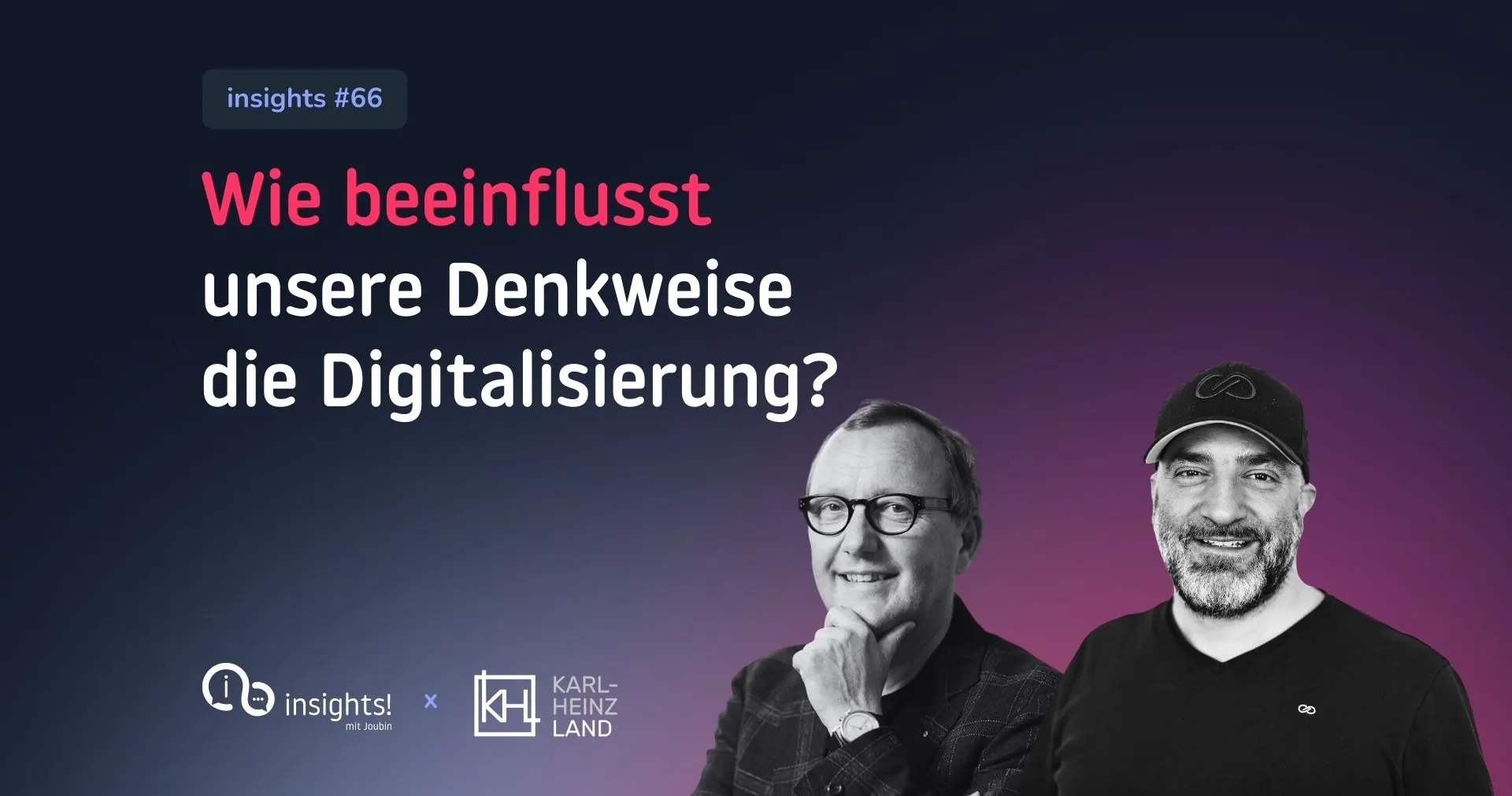
Fear of new things is human, but we could do much more if we were a bit more optimistic.
In a world that's changing rapidly, it's often difficult to keep track. But Karl-Heinz Land, a thought leader in digital transformation, shows in an inspiring conversation how we can not only understand technological advances, but actively use them to shape a better future. His message: we don't need to fear the future, but look forward to it – and shape it deliberately.
Earth 5.0: a plan for a sustainable future
In his book "Erde 5.0", Karl-Heinz Land outlines a vision of how we can master the challenges of our time — from climate change to digitalisation. Instead of letting the pace of change overwhelm us, we should recognise the opportunities within it. Technological progress, often perceived as a threat, can help us keep the planet liveable. The central question is: how can we use technology to secure a sustainable and fair future for coming generations?
No fear of the unknown: why Germany needs to become bolder
In Germany there's often a certain reticence towards new technologies, particularly artificial intelligence (AI). But Land argues this reticence is unfounded. He compares it to a roller-coaster ride: what seems frightening at first can turn out to be exciting and rewarding. To remain competitive in a globalised world, we must dare to take new paths and explore the possibilities of AI and other technologies.
An interesting thesis from Land is that German reticence could be deeply rooted in our history. He suspects that Germans who stayed, while others emigrated, may have genetically developed a tendency to hold on to traditions and tried-and-tested ways. In the USA, on the other hand, a country of emigrants, the readiness for change and adaptation is far more pronounced. This possibly explains why innovations are often adopted more quickly there.
The role of artificial intelligence: recognising and seizing opportunities
Artificial intelligence is a central theme in Land's work. He emphasises that it isn't "real" intelligence, but rather machine learning – a parrot mechanism that holds enormous potential. For companies, this means they can drastically increase their efficiency and productivity through the use of AI. One example is tender management: while in the past a team spent several weeks processing a complex tender, AI can complete this task in a few days – and even deliver qualitatively better results in the process.
However, Land also warns against the unreflective use of AI, particularly when it comes to transmitting large amounts of data to American tech giants. He advocates developing and promoting local alternatives in order to retain control over one's own data and secure value creation within one's own country.
Democratisation of knowledge: the next stage of the digital revolution
Another exciting topic is democratisation of knowledge. Karl-Heinz Land sees in AI the potential to spread knowledge and experience in a way previously only achieved through printing or the internet. This could usher in a new era of knowledge and innovation, where everyone has access to information and can use it to advance their own projects and ideas.
Yet this democratisation also brings challenges. Companies must learn to handle the wealth of information and draw the right conclusions from it. Whoever masters this will be able to offer innovative products and services that can transform the market.
Conclusion: looking forward to the future – with optimism and technology towards a better world
Karl-Heinz Land encourages us to approach the future with optimism and drive. Rather than fearing change, we should see it as an opportunity to improve the world. With the right mindset and conscious use of technology, we can not only secure our prosperity but also create a sustainable and fair future for everyone.
Ultimately, it's about sparking enthusiasm for the future – in ourselves and in the companies we work for. Because only those who are curious and open to change will be able to fully seize the opportunities of the digital revolution.
Would you like to listen to the full episode?
Find the podcast of the interview here:
Please accept the corresponding cookies to view this embedded content.
Prefer to watch the episode? No problem!
You'll find a recording of the interview here:
Please accept functional cookies to watch this video.
Prefer to read?
Joubin Rahimi:
Great to have you back for a new episode of insights. My name is Joubin Rahimi and today I get to welcome Karl-Heinz Land in my studio, or rather in the virtual studio. Hello Karl-Heinz!
Karl-Heinz Land:
Hello Joubin!
Joubin Rahimi:
So, before we get started here, let me briefly explain the costume. Yes, Super Mario has been through a lot of changes and still is. But why that is and how it matches with the Karl-Heinz and Karl-Heinz topics, you will find out by the end. But before we start, Karl-Heinz, maybe say two, three sentences, or maybe five, six, about yourself. In that time I will take off this warm clothing.
Karl-Heinz Land:
Okay, yes, take your time then. So my name is Karl-Heinz Land. I'm 61 years old, married, have four grown children. The youngest is 28 and the eldest is now turning 36. Two boys in between. I have fairly close contact with all of them. Family-wise too, even though the youngest daughter lives in New York, as she's in filmmaking, a camerawoman, and the others actually live here in Cologne. And some are also with me at the company, because we do a lot of strategy work, which also helps at times with finding topics for the books. Yes, and I've been in IT for over 40 years, so in information technology.
Joubin Rahimi:
And you just mentioned books. Among other things, you wrote the book Erde 5.0. Yes, it's a genuine buying recommendation for anyone who doesn't have it yet. A reading recommendation in any case. So reading it is actually far more important than buying it. And that impressed me. That's also why you were at our Digital Horizon event, where we were able to talk about Erde 5.0 too. But maybe for listeners and viewers, a short summary. What? What is Erde 5.0 and what would you like to highlight?
Karl-Heinz Land:
So Earth 5.0 is about how we need to shape the future. I chose the subtitle because we practically need to provoke the future, because a lot is happening right now. You mentioned changes. I think we'll come back to that in a moment. Right now a lot is changing for people and many are unsettled too. Think of climate change, migration, refugees, our ageing population here, technology that's changing, digitalisation, transformation, and now, more recently, artificial intelligence. Everyone's played around with ChatGPT at some point. And the book is about how technological progress is changing all our lives, society. But from my perspective, and that's why 5.0, how we can also use the opportunities in technological change to keep the planet liveable. So that your children, mine, ours, and the grandchildren and great-grandchildren still have an Earth they can live a good life on. And that's what the book Earth 5.0 is about.
Joubin Rahimi:
And I find that totally exciting, because it's simply another new perspective. We're always happy to use technological progress to explain things, and through it we as people change too, in how we deal with companies, markets and so on. That's why companies have to change. You say that with AI among other things, so with technological progress, you can meet these problems or parts of these problems and make things fit for future generations. And with AI, that's why I love talking to you, you don't say the world is going to end, instead you say let's use the technology to create something better. And I'd like to hear your view on this. Why are we Germans always afraid of technological change?
I don't know whether that's a topic you can touch on and what thoughts you have on how AI can then also help us make the earth fit for future generations.
Karl-Heinz Land:
Well, first of all you have to say, things that are unfamiliar to us humans often feel frightening. Once you've experienced them, even a roller coaster can be very frightening. But once you notice, well, this is actually safe, there's a nice tingling in your stomach, then afterwards you might even enjoy it. And it's the same with many things. Things that seem unfamiliar to us, we tend to be cautious about, even defensive. Things we've come to know, we happily use, and so on. Maybe a simple picture: if we look at why we live as well as we do today. That's down to a great healthcare system. It's down to a transport network, infrastructure, internet, computers, cars that get us from A to B very quickly and even have a great entertainment system too. All of that is owed to technological progress, let's say of the last 100, 200 years. Because otherwise we wouldn't have this medical care, couldn't move around like this, and so on. And our houses probably wouldn't be so pleasantly cosy and warm either. If we could look back in 50 years — you might still be able to, for me that's rather unlikely,
Joubin Rahimi:
We're all getting older.
Karl-Heinz Land:
Then we'll find, by the way, also thanks to technological progress, or in this case thanks to progress in health, in medical progress. So, but if we could look back in 50 years, we'd find that our prosperity and also the convenience of life again came from the technological progress of the last 50 years. And that's how it will carry on. And that's why I think, firstly, we shouldn't be afraid of the future, and also not of technological progress. It helps us. But there were a few things that didn't work out so well. So if we look now, for example, at climate change, that also has its origin, also lies in technological progress. Why? We had stored-away CO2, meaning trees that had absorbed CO2, were transformed over millions of years into coal, gas and oil, and they were stored away under layers 100,000 metres thick. And then humans said, well, what a great fuel, we need energy. So prosperity also depends on energy being available cheaply. So they got it out, the oil, the coal and the gas. And we released it again beautifully. And lo and behold, side effect, one and a half degrees of warming. And probably more will come on top. That seems bad at first. But I say we can use that very same technological progress to capture it again. And that's why I simply believe we shouldn't be afraid of technological progress, but we should be wise, use it sensibly, and leave out what causes harm. But we can certainly talk about that in a moment.
Joubin Rahimi:
The issue I've encountered within Germany is that we're very reserved. And in America it's not quite so reserved, simply by nature. But the countries that, let's say, haven't had as much technological progress, use it much, much more. And I have the feeling, maybe you have a comment on this too, that in Europe and especially in Germany we simply rest on what we've achieved over the last 100, 150 years and say, okay, let's wait and see and rather not do anything.
Karl-Heinz Land:
But the environment... That might, I have a theory, I also discussed it once with an evolutionary researcher, but it's unconfirmed. So just to say that upfront. If you think about it, we Germans are very down-to-earth. So in America, you buy a small flat. When you're young, then you buy a bigger flat, the third flat, the first house, then a bigger house, and right at the end you sell everything again and move to Miami, roughly to the golf course. So this change is basically inherent to the system. Nobody in America would buy a house for life, from the cradle to the grave, so to speak. But we would. So we plan a house that has to be so good that it covers everything from living alone to when I finally go into the box, so to speak. And that's nonsense, of course. But the reasoning is, Americans are in a sense a selection, a biological pre-selection. Why? They all emigrated, so it's in their ancestry. They all let go at some point. That means they're from England, in the Middle Ages a lot from the Swabian region, so from Germany overall. Why? They couldn't live here anymore, it was impossible. And then they went to America. Those who emigrated there left everything behind. They knew they'd never see their family again. They knew they'd never see their plot of land, their house, their village again. So my thesis is, genetically speaking, we are the ones who stayed behind, the ones who hold on. Genetically speaking, the Americans are probably the ones who were brave and left. Whether by force or whatever, I don't want to judge that. But they let go. And Joubin, in the mid-80s I was at a young American start-up called Oracle. It was still a 300-person outfit back then. And here in Germany, people stubbornly stuck to their decisions in favour of mainframes, and in the US, people said, oh, relational databases, Oracle, that seems plausible, that makes sense, let's do it. Both banks and large industrial companies. And I always asked myself, why do we stick so rigidly to our decisions? And the others just go and say, who cares about my nonsense from yesterday. Here I'm giving you something new, something better. That's what I'll do. And I think it's down to this ability to let go. And I think it's down to a selection that took place biologically over centuries, of people who can simply let go. And we're more the ones who don't like to let go so much.
Joubin Rahimi:
Very interesting thesis. I'd totally go along with that too. I actually notice this in myself, by the way, because my career path is the way it is, with various countries, and my parents also always had to let go now and then. I have much less fear of letting go because of that. That's also why — I was in the Black Forest, I grew up in Hamburg, moved to the Black Forest, then later to Düsseldorf, Cologne, now Remscheid. You do have to let go of beautiful Cologne too.
Karl-Heinz Land:
Yes, and above all you always have to find the positive in the new, in the change. And you have to embrace it. You know, a lot in our lives has to do with our expectations. I always say expectations and happiness. What does that have to do with things? Well, if you expect your life to be like Rockefeller's or Onassis's or Bill Gates's, then you'll probably wake up every morning saying oh no, I've got the old banger. My poverty makes me sick. My house is dreadful. I don't live in California or New York. Then you'll be unhappy every day. So expectations minus experienced experience, experience = happiness, so experienced happiness. If expectations are high and you experience little, then you have no happiness. So then you're not happy. But if expectations are appropriate, and every morning you get up thinking: actually, what a happy person I am. I've got these two or three great kids. I've got a wife who makes me happy. We've got a lovely house. It doesn't leak. That alone could make you happy. And it's warm in winter too. Then you might well come to the conclusion that you're happy. But if you fret every day, the neighbour's got such a flashy car and I'm driving the old banger, he's got a house with 50 square metres more living space than mine. And besides, he's got the top blonde and I've maybe got my wife, who's put on two kilos or so, then you could become unhappy. And if he wants that, then he'll become unhappy too. So it's just a matter of will and of expectations.
Joubin Rahimi:
That's ultimately the mindset.
Karl-Heinz Land:
Exactly. And the person from Cologne, they're the, well you could say fatalist, but also a bit the philosopher of the Germans, because they're wonderfully mixed. Because in Cologne, there were the French, there were the Belgians, there were the Italians, so the Romans. Everything passed through there at some point, so to speak. We adopted a lot of that. So every culture left its words, its terms and rules of the game here. So don't do anything foolish with the girls. That's what was said to the girls back then, when Napoleon was in Cologne with his soldiers. Because don't go into the tent with the soldiers. That was Maton. And 'fiese Matenten' meant don't do anything you might regret later, because nine months later the girls turned out not to be pregnant if they'd got too close. Or 'Portemonnaie' [purse]. So the French left us a lot of the language too. But the Italians as well. So these rules, you don't come today, you come tomorrow instead, laissez-faire. So you don't have to take it all so seriously. We even invented our own way of telling time in Cologne with the present future. So two people are standing at the bar and one says listen, I'm off now. So they're still there, but already gone. Those are all things that show a very relaxed approach to language, to culture, so adapting. They took on a lot from others. Everything that suited them, the carnival, the uniforms, that was a parody of the French occupation period. That's why here with the reds, the greens and the blues. And the people of Cologne processed that playfully and are probably, genetically speaking, the most mixed biological-genetic population group in Germany, because everything was always in there.
Joubin Rahimi:
I'm curious about the comments on this. Researchers in this field too. We've drifted a bit from the topic of AI now.
Karl-Heinz Land:
True. A bit, yes.
Joubin Rahimi:
Because ultimately these are also bridges being built in the technological environment, which we're definitely building. You too. If I'm now a company, I'm often asked, Joubin, or Mr Rahimi, what should I do with AI now? I personally always find that question difficult, because it's not about AI. But what's behind it is how can I adapt this new technology and what can I adapt it for? Maybe for which bottlenecks? And there, through your research and experience in consulting, you've probably got a pointer or two on where to look.
Karl-Heinz Land:
So Joubin, I did my first project in the AI field in 1986 at the basic research institute. Back then we tried to find out...
Joubin Rahimi:
Shall we do it again for everyone? 1986.
Karl-Heinz Land:
Yes, that was before 2000. Feels like the day before yesterday. Yes, that's quite funny. Back then I was a young salesman at Oracle and the project was about predicting corrosion behaviour in metals. And the biggest problem was, first we had to find a database with more than 100 megabytes of data, more than 100 MB. That was hard. That wasn't easy. Just for reference, a one-gigabyte hard drive came onto the market around '86/'88, cost 50,000 marks, weighed 80 kilos for one gig. And later we needed ten gigawatts to finish the project. So, relatively a lot of storage. And back then it was only about spotting trends. So how can you spot a trend, in that case in corrosion, later in retail? Who are the good customers? Who are the bad ones? How can you sift out the products nobody buys but that sit in your warehouse and so on. So then came the actual turning point, indeed after 20, 30 years of AI winter, namely with GPT, ChatGPT, generative AI. We always have to distinguish there. Because fundamentally you have to note, firstly, there is no artificial intelligence yet at all. What exists is machine learning. We teach the software things it can then repeat. So really a parrot mechanism, put bluntly. But it has enormous potential. And I start many of my talks by saying this is the dawn of a new era, just as the steam engine did in the 17th century, which triggered the Industrial Revolution, AI is now really triggering the digital revolution. And companies just have to recognise and understand what that means for them. So what's happening there? How can I use the technology sensibly? And what should I do? And what should I best avoid doing? Because there's plenty you'd better not do with it. So you have two, three examples of what not to do first. Yes, so. Firstly, I'm a total fan of OpenAI and GPT and at the same time I'm the one who always recommends, don't use it if you can help it. Why? Because it can't be right that with our input we make American software giants, already big, even bigger and even more important, and hand over our knowledge to them just like that. Without payback. You get nothing back. It's like with Google and Apple and Facebook. We all dutifully hand over our data there too. They then make 1.6 trillion dollars in revenue with it and we get nothing except free advertising. I find that an unfair business model. A wise man once said, if the product costs nothing, you're probably the product. That's one topic. So best to steer clear of that, but at the same time engage intensively with AI. Because AI can help you be more productive, faster, more innovative, because it can give you really important impulses. It will massively increase efficiency and productivity in your company. We have projects at 25, but also 80, 85 percent. So a simple example, tender management, where five people probably spend three, four weeks reading, understanding and then answering an 800-page tender. You can handle that with AI in a day and a half with two people, easily. So then we're talking about 80, 90 percent productivity gains. And what's crazy is customers say the quality of the proposal has got better, not worse. Why? Because I think that's only human. We do many things at once and in the end time gets tight. And when time gets tight, sorry, we maybe rush a bit and cobble something together. Because AI does it at breakneck speed, in the end you still have plenty of time to focus on quality too. And that's something that's genuinely extremely usable. And imagine you use the technology and are right at the front, and your competitor doesn't use it. And you have an advantage. I won't say 80%, but let's say 30%, then you're 30% better, faster, higher quality. And I find it hard to imagine, we in Germany are a high-wage country, if we don't use this lever, it could on the contrary become quite critical for our economy.
Joubin Rahimi:
Total. So I can fully sign that. Yes. I took another analogy along through the interviews. We Germans have with Guttenberg or the Guttenberg, we Germans invented book printing. And with book printing topic of information got, yes, democratised. Everyone suddenly has access to information. And that course great. That led to eventually democracies emerged and schools came. And I think, very, very much is foundation.
Karl-Heinz Land:
Absolutely.
Joubin Rahimi:
If I spin this thread further, with the combination of internet and smartphone especially, so social media, but internet smartphone, we've reached the point where we can distribute experiences and knowledge, so knowledge through experience, very, very easily and we do it. And as a result, retail also had to change, because previously the customer simply went into a shop, decided on the shop and only then bought, not yet knowing what they were buying. Now the person already knows what they want to buy and decides where to source it. So do I go online, do I go into the shop, and advisory competence becomes much, much smaller. Also again because knowledge, we as entrepreneurs can keep people busy doing things and giving us knowledge or acquiring it. But this suddenly changed. It was there for everyone. Plus of course that one could then put oneself into the world, or blow into it, mess it up. And the last thing I now see with AI, something is, that's also generative AI, something is generated, so concepts generated, again mental work, where we as entrepreneurs might have said to a project manager, a consultant, an assistant, please do the following. For re-platforming, find the suitable vendors.
Joubin Rahimi:
Yes, yes, yes. And that's an analogy I use. I'd be interested to know what impulse you get from that. But I also think this will change our business again, so for us, our business will change.
Karl-Heinz Land:
Well Joubin, you've already touched on it correctly. It's ultimately about the democratisation of knowledge. And we need to be clear, we're actually living through a turning point in history, and it's not just Mr Scholz, our Chancellor, who says that, I say it too. Because the turning point we're living in is one where, we were an industrial nation and products were the biggest asset, so our entire, so which services and labour and products did we deliver, and from that came a GDP, our gross domestic product. In future we'll be talking about a knowledge and information society, and we're basically at the crossroads between, yes, we still produce products, cars, machinery and so on. That will probably decline a bit. They'll dematerialise, so they'll become software and service. In future, when the car is intelligent and drives itself, you'll use a shared service. That means you want mobility, but you may no longer necessarily want to own the car.
Joubin Rahimi:
Now things are happening directly with AI too.
Karl-Heinz Land:
I've got gesture control on. Did you see that? Yes, then it does that. Then it starts and it recognises the gesture and starts with some... Well, never mind. Anyway, this transition. Now if products, so if the car becomes mobility, meaning I no longer want to own it, then it's about the knowledge and information about the car. Where is it, who's billing for it, and so on. And I think that can happen with many things. So if Google offers the City of London, we'll give you 10,000 Google self-driving taxis, but only if we get the data exclusively, then the data is worth more to Google than the car. Try competing with Mercedes on that. That gets difficult. And what we as entrepreneurs should recognise is that this shift from industry towards service, perhaps you no longer sell your machine, but the service around the product manufactured on the machine. And for us Germans, that's been completely unimaginable so far. But AI will help us do that, to take this path. Because without AI, you probably won't be able to manage that anymore, because down here... Manageable volumes of data, let's say.
Joubin Rahimi:
Yes, you also need other people who then sell that. You need other people who generate these services. Who think differently.
Karl-Heinz Land:
And then we're back at a change topic, because ultimately I always say every change starts with a shift in perspective, with perception and with expectations. What do I actually want to do? And depending on whether the expectation is met or not, you're happy or unhappy. And in business life, if the expectation is met, you've made your revenue, or you haven't. And if you haven't, you're probably not so happy either. So it all ties together. But the decisive factor, as you say, is mindset. What mindset do I go in with? If you always take the same paths, you won't end up anywhere different. That's just how it is. But if you go a little to the right and to the left, you suddenly notice: wow, it's nice here too. Yes, I think that's exciting too.
Joubin Rahimi:
Yes, that reminds me of your LinkedIn post too, where you were in Boston. At MIT.
Karl-Heinz Land:
Ah yes.
Joubin Rahimi:
So what did you take away from that? It was also about new work. And I know some listeners and readers, viewers, not readers, they always keep an eye on new work topics too.
Karl-Heinz Land:
Yes, well fact is, that was back in 2017, hardly anyone thought about AI back then. That's only been the case for a year, let's say twelve months. I always followed the topic. That was of course due to my career stops, Oracle, Business Objects, Microstrategy, always analytics, big data, spotting trends. And I was of course involved with the topic of AI very early on, together with my colleagues and staff too. We built the big data warehouses for Deutsche Börse, for Commerzbank, for Telekom, for Rewe, DM and Allkauf. Always spotting trends, customers, products and so on. So, and then in 2017 I saw the invitation to MIT AI, Artificial Intelligence and the Future of Work. And I said, I won't just go there, I'll bring a camera team along. That was an expensive pleasure, Joubin. I brought three people with flights and gear and cameras and everything. And then we flew on to Toronto as well, because we also wanted to cover the topic of blockchain, because that was also a brand new topic back then. And then at MIT I really met the leading figures. Professor MacEffy, Ryan Jolfsen, Eric Schmidt from Google, the IBM lab head of Deep Blue or Big Blue and so on. So really Kai Foli, he was chief engineer for AI at Microsoft at the time and was just setting up a fund, I think with 10 billion just for Chinese AI developments. So really substantial, as they say today. And it was about what will AI become, how will it change work? And the conclusion was, many jobs will change, some will also disappear, new ones will emerge. So one example, a data forensic scientist, so essentially a criminologist who checks where does the data come from? Is it correct? Who put it there and where should it go? That's a data forensic scientist, that wouldn't have existed before. You only know that today from crime shows, from Tatort or similar. But it will exist. That's a new job though. Another job, for example, if you ask me, accountant, I wouldn't want to train anyone for that today, because I believe AI will do that much better than a human in a few years. Besides, is that even a nice job, typing something in and entering data somewhere the whole time. So I don't know.
Joubin Rahimi:
People are different. But the way you have your body language right now, we don't.
Heinz-Karl Land:
I'd underline that. But I'd say, for me it wouldn't really be a good thing. Above all, it's not really value-creating. It is needed, but it doesn't create value. That's not — by the way, that's also a good question for the big ones, the PwCs, the Ernst & Youngs and so on. What do you still need them for if there's an AI? So. And whoever has seen invoices from them, why are they actually so high? But that's another question. Long story short. I just wanted to tease a bit. You can tell. But what I'm getting at is, wouldn't it be good if people — well, every one of us has already had the feeling you're like in a hamster wheel. You're spinning at high speed because you're doing things, including routine work. And imagine if that were taken off your hands by AI, because AI can really handle routine well. And then you'd have time to focus on the essentials, maybe even an hour a day to think again. Because I always say this to my staff. The employee who scares me most is the one who, with really a lot of energy and drive, does completely the wrong thing. And I say, it's not just about doing things right, but about doing the right things. And AI can help us with that, because it will take routine work off our hands. And that's why I think it's an incredible enrichment that everyone should examine for themselves.
Joubin Rahimi:
Great. So that's also called high level. If I take that on board, the people who love routines, working through them, they face more challenges in a change than those who say hey, throw me in at the deep end. Doesn't matter, I can't swim, I'll learn once I'm in the water.
Karl-Heinz Land:
Absolutely, absolutely. And I always try to come up with a term I once stole from the Dalai Lama, who said we need to enjoy the future again. Enjoy in the sense of experiencing it, discovering new things, leaving the beaten track, sometimes venturing into unknown territory. And that's something, and here we are back to the Germans, who like going on holiday to Italy or Spain or Mallorca. But they're not necessarily the ones who want to go on a jungle tour where wild animals and beetles and snakes are crawling about. I'd wish that we Germans might be a bit braver again, trust ourselves more. So enjoying the future also means future optimism. And I believe we could achieve much more if we were a bit more optimistic, if we perhaps adjusted our expectations a little and then said: Right, come on, let's just give it a try.
Joubin Rahimi:
That sounds exciting. And I think Germany could use a bit more of that. And I think that's a great closing thought. Excitement for the future. You have it, I have it. And I hope we can win over even more people to feel excitement for the future, so that we can continue living well and in prosperity in the country we live in. That surely plays a role too.
Karl-Land Heinz:
Because that's crucial. Prosperity always needs these three things. Cheap energy, energy expensive and prosperity down, we just experienced. Mobility is infrastructure, so roads, rivers, railways, airports, and the internet is also a mobility infrastructure. And the third is technological progress. Because when we look back in 100 years, we'll see how good it was that we had AI and all these technologies that help us build our prosperity.
Joubin Rahimi:
Karl-Heinz, thanks for the summary and the three nuggets for everyone who has listened and watched.
Karl-Heinz Land:
Yes, great. Thank you, Joubin, for the invitation. That was fun.
Joubin Rahimi:
Absolutely. As always, hugely exciting. And if you've got questions on screen, on your phone, on your smartphone, at the airport, feel free to drop them in the comments. We're happy to answer them, or send us a direct message. We're all super social on social media, super well connected there. And in that sense, we're social too. But we always try somehow. So, looking forward to the future, I'll keep that in mind. And thanks again, Karl-Heinz.
Karl-Heinz Land:
Thanks.
Have questions or feedback?
Then feel free to contact us directly.
- Joubin Rahimi
Managing Partnersynaigy
Show phone numberShow mobile numberShow email address
Subscribe to the blog now and never miss any news
✔️free of charge ✔️weekly news ✔️expert knowledge
Please accept the corresponding cookies to view this embedded content.