



insights! episode #7: likeability factor
 Joubin RahimiManaging Partner · synaigy
1 min read
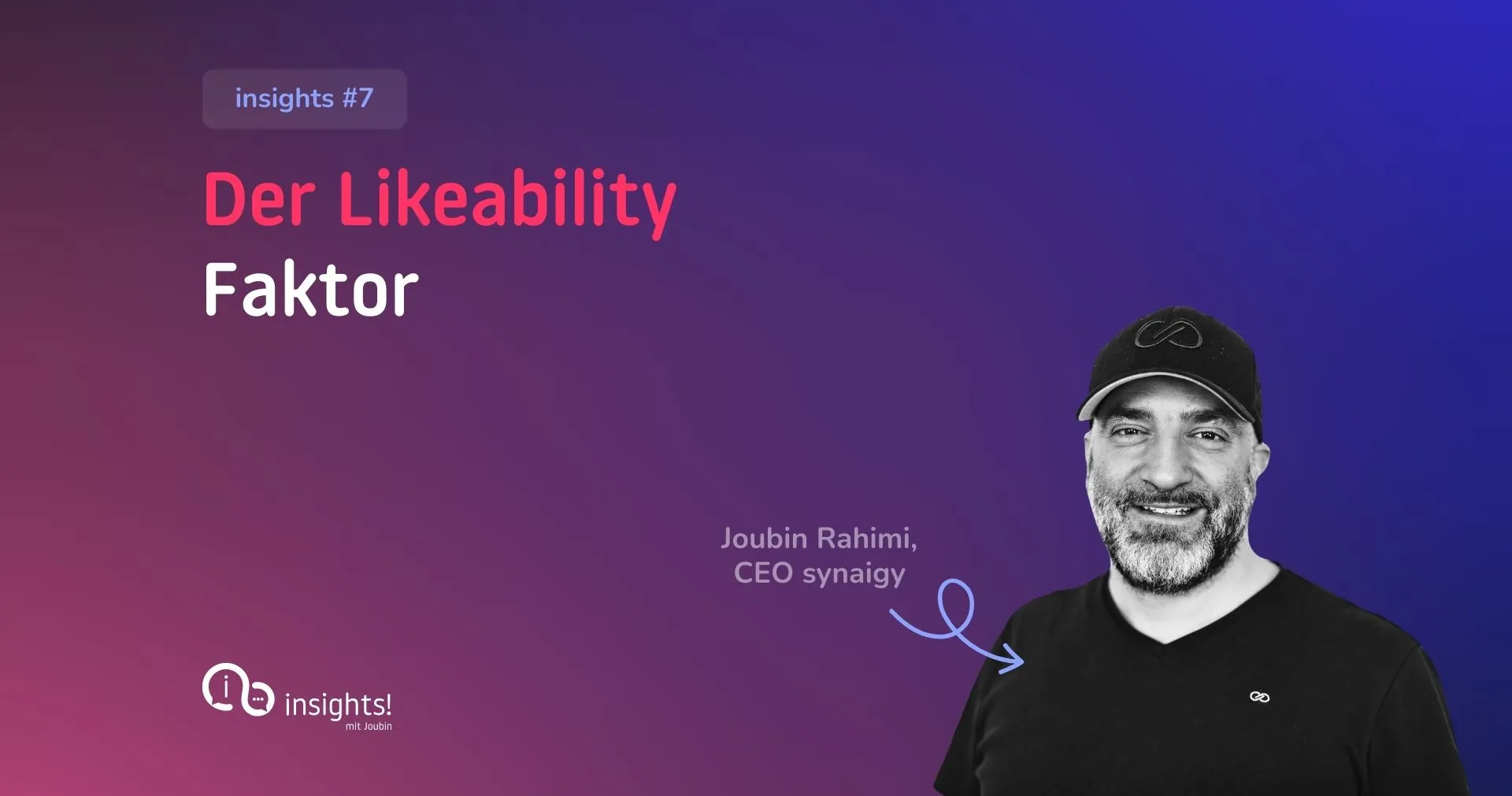
Have you noticed that successful companies are usually represented by human figureheads?
Companies need a story for people and a vision.
Sometimes it's a Steve Jobs, sometimes a Zuckerberg, more and more often lately an Elon Musk.
Usually it's people that users and customers can identify with best. Of course it's helpful for a company to have a high likeability factor. Who doesn't like being liked!
The problem is that steadily growing companies gaining in popularity tend, at some point, to risk losing likeability. So my advice is to let the company show some "human touch" in how it presents itself externally. Elon Musk demonstrates this with Tesla – you don't have to like him, but he is a personality, and a human one at that. It's human nature to want to interact with other people, even when it's a fairly abstract form of interaction like online shopping. The question then is how companies achieve a high likeability factor – "For that, I need a story for people on the one hand, but also a vision of what I'm offering on the other."
Would you like to listen to the full episode?
Listen in directly and find out more:
Please accept the corresponding cookies to view this embedded content.
Prefer to watch the episode? No problem!
Here's a recording:
Please accept functional cookies to watch this video.
Prefer to read?
Great to have you back for another episode of Insights with me, Joubin Rahimi.
This is about the seventh of eight parts: what do the GAFA do strategically differently to other companies?
One point is likeability, that's the seventh point.
We like the GAFAs, not everyone does, since the GAFAs certainly ruffle feathers too, especially among mid-sized companies. But as such we like them, and that's really the point I want to make.
Do we like the company or do we like the person?
Mostly it's the people, we see that with these GAFAs too. Let's take Google.
Google was founded by Larry and Sergey, and both are people that many users can really identify with.
Come from university, invent something, tinker with it, work hard on it, write "Don't be evil" into their company's statutes. These are all things we like entrepreneurs for.
Even Zuckerberg had to assert himself, fight and build the whole thing up, even though he's very, very well positioned. But he managed it, also with his manner, always wearing the same T-shirts, to convey a different corporate culture at eye level to the outside world. And exactly the same thing happened at Apple and Amazon. The bigger the companies got, the harder it naturally became to hold onto that likeability. De facto it's the people, and we see it in other areas too - Tesla, Elon Musk, likeable per se, even though he's polarising. But per se he's an interesting personality. You don't have to like smoking weed, you don't have to like the laws around it either, that he could do that on a radio show and filmed himself doing it. But it just shows his entrepreneurial foresight, his understanding of freedom, which he then also takes for himself. Maybe also his mistakes, the ones he makes when he posts tweets. He's human in that sense, and that's what's special.
The question companies can naturally ask themselves is: can I be likeable as a company? Or do I need a person for that? Do I need the founder? Do I need the managing director?
From my perspective, it's always people.
We can simply take a look into a sector that was for a long time strongly dominated by men, and in which a woman has fundamentally changed things: the sale of erotic articles.
Beate Uhse revolutionised the industry. And what's special is, above all, that she was a woman. And interestingly, exactly the same story repeated itself 40 years later in online business.
Many companies existed in this business, like Eis.de and co, but in the end a start-up did it, where a woman was managing director and the public face: Amorelie.
This shows time and again: people make the difference.
We love buying from people, doing business with people. And companies are merely a vehicle. They may be able to provide security, but likeability is created by people.
That's what attracts people.
How can I be likeable?
For that I need a story, and I need a story for the people, but also for the vision of what I offer. And with that, we're already at part eight.
I look forward to discussing this eighth part with you next week.
See you then!
Have questions or feedback?
Then feel free to contact us directly.
- Joubin Rahimi
Managing Partnersynaigy
Show phone numberShow mobile numberShow email address

Subscribe to the blog now and never miss any news
✔️free of charge ✔️weekly news ✔️expert knowledge
Please accept the corresponding cookies to view this embedded content.