



insights! #77: from guest experience to customer loyalty: insights from the Okura Bangkok
How does a hotel manage to impress its guests anew every day? In this insights! episode, Niek Hammer, GM of the Okura Hotel in Bangkok, is our guest. He shares his experience of how to deliver outstanding customer service in the hotel industry with heart and dedication, and how to build a culture of continuous improvement. You'll learn how to deal with mistakes and why a human leadership style makes the difference. Niek also sheds light on how the Okura team strives for excellence every day, what lies behind their continuous improvement process, and what role employee leadership plays in it.
 Joubin RahimiManaging Partner · synaigy
2 min read
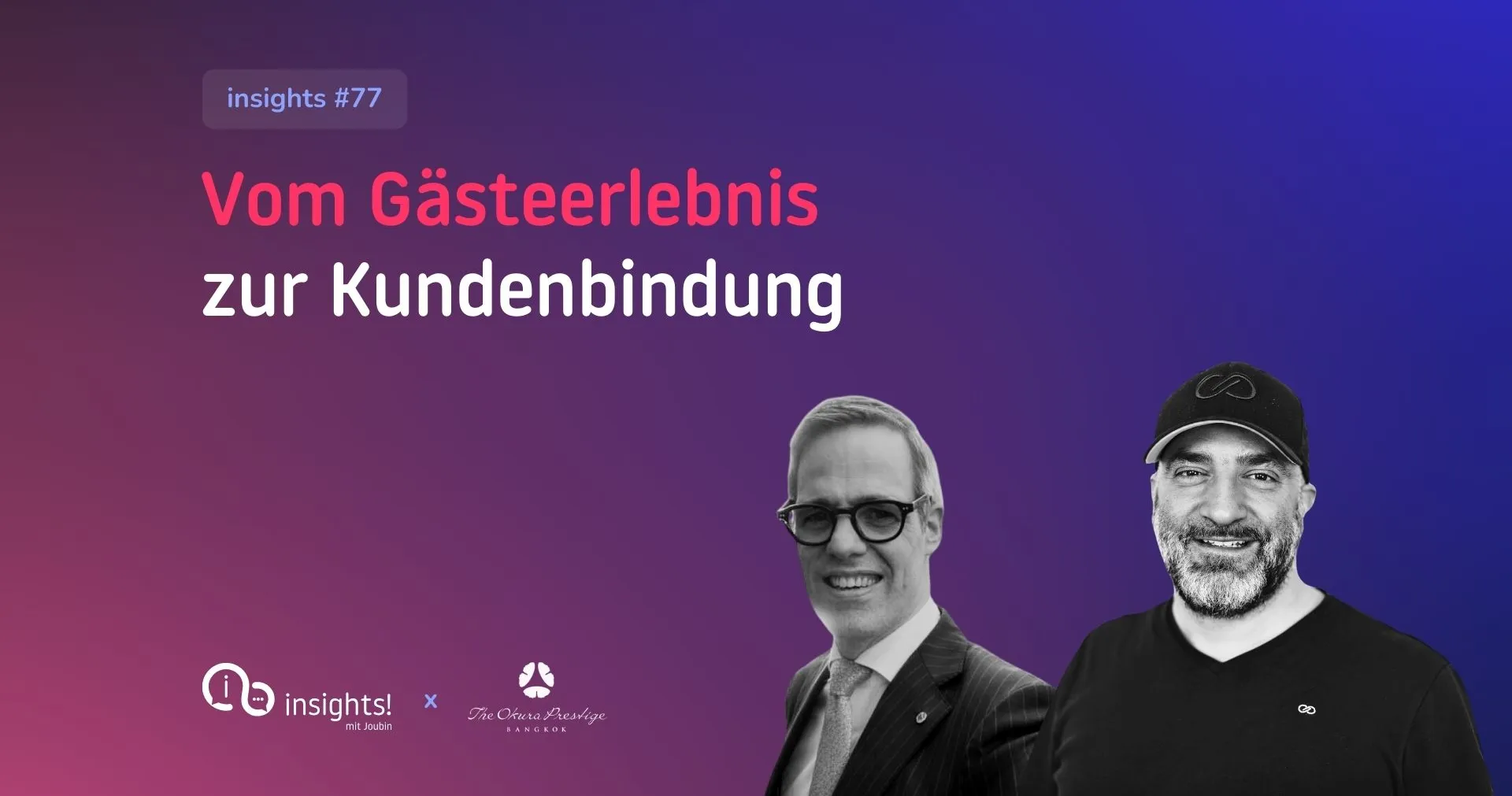
We work with people and for people. If you make a mistake, that's not the end of the world. It's always about us solving it together.
In this insights! episode, you'll get valuable insights from Niek Hammer, General Manager of the Okura Hotel in Bangkok. The Okura Hotel is known for its first-class service and outstanding hospitality, and Niek generously shares the experiences and secrets that have contributed to the hotel's success.
Key part of Okura Hotel's success is cultivating culture of hospitality. He emphasise importance of creating environment where guests truly feel welcome. Hotel team work hard to make every guest feel valued part of Okura family. They see mistakes not as failures, but as opportunities to learn and grow. Through culture of openness and constructive feedback, they can constantly optimise service and ensure guests' needs are always met.
He also emphasises the importance of modern leadership cultures and teamwork in the hotel industry. He firmly believes that genuine teamwork and collaboration are essential components of a successful hotel. The Okura team works hand in hand to ensure that every guest has an unforgettable experience. In doing so, an environment is created in which employees feel valued and supported. Niek places importance not just on being a manager, but on being part of the team working together towards one goal: to offer exceptional hospitality.
Another important aspect Niek addresses is handling emotions in customer service. He stresses the need to always stay professional and not let emotions gain the upper hand. This helps create a positive environment for guests and staff alike.
Would you like to listen to the full episode?
Find the podcast of the interview here:
Please accept the corresponding cookies to view this embedded content.
Prefer to watch the episode? No problem!
You'll find a recording of the interview here:
Please accept functional cookies to watch this video.
Prefer to read?
Joubin Rahimi:
Wonderful to have you back for a new episode of insights! My name is Joubin Rahimi, and today's guest is Niek Hammer from Okura in Bangkok. Hello Niek.
Niek Hammer:
Good afternoon from Bangkok. Delighted to be here again. I'm Niek, I'm 47, I'm from Holland and I've been living here in Bangkok for almost five years now, and I run the Okura house and have been working for the Okura Group, a Japanese hotel company, for over 21 years, and now over eight years in Asia. I enjoy it, and so do we. I have a family here, a wife and three children. We really enjoy being here in Asia.
Joubin Rahimi:
Yes, and thank you. I enjoyed the time, in Bangkok, but also with you. And the exciting thing, which I'd like to share with everyone first, is how we got to know each other and why that's so incredibly interesting for you too, because it's really about great customer experiences, from which we can all certainly learn something, and I'll start with myself. Niek, I'd tell the story, if that's okay.
Niek Hammer:
Yes, gladly.
Joubin Rahimi:
Great. That was the second time in Bangkok this year. I'd already been in a different hotel earlier in the year. That was for a conference, and this time we were there again to meet business contacts. And we then decided on the Okura. Or I should say, I decided on the Okura, just to see something different for once. Otherwise I'm often in other big hotel chains, and I found that exciting. But it was mega difficult, because Bangkok has so many beautiful properties, as you say too, and I then decided on the Okura. And in that booking there was also a point about it. You could hand in shirts, or two garments per day for cleaning. And I'd just had shirts tailored beforehand — wasn't in Bangkok, but I had shirts tailored — and wanted to get them cleaned, and handed them in. And then in the afternoon I had a note: "Please come back down to reception." Not written as casually as I'm saying it now. Or: "Please call." Went down. And your colleague at reception then apologised immediately in a way I'd honestly never experienced before. From the heart, it just felt to me like it was from the heart, and I still didn't know what had happened. And then I said, I'm German, I can take it straight. And she then hesitated and said that the shirts, which had never happened before, suddenly had stains, black stains. I even put them on again here specially. You probably can't see it on the recording, but I wanted to bring it as an example. Has black stains on it and just isn't fit for a business shirt any more. And you then made an offer about it, which we then talked through further, and she said she'd get back to me later, and I then just went off to some public area. She then came after me there, and you also made me an offer, either a voucher or a room upgrade, and that was already great. I thought that was brilliant, but that's not yet the — many don't even do that, but it was simply good, and the manner was really good. But the special thing was, and that's how we got to know each other, you were by complete chance at the table at breakfast the next morning and asked how things were going. The way you did it actually led me to this: you obviously knew what had happened, you wanted to raise the topic too, but also see how I'd react, how I'd take it. I felt really well looked after there, and that was the point for me where I thought: brilliant. And that's the story of how Niek and I got to know each other. And now comes the actual question I asked. We said: you've got great hotels everywhere, and you've now done this brilliantly too, and you have the ambition to do it brilliantly. But how do you ultimately get that into the hotel, into the staff? Or how do you select them? And that's also the question I'm asking straight away first: how can you carry this ambition you have over to the hotel and to everyone?
Niek Hammer:
Yes, at first though I had hoped that wouldn't happen, but we work with people and for people. And if there's something, then something can happen. And for me that's always very important. And my team should always know: if you make a mistake, that's not the end of the world. It's always about us solving it together. And for me that's also very important. Especially, I'm the GM of the house, especially towards the staff, I'm quite relaxed with it. I found it very, very important that the people, my team, shouldn't be nervous about meeting me. We really do this as a team and we do it together. And for me that's really, it's a lot of fun for me. For me it's always, I say: I wanted people in my house, in my hotel, who are nice to the guest who is in my house. And that's very, very important to us. And that feeling, I don't just bring that, my team brings that together with me. And that's always something small. And that can be an apology, it can be that someone wants a double espresso, or someone has a specific table they like in the restaurant. We have many staff, and yesterday we celebrated our 12th birthday for our house, and we also have staff who have already worked for our company for five or actually already ten years, in Bangkok. And that's all of it. That's from our operation. These people know the culture, and these people really do this every single day to make all guests feel comfortable. It's quite simple. Our industry is very, very simple. We don't approach them that way, we do something with a good atmosphere, with good performance. And some people want distance and some people want personal contact. But you should always scan: what does a guest need? And who might speak to the guest again?
Joubin Rahimi:
And I find that exciting. You say it's simple, but I don't think it's that simple at all, because every person and every employee has needs too, a good day, a bad day. Every day you're there for others. So how, for example, do you recognise a person in a job interview who can go this path with you and fit into the team?
Niek Hammer:
That's not always there at the start, but you learn it together. The people who have worked for the company for a long time should pass the culture on to new employees. And that's on the job too, a lot of guiding and coaching. That's why I found it very, very important to be present out front of house. I wanted to see for myself, and I wanted to say, also to my employees, when I observe something, I'll always say it to my employees. Not in front of others, but afterwards: this is how you can do it, and this is how it's experienced by a guest. And that's how we can get a little better every day. That's really important.
Joubin Rahimi:
Wow, you're touching on really modern leadership cultures, so a coaching mentality and leadership through coaching, which in the industry we're in, we call it New Work, we're slowly changing. And my question is first of all: is that something you've lived as a hotel for a long time already? Is that typical for you, or is it also a new way of leading for you, and other properties are led differently? Do you have insight into that?
Niek Hammer:
This is certainly managed differently, yes. And I hear this often, I hear it too, in Operations, when I speak with a guest, I introduce myself and I might already have collected a plate from a table or served a coffee, and they say: But you're the GM, you shouldn't be doing that. Then I always say: I'm Frank Sinatra, I do it my way. And for me it's really no different whether I'm handing a pastry or a coffee, or helping the team. There's a lot to do in a day. I have many stakeholders, I have my Corporate Offices, I have my Owning Companies, I have my staff and my guests, and everyone should be happy at some point. But at the end of the day, in my house it's very simple for me: my guests are always priority number one. And if there's something like ripples or documentation, that can wait until the afternoon or the evening. This work doesn't run from 9 to 5. It's a way of life, that's what you want. And yes, certainly, everyone runs a house in their own way, but my parents were also in hospitality and always told me: yes, you should work for your guests, together with your staff. If they do it well, the guests will come back, and then it happens almost automatically. And that is, as I said, very simple for me.
Joubin Rahimi:
Yes, I think it's great, because you say it's for the guests, and now at our company too, and sometimes in seminars we give or in workshops, we ask: what do you understand by collaboration? And collaboration can also mean working against each other, which isn't a good form of collaboration, but in Germany in politics that happens very often right now in the coalition government, which is actually supposed to work together but works against each other more. Then in large companies it's often working alongside each other. So that's structural too. And many people say: I want to work with one another, and you say for one another. And that's what I find exciting, because I think that's the way forward, if everyone has that mindset, this for one another. And I can say my personal challenge is also recognising whether the people we bring on board are also the ones who say: I work for one another, and we set everything up for one another, because only together can our customer be happy, as with you too. So if the woman at the front desk is great, but the whole team behind her doesn't work for one another, then she has a hard time too. So this interlocking.
Niek Hammer:
That's a challenge. Sure. For me too. When I do interviews with new employees at that level, for example, education isn't always the key thing for me. In the first five minutes of a conversation, I already say to myself, in my head: yes or no? And that's perfectly normal. I work with a lot of people, and I've been doing it for over 25 years in this industry, and I deal with a lot of people, staff and guests, where you can often scan and then see: what kind of culture is this? Do they have good character, or can that be picked up a bit? I can't change character, but making a coffee or carrying a plate, that's simple. We can all learn that, it's not that difficult.
Joubin Rahimi:
And you were in the breakfast room in the mornings too? You said you were almost always in the breakfast room, right? Every morning?
Niek Hammer:
Yes, every day. That is, in a hotel, generally there are 65 and sometimes 70% of the house guests who all come for breakfast. And I have, of course, I have VIPs, I meet them on arrival or departure, but I can't meet everyone. But at breakfast, in the morning, or for example in the club lounge, with cocktails, in the evening, there I can meet the guests and then you can make a bit of small talk and get to know one another. And I've also noticed today: the word daily, yes? Isn't it all more like formal you and informal you? Yes, sometimes that becomes all the same too. We are people and we work with people. That's all the same. And very often I arrange that with people too, via WhatsApp, via Line or WeChat. You meet one another. And when I hand over my card, on my card is my mobile number, and if there's a review, I do that myself every day, I respond to it and then I add my mobile number too. If there's anything, please let us know. And then that brings things onto the same level. That means you no longer know formal or informal, that they no longer have the customer and the business. I do that together. We have fun together.
Joubin Rahimi:
You're also raising the topic of reviews, and I hear this from fellow entrepreneurs sometimes, especially in retail, who say: I've had another bad review, and this customer always sends everything back. There's a bit of the German mentality coming through there. And what I found interesting just now is that you take time for reviews every day?
Niek Hammer:
Yes.
Joubin Rahimi:
I'll let that stand.
Niek Hammer:
Yes. And I always say the shared team too, yes. And sometimes people write something, then they say: Yes, but that's not what happened. That's our opinion, but that's the interpretation of the guests. They experienced it in their own way and we should look at how we can make things right again, or how we can learn something from it, to improve for the future. That's the most important thing for me. Sometimes it turns around when I respond. Then you have contact, and the contact with a guest becomes a contact for life. And then maybe you meet once a year, once a year in Bangkok, or once a year, and then you write to each other by e-mail or WhatsApp: How are you doing in Germany? How are you doing in Holland? How is it in Tokyo? And that's really enjoyable. Then it's no longer just a business that brings in money, but a friendship comes out of it.
Joubin Rahimi:
Yes, and I have to say, I'd love to go to Bangkok again and would also love to show it to the family, the children, that we experience it. For me it's totally clear where I'll stay. It's quite funny: you didn't tie us down, rather, I fell in love with the house, with how it is there. And that, I find... Afterwards I thought about it again. There are customer loyalty programmes and so on. But it's a bond. So it's actually always customer retention and not customer love. And I think that's what, afterwards, I thought: that's what you, what the team achieved with me, to feel that. I find that powerful. So first of all thank you for letting me learn and experience that, because I've always asked myself that question too: how can I, when, with us not everything runs smoothly either, how can I then react and deal with customers accordingly? And when might we perhaps reach for the phone faster, where I thought, I'm perhaps not that bad already, but it can still be done much, much better.
Niek Hammer:
At the Okura we do this too, I can tell you, continuous improvement. A little better every day. And every day we're meant to try that. It's not about how yesterday went. Today really is a new day, something different happens. And for me too, when I tell myself my work, my day is never the same. Every day I have my appointments, but something happens at the hotel. Everything that happens in life also happens in a hotel. And that happens every day too. And I can tell myself today: okay, today's quiet. And if I say: today's quiet, then it turns into a very busy day. And that can change every day. And that's what makes it so wonderful.
Joubin Rahimi:
Yes, as you say, everything that happens in life also happens in hotel. That's certainly special. As people person I find that mega exciting. I have one final question, namely: you meet loads of entrepreneurs, managing directors, managers in hotel. And maybe you have insights too, but what are things where you say, that's something you'd sometimes wish for, or that'd be good, or that'd be something that'd make customer experience of companies, of people who are there, even better? It's a difficult question, because I've phrased it so awkwardly. But with your attitude and experience you probably have odd thought sometimes when you talk to other guests or other people – doesn't even have to be guests – regarding customer experience? Or do you not even think about that?
Niek Hammer:
Yes and no. I think if you open yourself up to learn something or get feedback, then you always have a good conversation. And I think it's important that you always, from all sorts of people, and in a hotel everyone comes through. We have CEOs, we have prime ministers, we have regional heads, we have people who really put in money to have a 5-star house even just once. And for me that's always the same. We should give everyone - and of course it's a bit different - but the same feeling with it. And you get that when you're interested in people, when you genuinely have interest in how someone is, being on the same level together, then you always arrive at a good conversation and then you learn a lot from that, from how people run a small or large company. Yes, I learn that. Every day I learn from that, from my team, but also from all the people who are relevant to my work.
Joubin Rahimi:
Yes, great. Being open. Now, you can be open when you're at peace with yourself, when things are going well for you, and you certainly also sometimes have emotions that aren't positive, for whatever reason, or precisely in customer situations too. Do you have a trick for that? I'd guess, you said it earlier: something happens in some situation and there are different views on it, and your own emotion can be part of that too. And I'd guess, the way you put it, turning your own emotion outward isn't the right approach then. Do you have a tip? How do you deal with that emotion, where you say, no, that's not right now, I need to put that away or whatever. How do you handle that, in situations like that?
Niek Hammer:
If that's really the case, yes, I should always remember — guests aren't, or guests or staff or other stakeholders aren't always reasonable. But if something happens, it should be mentioned in a word, yes; if you don't want to give an answer, then you can say: okay, let me reconsider, or give me the points back again, yes. And then you can dial the emotions back a bit, and later on you can think about what actually happened to me. But sometimes you should also have a bit of a poker face. That's important too. A guest can never, their emotions can never get to you. It can't happen. That must never happen.
Joubin Rahimi:
Great. Thank you. I think this clear statement, which you then say once more: emotions must not reach the guest, I find that amazing. I find that hugely important. Niek, thank you for the insights. This last one too was just hugely valuable for me, and hopefully for one or two others who are listening and watching right now. And all the best to you going forward, and we'll surely see each other again at your place.
Niek Hammer:
Thanks. Looking forward to seeing you again, Joubin.
Have questions or feedback?
Then feel free to contact us directly.
- Joubin Rahimi
Managing Partnersynaigy
Show phone numberShow mobile numberShow email address
Subscribe to the blog now and never miss any news
✔️free of charge ✔️weekly news ✔️expert knowledge
Please accept the corresponding cookies to view this embedded content.