



insights! #78: 50% of Revenue Through Online Sales: Schäfer Shop's Success Strategy
 Joubin RahimiManaging Partner · synaigy
4 min. read
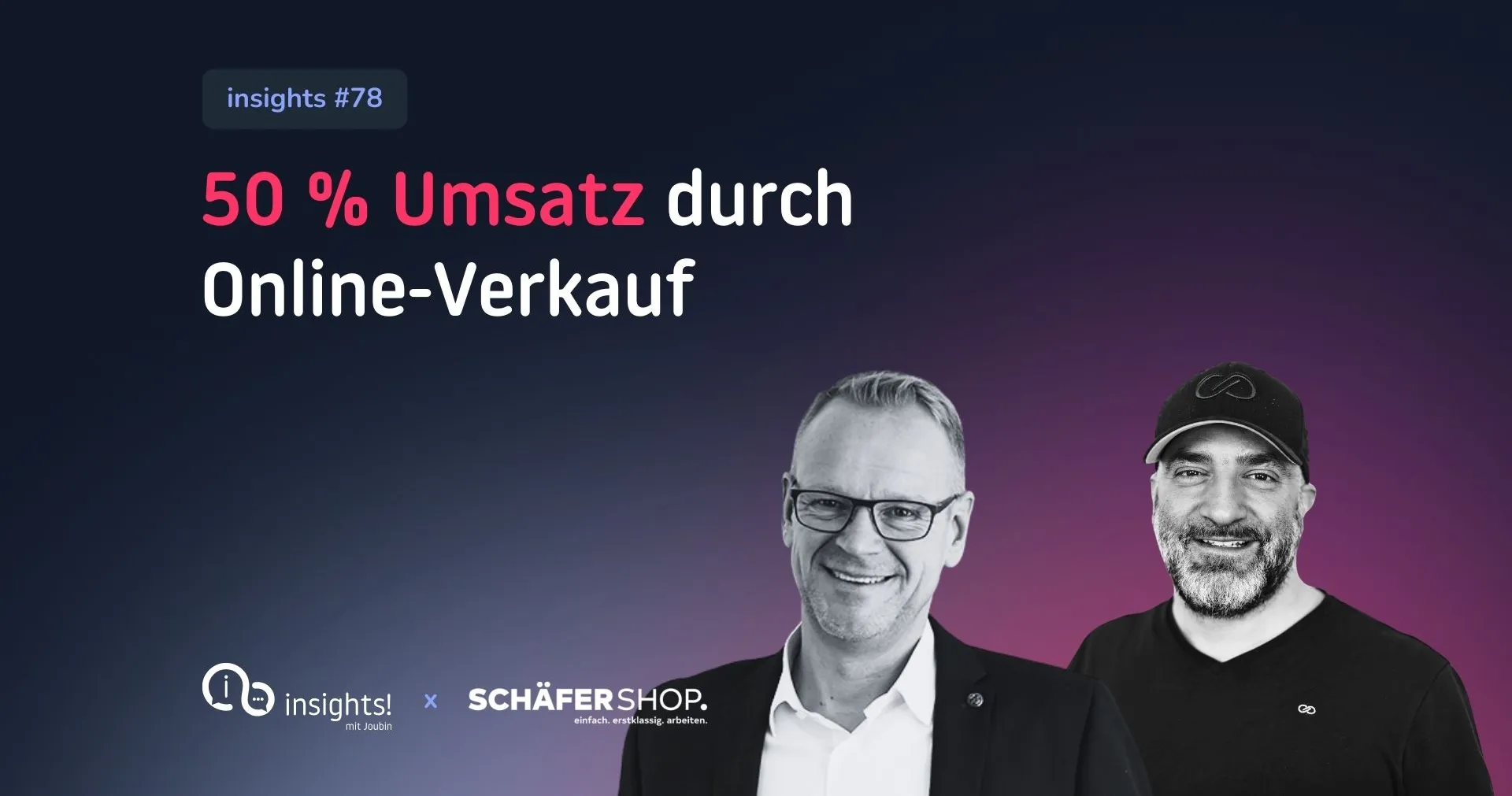
In the latest insights! episode, I talk with Andreas Reuter, CEO of Schäfer Shop, about the successes of e-commerce strategies, the future of work with hybrid working models, and the impact of innovative technologies such as live translation and deepfakes on global collaboration – overcoming language barriers and creating innovative ways of communicating. Despite these fascinating possibilities, we also address the challenges and ethical concerns that come with them.
But we know that when it comes to convenience, e-commerce is unbeatable
The Digital Revolution as a Corporate Strategy
Technology sets the pace. Schäfer Shop recognized this a long time ago, and in the new insights! episode the company shows how traditional business models can be successfully transformed. It has evolved from a classic mail-order business into a leading player in digital commerce. This transformation is not only impressive, it is also exemplary for the sector as a whole.
From Catalog to Click: A Decade of Digital Innovation
Schäfer Shop's digital journey began more than a decade ago, when e-commerce was still in its infancy. Starting from an e-commerce revenue share of 16% in 2012, the company has systematically expanded its digital presence. Today, more than 50% of its revenue is generated digitally – proof of the successful execution of its digital strategies. This development reflects not only a shift in corporate strategy, but also a profound change in a corporate culture and philosophy that is strongly customer-centric.
LinkedIn: More Than Just a Platform
Using LinkedIn actively has allowed Schäfer Shop to raise its brand presence significantly. By regularly sharing posts that offer insights into the company, Schäfer Shop has built a community of (potential) customers and employees. This strategic use of the platform goes far beyond marketing activities.
Innovation and Adaptability in the New World of Work
The launch of the "Strategy Lab" shows how Schäfer Shop actively integrates the concepts of "New Work" and "Future of Work." Plenty of companies could take a page out of that book: don't just react to external trends, but also foster innovation internally. That can have numerous positive effects: it motivates your employees, because they get to actively shape the company's future. This initiative also demonstrates a new form of employee leadership and development that is not yet established in many traditional companies.
Keeping an Eye on the Future
Being a digital pioneer also brings challenges, particularly in the area of cybersecurity and in the use of artificial intelligence. Schäfer Shop takes these challenges seriously and strives to implement technologies that support and extend human qualities. The task for us as people is to find our role in the AI cosmos. It was made for us.
The Role of Leadership in the Digital Era
The role of leadership in digital transformation is decisive. Schäfer Shop shows that leadership styles have to be flexible in order to cope with the constant changes of the digital world. The way the company involves its employees through the "Strategy Lab" and other initiatives is a clear sign that modern leadership means more than just administration; it is about creating visions and empowering people. This approach could and should be adopted by other companies going through similar transformation processes.
A Model for the Future
Schäfer Shop is setting the course today for tomorrow. Through constant innovation, a well-considered use of digital platforms and a future-oriented business strategy, the company has not only held its ground in the digital market, it has also shown how far-reaching change can be shaped successfully. It proves that the right mix of technology and humanity is the deciding factor for success.
Here are further key takeaways from the episode:
Activity on LinkedIn: Schäfer Shop uses LinkedIn successfully to generate leads and to win new employees. This activity has allowed the company to build a strong online presence that appeals to customers and potential employees alike.
Office Reconnected: The "Office Reconnected" initiative promotes collaboration and personal exchange in the office, which leads to better team dynamics and more efficient work processes.
Strategy Lab: Schäfer Shop has launched a "Strategy Lab" in which employees were released from their regular duties to develop new value propositions and services for customers focused on "New Work" and the future of work. The initiative is showing its first successes and is set to be extended.
Dealing with AI: The point was made that companies should be open to using AI, but at the same time have to put safeguards in place to avoid possible negative effects.
Would you like to listen to the full episode?
Here you'll find the podcast of the interview:
Please accept the corresponding cookies to view this embedded content.
Would you rather watch the episode? No problem!
Here you'll find a recording of the interview:
Please accept functional cookies to watch this video.
Joubin Rahimi:
Great to have you back for a new episode of insights! My name is Joubin Rahimi and my guest today is my good friend Andreas Reuter from Schäfer Shop. Hello Andreas.
Andreas Reuter:
Hello Joubin. Great to be here again.
Joubin Rahimi:
Yeah, awesome. I'm really happy you're here. You basically broke our charts for clicks, views and time spent on the video – number one. And that means it was the coolest content. Otherwise people wouldn't watch it that often.
Andreas Reuter:
Cool.
Joubin Rahimi:
And thank you for the insights from last time. One question right at the start, because it struck us: we've known each other for a good few years now, quite a while actually. When we first met, LinkedIn wasn't all that popular, and in the years after that, Schäfer Shop – and you personally, as the people behind Schäfer Shop – weren't very active on LinkedIn either. If you look now, you're super active. One of the, I'd say, most active companies in your segment. And why do you do it? I think it's great, because otherwise we probably wouldn't be doing this podcast at all. What's behind it?
Andreas Reuter:
Maybe it's exactly what you're saying. We wouldn't be doing the podcast at all if we weren't using LinkedIn the way we do. Now, for us it isn't primarily about podcasts, it's about generating leads, so winning customers, on the one hand. On the other hand, we're always looking for skilled people, employees who want to work for us. And we've realized that we can – and have to – build a good reputation. And LinkedIn is simply a really good way to do that. So on the one hand we can generate good leads via LinkedIn, and on the other, when we're sitting in job interviews, we keep getting the feedback: we looked at your posts. Hey, what you're doing there is cool, and so on. That's the idea behind it.
Joubin Rahimi:
Exactly. That's probably part of the overall strategy, because back when we met you still had the catalogs, and your online revenue was maybe in the single or low double-digit percentage range. That has grown considerably since. And I'd like to get a few insights from you on that, for everyone else listening. How did you pull it off? Is it really that one channel, or what's the thinking behind it? How did you manage it? How did you manage it – or all of you? Because it's a team success, of course.
Andreas Reuter:
It's definitely a team success, and the team has changed a lot over the past few years, learned a great deal and grown considerably. But how did we manage it? I joined the company in 2012, and I said this in the last podcast too: the task was to lead Schäfer Shop into a successful future. And in 2012 e-commerce was already a perfectly valid, well-used channel. At Schäfer Shop too, but it didn't necessarily have huge relevance. That means – you just said it yourself – back then we had an e-commerce share of 16%. 16% in 2012, that was already nothing to sneeze at. And then we actually took the time to rework our go-to-market strategy, to look again and say, okay – and customer centricity always played a key role there. We then looked at: where do we win customers today? How do our customers, the B2B customers, actually want to buy? They want it fast. They want a quick way to purchase, and so on. And then we said: okay, now we have to reposition ourselves completely in e-commerce, both technologically and on the marketing side. And we did. Exactly.
Joubin Rahimi:
Exactly, you did. Where do you stand now?
Andreas Reuter:
Today we have an e-commerce share of … well, if we count only the genuine e-commerce share, without e-procurement and so on, we're at over 50%. If we look at digital ordering channels overall, then things like e-procurement come on top, punch-out search and so on. Then we're well over 60%.
Joubin Rahimi:
And compared to the market that's probably a high figure, at least to me, if you look at other companies, right?
Andreas Reuter:
Yes, absolutely. And what we also see is that we're not just e-commerce; what we do is look at the customer journey as well, look at how we win the customer, how the customer prefers to buy. And an online customer isn't necessarily just an online customer – an online customer may well have a need to meet our field sales team on site, because they're planning an office or a warehouse or whatever. And that's how we connect the channels much more closely today. But we know that when it comes to convenience, e-commerce is unbeaten.
Joubin Rahimi:
Exactly, that was part of the last interview too, and comparing then and now, what struck me is that you talk a lot about strategy. You have pictures of people in workshops. What are you doing there? So do you already have a strategy? Or what are you building there? It's really exciting.
Andreas Reuter:
We do have a strategy. As you may remember, back in 2019 we also treated ourselves to a new brand core – brand core, external appearance and so on. So we said that after 45 years, which is how old the company was at the time, it somehow needed a fresh go-to-market strategy on the one hand, and a fresher appearance on the other. And in that context we worked on our vision, our mission and so on. And our mission – I'm sure I mentioned it last time too, because I repeat it over and over – is: we create positive working environments that make our customers more successful. Now, back then, in 2019, there was no coronavirus yet. It was just starting. I remember that two months after we presented the topic, it basically began. Then coronavirus came. And coronavirus, as you'll remember, and as every listener will remember, changed a lot in the world of work. Working from home wasn't really … well, before coronavirus it existed. People talked about it, but it somehow felt far away, and suddenly we were all forced to work from home. And we simply realized that many people didn't want to come back at all, or only wanted to come back temporarily, and so on. And then we said: if we talk about positive working environments, what actually are positive working environments in the future, or in the present? And that's exactly the topic our strategy now describes anew. So saying, okay, now it's about integrating New Work or the Future of Work into our strategy.
Joubin Rahimi:
And that's really exciting. It affects us in exactly the same way, by the way. Software developers can develop software just fine from home as well. But we just had an offsite. When everyone comes together, new ideas emerge that you'd never get through a Teams invitation, because they simply come up over coffee or in casual exchanges. And that's why we'd also like our colleagues to be in the office more often. We're working on it, but how do you manage that? You help companies like us, or like everyone else. We all have the same issue.
Andreas Reuter:
Yes, that's a really good question, and it's one we've dealt with ourselves. It's like this: under the megatrend New Work there's a trend called Office Reconnected. What it means is what you just described – you'd like to bring your people into the office more. The first question is: why? So what do you want to achieve? And the second question would be: how, and what's the added value for your colleagues? So what's the added value for colleagues in coming into the office?
Joubin Rahimi:
I always compare it a bit to sports. Why do we want it? We believe that as a company we get fitter that way, because we have better ideas and can also discuss certain things faster, because it doesn't drag on for weeks through super-structured Teams meetings – instead everyone is briefly in one room, coffee, and it's done. We really see it that way. That's one thing. And it's also a bit like sports: you go, maybe you don't really feel like it, but at the end you say, that was good. That was good, yes. And getting that team spirit in there – maybe it's the wrong analogy, but that's what's driving us here.
Andreas Reuter:
Honestly, I don't think it's the wrong analogy at all, because it's the analogy for your company. Let me give you an insight into what we found here, or what we have here. We have a relatively large administrative building with an incredible number of offices. And if you look down the hallways here, some of them are single or double offices with closed doors. And what we said is: if we now tell people – and you almost gave the answer yourself – if we tell people, hey, come back to the office, sit in your office, close the door and work in your single- or two-person office, work exactly like you do at home – what's the added value for that colleague in coming back to the office? But you just said, well, sometimes it's like this: we go into a room, we sit down together and then we exchange ideas, and something comes out of it. Social contacts emerge, exchange happens, team spirit emerges and so on. That's already part of Office Reconnected. Namely, people work collaboratively, cooperatively, and exchange ideas along the way. That's just as much a starting point that carries this Office Reconnected topic.
Joubin Rahimi:
Great. If someone is or becomes a customer of yours, do you help exactly there with ideas and thoughts, or how should I picture it?
Andreas Reuter:
That's also a really good question, and one I can't fully answer today. Why not? We launched an initiative in March. You mentioned LinkedIn earlier, and anyone following us on LinkedIn will have seen that we set up a working group called the Strategy Lab. We have eight colleagues there who were released from 80% of their work for three months to do exactly what we're talking about, namely to create value propositions and services for our customers that pay into the topic of New Work, Future of Work – and that can then offer exactly that kind of advice, tips, suggestions and so on. They do nothing other than deal precisely with the question of what our offering, our setup for our customers in the future actually is.
Joubin Rahimi:
That's amazing. 80% of their time is basically out, only available for emergencies. Do you – typically you're either at management level or in business development. How did you staff it? So where do the people come from? Or do you not have business development and are compensating for it this way? So many questions.
Andreas Reuter:
We actually don't have a dedicated business development function that deals with the future in that way. And we also believe we don't need one. Where do the people come from? That was the exciting part of the whole story. At some point in March we launched a call for applications via our SharePoint. We had our annual kick-off event, which we do every year. We bring all colleagues together. Then, on the one hand, we explain from a management perspective: what are the goals for this year? How do we want to achieve them? But we also dare to glance in the rear-view mirror: what have we achieved? And we try to structure it so that everyone understands what it's about. I could stand here and present highly sophisticated plans where half the people might say: hey, honestly, I don't care. We try to do the whole thing in a way that everyone really understands and everyone can identify with. And in that context we presented the topic of Future of Work and announced that with, or for, this Strategy Lab we were looking for colleagues to do exactly what we just described: work on value propositions for three months. And we presented the framework conditions. And then we said: hey, no matter where you come from – whether you're at Schäfer Shop in Germany, whether you're at Schäfer Shop in one of the country organizations, whether you sit in controlling, in marketing or in the warehouse – you can apply, and you can become part of this Strategy Lab. Sure, we said eight people, that's the limit. But apply, and then we'll choose – we'll put the teams together in whatever way really works best. That means we didn't say: you have to join and you have to join. We deliberately didn't do that; instead we let people be intrinsically motivated to actually apply. And I think that was the cool part. If you look at the group today, by the way, it's only women – which doesn't mean the men … we somehow had two applications from men, otherwise only from women. And they come from all kinds of areas. Some come from e-commerce, we have someone from controlling. We have someone from HR, from recruiting, and so on, and from sales. And a real dynamic has developed. The group has been together since the beginning of April – sorry, since the beginning of March – and you can feel the dynamic.
Joubin Rahimi:
That's incredible. So something really developed out of it. Amazing. And after the three months it will be extended. That's coming up soon, isn't it?
Andreas Reuter:
It is indeed coming up soon, and yes, it will be extended. This Strategy Lab will have achieved the value propositions, so the goal, within the three months. Maybe just briefly on this before we get to the episode: what we're currently learning as managers is that New Work also means self-determination. That means that we as managers don't walk in and say: right, now you work on this, this and this, and this is good and this is bad. Instead, we gave them a task, we're informed regularly, and that's it. So leadership emerges from within the team. And that alone is so cool to watch. Everyone has somehow taken on their role. To some extent it's not a role defined by a job description – they simply found their way into it. Everyone has their role and it works great.
Joubin Rahimi:
So you pass on responsibility. I don't want to say you sign off on it, as if you have nothing to do with it, but you pass it on. And all the participants can work on the company, right?
Andreas Reuter:
Yes, exactly.
Joubin Rahimi:
I always think that's the nicest kind of work.
Andreas Reuter:
Yes, it does take some getting used to. But you know what? I come from a generation of leaders that still knows what it's like to work in hierarchies. And when you hand over such an incredibly important topic and say: hey, that's the task. But how you achieve it and what you achieve is entirely your thing, not mine – at first that does feel a bit like a loss of control. You can't go in there and say: this is right, this is wrong. With those topics it's always difficult anyway. But that's exactly what makes it, and that's cool. I can say that not just the people in the Strategy Lab, but at the very least our leadership team, is currently learning to lead in a new way and to let go.
Joubin Rahimi:
That's really cool. We don't have quite the same setup as you. We also want to make decisions more where they arise as a company. That's a topic we're simply working on, because we have software developers and UX people. We only have smart minds. It's not as if Wolli or I were smarter. We think differently, we've been lucky in life, maybe we also have different perspectives, different abilities – whether that makes a decision better or worse. Distance is always a question too, and that's exactly where we want to get to: that decisions happen more … let's say, I used to play football, line of scrimmage, so where the interaction happens, so you get there faster. We find that exciting too, because the first feedback from this pioneer team, as we call them, is full of energy. I think that's great. It's also striking – I get feedback and think: why that? Surely it should be further along. But on the other hand, Jan Stasser, who also got to experience it, put it to me collegially: you are where you are. And he's right. We are where we are. It doesn't matter. From there it goes forward, and then we have to work through the points ahead of us. I found that you also work on yourself a lot, even without working on it directly. That's the exciting part of it.
Andreas Reuter:
But do you know how much you work on it without having the feeling that you're working on it? But you said something really great just now, and I think it hasn't reached every manager by a long way. I have a lot of great people, super intelligent people, and in case of doubt we don't know any better either. We're privileged because we get to hold this position. That's the right mindset, because it has something to do with trust.
Joubin Rahimi:
Exactly.
Andreas Reuter:
So leadership today means something completely different than it did ten years ago. And I think what you bring to it is great, because you say: hey, the people are there and I trust them. And as Jan said: honestly, what good is it to you if you have the great ideas? You're way out ahead, but you forget to take your people along. You won't get anything implemented that way.
Joubin Rahimi:
That's always my main problem. I'm always way off in the future. And then understanding it and saying: okay, how do we all get to the future, and not just one person?
Andreas Reuter:
Exactly, and in what steps. I think the future – that's always the thing. The future is pure fiction. I recently read a really cool book on exactly that: the future is pure fiction. It's not something you can pin down, and it's pure illusion too. Because the future can only be planned to a certain extent. Sure, you shouldn't be naive and only live in the here and now – you should have an idea of where you want to go. But how you get there, that's not something you decide on your own anymore. You can say: look, this is how I did it. I said: New Work, Future of Work, we have to engage with that. The thing is here, and with our mission we simply belong in it, and it's a huge opportunity for us to really win market share again, because in the end that's what it's all about.
Joubin Rahimi:
Is the market getting bigger or not – it's probably changing, isn't it?
Andreas Reuter:
It's changing, exactly. And the pie is probably about the same size. Now it's about redistributing the slices. And that's my job. But my job is also – just like yours. You described it too: taking people along and going step by step, packaging it into portions people understand. And by now I've realized that the working group, our Strategy Lab, is much further into the future than I ever was.
Joubin Rahimi:
They also get to spend 80% of their time on it. But that's really cool, because it gives me orientation again, and then I can give others orientation, and that's how things really start moving. When we talk about the future, at the moment everyone talks about artificial intelligence, generative AI. How does it affect you? And not just in terms of which tools you use. That's very often the question – which tools – but I don't find that all that exciting. Rather: how does the working environment change from your point of view, or how do you support that? Or maybe there are questions I haven't asked at all that would be really exciting in this context and that I should have asked.
Andreas Reuter:
Well, the topic – sure, AI is a topic for us, for everyone.
And anyone doing e-commerce, or setting up their business in a future-oriented way, will have to engage with the topic, and will get to. We don't primarily see the whole thing as a threat – I'll come back to that in a moment – instead we see it as a huge opportunity here too, and it is an opportunity. When I think about how much more efficient we can become. Years ago, since 1995 – I think I said this last time too – we've been recording all customer movement and behavioral data and working with neural networks that show us next-purchase behavior, that tell us which customer still has how much development potential, and so on and so forth. So we've been using these early approaches for decades, you have to say. But now the whole thing is picking up a completely different speed. And suddenly we notice: okay, if we think about product videos, at some point you may not need to film them anymore, you can have them created by artificial intelligence. Product content – we do a lot of that with ChatGPT by now, we have it reworked afterwards and so on, but we already do it today, developing much more content via artificial intelligence. Topics like chat and so on are almost a no-brainer, you have to say. Anyone not engaging with it today should at least give it some thought. That's the one side, and that's the positive side. On the other side, of course, there are also things that can genuinely become threats. Because anyone following us knows that a year and a half ago we became the victim of a cyberattack. And back then, you have to say, a year and a half ago, that was still a relatively simple method. Today you can do completely different things. You see these deepfake, deep-face stories and so on. You really have to be well prepared. And for us it was business model development on the one hand, but on the other we said we basically need governance and rules for dealing with artificial intelligence. We want people to engage with it. Everyone here, everyone should do it. But we also say it needs rules, so we don't open the floodgates to anyone who might not have only good intentions.
Joubin Rahimi:
I think for us as an IT service provider and digital agency it's also changing a great deal. You just said it: we have a UX and graphics department. Content is then created in-house. You don't have to outsource much anymore. That's fine, it's changing. You can see it as a danger, but I think it's changing now. I see the same in software development. Actually, software development is completely clear-cut, because everything is digital apart from the input and the parameters – the parameters of what you want to have. But when I develop something, I get there faster and faster, and I think that will also be the case over the next one or two years, where a really good developer who's up here and an average one – sometimes the average one is two, three, four, five times slower. There are studies on that too. We said: what? That much? But sometimes it's horrendously slower, and in a team it evens out. But now that AI is coming, it pushes the very good developer up a bit and the average one in that direction too. What does that do to salaries? What does it do to prices? I think we have very good software developers in our company. We see that these software developers are occasionally in high demand with customers, or analytics people and so on. And that's fine, but if things become more equal, what's the added value of being an IT service company? And that brings me back to deepfakes. With deepfakes you create a text and then it gets made, but everything is getting faster. That means at some point you'll have live transcription and live video, and then I could speak no German at all, only Farsi, that is Persian, and we could still have this conversation live and the system would translate it into my language with the right modulation – it's insane. But what does that mean for remote work or for offshoring? And I think that will completely change our IT industry, change it massively. And the ways we work too, which I find really exciting. And how do we work then, New Work, and reconnect together? Will it be AR?
Andreas Reuter:
You know what? No, what you're describing is wild. We talked at the beginning about how I get people back to the office. But now, the way you just described it, you have someone who may not speak any German and you understand each other because you have some translator running alongside that actually does simultaneous translation. Now you come together in the office and realize: hey, for a moment we can't talk to each other anymore. How do you solve something like that? That's a cool question, honestly.
Joubin Rahimi:
That's basically the wave after the wave.
Andreas Reuter:
Yes, and it's rising.
Joubin Rahimi:
It will definitely be what happened to retail with the internet and ordering via e-commerce. That didn't really affect IT all that much. Now it's going to hit the IT industry too. Every industry gets its turn at some point, I feel.
Andreas Reuter:
That's how it is, but you know what I ask myself? I mean, you're right. I know that ChatGPT, for example, can already write simple Java code. But then it's about how I embed it into my system. That's certainly still an issue to be solved. But the next question is also: what will change? I simply believe you need more people who are able to write prompts or to program prompts. That means IT people will probably still be needed for now. But those are the tasks – the content simply changes, and with it the value that people can add.
Joubin Rahimi:
I think the greatest art will be translating customer requirements into the prompts or into that environment. That's one thing, and doing it with a sense of fun. I mean, who would you rather work with? It will become far more service-oriented, whereas IT people could get away with being quirky for a very long time, simply because there are so few of them – that's simply going to change. And then every customer of ours wants to deal with people they can say are great to work with. We'll be the craftspeople of IT. That's how it is. It's not a popular opinion here. But that's how it is. The craftspeople of IT.
Andreas Reuter:
You know what I think? That's a topic we have to deal with anyway, because we humans are demonstrably social beings. So this social interaction, social contacts and so on, from my point of view – and I hope it stays that way – still play a really big role. So as we said at the start: when we bring people back into the office and they sit together as a team, sometimes things emerge that would never emerge in a Teams meeting. And I believe those are the strengths we have to remember. I don't believe that artificial intelligence … people always say humans are empathetic, artificial intelligence isn't. I think that's nonsense. First of all – sorry for putting it that way – first of all, I don't believe that every human is empathetic. And secondly, I believe an artificial intelligence is perfectly capable of learning what empathy actually is and how to deploy it. And even so, it's still nice to sit together with people today and exchange ideas and keep interacting, personally interacting, and so on. I still consider that absolutely essential.
Joubin Rahimi:
We firmly believe that too. That's also why we have the Behind Closed Doors dinner – so behind closed doors that we don't even promote it on LinkedIn. But I believe, deep down, that through all the digital stuff I want to build trust with people. And the more digital we become, the more I think I can only do that physically. As funny as it sounds – telling whether a deepfake of you is talking to me now to lure something out, or the real Andreas Reuter. It's really important to simply know trust and to pick up on the particularities of a conversation, the things you typically don't see otherwise.
Andreas Reuter:
I believe that too. I was very lucky to be invited to the last Behind Closed Doors event in Cologne. And there were, I think, 40 people there. I wrote about it afterwards. It was such a lovely evening, the exchange, standing together with people, getting to know new people. I think that really makes a difference. It made a big difference to me.
Joubin Rahimi:
That's great. We're happy to read that every time, because it simply confirms what we're doing there. It's a medium-term thing as well. It pays into the very long-range goals we have. We want Germany and Europe to simply get better. And I believe we can only do that if we exchange ideas. And it's not a sales event, the way it so often is – how many leads, turnaround, capture.
Andreas Reuter:
It really isn't. I mean, you meet people you know from the past. You get to know new people. Suddenly you're in a group in the middle of a discussion. It was really exciting too – we had a discussion about values, which plays a role as well. So for me, that's a given.
Joubin Rahimi:
Or understanding as well. He had a group colleague with him, Hermann Ballé, and he had talked with you and with others too, and said: ah, it only really became clear to me why all those retailers switched over all their ERP systems at the beginning of the 90s. Well, because business was going really well back then. And then you did these big projects, and they're very often 30 years old now. And then there are all the many legacy systems. We have a brand that deals with exactly that, but that's the foundation of it. You won't simply get that out of ChatGPT in a targeted way. Or maybe you wouldn't even ask the question in the first place.
Andreas Reuter:
I mean, with ChatGPT you have to say anyway, or with any artificial intelligence, it's … I don't want to say shit in, shit out, but if at some point artificial intelligence is only being fed by itself, then what we see gets smaller and smaller. That's why I believe we humans are still needed. I'm probably either naive enough to believe that or perhaps wise enough to know that people will always be needed somehow – at least I hope so.
Joubin Rahimi:
I believe we do it for ourselves and not for the systems. I think that's a very big difference.
Andreas Reuter:
In 2018 I was once invited by Google to Silicon Valley, and I heard a talk there. It was about artificial intelligence, so real intelligence in computers, singularity and so on. And back then I had the feeling that it was considered entirely desirable for us to reach technological singularity, meaning that computers are basically smarter than we humans and so on. I don't find that desirable at all. No. I mean, then we're not doing it for ourselves anymore. Then we're only doing it to make ourselves redundant. And it was Ray Kurzweil who talked about it. He was the researcher in that field. So I think the way things are going now is fine, and it will keep developing, but it is important that we humans find our role in this game too.
Joubin Rahimi:
And what do you think will not change? So is it exactly the point that we humans, as social beings, need this interaction? Or is there something else that other company leaders can look to? So not just what changes, but what you should simply bet on? That's an exciting question too.
Andreas Reuter:
As I said, at the last Behind Closed Doors event I talked with someone you also work with, about the topic of values. And values drive a corporate culture. And at the end of the day, a corporate culture determines whether people come and want to work for the company or not. And I believe that we humans are needed for exactly that. Because, I mean, what is artificial intelligence there for and what does artificial intelligence do? It's supposed to make our lives easier. It's supposed to help us make decisions and so on. But in order to help people, I first need people inside the shell that a company provides. And I believe that culture, being together, human interaction, social networking and so on still play a big role. And I believe our role as a company will have to focus on that even more clearly. I mean, beyond the topic of wanting to grow, we always have the issue that there are fewer and fewer people to work with, simply fewer employees. And there too it's about: how can I actually differentiate myself? How do I manage to bring people to us and not to our competitors? And so on. I believe that will always be needed. Well, I hope it will always be needed.
Joubin Rahimi:
And do you think the competition is primarily local? So is your competition in Europe, or is the competition outside Europe? Where is the real …
Andreas Reuter:
Quite clearly, the competition of the future. Today we're very local. Sure, is Amazon local? Amazon isn't local and is still a competitor of ours. But if we look at what's happening right now with Alibaba and so on, with shortened supply chains, with delivery speeds and so on, we definitely have global competition. Definitely. And Alibaba is just one example. We see everything that's happening in the market. In the past you'd say you ordered from, I don't know, whom? Alibaba. I'll stick with that one because it's such an example – people ordered from Alibaba and then it took three weeks until the goods arrived. Today it may well take less than a week and you have the goods. So where is the advantage of local commerce?
Joubin Rahimi:
Yes.
Andreas Reuter:
Those are things we do have to deal with.
Joubin Rahimi:
And they have far more options. I find that exciting too, from a legal point of view. I think it's good that people think about how you can also use AI safely. But it's also characteristic of Europe that we first regulate the whole thing without knowing what we're regulating. I was just in Asia and they said: we think it's just wonderful that you're putting handcuffs on yourselves.
Andreas Reuter:
I mean, I really put my foot in it once on that. Because I said exactly the same thing. I said: great that we're once again … back then it was still the GDPR. That's also one of those things that first … It is important. So I believe protecting data – don't get me wrong – is absolutely important. And with AI, imposing some rules on ourselves is absolutely important too. It's just that if we impose it on ourselves for Europe while we have global markets, then we're heading … In the long run you have to think about something like that globally too. You can't say: okay, we now have an AI Act in Europe. Never mind what happens in America or what happens in China. That simply doesn't work anymore.
Joubin Rahimi:
And it's so all-encompassing that European companies effectively can't do anything.
Andreas Reuter:
No.
Joubin Rahimi:
And that's then a bit like with the DSGVO and GDPR.
Andreas Reuter:
Yes.
Joubin Rahimi:
Strictly speaking, none of us were allowed to use Microsoft at all.
Andreas Reuter:
No.
Joubin Rahimi:
But that's … the ECJ even said: yes, it doesn't work, but we won't draw any consequences, because otherwise you'd have nothing, you'd be back in the Stone Age. So they say: yes, you have a law, but then it doesn't achieve anything.
Andreas Reuter:
It's so extreme. It's so extreme, and first you have to deal with it, and everything carries some penalty. As a managing director you always have something: you have to reckon with this, you have to reckon with that. So basically you always have to reckon with everything. Except that if you don't do it, you have to reckon with something else, which again carries some penalty. So it somehow hasn't been thought through to the end.
Joubin Rahimi:
That's true. Maybe to take two or three takeaways from all this. We've now talked about AI and about entrepreneurship, as I'd call it, or your strategic development within the team. What are the things from the last three to six months that were genuine key takeaways for you, where you'd say it was great to experience that, and that you'd like to share?
Andreas Reuter:
Well, my biggest key takeaway right now is this Strategy Lab topic and what I'm currently learning for myself about how my leadership has to change. So what am I needed for in the future? What is my role in the future? How do I want to lead? How do I want the company to be perceived? And so on. That's one key takeaway, and I'm nowhere near the end of it. I think we're already very progressive when it comes to leadership, and we've been named most wanted employer three times in a row by Kununu and Zeit. Those are the kinds of things that show you we're doing a lot. But the amount we do today compared to what lies ahead of us in the future – those are worlds apart. I think one thing is to stay open, to really take an interest in people, to take an interest in what actually happens when I hand over responsibility, what works with people, where people might need guidance and where they don't, and so on. So leadership – I think that's the first thing. Leadership is something completely individual. There isn't one single leadership style that works for everyone; you have to engage with each individual person individually. And the exciting thing is that you talk a lot about leadership and organizational structure, and the basis is actually the change in people brought about by digitalization. I find that's the exciting part – that the answer to it isn't: I add more technology, but rather: I lead differently. Because we had digitalization back then too. That was the annual kick-off event in 2023. That's when we showed a bot for the first time, we called it the virtual call center agent, and we showed a video of a young woman – it was okay, but it has developed a lot since. We showed that to people and stirred up an enormous amount of fear here. Because they then said: hey, but if at some point it's so good that you can't even tell it isn't me, what am I still needed for? I think that really has to be dealt with. Digitalization is there as a cool solution, but there are still people behind it who are afraid.
Joubin Rahimi:
Absolutely.
Andreas Reuter:
That has to be managed, and you really have to show people perspectives too.
Joubin Rahimi:
As you said at the beginning. Our job is to take everyone along on this journey, where we don't yet know exactly where it leads, everyone who can work with and for each other on this journey.
Andreas Reuter:
Yes. And the second topic, second key takeaway, and then I'm done, is really: be genuinely open toward AI, embrace it, but also protect yourself, because you can't only use AI for good things, you can also use it for thoroughly bad things. And before you set off on big journeys, you should at least be clear about a few rules that you also give people to take with them, because otherwise you get people's fear there too: I'm using something and I have no idea what will come of it. But if I say, okay, this is the framework we're operating in, then you can actually do something with it. So you should definitely do that. That's it, at least on the topics we've just talked about.
Joubin Rahimi:
Great. Thank you very much. We didn't agree on this beforehand, but knowing him, if you have questions feel free to ask Andreas directly. We always appreciate comments and interaction, because that makes the podcast and the LinkedIn newsletter and so on richer. So questions on this are very welcome. And thank you, dear Andreas, for all the insights. That was simply great.
Andreas Reuter:
Likewise. Thank you very much, Joubin. It was fun again.
Joubin Rahimi:
Thanks. See you.
Andreas Reuter:
Bye.
- Joubin Rahimi
Managing Partnersynaigy
Show phone numberShow mobile numberShow email address
Subscribe to the blog now and never miss any news again
✔️free of charge ✔️news every week ✔️expert knowledge
Please accept the corresponding cookies to view this embedded content.