



Personalisation, AI, data = dream team for your online shop
In the latest insights! episode, we had the pleasure of welcoming Ralph Hünermann, founder and managing director of ODOSCOPE GmbH, to the studio. The conversation centred on the approaches ODOSCOPE pursues in e-commerce personalisation, artificial intelligence and data analysis.
 Joubin RahimiManaging Partner · synaigy
4 min read
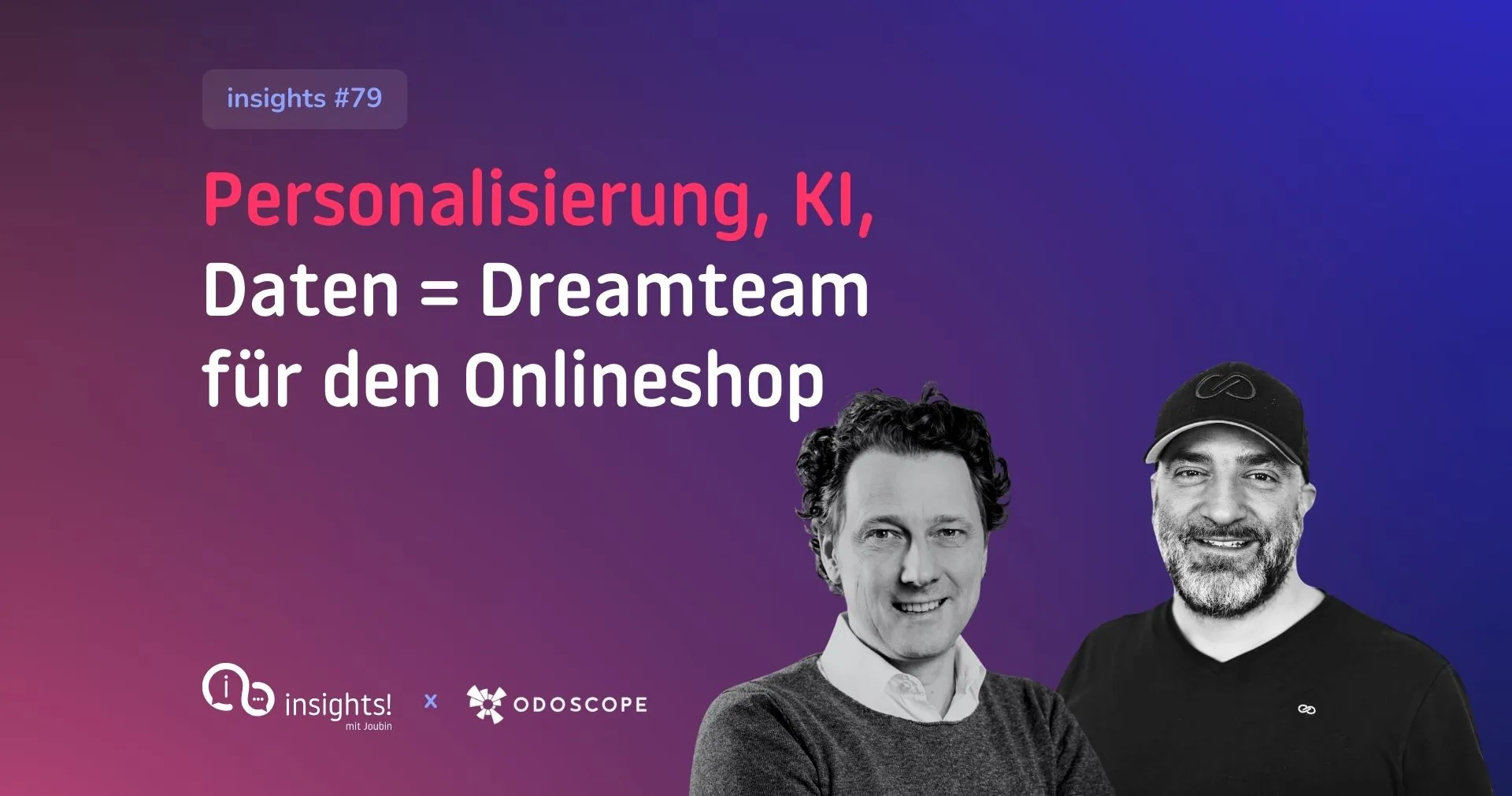
Customer experience and conversion rate must be in harmony
Artificial intelligence and data analysis are transforming the way we shop online. Gone are the days when online shops were static and impersonal. Today it's about addressing each customer individually and offering them a tailor-made shopping experience. But how is this achieved? With intelligent algorithms that recognise users' needs in real time and respond to them.
Revolution through AI and data analysis
ODOSCOPE uses AI to personalise online shops in real time. Unlike traditional approaches based on manual rules, the AI learns independently from the available data, offering a dynamic and individual user experience. This scalable personalisation means users are no longer confronted with predefined rules; instead, the AI anticipates, based on the data, which products are most relevant to them. This happens without manual intervention and ensures that every user gets a shopping experience tailored to them. Closely linked to artificial intelligence is data analysis too. According to Hünermann, "analysis must be at the centre of the shop system". Only this way can it be ensured that all elements users come into contact with are served in a data-driven way. This not only increases the conversion rate, but also perfects the customer experience. Convenience plays a central role here. Shops that operate in a data-driven way and anticipate their users' needs create a comfortable and appealing shopping experience, which can lead to greater customer loyalty and increased customer lifetime value.
From personalisation to situationalisation
ODOSCOPE extends the concept of personalisation with what is known as situationalisation. This considers not only the person, but also the specific situation they are in. Data such as the device used or the access channel (e.g. Instagram or Google) influences which products are shown to the user. This enables an even more precise adaptation of the offering to the individual needs and situations of users. For example, users accessing the shop with an iPhone might have different preferences than users with a Windows machine. The AI uses this information to optimise the shopping experience.
The correct sorting of product lists
One of the central challenges in e-commerce is sorting product lists. In times when users browse from small screens, it's crucial that the most relevant products are visible immediately. This is where ODOSCOPE's strength shows: by using AI and data analysis, products can be sorted so that every user sees the products relevant to them straight away. This increases the likelihood that users stay in the shop and ultimately make a purchase. Correctly sorting product lists has an enormous impact. Often these lists are only sorted by top sellers or even alphabetically, which makes little sense and doesn't inspire users. The right sorting, on the other hand, can significantly increase dwell time and purchase likelihood.
The most important thing: the use of tracking data
Companies who have their data under control can use this information to calculate relevance of products. It's not just about what's bought, but also about behaviour of users in shop – which products they view, add to basket or remove again. All this information flows into analysis should be used and helps to further improve shopping experience. It's crucial to use this data from the start.
Central role of data analysis
For growing a successful e-commerce shop, analysis must be central. All elements users come into contact with should be delivered data-driven. This enables dynamic adaptation to user needs and drives a better customer experience. A higher conversion rate and increased customer lifetime value are the logical consequences.
Would you like to listen to the full episode?
Find the podcast of the interview here:
Please accept the corresponding cookies to view this embedded content.
Prefer to watch the episode? No problem!
You'll find a recording of the interview here:
Please accept functional cookies to watch this video.
Prefer to read?
Joubin Rahimi:
Great to have you along for a new episode of insights! My name's Joubin Rahimi, and today's guest in the studio in Dortmund: Ralph Hünermann. Hello Ralph.
Ralph Hünermann:
Hello Joubin. Thanks for having me.
Joubin Rahimi:
Yes, absolutely delighted. And great that you made the trip here to Dortmund. We usually do it remotely, but in person is always much nicer.
Ralph Hünermann:
But in this great studio, you're happy to be here, and I'm really glad to be here. You've built this really nicely.
Joubin Rahimi:
Thanks. It's also great with the history and so on. But that's not what today is about – it's about you and the insights you generate daily working with data for clients. Now some people may know you or know ODOSCOPE, but perhaps you'd still like to introduce yourself and say a bit about ODOSCOPE, so everyone can place you.
Ralph Hünermann:
Yes, my name is Ralph Hünermann. I'm founder and managing director of ODOSCOPE GmbH. By background I'm more technical. That means I studied engineering with a focus on technical computer science, so there was always a bit of programming involved. But it was also always this bridge between machine and human. So how can I make machines so that they help people, and that they essentially support people? And then, after my studies, I did a doctorate in neuroinformatics, which was about neural networks and AI topics, to get closer to making machines better able to approach humans. Yes, and later on I also had an agency, but agency work wasn't really what I wanted to do long-term — I was always looking for a product. And that's how ODOSCOPE was born, which we then spun out at some point, and the current ODOSCOPE GmbH has now existed since 2015. There we use AI to personalise at scale, specifically for online shops in e-commerce. Scalable here means that, unlike other personalisation solutions, I don't have to set manual rules. So I don't have to say, if someone comes with these and those characteristics, show them that — instead, the AI tries to anticipate that independently based on the data.
Joubin Rahimi:
Let's dive straight in. That's practically a perfect lead-in for me. First of all: which customer clusters do you typically serve?
Ralph Hünermann:
We're not actually restricted to one particular industry now, we mainly target medium-to-large e-commerce shops, when it comes to large assortments being in use. That's a bit the theme here, because that's exactly the point where ODOSCOPE is strong, that we can restructure the assortments. We can essentially rebuild the shop in real time, so everyone sees the products relevant to them.
Joubin Rahimi:
And that's perhaps interesting too. In pre-call you told me about story that had immense impact with very little effort. Perhaps we can dive into that, because I think that's something most people, as you just put it, completely miss and is actually so obvious.
Ralph Hünermann:
Yes, that's the product list. So that's the list where lots of products are lined up, often across dozens of pages, and nobody scrolls through that anymore. I mean, in the age of smartphones, we have small screens, there are only a few products, you scroll a bit and Google has taught us everything relevant to you is on the first page.
Joubin Rahimi:
That might be quite exciting, right?
Ralph Hünermann:
Yes, and that's why it's so important. It's no use having hundreds of products still sitting on other pages. I need to bring that to the front.
JOubin Rahimi:
Actually, taking Google analogy, what customer and user search for – if maybe you don't even know what you're looking for, because you're in some category with thousand products in it – has to be on top, right?
Ralph Hünermann:
Exactly, and individually. I mean, why are there a thousand products in the category? Because the shop wants to be a specialist in whatever topic it serves and wants to have something for everyone. But since we're all wired differently, be it in sports equipment, then I have loads of different variations and I want to serve each one individually. Or be it in furniture or fashion, whatever. And that's the reason there are such huge ranges. So now this individual relevance meets these huge ranges.
Joubin Rahimi:
And I had asked the question about the quick win.
Ralph Hünermann:
And this sorting, i.e. the correct sorting of the list, has an enormous impact. Often it's simply sorted by top sellers. We've even seen it happen with a client where it was sorted alphabetically. I mean, that's obviously completely pointless. You mustn't forget, in this list – and it's often hugely underestimated by most e-commerce managers – that's where people are looking for inspiration. Right? That means they don't yet know exactly what they want, because otherwise they'd be on a product detail page, probably straight from Google, or they'd type exactly what they're looking for into the search. No, they enter something more general, because they want to be inspired. Do you have experience of how this differs between people who already know the shop versus those visiting the shop for the first time? Is there different behaviour there? Well, it's true that people coming in from outside, in the furniture sector, are looking for a new three-seater sofa. And then they go to Google and type: three-seater sofa, and they get a few results and end up in a furniture shop. Or I'm looking for a dress with a floral print pattern or something like that. And then I end up in the corresponding categories, often with corresponding filters applied. And Google offers me lots of options I can click on. There isn't just the one shop I end up in. And the shop's job is to catch that person now and make sure they stay with them. That means I now have to manage to show this user, in that moment, what's relevant to them, so that they say to themselves in the shop: Oh, they've got exciting things here, and not: What have they even got? There might be something on page 20 that the user would find interesting, but she doesn't see it straight away. And then she's gone again and takes the next link on Google. And that's exactly why it's so important. That's why this impact is so big. If you show something relevant there, people stay in the shop and then, of course, the likelihood of purchase automatically increases too.
Joubin Rahimi:
I'd like to state this quintessence again, because what you said, I'd like to put it pointedly once more, because I think it's mega important. It's a whole journey. You go on Google, you say, I'm looking for box-spring beds, you land on Kika Leiner, XXL Lutz, Poco Domaine, whatever.
Ralph Hünermann:
Right.
Joubin Rahimi:
And then there's already the question: if I then want premium and I only see cheap stuff, that's annoying.
Ralph Hünermann:
Right.
Joubin Rahimi:
If I want it cheap and I only see premium, I'm quickly gone too.
Ralph Hünermann:
So, on one hand I need to sort by relevance, on other hand I need to somehow address the individual.
Joubin Rahimi:
And how do you do that? You might not know that much yet.
Ralph Hünermann:
That's exactly the problem now. So when people conventionally talk about personalisation, they always think of the person. That means, you want to-
Joubin Rahimi:
It's in the name.
Ralph Hünermann:
Exactly, in principle you want to identify the person, know what they've bought in the past, and then place something accordingly. But that information is only available for a fraction of the users who appear in the shop at all. That's why we've extended our engine with so-called situationalisation. And that's not just about the person, but also the situation they find themselves in. And then, based on the data – so we're back to data again – you can see, for example, that people with an iPhone buy different products than people with a Windows machine. So, and I can of course make use of that, because that's information the user brings along when they arrive. And then in principle I can say: okay, what are users with a
iPhone, when they search for box spring bed? Whether these more expensive or not, leave that open, because data decide that. Data decide that. Could be more expensive, doesn't have to be. And we know, for example in fashion sector, we have with one customer, they made price clusters via their customers. Meaning, buy more expensive, buy more cheap and so on. And there are for example products, basic blouses, plain white, not particularly expensive, but bought by both groups, whereas floral patterns or so, more in lower segment, and more business-like, light blue blouses and so on, more expensive, more in this higher price class.
Joubin Rahimi:
Is that the case in the iPhone segment or not?
Ralph Hünermann:
No, that's exactly the thinking that has to go. That's what conventional personalisation always does: oh, someone's coming with an iPhone, let's show them expensive stuff. No, you have to show them what people with an iPhone actually buy.
Joubin Rahimi:
I think that's mega, because it also shows the difference between: I automated something and the data proves you right, versus a feeling.
Ralph Hünermann:
Exactly, the other thing is just a feeling. And of course some analysis underlies that feeling too. That means I go and analyse and say: okay, look, the average basket of an iPhone user is 10% higher than that of an Android user. So I show them more expensive products. But that can just as easily backfire. So it's better to show what iPhone users actually buy. And you can transfer this principle to other parameters too. And then, for example, you can look at the channel - does this person come via Instagram or via Google or via the newsletter. There too, you can see that completely different purchasing behaviour lies behind it in the end, or the time of day too. We can all relate to the fact that people who buy on Sunday afternoon have completely different purchasing behaviour than those who come into the shop Monday morning at seven. Or those who come into the shop at 11 or 12 at night. That's simply a different group of people, and they naturally have different purchasing behaviour too. And you can make use of that, and then display the shop differently accordingly. And the biggest lever here is really these lists where people want to be inspired. But that also works on landing pages, where I tease things, or with recommendations too, where I say: okay, if you don't like this, but people like you also like this sort of thing. And then I can make the recommendation accordingly. Yes, and location, for example, also plays a big role. So it's obviously a huge difference whether someone in Berlin Mitte is looking for a trendy hoodie or in Upper Bavaria, yes, for a trendy hoodie. They mean something different. They're both saying the same thing but meaning something different, yes.
Joubin Rahimi:
OK, that someone in Upper Bavaria is looking for a trendy hoodie – well, young people, sure. But that's not the same as being a hipster.
Ralph Hünermann:
They tick differently then, yes?
Joubin Rahimi:
Right. You provide a technology and customers use it. Which customers do this most successfully, and why?
Ralph Hünermann:
The customers who are most successful at this are the ones who have their data under control. That means the ones who essentially have clean tracking data, because it's not just about my customer data, it's also about the non-customer data. So what do people who don't buy in my shop actually do? Because they also show certain patterns for what they're interested in and what they're not. So we don't just use the purchase event, we also use other events to calculate the relevance of products. So looks at the product, goes into the detail view, reads through the detail information, adds it to the basket, takes it straight back out again, sends it back afterwards. All this kind of information feeds into the relevance calculation. And of course it's important that this data is then actually available.
Joubin Rahimi:
You say companies that have their data under control. How do they have it under control? Well, that comes down to the team you have. If you don't have a team that's implemented, you simply don't have the data.
Ralph Hünermann:
That starts already with basic tracking, that you have that in place, for example. Then a CRM system, so you have customer data in there and know purchase histories. Customers with large assortments, meaning our clients, so shops with large assortments, usually also have a large customer base, because otherwise the large assortment wouldn't pay off, and they're usually set up so they have their data under control, because they have to serve their customers, they need a CRM system because they optimise their shop, with tracking. The product feed is also important, so what do I know about the products? So it's not always just about people who bought this SKU also bought this SKU, but I want product information. I want to know, people with these attributes bought products with these attributes or were interested in them. And then I can say: okay, they go for pricier options, they go for more colourful items.
Joubin Rahimi:
Do I only ever buy in the sale?
Ralph Hünermann:
Something like that, exactly. And then I can go ahead and apply that to new products too. That means the system doesn't need to learn the old products first, or learn each product individually – it can learn via the product attributes instead.
Joubin Rahimi:
Okay. Also a really, really interesting point, then. Yes, exactly.
Ralph Hünermann:
And that's how you get a kickstart. And another important point about the data: because we essentially only use data that's already there, we get a kickstart from day one, because that data already exists. The system doesn't need to learn first, doesn't need to be trained first — the information about what iPhone users in Berlin buy in rainy weather is already in the data. You already have it.
Joubin Rahimi:
Now a role play: if you say you'd build an e-commerce system again, or an e-commerce system at all, or set up a shop, and were a retailer yourself. What three things would you really focus on?
Ralph Hünermann:
That analysis is at the centre. Just one thing. That's the core. That's the core from my point of view. And that's something none of the shop systems out there have really internalised yet. That's something I've been pursuing for 15 years, saying: if you want a clean shop system that really works well, then everything that's played out must be played out data-driven. The analysis must be at the centre and the shop system must build on the data, not, this is the shop system and it also generates data and somewhere on the side we then analyse it occasionally and somehow keep tipping things in and adding a few rule sets to it, but if I were building such a shop system, I would really make sure that I play out all elements users come into contact with in a data-driven way and am dynamic at every point.
Joubin Rahimi:
What else can you read from the data, other than me reorganising it again? So if you say it's at the centre, you're probably even more ...
Ralph Hünermann:
Well, it's really about, bottom line: how can I generate higher conversion? And that's always the goal. I want to increase revenue, which means I have to deliver a good customer experience. That's the only way I can bind people to me, so to speak. I can generate a high customer lifetime value. I can generate a high basket value. That means I have to have a good customer experience. How do I create a good customer experience in a shop? Through convenience. We all know this, we know the history of e-commerce. A huge step towards convenience was not having to enter my card details every single time. So the shop that could store that early on had already won. It had already won.
Joubin Rahimi:
Now it's Apple Pay and Google Pay.
Ralph Hünermann:
Exactly, now there's Apple Pay, PayPal, whatever. Either way, I don't have to enter much any more, with Apple Pay myself too, it's just... Done. I don't even have to enter a PIN or anything like that any more. So personally, for me that's convenient, that I no longer have to enter the PIN for the card. And that's how it is with convenience. And when I have convenience, I automatically feel more comfortable. So at that point, for the online shop, data-driven means convenience, it tries to anticipate what I want. And then I don't have to search for long at all any more. Of course the shop can't read from my eyes exactly what I'm looking for right now, but it can at least head in the right direction, and then I automatically feel better looked after and think: right, they've got a handle on this somehow. They've got really nice things. Even though they've also got plenty of things I don't like at all. But then I feel: ah, they've got nice things. That's a cool shop.
Joubin Rahimi:
Because you mainly saw the ones you liked.
Ralph Hünermann:
Exactly, yes. And I mean, we have a client who measured the NPS, the Net Promoter Score, in parallel, and we were able to increase it by 25% through the use of data-driven lists. And that's a clear sign that customer experience has improved.
Ralph Hünermann:
And that's, I think, also a really great closing line, because ultimately we all say the customer experience has to be right. So it has to be excellent.
And conversion rate doesn't always increase customer experience. It can, not always, but when they're in harmony, it's great if you can do both. So thanks for the conversation, for the insights. If you have more questions, post your comments below, message us directly and also check out ODOSCOPE. It's mega exciting, and our data team within synaigy is also a bit in love with ODOSCOPE. Thanks for your time.
Ralph Hünermann:
It was a lot of fun.
Joubin Rahimi:
That's great. Thank you.
Ralph Hünermann:
Thanks.
Have questions or feedback?
Then feel free to contact us directly.
- Joubin Rahimi
Managing Partnersynaigy
Show phone numberShow mobile numberShow email address

Subscribe to the blog now and never miss any news
✔️free of charge ✔️weekly news ✔️expert knowledge
Please accept the corresponding cookies to view this embedded content.