



insights! #80: Achieving satisfied customers with modern order management systems
In this episode of insights!, I had the pleasure of hosting Linda Kuhr, founder and managing director of Fulfillmenttools. She shares her experiences and insights into the world of modern order management and the challenges that need to be mastered along the way.
 Joubin RahimiManaging Partner · synaigy
2 min read
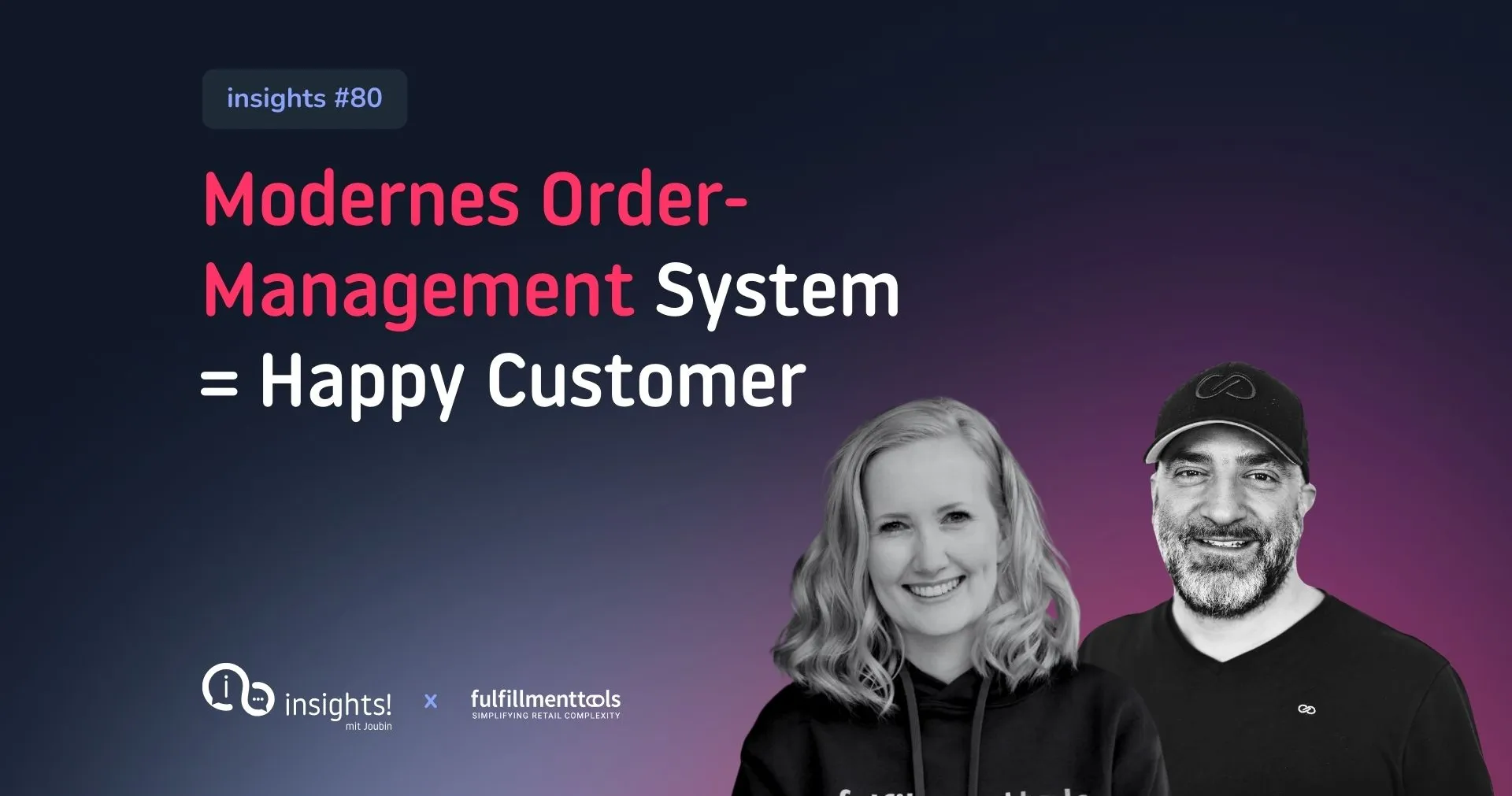
Interface is only 5% or 10% of whole experience.
The importance of flexibility and transparency
Linda Kuhr brings a wealth of experience from the start-up scene and venture capital, and has led Fulfillmenttools since 2019. Fulfillmenttools offers a solution specifically designed to support omnichannel retailers in integrating their sales channels. A flexible and scalable architecture built on the MACH principles – microservices, API first, cloud native, headless – makes the decisive difference here. This means you can both start small and grow quickly, allowing you to adapt your processes dynamically.
A core problem for many retailers is the lack of transparency around stock across different channels. This leads to inefficient processes and longer delivery times. A concrete example shows how a lack of transparency led to a click & collect order taking twelve days. A modern order management system, such as that from Fulfillmenttools, can help here by identifying the optimal location for order fulfilment and making the goods available within minutes or hours.
Omnichannel as success factor
Linda Kuhr explains that customers who can shop both online and offline tend to spend more and are more loyal. A well-integrated omnichannel system can increase revenue by 30 to 40 percent, as observed among many customers of Fulfillmenttools. This shows that connecting sales channels not only improves the customer experience but also has a direct impact on business success.
Challenges exist across various industries
Fulfillmenttools has gathered experience across diverse sectors, including food, fashion, jewellery and furniture. Each sector has its own challenges, be it managing cold zones and best-before dates in the food sector or personalising services such as engravings in jewellery retail. A flexible order management system must be able to meet these specific and complex requirements.
Technological openness and the best-of-breed approach
Linda Kuhr recommends that companies open up technologically to new approaches and see themselves as orchestrators of their systems. The best-of-breed approach, where the best solutions are selected and integrated for each discipline, offers considerable advantages. You shouldn't try to build everything yourself, but rely on proven partners and technologies to ensure smooth integration. The discussion with Linda Kuhr shows all of us how important modern, flexible order management systems are for retail. Through transparent inventory management and efficient processes, companies can not only improve the customer experience but also increase revenue. A technologically open approach and collaboration with specialised partners are the key to success.
Would you like to listen to the full episode?
Find the podcast of the interview here:
Please accept the corresponding cookies to view this embedded content.
Joubin Rahimi
Great to have you back for new episode of Insights. Today with Linda Kuhr from fulfillmenttools. And I'm really pleased we managed it today, even though, as you see, setting is different from our usual studio. Hello Linda.
Linda Kuhr
Hi Joubin, I'm delighted to be here. Thank you very much for the invitation.
Joubin Rahimi
Very happy to. And actually we already chatted for three quarters of an hour beforehand. That was brilliant. So everyone can already look forward to this being a great recording, because that was tremendous fun and a lot happened in that time. We've actually known each other in person for three quarters of an hour now. So maybe you'd like to say a couple of sentences about yourself, for those who felt the same as me, who didn't know you yet, and don't know fulfillmenttools yet either.
Linda Kuhr
Yes, gladly. As Joubin already said, I'm Linda Kuhr, founder and managing director of fulfillmenttools, the next generation order management system. Before I go into what we do, maybe two sentences about myself personally. I have background in venture capital, so I dealt a lot with start-ups and
Joubin Rahimi
Yes.
Linda Kuhr
Have also founded my own company before, and have been working full time on fulfillmenttools since 2019, and I'm thrilled to be building this exciting topic in a really exciting industry. What is fulfillmenttools? I already mentioned order management system. Many people probably picture dinosaurs, large old legacy systems. As I said, we've been active since 2019-2020 and have made it our mission to support omnichannel retailers in connecting their channels. That means simply finding the best fulfilment location for every order, across all possible sales channels. That's what we do, in a nutshell.
Joubin Rahimi
And that's hugely important, because we talk a lot about customer experience, and customers should be understood, and customer experiences should be as smooth and cool as possible, and lots of people immediately think about what the interface needs to look like. But de facto the interface is only 5% or 10% of the whole experience. It's also about when do I actually hold the product in my hands? So when? And what's the handover like, or the products? And that's often about the processes involved, and you introduced it so nicely. We've been doing this for a few years now too, even longer than your company has existed. And yes, with the IBM background it wasn't so far-fetched for us to do that with IBM too. And otherwise we often wrote it ourselves, when the multi-million projects were simply too much and you ended up writing a two, three, four hundred thousand euro version of the limited solution instead. Always a big number for the person responsible for that. And hugely important, but maybe that's also the connection to you, Linda Kuhr. Because you're not coming in saying we need two-million-euro projects, you're much smaller. And that's also why we chose you, because I think that matches the target group too. But maybe you have one or two cases where you'd say that was just amazing to see, what a difference it made that people are now thinking about the processes in order management.
Linda Kuhr
Yes, absolutely. As you say, it's simply the customer experience, which in many areas is currently still quite bumpy, mainly after an order has been placed. But order management systems also play a big role before that, namely when it comes to which product is available where, and what my actual reason for purchase is as a customer. Why do I want to buy something and how do I want to buy it? Do I perhaps want it especially quickly? So, maybe an example from me personally. I once wanted to go to the coast with my kids at the weekend, needed some warm clothes. I thought, right, Friday morning, I'll quickly order this via click & collect so I can pick it up this afternoon and we can head off straight away. And click & collect specifically, because same-day delivery is very, very difficult in Germany. But click & collect — it's hanging there in the shop, I can pick it up right away. And then it's reserved, nobody else can buy it out from under me. That was my thinking as a customer. I order, and then at first nothing happens at all. Then first comes: thank you for your order, we'll be in touch. So no indication that you can pick it up in one or two hours. Then, believe it or not, six days later — my weekend was long over by then — I get a notification: your product is now being shipped. I actually thought I'd misclicked. Shipped? I actually wanted to pick it up. And then it was shipped to the branch I'd selected. And another six days later, so twelve days after my order,
Joubin Rahimi
Is that your client now?
Linda Kuhr
We're still working on it. But that's simply something I can improve by deploying an order management system. Because what's the problem? I asked that too, of course. The problem is that there's simply no visibility over stock across the various channels. You don't know what's in the store, what's in the warehouse, what needs to be delivered.
Joubin Rahimi
Yes.
Linda Kuhr
And that's simply how such processes come about. Goods then arrive via store delivery, really via completely normal store delivery. And if I simply create this transparency with order management system and then pick perfect location for this customer, then I can make these goods available within minutes, but perhaps also two hours. And that's exactly difference one can achieve. And those are simply cases we very often replace, where simply
Joubin Rahimi
Yes.
Linda Kuhr
Something like this takes very long. I'd say, the normal case. It's four days on average. That's what we found when examining 100 fashion retailers. That's four days, which I simply find unacceptable in an age where, as a Prime member, I get things from Amazon the very next day.
Joubin Rahimi
Yes, totally. And we once did it for a shoe retailer that no longer exists. The name is Reno, so it was huge. And they were set up well in that respect, before Covid. Click & Collect was used a bit, but then with Covid, when the stores were suddenly empty too, it was brilliant. So we had Click & Collect and all those things in place. At some point they replaced Wavi, the merchandise management system. And then you could compare or reconcile stock levels in total with the till, so we had an overall view. Why am I telling you this? Because I also know from customers who say, I don't even know how much stock I have in my merchandise management system. How do you deal with cases like that? Do you say, okay, you need to get a handle on that first, or do you have solutions for that?
Linda Kuhr
So we're actually also very often used as the system of record, because we can simply establish transparency when it's put together correctly. So once we know what the stock levels are and we know what's sold online, sold via click & collect, and then also know what's sold in store, then we actually have all the information.
Linda Kuhr
And that's how we replace a lot of systems, even though that wasn't originally our intention at all. But that's how it's developed historically now. And that's actually the case that works really, really well. Especially with retailers like that, because that's actually what we see too. They're often very traditional retailers who simply have this huge asset of many branches and are so close to every customer and could actually offer such a cool customer experience, because they have everything there, but they don't do it, because the technology limits them. And that's what we set out to change, saying, this really shouldn't be the case. Yes.
Joubin Rahimi
Yes. That's brilliant, because that's of course exactly the core topic. That's the bottleneck, that they say, I don't even know where to look. But if you can solve that, that's great. You belong to the REWE Group. And the next question most people probably ask is, then that's only for grocery retailers, right? I've already asked loads of fashion retailers. So you do fashion, you do more too. But where do you say, how big should a customer be for it to be worthwhile for them?
Linda Kuhr
So actually, we already start with very small customers, even with 20 branches. So whenever I simply have complexity and these inventory problems and want to deliver this customer experience, an order management system actually makes sense. And yes, our background is grocery retail, and that's why we believe we master the discipline very well, because there's nothing more complicated than shipping minced meat at the right temperature from the warehouse to a customer's home. If I can do that, I can also ship shoes, I can also ship jewellery. The only thing we haven't yet dared to do is organ trading. That might be a bit more complicated, but that's simply our background, and we're industry-agnostic. So many customers come from other sectors too, jewellers, we also have food, but of course fashion too, furniture, DIY stores, these are all sectors where many of the challenges are very similar. There are always specifics, but basically we ship both a bag of crisps within 15 minutes and a Rolex via our platform. And for that it's just one and the same platform.
Joubin Rahimi
The Rolex customer doesn't just reach in randomly, after all — it has to be the one with the serial number. Although it's probably also interesting to find a bag of crisps with the best-before date, when you have three different best-before dates. That's probably a challenge too.
Linda Kuhr
Correct, exactly. And so every industry has its own challenges. Grocery retail has quite a few. I have cooling zones, I have best-before dates. Orders are actually orders with a very large number of items. And then it's about route sequencing, multi-order picking. But that's also interesting for the fashion industry in turn, where I often only have one or two items. So there are some overlaps in places, and in other places we also have different industries that simply have their own specific challenges, which can then be covered well. Or I have services involved. I want to have a watch engraved, for instance. That kind of thing has to be possible too.
Joubin Rahimi
I'll note that engraving point again. While you were saying that, I had another question, namely, if the customer experience is better, that's great. If I'm a business owner or decision-maker, I ask myself what I get out of it monetarily. Making customers happier is nice, but ultimately it also has to show up monetarily. Do you have statistics on the extra revenue or savings it brings? Or do you say you have to do it this way regardless, because everyone expects what Amazon has?
Linda Kuhr
Yes, well I'd say that's simply the standard now, especially in a time of inflation, a declining economy, a consumer slump, I just need to keep up in order to survive at all. And also deliver on that standard just to survive at all. That would be point one. Point two, that pays into customer lifetime value. That's simply the topic, and those are the KPIs we really want to improve: How often does a customer come back to me as a retailer? And why is that important? So I don't have to keep pulling them into my shop with expensive marketing every time. And that's exactly what we're paying into. The figures vary a lot. It starts with the fact that if I connect my channels at all and offer my customers the option to buy across different channels, I can already increase revenue by 30 to 40 percent. We've seen that with our customers. That's simply a foundation I need to really, I'd say especially in these current difficult economic times, to really survive.
Joubin Rahimi
Did you say increasing revenue by 30 to 40 percent? You said you're a numbers person. Now you've thrown out quite a big number.
Linda Kuhr
The biggest figure I've seen is 44%. I won't say where, but that's what we've seen. That's simply the difference between a single-channel customer and a multi-channel customer. And if I network this intelligently and tell my click & collect customer, I can deliver another product to you from the other branch by tomorrow, then that's naturally something that always encourages customers to come back.
Joubin Rahimi
You said something else really cool. That brings me to the engraving. The division of omnichannel and single-channel customers. And that that's the lever in itself. That it's really about winning omnichannel customers, because they buy more and are more loyal. Is that right?
Linda Kuhr
They simply spend more money with the one retailer who can serve both channels seamlessly.
Joubin Rahimi
To all omnichannel retailers: this is good news. Customers want both. You just have to make it cool. We also do a lot of work with the Institute for Retail Research on omnichannel, and with industry too. But omnichannel is also very close to my heart.
Linda Kuhr
Yes, absolutely. Yes.
Joubin Rahimi
They're always bashing everyone else. You don't need to. You've always got a cool asset. And we can see it too, that others like Notebooksbilliger are suddenly opening stores or moving into pedestrian zones. They're not doing that out of love for city centres either, but ultimately because of the euro. I think it's great that you say, okay, from your numbers it's clearly visible that they want this.
Linda Kuhr
And many retailers simply need stores on these high streets to keep building the brand. It's a lot about brand-building too, and it's hugely important to become more present in people's minds that way.
Joubin Rahimi
Thank you. The brands do that too. They build shops in there too. Exactly, that's why. Great, now let's move on to engraving. In the end, you can also individualise processes so that you say, I now have an engraving or an installation, which is probably similar, that's also a service or a two-man delivery.
Linda Kuhr
A structure.
Joubin Rahimi
Setup, those are special stories. How do you handle times and slots? I mean, if I suddenly need to do 2,000 engravings in one day, that just doesn't work. Do you also manage service capacity, or how do you handle that?
Linda Kuhr
Yes, exactly. So with us you can simply set capacities too. These can also be fed from other systems where I may have already handled it elsewhere. That doesn't just apply to services, it also applies to packing parcels in a store. So our customers have stores that might be 100 square metres in size, and they then have 200-250 orders a day. That has to be manageable with one or two people on the floor. And that's why many customers use the feature where I simply set capacities and can also adjust them dynamically. That means if I normally have three people in my store and now one calls in sick, of course I then also have to scale the capacity down.
Linda Kuhr
And that's exactly the advantage. And whether that applies to services or orders or clearing stock, that can be set flexibly. Yes.
Joubin Rahimi
Great. Why use you instead of building it yourself? I said earlier we were often much cheaper building it ourselves than Manhattan or IBM. Okay, not all flexibility though. But roughly 100, 200 days was typical volume. And why shouldn't one build it themselves? It's not that much.
Linda Kuhr
Yes, well we're currently in what I find a really exciting phase in this whole order management market, because there are these IBMs and Manhattans that cost a huge amount of money. It takes ages to break them down to my case and they only start at billions in revenue and millions of orders anyway. That's why it's actually often the case that we replace self-built solutions, because we're simply much more flexible. Firstly, our architecture is built according to the MACH principles, i.e. microservices, API first, cloud native, headless, which simply enable extreme scalability.
Joubin Rahimi
That's great.
Linda Kuhr
You can start really small with us, but you can also scale very quickly, which we see very often with our customers. And you simply have flexibility, because the real core lies in being able to adapt your processes to whatever's happening around you. We actually came about during Covid. But if you think back to the kind of solution customers needed almost overnight, being able to offer in-store collection, for example, you can adjust that very easily with a system like this. And that's our strength. It's the scalable architecture on one hand, and the flexibility we offer in our processes on the other. That we can map different use cases and respond very quickly and flexibly to change.
Joubin Rahimi
What should a company not do, as closing question? What's the thing where you say, seen it, can be done, but it's rubbish?
Linda Kuhr
I think you simply have to open up technologically to a new path. I consider that absolutely crucial. And really build less yourself, and see yourself more as a retailer, as an orchestrator.
Linda Kuhr
The classic best-of-breed approach: I put together what I need – so the order management system that's really, really good at order management, but maybe not 37 other tasks around it. And then I see myself really just as an orchestrator who runs integration layers and makes sure the data flows correctly from A to B. But this build-it-yourself approach is exactly what we very often see reaching its limits at some point. So that would be my recommendation:
Linda Kuhr
A smart best-of-breed approach with good partners like Synergy, who can ensure everything integrates smoothly with one another, and then really selecting the best of the best for each discipline. That would be my very strong recommendation. Exactly.
Joubin Rahimi
Yes, brilliant, thank you. Above all, that would need really great architects too. The orchestrator would be the conductor of the architects. I think that's another important role that's missing in quite a few companies. So that's certainly another really great pointer as well. Linda Kuhr, thank you. In our pre-conversation we had entirely different discussions too, about entrepreneurship and building a company and balancing all that comes with it. I'd be delighted if we could pick that up again sometime, because that was really fascinating too. I'm already teasing it, because that's totally unfair.
Linda Kuhr
Yes. Yes. Yes, I'd be delighted. I'm waiting for your invitation.
Joubin Rahimi
Will do, I'll play it straight back to the team afterwards. That was brilliant, brilliant insights. I'm really pleased that we got to meet here. And I hope that everyone else who's been watching, for the 15, 16 minutes, has taken away just as much as I have. If there are any questions, you can of course get in touch with you or the team directly, as always.
Linda Kuhr
Yes, gladly. Any time. Link in the usual channels. Joubin, thank you very much.
Joubin Rahimi
Great, thanks Linda, and every success with further growth. You're already over 100% after five years. With further growth and, yes, making customers happy and making customers' customers happy. Thanks for your time.
Linda Kuhr
Very glad to.
- Joubin Rahimi
Managing Partnersynaigy
Show phone numberShow mobile numberShow email address
Subscribe to the blog now and never miss any news
✔️free of charge ✔️weekly news ✔️expert knowledge