



insights! #83: AI, marketplace, internationalisation - how these building blocks boost online retail
 Joubin RahimiManaging Partner · synaigy
3 min read
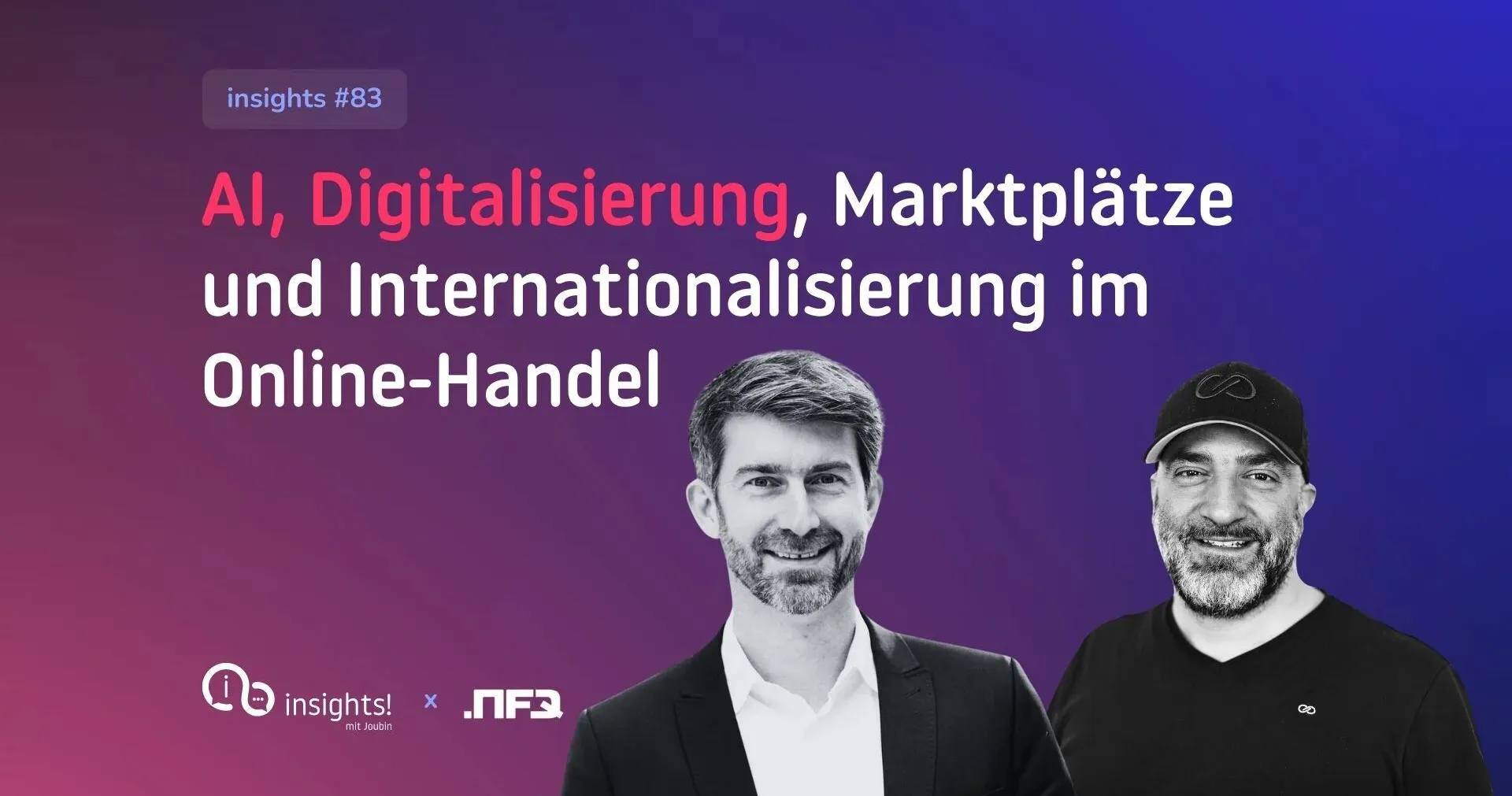
In this insights! episode, Oliver Lucas, Managing General Partner at NFQ, talks about his many years of experience in e-commerce and digitalisation, his different perspectives from the fulfilment and consulting sides, and his current work at NFQ. The discussion also covers the challenges and opportunities of digitalisation, the importance of marketplaces, the role of AI and the changing nature of software development. In closing, they discuss how digital projects should be viewed as ongoing processes of change rather than one-off projects.
We need to think of this positive force of change, and digitalisation is the means to that end.
The challenges of digital transformation
Digital transformation presents companies with a wide range of challenges. Oliver Lucas and his team at NFQ pursue a holistic approach to overcoming these challenges. Their goal is not only to support companies in implementing new systems, but also to question and optimise their underlying strategies. The work always begins with a comprehensive analysis. They want to understand the customer's strategy and examine the existing systems, processes and structures. In doing so, they often come across inefficient ways of working or manual interfaces that can be optimised, such as manual data transfers. "Sometimes it's inefficiency in the way of working, sometimes it's interfaces that are traditionally maintained manually via Excel," says Oliver. Identifying and optimising these processes is crucial for improving a company's overall performance.
Flexibility and marketplaces: the future of e-commerce
Flexibility is a decisive factor for success. You need to be able to react quickly to changes in the market and adapt your strategies accordingly as needed. One way to achieve this is by using various sales channels, especially digital marketplaces. Oliver emphasises the importance of marketplaces and partner approaches for internationalisation and opening up new markets. „Marketplaces offer a great way to expand internationally without having to invest immediately in your own infrastructure. There are platforms that cover everything from translation to logistics. That opens up huge opportunities for companies.“ By using marketplaces, products can be offered quickly and efficiently in new markets without bearing the high costs and risks of your own infrastructure. This allows flexible responses to change and opens up new business opportunities.
Artificial intelligence as an efficiency and innovation driver
Oliver and his team at NFQ use AI to achieve efficiency gains and develop new business models. AI plays a decisive role in automating processes and optimising business operations. AI is fundamentally changing the programming business. Many tasks that used to be done manually can now be automated. This means developers can focus on more complex and creative tasks.
A concrete example of using AI is the optimisation of content creation and SEO strategies. This allows companies to create high-quality content faster and more efficiently, and to improve their visibility in search engines. This leads to better customer loyalty and increased revenue.
Digitalisation as a continuous process
In closing, Oliver emphasises that digitalisation is not a one-off project but an ongoing process. "Digitalisation should always serve the company's goals. It is not an end in itself, but a means to improve and remain competitive. We must harness the positive power of change to succeed in the digital world."
This approach requires continuous adaptation and development of business strategies. Companies must be willing to keep learning constantly and adapt to changing conditions. Only in this way can they succeed in the long term and hold their own in the digital world. They see digital transformation as an evolutionary process. It's about continuously learning and improving. Companies need to understand where their business is heading and what adjustments will be necessary in the coming years. This is the challenge we must tackle together.
Would you like to listen to the full episode?
Find the podcast of the interview here:
Please accept the corresponding cookies to view this embedded content.
Prefer to watch the episode?
No problem!
You'll find a recording of the interview here:
Please accept functional cookies to watch this video.
Prefer to read?
Joubin Rahimi:
Great that you're back for a new episode of insights. My name is Joubin Rahimi and today I get to welcome Oliver Lucas. Hello Oliver.
Oliver Lucas:
Hello Joubin. I'm glad to be here.
Joubin Rahimi:
I'm really pleased about that, because what I find exciting is, we met, or I met you, seven years ago, because you were actually supposed to moderate something but couldn't due to illness. And I got to step in instead. That's why your name was familiar to me back then, and I thought it was great that we met at the start of the year at NFQ's entrepreneurs' meeting and could spend so much time together, and that's actually the trigger for today's interview. But before I say any more about that, maybe you'd like to say a few sentences about yourself and where you are at the moment and what your mission is.
Oliver Lucas:
Yes, very happy to. Didn't even know until just now, Joubin, that this first Connect somehow happened, that I didn't turn up somewhere. One or two of you may have seen me before, because I turn up often. So I've actually been in this whole e-commerce, digitalisation and multichannel context since 2003. And what I always find quite helpful is that I know the different dimensions. I worked on the fulfilment side, had my own company there, more towards full service, also know the negative sides of entrepreneurship, and because that wasn't so successful in the long run, I was then on the consulting side for quite a long time, was on the agency side in between. So I can bring quite a lot of perspectives on this whole topic of digitalisation into my projects and my topics. And now, since January, I've sold my entrepreneurial activities to NFQ and moved over with my team, and that was also one of the nice consequences of us meeting, Joubin, and now I'm at NFQ. And that's of course a really exciting new perspective, and I like bringing in my networks and my years of experience in various topics and projects, and I also like being out and about a lot, and sometimes on one stage or another as a moderator or speaker, and also happy to take part in podcasts and video formats. So, I'm looking forward to this insight format.
Joubin Rahimi:
Yes, great. What I just noticed, I looked at LinkedIn again just now, that was Dohmen Solutions, wasn't it?
Oliver Lucas:
Yes, correct. Right. That name does not really exist any more, because we actually went into insolvency in 2010, then were sold to Docdata out of the insolvency. Docdata later became Ingram Micro. So a long history, but I have put that behind me. Funnily enough, there are IT systems that we built back then. We were very early with that, but preferred to sell logistics rather than IT, bracket open, that was perhaps a mistake. Those IT systems still exist. Logistics locations still exist too, but the company simply no longer exists, and I do something else now.
Joubin Rahimi:
That's where my competitor was, as we put it. We had contact points much earlier. You did that with IBM recently. Found that funny.
Oliver Lucas:
Totally. IBM was for us back then in backend logistics actually on AS/400. I still find customers today using AS/400. I think it's called something else now. And back then too, WebSphere Commerce was one of players used for frontends. Though more at enterprise level. I think back then Oxet was topic many talked about in 2000s.
Joubin Rahimi:
Exciting. Funny. The world's that small, and that's why it's even more important to network within that construct. Now you said you brought your business into NFQ. So what is your business? What do you mainly do there or which topics do you work on for clients?
Oliver Lucas:
That's always quite challenging to explain, because we're relatively broadly positioned, since we always tell our customers and partners that we understand Digital Commerce as a whole, and accordingly we always get involved in topics, projects and issues and often create new contexts on the customer side. That means if someone asks me: Do you know about PIM or CRM? Or can you select a shop system? Or can you somehow change my logistics provider? Then the answer is yes, and that alone is already relatively broad. But then I usually come back, or my team and my consultants do, and we question why exactly this task is on the table now and what it's needed for. So what is actually the company's strategy? That's important for logistics, for PIM, for CRM, for shop, for everything. And we don't want to do name-dropping, but rather we actually want to help the company understand that such projects are always an opportunity to pay into an overarching target picture in the long term. And I think that's a mentality that makes us a bit unique, without us selling systems now, or perhaps precisely because we don't sell systems, but rather want to bring this philosophy and this mindset to our customers.
Joubin Rahimi:
I really relate to that, because we often have replatforming projects with us and then they're projects and you think: well, actually it's not a project. Sure, you can say it's a project, but it's an engagement and actually it's a product that's being developed. That's our view on it. How do you handle that? You say digital commerce in its entirety. You don't just throw in three systems and say: right, that's probably it, you also have an approach for it.
Oliver Lucas:
Yes, of course. We also have a classic approach here, because it's always difficult to sell consulting and say: we'll just start and see how it goes. Instead, our approach is actually fairly classic in the sense of analysis, conception and implementation. I mean, that's normal. Agencies hopefully mostly work that way too. Our analysis, however, is fairly holistic in that we say, okay, we want to understand the strategy and then look at the company's systems, processes and organisation, and try to bring that together. And then the customer often knows where they're not doing well. And if they don't know, we find out. Sometimes it's an inefficiency in the way they work, sometimes it's some kind of interface that's essentially a classic manual Excel interface, where someone copies something out of it and uploads it again, and in between the data gets manipulated. So that can be all sorts of different issues. We want to get a bit into the engine room, so to speak, get under the bonnet, and not evaluate the images but actually the processes behind them. Then we develop things together with the customer, essentially by pestering them a little and saying: 'Okay, where is your business heading?' And that's the strategic discussion that's very rarely had. I don't know, five years ago it was obvious that marketplace business was a perspective, and everyone wanted to invest in their shop. And we told people, yes, that's all well and good if you're now, I don't know, integrating Shopify or Shopware or Oxid or whatever in there, but what about playing out content across the various channels? That's not so important, that's what some intern does, uploading Excel lists. And some still do it that way, while others do it professionally and are then able to grow and develop. So, in short: strategy, system architecture, processes, it all belongs together.
Joubin Rahimi:
What do you say about marketplaces? Is it about connecting to marketplaces? What are the new trends you're seeing? Is it your own marketplace? Is it AI? Is it really omnichannel this time? Or what do you come across? What do you think will be the important thing?
Oliver Lucas:
Yes, I think the important thing is to position yourself reasonably flexibly, because you can't precisely plan what happens tomorrow. So what's quite clear, unless you're now, let's say, Otto or Zalando, then an enormous amount happens on your own shop. For everyone else you actually have to say, think about multiple sales channels, multiple digital sales channels, work together with e-retailers, work together with marketplaces. And that's a systemic, procedural and also logistical challenge. That's quite clear. And on top of that, sometimes I can't internationalise so well from my own strength. And that works brilliantly via marketplaces and partner approaches. So I can work with certain providers, I don't want to do any name-dropping here or anything, but there are platforms that are set up internationally, where in principle with your existing German product data, they translate everything for you. It's a worry-free package and you can then, figuratively speaking, offer your products the day after tomorrow in Poland, in Portugal, in the UK and elsewhere, provided you can fulfil it. And that's of course a huge opportunity. And that's clearly where the journey is heading. I haven't mentioned AI yet, but we'll definitely get to that in a moment. But internationalisation is a big topic.
Joubin Rahimi:
I'm with you. And also interesting, to repeat once more, the starting point: I first enter a country via marketplace rather than saying I'll set up my own website and maybe a distribution centre – instead I go through shared resources first. That's the.
Oliver Lucas:
There you should look at what options are available. I've been supporting, I think for four years now, an international format called Cross-Border Commerce, a so-called high-level group for direct-to-consumer. And there were one or two providers involved and they said, okay, our internationalisation strategy, our rollout is essentially e-commerce. That means you have a strong brand in one country and you're also represented there physically, and then you go via digital channels into a third, fourth, fifth country and see whether it works. If it works well, you can go physical. If it doesn't work, why would you build up a physical sales team? And that's simply a mindset that's normal for both of us, and we say, well of course, but there are still so many companies out there who don't understand this at top management, at entrepreneur level. And that's a bit our mission too, to raise awareness of that and make it clear to people and help with that and build it into strategic roadmaps.
Joubin Rahimi:
Since you mention it, with the mission and with people who might not know it so well yet, it's also always a process of change. And someone from my network once said: in today's world, with all the changes in digitalisation, executive boards don't actually know what they should really instruct. But they're used to instructing, because their leadership style has simply been ingrained over the 30 years they were on the board or managing director, and they can't let go, and I found it a massive insight that this is such a blockage. I don't know, would you underline that, or is it more of a rare phenomenon?
Oliver Lucas:
I don't have statistics on this, but I'd tend to underline it rather than argue against it. I believe this pace of change we have, and also the possibilities systems and infrastructures offer today to change the business quickly, overwhelms many, let's say, 50-plus managers who come from a different era. I'm allowed to say that, I belong to that group myself. I'm also already – parenthesis open – unfortunately 50 plus, but that's okay. You gain a great deal of life experience through it, and professional experience too. And yes, change is an important task there. I recently had a title at an event where I present the magic formula for international scaling and market performance management and so on, and the Z stands for listening. That's where it starts, and I expect from a leader of a company, from a C-level, that the knowledge that already exists about the possibilities and connections – I expect them to listen. And either they bring in a consultant for that, or they draw on bottom-up competence from the organisation, or they go to K5 and other events themselves, like DMEXCO and OMR, and don't just send their marketing ladies there, whom they then don't listen to afterwards. So I believe we need to start very, very much at the top. Of course there are also great positive examples. Not everything is bad.
Joubin Rahimi:
You briefly touched on a bit of a chauvinist angle there, or maybe not. The question could be: a female board member is more likely to be found at OMR or K5, so we've met both. And a male board member perhaps not from a similarly large company.
Oliver Lucas:
I don't actually know. It's unfair anyway, because unfortunately the majority of executive boards tend to be male-dominated, and women are still in the minority. But maybe you didn't mean to focus on gender, you just threw me a bit off track with that chauvinist remark...
Joubin Rahimi:
No, no. What I was getting at is that the women who are in these roles now are far more open, far more flexible, than those who have been in this role for a long time and then, statistically speaking, tend to be male, like naturally... a fair comparison would be both the same age reaching that level. Or not, but I also notice that the owners of a group would probably look far more towards female board members too, because they bring a completely different spirit to it. There are even studies on this.
Oliver Lucas:
That's a good thought. I myself also really enjoy working in heterogeneously composed teams, and so my teenage daughters would say I can totally relate to what you're saying, Joubin.
Joubin Rahimi:
Yes, I'll learn those sayings too. They're still too young. Yes, we hadn't touched on the AI topic yet, but it keeps coming up. Where does it come up for you? And do you have any sense of where it's heading?
Oliver Lucas:
It happens constantly with us. Once in daily work we do, maybe half a sentence on NFQ for those who don't know it. We've been operating globally for over 20 years with quite a lot of developers and now have 800 people across several continents. And there we naturally always have to stay on the cutting edge, or keep our finger on the pulse, whatever you call it. And AI is changing the programming business. On one hand you have to look at which activities you can still meaningfully offer as a service, and which services on the software development side get automated themselves there. And quite a lot is happening there. Now I'm not an IT person, so I can't go into that much depth. Then we have clients we work for, always two or three different approaches. The nearest thing is always on the content level and SEO level and SEA level, saying, okay, use AI to bring in more efficiency and also get more information into… We used to talk about A/B testing. Today you can do A, B, C, D, E, F, G, H, I, J, K, L and so on testing in shorter time than before, and that's great. But what I find much, much more exciting is asking, okay, how does AI change business models? And where can you build that in meaningfully, without thinking in this content dimension? And quite a lot is happening there. There was just a big shop system that had an official day, and they are also…
Joubin Rahimi:
You probably mean Shopware yesterday, right?
Oliver Lucas:
Yes, exactly. And they also communicated that their software contains several modules geared towards AI, and some of these were actually programmed by teams of ours too. We don't talk about it on stages – for us, AI is daily business.
Joubin Rahimi:
I'm really keen to see that, because I also split AI into three areas. One is efficiency gains in the daily tool. The second is making things better for the customer based on the data I have. And the third is setting up new business models with it. Those are, for me, the three themes. And making one thing more efficient, everyone will do that one way or another.
Oliver Lucas:
Sure.
Joubin Rahimi:
And the second thing is: how can I, for example, really implement e-commerce with AI? What do I do better for the customer? And that's where I think of the digital assistant. I don't want to search any more. What I actually want is for a digital assistant to handle everything I currently need done. And the third thing is really generating new things. But all of that is underpinned by something you just said, which I also find hugely exciting. How is software development changing? Because if I've had renovations done, there are bricklayers and people demolishing. One thing, and next to it something's being built, finished with technology. You can already ask yourself: how much do you really need to develop yourself every time? And I think AI, if you have a mid-level developer and a good one - a good one is usually two or three times better than a mid-level one on various points - AI will push it upwards, but not beyond, I think. The good one will still be a notch better, but the gap, the gap will get much smaller. Then we ask the question: where are our customers then, meaning NFQ's and ours, what do they want to have? I think they want people who understand systems, who have trust. And that's then again not a system. But who ultimately develops it? And I think there's a huge shift there, that it's distributed worldwide. That's why we're talking about it, but I find that hugely exciting. Do you share that view, or would you say a programming job in Germany is a safe bet for the next ten years?
Oliver Lucas:
No, I wouldn't say it's like that, I'd rather say you need people who understand software, people who understand IT architecture, you don't necessarily need a coder. I think that's a shift in the profiles needed. I was recently at a software vendor's big conference in the US, and the Chief Strategy Officer said he wouldn't steer his kids towards becoming software developers anymore, but rather, let's say, towards becoming a kind of IT generalist. I actually found that quite interesting. You need people who understand this. It's no longer about whether you're a PHP or Java or .NET person or whatever, because going forward that won't matter anymore — you need to understand how these things fit together. Now I need to be careful not to go out on too thin ice here, since I'm not an IT person myself. But I think the world is heading that way. And to bring it down to e-commerce briefly: I don't know how much longer it'll take, or whether it hasn't already happened, that a Shopify or Shopware shop gets created automatically through interaction with a good AI assistant. And that's naturally also a challenge for agency landscapes. It changes everything, a lot. And that's exactly where what you're saying comes in — trust, customer care, developing topics, and guiding and accompanying the customer. But the pure doing, making money off that, that's going to change too. I think a lot of agencies will still face challenges there. So, folks, take a good look at what's really possible with AI, because it's going to happen whether it suits you or not.
Joubin Rahimi:
Yes, that's a good point. You can actually picture it well, you say Shopify asks you 20 questions and you download files into an Excel list, create a batch of files, of images. And you say, here, download these two gigabytes, and it already puts the things together.
Oliver Lucas:
Exactly. And then please also search in parallel for identical or similar products and turn that into a really great product description for me and whatever else. That's all today... Not that I could do it, but it's technically possible.
Joubin Rahimi:
Yes, really exciting. To finish, I'd like to come back to the point where we actually started: projects. We said that e-commerce replatforming or digital projects like this, or what you also call digital commerce, holistically, aren't really projects. And I fully agree with that. And for our listeners now the question is surely, well, what is it then and how should I position myself and why? That's the pressing question I'd like to leave you with. That's really the core of it, isn't it?
Oliver Lucas:
Yes, totally. I think in some form it is a project, if you really engage with the philosophy of a project. That said, I always see it as a change project too. And I'm not really for treating it in isolation, saying I'm just bolting this or that in somewhere. And above all, it's not the case that once you've built something in, as a standalone project, it's finished — it's always an evolution. It keeps developing further, and that's why I think this holistic thinking, understanding where your business is heading and what you need to adapt for that over the coming years, that's the challenge we all share, and also the path that's going to happen regardless. You should still see it as a project, but it's a company-wide project. Depends what you're doing right now. If you're renewing your website, I don't know if you can call that the same thing, but ultimately the digital business card is probably more important and relevant today than how often you show up to a trade fair in which shirt and jacket. I think digital first still hasn't landed in many companies at all, because digitalisation as an end in itself is pointless. But digitalisation is something that changes many companies for the better and helps them improve. And if we in Germany can't manage to get better, it'll keep getting harder, because we're already a bit behind and lagging when it comes to digitalisation. So I think we need to keep this positive force of change in mind, and digitalisation is the means to that end.
Joubin Rahimi:
Lovely closing words. And I'll leave it at that. If you've further questions for Oliver, just drop them below. We're happy to discuss and I'm sure Oliver is too. I spoke for you too there. Otherwise feel free to message Oliver directly too. I really enjoyed this. Thank you.
Oliver Lucas:
Thanks, Joubin. That was great fun.
Joubin Rahimi:
And taught a lot again, looking forward to many more touchpoints in shorter cycles than 14, 7 and 7 months. 14 years, 7 years, 7 months roughly. Thank you, Oliver.
Oliver Lucas:
Alright.
Have questions or feedback?
Then feel free to contact us directly.
- Joubin Rahimi
Managing Partnersynaigy
Show phone numberShow mobile numberShow email address
Subscribe to the blog now and never miss any news
✔️free of charge ✔️weekly news ✔️expert knowledge
Please accept the corresponding cookies to view this embedded content.