



insights! #99: Too expensive, too complex – or the future? The truth about VR in online retail
 Joubin RahimiManaging Partner · synaigy
4 min read
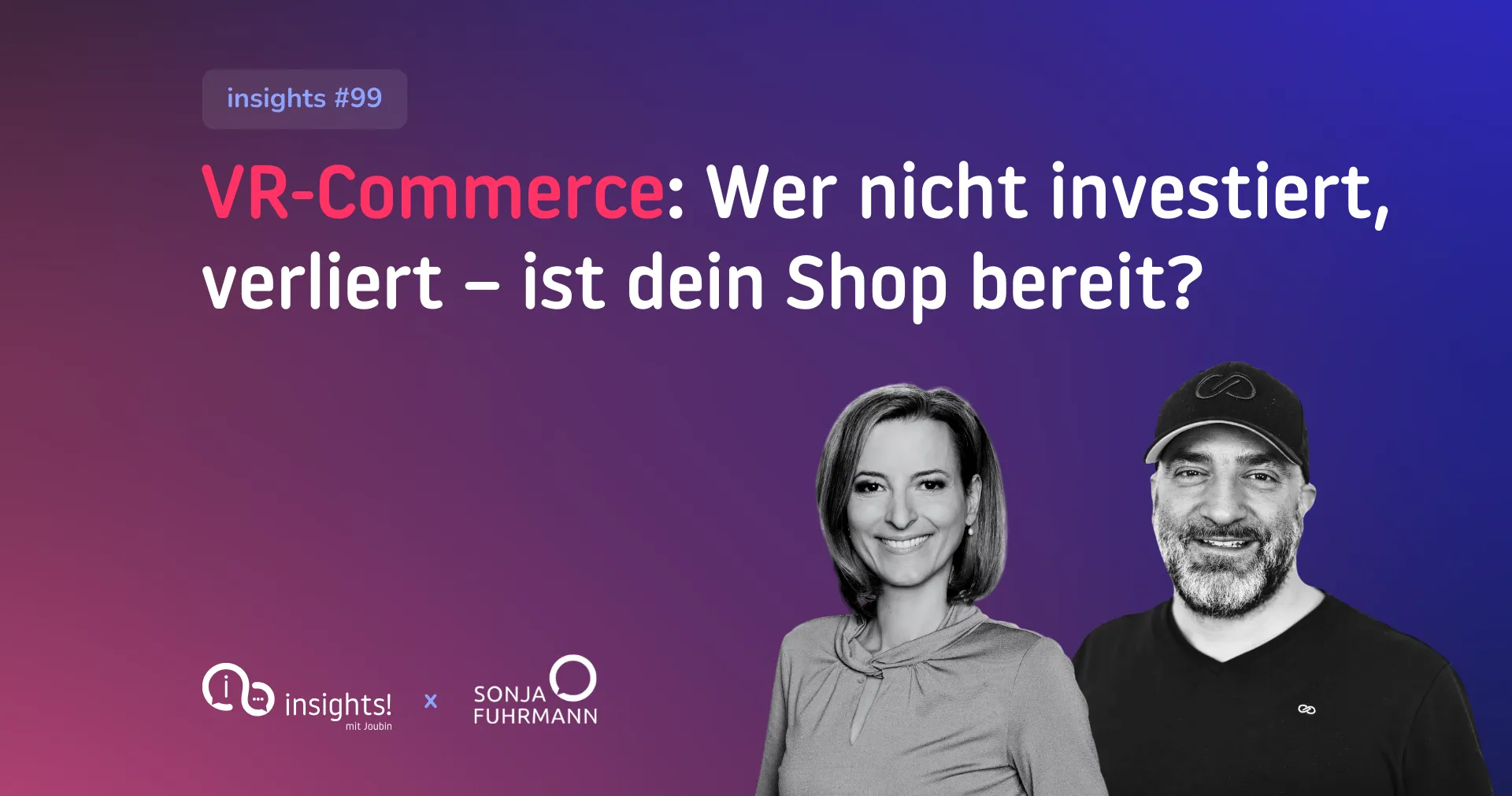
Glasses on, into the shop, done? It's not (yet) that simple. Truth is: VR in retail has so far been more hype than everyday reality – partly due to complexity and cost. Is VR the future – or will we stick to clicking into the basket?
You have no other touchpoint with your users than search on the website. Neglecting that is a real shame, because then the user probably runs back to Google and tries their luck there instead.
Virtual reality in e-commerce currently still in its infancy, as high costs and elaborate content creation deter many companies, even though technology offer great potential. With introduction of innovative hardware such as Apple Vision Pro and linking of VR with artificial intelligence, new standards could however be set in next two to three years. Whether VR actually become revolution in online retail depend on how quickly technology develop further and become accessible to broad masses. More on this in today's article.
Virtual reality in e-commerce: revolution or just hype?
Virtual Reality (VR) is often touted as the future of shopping. But how realistic is this notion? Is VR truly the next big revolution in e-commerce, or merely a short-lived hype that will soon fade again?
Explained without jargon: VR, meaning Virtual Reality, means that a computer-generated world is perceived with the help of special goggles. This world feels realistic but exists only virtually. In addition, there is Augmented Reality (AR). Here, the real environment is supplemented with digital elements. Companies like IKEA already use AR to let customers virtually place furniture in their own living room via a smartphone app.
The previous VR hype
The first VR headsets have been on the market for several years now. Despite technical progress, the big breakthrough has so far failed to materialise. Many consumers own a VR headset but rarely use it. High acquisition costs, complicated handling and a limited range of content have all contributed to VR being perceived so far more as a gimmick.
A possible turning point: Apple Vision Pro
With the recently unveiled Apple Vision Pro, this could change. In the past, Apple has shown with products such as the iPhone that it is capable of transforming mass markets. The Vision Pro could have a similar effect on the VR market, particularly in professional settings, where the use of lightweight, powerful headsets offers new possibilities.
VR in the shopping process
Question remains whether VR can replace in-store shopping experience. When shopping in store, factors like haptics and smell play decisive role. These sensory experiences currently can't be reproduced with VR. Research into haptic feedback and even smell technologies is ongoing, but their market readiness still lies in distant future.
Today, however, there are already sensible approaches for how VR can complement the shopping process. Applications from IKEA or Amazon enable the visualisation of furniture in one's own home. The next step could be the immersive viewing of these products in a virtual environment.
Potential through the combination of VR and AI
The combination of VR with artificial intelligence (AI) is particularly promising. In future, room layouts or product configurations could be automatically created based on individual requirements and visualised in VR. This combination could create real added value both in the private sector and in the B2B segment, for example when planning office or warehouse fit-outs.
Despite the possibilities, many companies still hesitate to use VR in e-commerce. The biggest obstacle is the high cost of creating 3D content. Producing VR visualisations requires special skills and is more elaborate than classic product photography. In addition, many companies lack staff with the necessary qualifications.
The influence of pioneers
Development of online retail shows that innovative pioneers shape market. Companies that use VR successfully early on could set standards and force competition to follow suit. Still, VR is in early phase in e-commerce. Experts assume coming two to three years will be decisive. Further development of hardware, especially lighter and cheaper headsets, could significantly increase market penetration.
Currently, VR in e-commerce is primarily a field of experimentation for technology-affine companies. However, the potential is considerable, especially in combination with artificial intelligence. If hardware and content continue to be optimised in the coming years, VR could genuinely revolutionise e-commerce. Whether the technology becomes widespread depends on how well costs can be reduced and the application made attractive for broad customer groups.
Would you like to listen to the full episode?
Find the podcast of the interview here:
Please accept the corresponding cookies to view this embedded content.
Prefer to watch the episode? No problem!
You'll find a recording of the interview here:
Please accept functional cookies to watch this video.
Prefer to read?
Sonja Fuhrmann
VR in e-commerce, is that a real revolution or maybe just hype? I'd like to talk about that with Joubin now. Can you briefly explain what VR actually is? Without jargon, please.
Joubin Rahimi
Without jargon? Okay, VR, Virtual Reality. Typically you have something in front of your eyes, often in 3D, which simply depicts a reality that is nevertheless virtual and fed by software. And besides VR there's also AR, Augmented Reality. That's exactly where I still see something real, with a layer of digital content overlaid on top.
Sonja Fuhrmann
So is it all just hype or a revolution, what would you say?
Joubin Rahimi
That wasn't original question, was it? Right. This is a really, really exciting situation now, because we've had glasses for a while and de facto that was, I think, a lot of hype. It didn't catch on. I don't know who of you has glasses at home and how often, if you have them at home, they get used. Still fairly rare. But whoever had chance to look at Apple's new Glass division, that's another leap forward. It's a bit like iPhone arriving now, because real working environments get represented quite differently there. And if we manage, I think, to support working world with a lightweight pair of glasses, then it won't be hype either, it'll be a trend, but chances are very, very high it becomes one, question is only: how big is the device and how seamlessly is it integrated? Yes.
Sonja Fuhrmann
How can VR replace the in-store shopping feeling? I mean, I'd also like to touch things physically.
Joubin Rahimi
Yes, well of course that doesn't quite work that way as it is, because you only see it and you said, touch it haptically. If I look very far ahead, there might one day be something where I have parts that play back a haptic feeling, the way we've now also slowly invented scent machines and can even produce those, but not in the B2C space. So I'd say that's still a long way off. But having the experience of being in the shop and being able to try things out, I don't think that's the right way, but rather the question again: what do you want to do with it? And there are already the first applications going mainstream, IKEA for example, or also Amazon. There you can say, I now have, for example, a laundry chest, and it's a metre high, 30 centimetres wide, 50 centimetres long. What does it look like at my place? Does it fit or not? You can already do that quite smartly just with your smartphone, but it would be cooler if you could really see it in 3D. Absolutely. That's roughly where things stand right now.
Sonja Fuhrmann
What potential do you see for e-commerce going forward?
Joubin Rahimi
The combination of the visual and a shopping advisor, I think that is really powerful. Let's take this room here. We had to imagine ourselves how the sofas would look. We've now used different sofas. Whether the panels look good or not could have gone really wrong. I think this setup here turned out great. And if I can say that upfront to an AI: I'd like us to shoot an interview format here, that we have a table, that it looks a certain way, this is our target group. We need to do something about the sound or the sound feedback, show me examples in this room. I think that would be really cool. But there you see the combination of VR plus artificial intelligence, which then translates all these voice inputs and makes suggestions.
Sonja Fuhrmann
But probably not suited for everyone. You watching at home probably tech-savvy, I'd say, but that's not everyone's thing either. Doesn't that lead to split in buyer segment?
Joubin Rahimi
I think that's a matter for everyone. So very, very clearly.
Sonja Fuhrmann
Well, Aunt Anna at 89, I don't know.
Joubin Rahimi
No, but maybe she watches television or looks at other … There are other shops too, like the perfect housewife or something like that. Yes, that's really the name of a shop. That's a different target group, that's quite clear. But I think that's something for B2B and B2C, for a small and large budget, wallet, you could say: What should my work setup look like? Office suppliers can use this for doctors' surgeries, for warehouse fittings, so B2B, but also for a private individual on a small scale. And then perhaps also, how big does the sofa look in my living room, or the wardrobe, or what does the toilet roll holder look like?
Sonja Fuhrmann
Many possibilities. Yet there are also some companies that hesitate to use VR still. Why?
Joubin Rahimi
Because it's expensive. You need a huge amount of content, and simply having it there doesn't help you – the question is how you embed it into this purchase story. And if you consider who will do it at your organisation, then you need people who suddenly bring new skills, or you have to teach existing staff these skills, because this is suddenly the third dimension. So far in e-commerce we've only been in two dimensions. And that's definitely considerably more demanding to do well.
Sonja Fuhrmann
In your view, is there no way around this trend anymore? Or what happens to companies that can't or won't go along with it?
Joubin Rahimi
If the first one did it so well that it's a breakthrough, the rest have to follow suit. The internet showed us that. Whoever brings it online first and did it brilliantly is the one who sets the standard. I think we're still right at the beginning with this, and it hasn't really been set yet. So the IKEA shopping planner support already helps immensely, but it's also not yet completely visible in VR. That will come in the next two, three years.
Sonja Fuhrmann
That would be the question now: we're at the beginning, you say, what time horizon do you see here, two, three years?
Joubin Rahimi
Yes, with the introduction of the Apple headset, a lot is going to happen. It is fairly expensive, though, just as the first smartphone was unbelievable compared to all phones, and that will simply catch up in two or three years, and then we'll reach the point where we say, okay, we can use so much more.
Sonja Fuhrmann
Exciting. Curious to see what's still coming our way. Thank you very much, Joubin, for the conversation.
Joubin Rahimi
Sure, Sonja.
Sonja Fuhrmann
And thanks for watching.
Joubin Rahimi
And if you have questions, ideas, food for thought, or even think this won't catch on at all, let us know your thoughts. We'd really love to discuss this with you. Just drop a comment below.
Have questions or feedback?
Then feel free to contact us directly.
- Joubin Rahimi
Managing Partnersynaigy
Show phone numberShow mobile numberShow email address

Subscribe to the blog now and never miss any news
✔️free of charge ✔️weekly news ✔️expert knowledge
Please accept the corresponding cookies to view this embedded content.