



insights! episode #38: interview with Intershop Executive VP Customer Success Tobias Giese
How personalisation can help you optimise processes and improve the customer experience
 Joubin RahimiManaging Partner · synaigy
2 min read
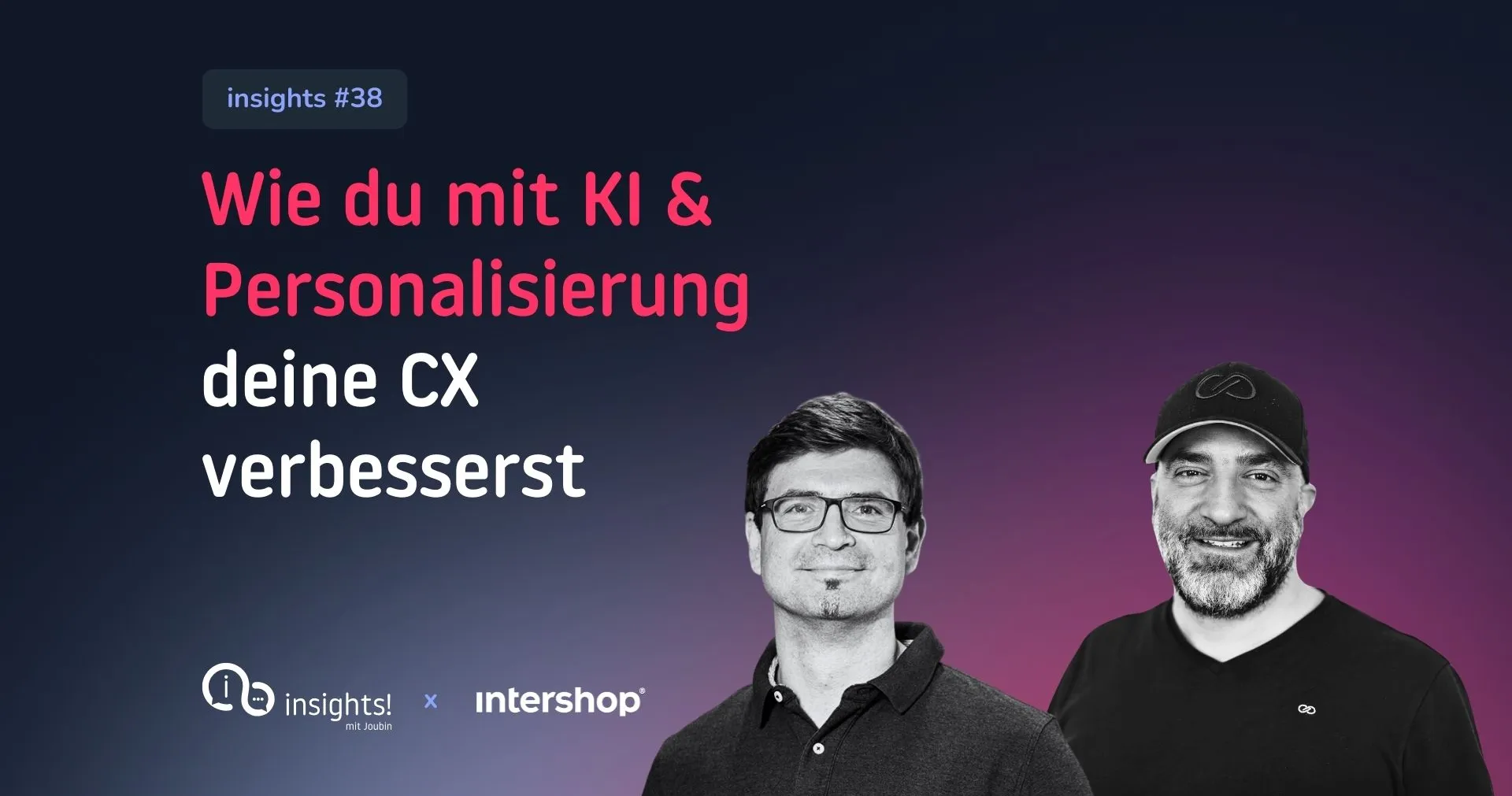
Tobias Giese, Executive VP Customer Success at Intershop, and I talk in this insights! episode about the use of artificial intelligence (AI) at Intershop, the added value for end customers through efficient personalisation, and the resulting competitive advantages.
Intershop is a leading provider of e-commerce solutions for B2B and B2C companies. The company was founded in Germany in 1992 and has since won numerous well-known customers. The comprehensive platform for online shops enables companies to market and sell their products and services effectively.
Intershop places particular focus on personalisation. Existing technology is meant to be used to generate recommendations and predictions and to make AI-supported decisions. We talk about the current maturity level of Intershop's technology and how feedback from customers and partners is used to further develop the technology. A strategic partnership with long-term commitment is necessary here in order to respond quickly to changing market requirements.
In our conversation we also look at the challenges that can arise when integrating e-commerce platforms. Personalisation also plays an important role here, since every B2B customer is individual and has specific requirements. Through personalisation, for example, spare parts and services can be offered that are tailored to the customer's needs. This can help to optimise processes and improve customer service. However, integrating different systems is often very time-consuming and requires good planning and preparation.
An experienced provider like Intershop can help respond quickly to changing market requirements and strengthen your own competitive advantage.
Would you like to listen to the full episode?
Listen in directly and find out more:
Please accept the corresponding cookies to view this embedded content.
Prefer to watch the episode? No problem!
You'll find a recording of the interview here:
Please accept functional cookies to watch this video.
Prefer to read?
Joubin Rahimi:
Great that you're back for a new episode of insights!. My name is Joubin Rahimi and today I get to introduce Tobias Giese from Intershop. Tobias, would you like to introduce yourself?
Tobias Giese:
Gladly. First of all, thank you for the invitation to be here. My name is Tobias Giese. At Intershop for 18 years now. I started in the consulting area doing quite exciting international projects, Australia, Europe-wide, USA, and I'm now responsible for the customer success area. That means we have over 100 platform customers to look after with my teams and we're always in lively exchange. What can be improved? Where's the journey heading? How can we support strategically but also operationally? And I'm glad to be here today.
Joubin Rahimi:
Yes, that's great. We haven't personally known each other that long, but our companies – and you know our company, or rather my colleagues have known you for a long time too. I believe we're also one of the first Intershop partners in this regard, or rather, for 18 years. Naturally the immediate question is always how modern things are in today's day and age. Those who know Intershop and have known it for a long time, who work with it, I think have the right picture. Those who don't work with it and only know it from the press and what others say about you, certainly have the wrong one. Could you perhaps say a sentence directly on that, on how things stand with your platform, the company, and how modern you are, so that those who don't know you at all can also take something away, because that's what matters from today onward and into the future.
Tobias Giese:
Well, it feels like it already started in 1992 with the first online shop that Intershop invented and provided. That means various technologies were naturally in use, and even when I started, there was of course a bit of an effort to dominate the market accordingly and also drive things forward technologically with in-house development. That means there were Intershop-specific markup languages and so on that we wanted to establish, but we also of course realised that scaling only works through partners, as you just said. There it's naturally important to have a large community, and that's why we rely heavily on open source technology and have built out very, very much, so to speak almost all proprietary technologies. That was important, that was a big step. That doesn't happen overnight. But that was the clear roadmap for Intershop in recent years, to move to the cloud, to offer a subscription model, but also to throw these old technologies overboard, and now, so to speak, on the operational level we have well-known top-notch technologies like Kubernetes and Docker. But we also use the most modern frameworks in the frontend area. One of them is Angular in the frontend area, so that we're completely decoupled, doing everything only via APIs. That means I no longer need such extensive Intershop knowledge to get started, to make projects successful, but can instead rely on proven technologies that I know from my studies, that I know from the environment, that I know from the community, accordingly. That makes it more attractive again, also in the AI area, in that you can really use the latest technology, and we've found that it's also super important to offer that to the partner community accordingly, because that of course also creates desire and then also attracts developers, so to speak, to work with the technology.
Joubin Rahimi:
You mentioned AI, you have got a claim featuring AI too, which I am sure I will not get quite right. AI Commerce, not sure if that is correct, or Commerce AI. Perhaps you could correct me and say a few more words about what you do with AI, because AI does not always have to be good.
Tobias Giese:
Absolutely. Everyone talks about it, everyone wants to have it. I think, or we also know, especially through closer contact with our partners, that not everyone has it yet. And we've clearly set ourselves the vision of making AI the core of our application, but also with a clear focus on not reinventing speech recognition or building a second ChatGPT. We want to use existing, established technologies, but we want to offer added value to the end customer in the commerce area, meaning using AI to really calculate large volumes of data in the personalisation area that I can't do by hand or manually, and thereby gain certain competitive advantages. That means, for example, search, recommendations, but also demand prediction, anticipating knowledge. What could now generate the biggest conversion, where can I generate more revenue? But, and this is perhaps also our vision, not just to say we want to offer that to end customers on the platform, but really to contribute accordingly to the stakeholders at our customers being able to make better AI-supported decisions. So what's the right promotion now? Which campaigns, which product ranges best fit this country, this brand? There's already a lot of information there, partly at the companies, that's still lying somewhat fallow, and our task will be, with the various products we already have in our portfolio but also still have on the roadmap, to aggregate that better in order to really be able to make recommendations.
Joubin Rahimi:
This assisted selling sounds mega exciting. We had that with you too, where we got to be part of the Advisory Board. It was also a topic for clients and partners, that this is important. How far along are you in this maturity level? It's just getting started now too. When can we expect the first things? You've already got things out there, so what can be used already and what's upcoming?
Tobias Giese:
Yes, also a very good question, because this concerns the different maturity levels, and what we already offer now, I'd say, is this search and personalisation engine. That means it already comes with ready-made algorithms, best practices. What's proven successful with other retailers, other manufacturers who are online? I can already use that one to one, but then also have the option of adding truly individual algorithms on top that cover my specific use case. What we have now is already the base technology. We also already have, let's say, these best practices. And we're now working on the basis of customer feedback. What we received last week in Berlin, that was a wide range, and now we're going through it based on the votes from you, from you as partners and customers, and picking out the top ten, putting them on the roadmap and working through them step by step. Of course, in customer contact, especially AI use cases require a lot of explanation. Everyone has some idea. I now want to support a specific search, or I want a search where I combine this ChatGPT thing a bit. What does that mean? For that I also need usability testers, I also need initial feedback. How is it received? From the first idea through to implementation. And I think that's also part of it. So not immediately coding it up the way it might have been done in the past, but the USP is really also about continually refining it in cooperation with you and the customers, and then not just saying, from a toolkit of 20 things, I'll just pick something out and adapt it, but really, hey, I helped shape this. A strategic partnership, many customers are looking for that, especially as with a cloud provider, you sign a contract for 3, 5, 7 years. And then I'm looking for a long-term strategic partner who advises me, where I have a platform, where I can say, hey, now I have this market requirement here, it's fairly new. You know this from the project. It changes fairly quickly, such a project phase, the priorities, but that you can react to it quickly.
Joubin Rahimi:
First off, hats off again. You had really good vibe at that event, between partners, customers, all of you. Very pleasant and super open too. We're partner of several software vendors in that space, and there's some that are open for improvement and you feel it from the heart, when you can really build something together and feel like you're in it together. That's naturally much more fun than when it's all distant, and we're fans of approachable partnerships. Side compliment on that topic. Question that comes up among some of our customers or prospects: there's over 100 shop systems on the European market including the big international players, that's far too many. Many aren't even relevant for most, and people always ask what's the best system? And when you look at certain data, at charts like that, it says okay, how much revenue goes through, how many customers use it, and then Shopify or BigCommerce wins. But from our view that's not the right approach at all — you always have to think about who's good for what. And I'd like to briefly champion this, because B2B is one of your focus areas, fortunately. Fortunately, because B2B isn't a switch you just flip on, it's not just VAT versus no VAT, it's far more complex. Tell us a bit about what you can do out of the box on that front. Because it's far more than just having a second price list for a customer, or even a customer-specific price list — that's a much bigger topic.
Tobias Giese:
Yes, very happy to. So in the B2B area we cover a wide range of what you already mentioned. Net, gross, prices, but also order templates – so simplifying recurring orders – but, and this is also very much B2B, it's always the depth, I'd say, you have strong integration into the systems, ERP, CRM, pricing engines and so on, asset management systems, machines, data management, presentation and so on. That means, I'd say, on one side it's about the indicator systems, making that as simple as possible. We now also offer a logo platform for that, where I say hey, I've got a standard integration into SAP, a standard integration into Microsoft Dynamics, but also, for example, into IoT-based systems where I have other protocols. That's how we get behind this smart, personalised portal, which is our credo, I'd say – B2B isn't about having a B2B online shop, others have that too, as you rightly said, but really going into depth, and it doesn't even look like an online shop any more, suddenly I see my machines and everything I do – search, navigation, checkout. The whole customer journey processes are in the context of the machines standing in my warehouse, standing, I'd say, in the workshops that I use daily, distributed worldwide, so also very, very large. And there of course I also need this integration into the systems, and then on the purely functional side, which you also mentioned, there's this depth – I have a purchasing organisation, and that's not just, that's a family and that's a single orderer, but I have the service technician, I have the machine operator. And then I also have the commercial buyer above that who aggregates things. That means I have a complex purchasing organisation with cost centres and budget structures with approval policies. And that's where it gets down to the nitty-gritty. But that's exactly what B2B customers want, because that's also where the effort in projects lies, and having as high a degree of pre-configuration as possible there is, I think, quite sensible, and that lets me map many of these business processes and then focus only on the initial 20/25% gap that's individual, and just briefly on these integrations. I just said SAP integration, and then everyone who's done these projects knows, and I know this very well, having done it intensively for seven years myself – there's no such thing as standard SAP integration. There's always some effort involved, and we know that, and that's why we have this standard integration with a standard mapping from the data structure of Intershop to the data structure of SAP or of Dynamics. And if I then naturally have a matching customisation, which is very likely, then I don't go down to Java code level and have to program something, it's all there already. I have the mapping, and then I map the product ID from our system to the material number of that system, and I don't have that as a kind of black box, so to speak – I talk to the subject-matter people on the customer side who know the paperwork, and not also with the programmer on top of that. Then have to synchronise that, do test requests. You know how it goes. The SAP system responds with some error message. Then I ask the subject-matter person. Yes, and those are also the efforts that then result in the long project timelines. And we offer the whole thing, I'd say, on one platform, but modularised.
Joubin Rahimi:
You have such an integration component as part of that, which we also very much appreciate. And that's really one of, some choice words come to mind for that in projects. We just need the interface, or then even with SAP, the standard, which just doesn't fit, that's the technical box ticked, but really the next question is, do you actually have current documentation of the interface, and what it means if an article number is perhaps made up of manufacturer number and material ID or similar, that's always challenging too. What do discounts mean, how are they processed, and everyone looks at that.
Tobias Giese:
Exactly right. Maybe to add, you just mentioned it. In the projects you also see not just the challenge of the customised SAP or whatever backend system. Not against SAP now, but then also a parallel change to the backend system on SAP or whatever, alongside the e-commerce project. That's also become something of a standard by now. With that you always have a risk that you can at least plan for somewhat more proactively with standard integration components. I'd say - well I wouldn't say you have zero effort. If others claim that, I'd like to see it. Please let me know after your interviews with the other colleagues. It's about saying: hey, come on, I've got a data mapping now. Okay, that's just two days, I'll do that, but I can also test it there. And I think that's what matters.
Joubin Rahimi:
Let me look into my crystal ball — they all say it's demanding. That much I can say. The B2B part, integration, that's naturally always exciting too. You mentioned personalisation. Why do you place a focus on personalisation?
Tobias Giese:
I touched on this a bit earlier. All our B2B customers and their customers are of course highly individual. In offline business now, they already have a framework agreement, they know their sales reps. There are many established processes, including the classic 'I'll send another fax to register my machine'. And then of course try to map the whole thing digitally, offer as much self-service as possible. They no longer need to call the sales rep. And if the new machine is stored in the CRM system, why can't I also sync that to the customer portal accordingly and then offer personalised the spare parts, the services? Yes, and that's what customers are looking for too. Now, for example, as a machine operator, the machine is at a standstill, via IoT data I see this in the customer portal, something's happening, I'm suddenly under time pressure, BOMAG, a customer of ours, who produce these large rollers, which are of course there to build roads. And if they're at a standstill for 2-3-4 hours, then I have an extremely high loss that I'm essentially incurring by the minute. And that's why it's important, especially, they mustn't order the wrong spare part. They need to be, let's say, guided, it all has to be pre-configured. And now, with these predictive components that we already partly have built into the personalisation, the machine operator can also see. Hey, I now have maintenance, a maintenance interval in four weeks. This spare part is 90% worn. I need these consumables, this oil, and I need this service technician from the service agency or the manufacturer's organisation. And I don't want to have to call them, send a fax, this and that, but rather it all has to run consolidated through the platform. And that's why this personalisation isn't about showing the right T-shirt. That's not what I mean by it. That works quite well in other solutions, I think. But in B2B, as I said, I have this framework agreement, so I can't offer them just anything outside that framework agreement unless the marketing person responsible wants that, and then they can do that in our system, because this personalisation engine also isn't a black box, so you can nicely and transparently see for each calculation step which products are added, which are removed. So there, so to speak, for the sometimes 100 sales reps at the manufacturers who are also supposed to work with the platform, who are also supposed to generate added value. They're not meant to be replaced. They then see, okay, now my customers are getting this recommendation and that fits too, which I always find quite nice, that a lot of our customers then do a validation with the 100 sales reps. And that didn't exist before either, meaning it's not just personalisation. Black box somehow spitting something out based on collaborative filters, but rather if the sales reps say, I would never have recommended that, then you have no internal acceptance. Then it won't get promoted and they won't tell their customers that they can now use this self-service portal. And I think that's, sorry, I went off on a bit of a tangent there, but with personalisation it's not just explained as, like you said, product ranges tailored to the customer. That's the basis, but really in this context, they need this spare part, it's all already pre-filled, or for example, has a new project and I know exactly that 90% of the time they need this tool, they need this service. Yes, then it's already pre-filled. They just need to click the button, but first select 1-2-3 upsell or cross-sell products and are happy, have an exact delivery time and so on. As a sales rep, I don't need to talk about, do I have this product available and hey this order, but rather hey cool, I saw you got this and that, but we have the new machine. Shall I introduce it to you? Here, by the way, the link. Of course you get a nice 3D view in the customer portal. Can look at it yourself with mixed reality and then really only meet the sales rep for a coffee and say, great, the relationship works.
Joubin Rahimi:
From our point of view, if we may place you, you naturally have a very strong B2C arm, because you've been doing that for decades and still do. With SharkNinja, I believe, an American company that has really taken off here in Europe too by now. But Mister Spex also isn't known for old school business, but is quite modern and disruptive. But beyond that, we find it exciting that personalisation is seen in this overall context, which also includes B2B, i.e. Industry 4.0, and that supports it in a completely different way. Sure, everyone's using the same basic ingredients and you can do anything with anything, but the question is always the effort involved, and is it built for that? And that's what we find really, really exciting about you, because it's simply not commerce alone. It's not just about that moment of sale, but also about procurement beforehand with the various stages, and the ongoing operation and what happens with after-sales service. And that's roughly how we'd place you. But now the question is, when you look to the future. First of all: would you agree with this positioning? And is there anything missing, that was the first question. The second question is, how is the commerce market changing from your point of view, the market for our customers? And where do you think Intershop fits in, if you can and are allowed to say?
Tobias Giese:
Yes, gladly. So on the positioning there, I'm absolutely in agreement. I mean, we're a long-standing partner. It's important to us that we stay in close exchange and that you have an update on what we're doing, what you're doing, that we deliver successful projects together, and now perhaps to what the vision looks like. So we see, of course, or these are independent figures now from Intershop, naturally B2B growth or B2B commerce is growing somewhat stronger than B2C. Nevertheless, as a platform, I'd say we offer a kind of high-performance platform. Yes, of course with a focus on B2B processes, exactly what I mentioned, all that deepening, integration, that's our thing and that will, I'd say, be focused on even more strongly in future. And what I do see, right now, and here I bring up that classic ChatGPT example again, which everyone uses a bit for their own purposes and has somehow grown fond of, of course there are limitations etc. But precisely seeing that as a frame a bit, that's moving from today to tomorrow, and bringing that into digital commerce, as already said, search no longer run so much as a search field, but as a kind of prompt where I already know the customer's context in a personalised way, but I don't want a machine with the product number, rather more a semantic search, topics like that. And I always move within that context though. The machine does that, the engine room, for you. Yes and then to build the bridge again, really for the sometimes market-responsible person or business owner on the manufacturer side or on the wholesaler side who sometimes also doesn't know, we're rolling out into a new country, how are my products performing there. We want to gain a foothold there now, build brand awareness, then offer a transaction platform, so of course I have to strengthen the local teams there too, so I see that a bit as a trend, that everyone is guided in a way to understand what the commerce engine does, calculates that, gives concrete recommendations, so that I can say, I'm now starting with these products in this country for this brand, and that's also a really important aspect I'm learning there. Put all of that into the AI, the machine learning components I have, but then also see the results and adjust step by step, and that's a bit what we call autonomous commerce. So really a recommendation, I'd say, for the internal stakeholders, the marketing manager, the product manager. Yes, that will keep us busy in the coming years. We still see major challenges though. Especially the AI topic, and other manufacturers aren't yet 100% there in terms of the maturity level of product data. That's still, one has to say, a certain challenge in every B2B commerce project, some of course have consolidated things in the PIM system etc. But that's exactly what we see too, the better the recommendations and the AI things get, the better the foundation also has to be, and that mustn't be forgotten either. So not just saying I'm now looking to the future and doing the great things but don't have the foundation with the customer. That means, as already said, with the light integrations into the systems I bring together product data, category data, customer data, machine data, to really put together the perfect offer for the end customer, but also for the internal people, because skills shortage, war for talent and so on, that's a huge challenge for everyone, I believe. And with that you can perhaps mitigate it a little by offering more, more things as support. That's perhaps also a nice point to close with from our little interview. The system, the platform isn't just for your customers' customers, but also for the customers' employees. And not just in the sense of how can I enrich a bit more product data, then there's also the PIM system and co, but working within the processes, so working right into these processes, being part of the whole, and not having yet another platform where you then do that. So that's very often also something where, in the process, you do a lot of cumbersome things in an SAP or Dynamics or you name it, which you can shape far, far more simply on your platform in this real customer service, after-sales process.
Joubin Rahimi:
Yes, mega exciting. I also think every system always has its sweet spots. I hope we managed to hit that today, and I hope everyone who watched and listened can take that away too. Are there one or two sources where you'd say, if you want to stay up to date, also with regard to your software, your SaaS solution, or your cloud solution, you should definitely take a look? Do you have a tip or two for us?
Tobias Giese:
Very classically, I'd say LinkedIn definitely. We share a lot there. Yes, whitepaper stories, customer stories, invitations to webinars. I think that's a great resource of, let's say, the latest technologies, also in cooperation with our customers, partners, media partners, so that you really stay up to date, so that as a customer or potential customer you also pick up a few things. To pitch internally: hey, what's an MVP? How do I proceed now? What are the next maturity levels I want to reach, hot checklists too if you like, what the daily doing looks like without immediately jumping to or switching an e-commerce software, although of course that's also gladly seen by us, but yes, I think that's a good way to stay on the ball.
Joubin Rahimi:
Great. So we'll definitely link to your LinkedIn account, we'll link you with your LinkedIn account, and you can all always add comments too. So we're looking forward to comments. Tobias and I can then also answer them? Still far too underused. We do mean it, and so we hope it's given you all a little something. Thank you, Tobias, for your time, for the insights, and thanks again for the invitation to join the Advisory Board, to be able to work in there. I'll put it this way and wish you and Intershop every success in the coming months, quarters and years.
Tobias Giese:
Many thanks for the invitation. It was great fun, and here's to continued good collaboration.
Joubin Rahimi:
Thanks a lot, everyone.
Tobias Giese:
Thanks a lot!
Have questions or feedback?
Then feel free to contact us directly.
- Joubin Rahimi
Managing Partnersynaigy
Show phone numberShow mobile numberShow email address

Subscribe to the blog now and never miss any news
✔️free of charge ✔️weekly news ✔️expert knowledge
Please accept the corresponding cookies to view this embedded content.