



insights!-Episode #85: Smart devices, dumb decisions? The role of IoT in e-commerce
 Joubin RahimiManaging Partner · synaigy
3 min read
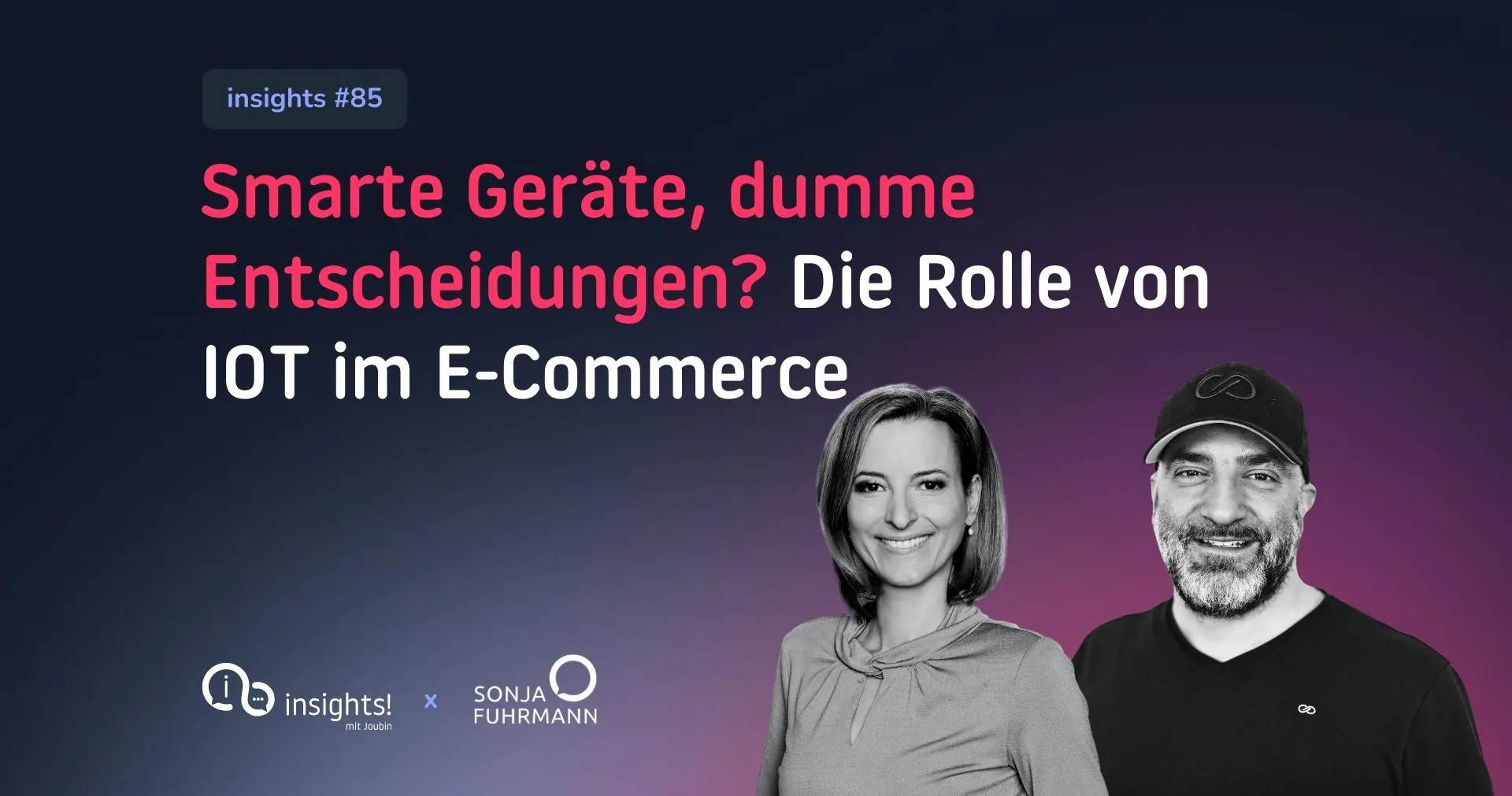
From smart devices delivering real-time feedback to personalised shopping experiences – the possibilities in IoT are huge. But with these opportunities come challenges too: new technologies require new know-how, and companies must adapt their business models. In our latest insights! episode, Sonja and Joubin show you how IoT is shaping the future of e-commerce and what steps you need to take to benefit from this revolution too.
They're wave movements after all. So I don't think it's that tragic that it's not talked about, but it is used, and we all use it.
IoT has undergone a remarkable development in recent years and is revolutionising e-commerce in a way that would have been unthinkable recently. IoT makes it possible to connect physical objects to the internet and collect data via sensors that can be used in real time. This technology gives companies the opportunity to gain deeper insights into their customers' behaviour and adapt their products accordingly. The influence of IoT extends far beyond mere data processing – it's changing the way companies interact with their customers and how they market their products.
An excellent example of this is Head's smart tennis racket. This racket is equipped with a sensor that analyses the player's movements and provides feedback in real time. Products like this offer considerable added value and allow companies to differentiate themselves in a highly competitive market. In addition, the data collected can be used to develop personalised services, such as a coaching app tailored to the user's individual playing style. This not only creates closer customer loyalty but also opens up new revenue streams.
Challenges in implementing IoT
Despite the enormous potential of IoT, companies, especially those that traditionally had little to do with hardware, face considerable challenges. Integrating IoT requires a comprehensive engagement with new technology, network infrastructures and the management of large volumes of data. Most retailers have so far only dealt with RFID scanners or barcodes, but IoT brings more complex technologies into play that require specific expertise. Companies therefore need to invest not only in new technologies, but also in the know-how needed to use them effectively.
The use of IoT in e-commerce also means that companies have to rethink and adapt their business models. The ability to monetise the data gained through IoT is crucial. It's not just about making products smarter, but also about developing new services that offer genuine added value to customers. One example is a sewing machine manufacturer that uses sensors in its machines to detect potential faults early and offer maintenance services. Innovative business models like this can make the difference between success and failure.
The future of e-commerce with IoT
The future of e-commerce will be significantly shaped by IoT. The connection of the digital and physical worlds offers endless possibilities that will fundamentally change both the way we shop and the way companies operate. IoT enables companies to create highly personalised shopping experiences precisely tailored to their customers' needs and preferences. Furthermore, IoT allows companies to develop more efficient processes and business models that help them hold their own in an increasingly competitive market.
The Internet of Things will revolutionise e-commerce by creating new opportunities for personalised experiences and innovative business models. Companies that adapt to this development early will be able not only to strengthen customer loyalty but also to open up new business areas. IoT is the key to a future in which the boundaries between the digital and physical worlds increasingly blur.
Would you like to listen to the full episode?
Listen in directly and find out more:
Please accept the corresponding cookies to view this embedded content.
Prefer to watch the episode? No problem!
Here's a recording:
Please accept functional cookies to watch this video.
Prefer to read?
Sonja Fuhrmann:
Today we're talking about the Internet of Things and why anyone involved in e-commerce in any way shouldn't ignore it. Joubin, what actually is this notorious Internet of Things?
Joubin Rahimi:
We already use this in very, very many places, and it starts with the smartphone. That's also a device that can measure a huge amount. And classically, the Internet of Things is something where I have small sensors that are in devices or distributed somewhere in the landscape and send data, mostly not actively doing anything, but could. Has IoT, as it's also called, really developed as dramatically as is often said in recent years? I think even much, much more, but at the moment you read nothing about it in the press, because AI ...
Sonja Fuhrmann:
Why?
Joubin Rahimi:
AI is on everyone's lips. ChatGPT and co, that's mainly what's being talked about, and IoT not yet.
Sonja Fuhrmann:
Wrongly?
Joubin Rahimi:
There are wave movements. So, I don't think it's that tragic that it isn't talked about, but it's used and we all use it. Anyone driving an electric car uses a huge amount of these IoT services.
Sonja Fuhrmann:
How is IoT used in e-commerce?
Joubin Rahimi:
That's a really good question, because I'd first like to take a step back. It's often said: "E-commerce, that's all virtual." No, it isn't. It's real. A virtual world is not a real world. But it is real. E-commerce is real, but it is digital. That first of all, it is digital. Why does that matter? Because IoT is also digital and also real, and it's even more about the link into the physical world.
Sonja Fuhrmann:
Describe it quite specifically.
Joubin Rahimi:
And that's actually the exciting part. And if I think about it, and I'm going to take a big leap now: I'm a manufacturer of, say, tennis racquets. There's Head, a racquet manufacturer, who say: build to performance. So I have racquets aimed at performance-oriented players. You could say that's a marketing angle. No, Head then goes a level further. They've developed a small sensor, or a sensor, that goes into the back of the racquet's shaft, and this picks up the movement, the vibration, and can be your personal tennis coach, because it can then precisely detect: did you hit the sweet spot on the strings or not? Were you too late, too early, hitting the ball? And that's obviously incredibly exciting. What does that have to do with e-commerce now? For one, IoT there is a means to an end. I can make the racquet smarter and, as a manufacturer, I can then differentiate myself further. And the first point is, I can develop digital services, like the coaching app, which is rolled out either free of charge or for payment. That's point one. Point two is, if I have the data on usage behaviour, I can communicate with the customer completely differently, on a customer level. We see that with Philips Hue. You can tell I could talk about this endlessly. Philips Hue is also used by quite a few people, and that's nothing other than IoT combined with smart home.
Sonja Fuhrmann:
Yes. How can the Internet of Things provide even more personalisation in shopping?
Joubin Rahimi:
I think, in shopping, only if you have a physical link – so if you're in the shop and there are sensors that notice something, or if you have corresponding experiences at home, to think it through quite far, for example. You've got smart home set up, and it notices you're not there but your heating is on. It could say: okay, let's turn the temperature down, or it notices the temperature is warm but you can't turn the heating down, and offers you something to buy again. That's always about making that connection, building the bridge between the real, physical world and the digital world.
Sonja Fuhrmann:
How do you think IoT will change e-commerce in future? These are indescribable possibilities you're showing me here.
Joubin Rahimi:
Yes, and I think with this question everyone also wonders: What comes next? What's the answer to that? Where does this go from here? I've already mentioned this bridge, and ultimately it's about generating new services. Because to say I only have e-commerce as a topic isn't right. We don't think in terms of e-commerce. We want to buy something, we want to procure something. We have something in mind. And that's where IoT simply helps develop topics and products that we couldn't develop before, because it flows into the physical world. What does that mean again? Let me jump right to the far end of the arc. We can also head towards bioimplants and so on. There are already small implants that measure insulin levels. We have watches that measure things. And this will simply go a level further too, to say: okay, I can optimise myself even better. I don't think I like this drive, but the drive for self-optimisation will be around for a while yet. And especially where illness is involved, or care needs, you can do a lot more with IoT, meaning with measuring, and an indication that happens automatically. So many possibilities through a stronger interlinking of the two worlds.
Sonja Fuhrmann:
If a company is on board now and says: super exciting, I want to get going, what do you need to watch out for? Can you just dive straight in or are there pitfalls?
Joubin Rahimi:
So they're manifold. Right, let me structure this briefly. Suddenly you have hardware in play where you never had hardware before. Meaning you have to deal with the hardware. And typically retailers have never, or rarely, dealt with genuinely electronic hardware. At most with an RFID scanner or a barcode scanner and so on. But now you have small, highly technical devices that send data over another medium. Meaning you have to deal with this topic of transmission, network and hardware. And ultimately, what's the business case behind it? Can I monetise it? And we talk a lot about B2C, but also in B2B. We have a customer who's a sewing machine manufacturer within our group, and they have sensors built into the sewing machine that detect when faults occur. And then to say this service: okay, I need maintenance, I need to replace the needle, the motor, or I have the mis-stitch, they get paid for this service. So it's actually not about IoT at all, but knowing IoT in order to get access to such innovations, that's the key.
Sonja Fuhrmann:
That's the key and the future. Thank you very much.
Joubin Rahimi:
Absolutely. Sure.
Sonja Fuhrmann:
Joubin, that's it for now, and thanks so much for listening.
Joubin Rahimi:
And as always we look forward to your comments, remarks, ideas. Let us share in your thoughts, and everyone else too, let's discuss it.
Have questions or feedback?
Then feel free to contact us directly.
- Joubin Rahimi
Managing Partnersynaigy
Show phone numberShow mobile numberShow email address

Subscribe to the blog now and never miss any news
✔️free of charge ✔️weekly news ✔️expert knowledge
Please accept the corresponding cookies to view this embedded content.