



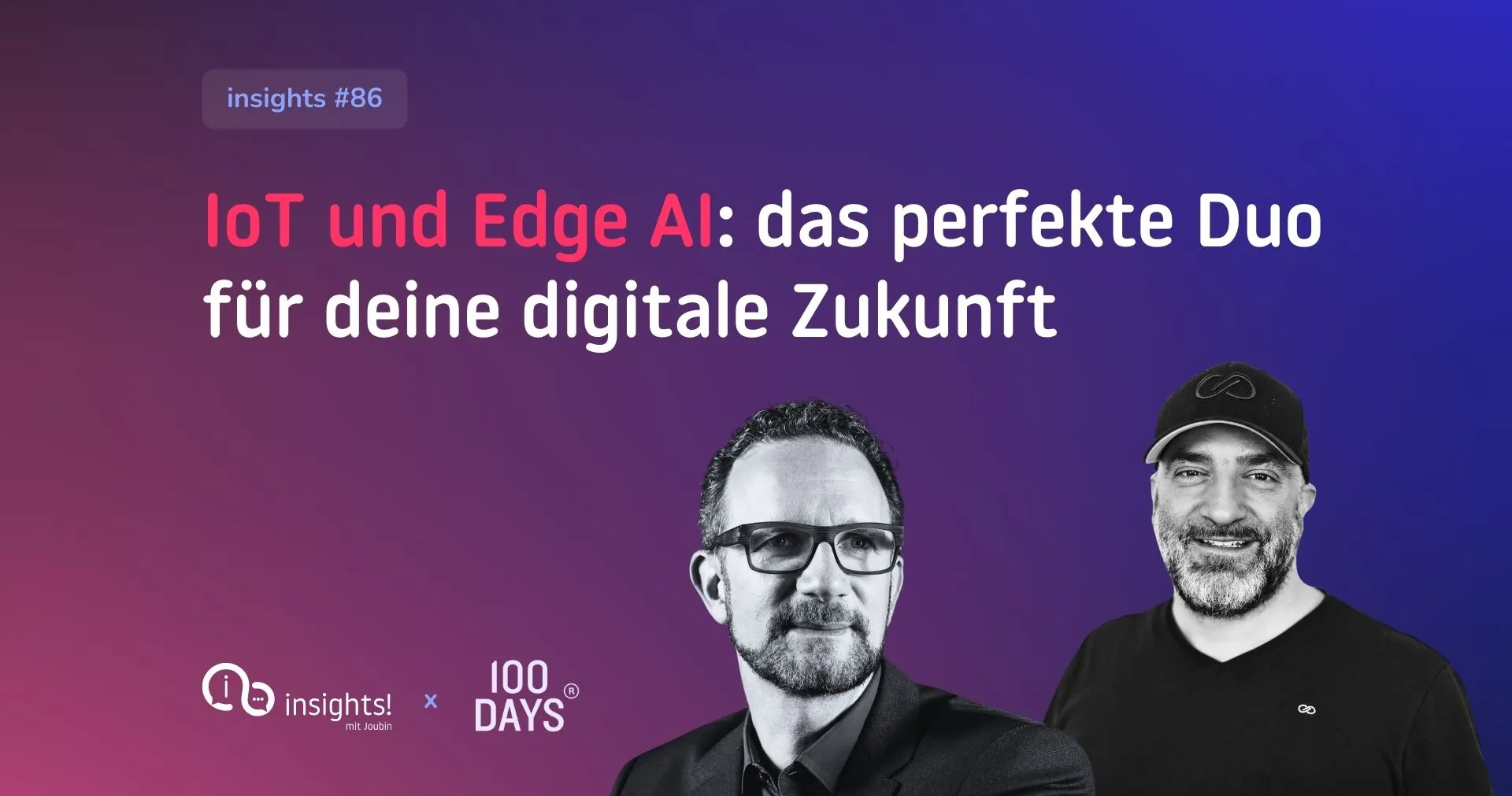
insights! #86: AI and IoT - the perfect combination for greater efficiency
How do you make the leap from an idea to a market-ready product? Gaylord Aulke, CEO of 100 DAYS software projects GmbH, spoke exactly about this in latest insights! episode and explains why edge AI – processing data directly on device – is key to faster innovations and more data protection. Through rapid prototypes, early testing and flexible adjustments, companies can stay agile and face challenges of modern technology.
 Joubin RahimiManaging Partner · synaigy
3 min read
Product you create always mirrors team, or structure of team that created product. You need make sure you try build fitting structure for topic you want tackle.
One of the most exciting fields, growing ever more important, is the merging of Artificial Intelligence and the Internet of Things, specifically in the form of Edge AI. This technology enables data to be analysed directly on site, i.e. at the "edge", without first having to transfer it to a central database. This offers not only technical advantages but also addresses challenges around data protection.
The challenge of new technologies
Gaylord Aulke, managing director of 100 DAYS software projects GmbH, is expert in this field. His company supports software teams in implementing innovative projects and integrating new technologies. Aulke stresses that key to success lies in trying new approaches and proceeding in small steps. His company is often brought in by companies or investors when new technologies or versions need introducing — whether in AI, IoT, or both.
Edge AI – more than just a technical trend
A particularly interesting example of edge AI in use can be found in traffic monitoring. Instead of sending complete video footage to a central hub, this data is analysed directly on-site, and only the condensed, relevant information is passed on. This preserves privacy while still allowing valuable insights for traffic control to be gained.
This concept impressively demonstrates how edge AI can be convincing not only technically but also from a data protection perspective. Storing and processing sensitive data directly on site minimises the risk of data breaches while at the same time enabling a fast and efficient response to change.
From analysis to forecast
Another exciting aspect of edge AI is the ability to make predictions based on data collected and processed on site. A neural network trained on real traffic footage, for example, could serve as a forecasting tool for urban planners. They could then make well-founded decisions before implementing structural changes.
Flexibility and adaptability as key to success
Aulke also stresses how important it is to stay flexible and adapt both the technical and organisational structures. Companies wanting to succeed in new areas such as Edge AI and IoT need to be ready to question their existing processes and structures and change them where necessary. In particular, the differences between product and service business often require a rethink within the organisation.
Would you like to listen to the full episode?
Find the podcast of the interview here:
Please accept the corresponding cookies to view this embedded content.
Prefer to watch the episode? No problem!
You'll find a recording of the interview here:
Please accept functional cookies to watch this video.
Prefer to read?
Transcript of the episode:
Joubin Rahimi:
Great to have you back for a new episode of insights! My name is Joubin Rahimi and today I get to welcome Gaylord Aulke. Gaylord and I met on an entrepreneurs' trip to Thailand, which was brilliant, and we had really great talks, so I couldn't help but say: come on, Gaylord, don't just share your insights with me in the taxi and in meetings, share them with the wider world. Hello, Gaylord. Great to have you here.
Gaylord Aulke:
Hello, I'm pleased too. Nice that I was invited.
Joubin Rahimi:
Would you like to say a couple of sentences about yourself and what you typically say, so we can all get a picture?
Gaylord Aulke:
Yes, my name is Gaylord Aulke. I have a consultancy in Stuttgart called 100 Days GmbH. We do enabling of software projects and know-how transfer to software teams. And I myself studied computer science and sociology and try to look at the whole thing from technical and less technical angles. And that's mega exciting, even the name 100 Days.
Joubin Rahimi:
How did you come up with it?
Gaylord Aulke:
Honestly, we thought about what we could call the company and mulled over lots of ideas. In the end it came down to the fact that we're deeply rooted in the agile world and want to work iteratively and actually deliver results. And with 100 Days the idea is that managers are typically assessed in new positions after 100 days on what they've already achieved. And our idea was to say we make changes in companies and software teams in 100-day steps. Hence 100 Days.
Joubin Rahimi:
I think the name is great and it resonated straight away with Wolli, who accompanied me, and with me. And now some of you might say: so we're competitors. And I don't really see it that way. But you have quite a specific niche too, and at a certain point you're typically operating very, very precisely. Could you say two or three sentences about where you're active there?
Gaylord Aulke:
Yes, normally we get called in by companies or investors when it comes to overcoming new challenges in a software process. So when a team has to work with new technology, has to build new versions of something, or simply faces a challenge they haven't had before, we're often brought in to steer people from our network towards it, who then build prototypes, move things forward, and then hand it back into the company's hands and do knowledge transfer. That's really our sweet spot, helping companies overcome new challenges.
Joubin Rahimi:
And with that you're always leading edge. It's typically about new challenges and you said you do a lot in the AI and IoT space.
Gaylord Aulke:
Yes.
Joubin Rahimi:
It's a mix, because many people always only talk about AI, but you've also sharpened up the whole thing again, AI and IoT.
Gaylord Aulke:
Exactly, because we've found that we function rather well across different technologies. And in the IoT field there's this low-end area, where you basically just wire up sensors somewhere and things like that, but there are now new technologies from Nvidia and other manufacturers that make it possible, even in the IoT field, to actually do the data evaluation at the edge, as we call it, directly on site, somewhere by the roadside or wherever, live. And we call that Edge AI, although AI is always a bit of a tricky term for me. If it's machine learning, it's probably programmed in Python. If it's AI, it's built in PowerPoint. We build machine learning algorithms that can run directly on site in small systems that operate on 10 watts of power consumption, and can condense data directly there. That's been our main area of work recently.
Joubin Rahimi:
That sounds mega nerdy, of course.
Gaylord Aulke:
Marcus:
Joubin Rahimi:
In the end he's like: okay, I'm a nerd too. So I always find this great, but the question is always: what does it bring? What's the added value? Or what can such cases be? After that, pretty much every business leader smiles, wanting to do something better or new.
Gaylord Aulke:
The world out there is of course ultra-complex, and there are an incredible number of things to observe and see, and then to derive information from that. And the idea is that we can build systems on site that condense information directly where it arises. One example: traffic monitoring. There's a camera hanging somewhere in a tree, looking at a junction. It records video, but the video isn't stored – instead it's analysed directly on site. Machine learning algorithms are used directly on site to work out what kinds of vehicles are where, how they're moving, and what information can be derived from that for traffic control or similar things. And the information that results is then transmitted via LTE directly to the control centre, in near real time, as we say, and from that you can then draw the relevant conclusions. That's one example of a use case you can build with this.
Joubin Rahimi:
What you then do differently is you do it at the edge. Why is there added value over: I transport the entire video, LTE sounds like this would work, to headquarters and have it processed there? Via a big planer. IBM did say you only need three mainframes.
Gaylord Aulke:
Yes, exactly. That has two aspects. One aspect is that I can distribute the computing power, so to speak, wherever it's needed, and I don't have to burden as many communication channels with the data, but I can condense the data beforehand. And turn it into something useful. The other point is data protection, for example. When we record a video, it travels exactly 30 centimetres from the camera into the CPU or GPU, where it's processed directly. And afterwards, nobody knows who walked across the junction and when; instead, it's only noted that a person walked from A to B at that particular time.
Joubin Rahimi:
And that, by the way, was a point that triggered something for me regarding our customers, because footfall analysis in the relevant stores is also hugely interesting, or also in the city centre, in the shopping centre. And usually this is done via cameras, and that data is then collected too, and you always then have the issue of data storage and data protection, and you can bypass all of that completely. You don't then have to work with workarounds like Bluetooth or WLAN in the system, because with that you might not even capture small children or other things.
Gaylord Aulke:
Yes, though someone told me recently that even just recording and transporting the video 30 centimetres, even if it's deleted again right after, could already be relevant under data protection law. It's always the question: how far do you want to position yourself on this? But I think we take a pretty good approach, not transporting the data anywhere at all, but processing it away directly. But data protection is of course always a very exciting topic.
Joubin Rahimi:
Yes, sure. I know some people who say: that gets saved too. And I say, yes, but only for a millisecond. Yes, but it does get saved.
Gaylord Aulke:
Yes, exactly. That's in the GPU for a fifteenth of a second, and that storage is already, theoretically, GDPR-relevant.
Joubin Rahimi:
I'd say, those who want to block it argue like this. But I believe that in case law, without me being a lawyer and not giving advice. And I also believe that, even with a judge, how do you put it, either at sea or in court, you never know what the main point will be. But the intention is that no one's up to mischief, and it's a technical necessity, I believe. That will sort itself out along the way, and someone who thinks entrepreneurially will say: okay, the residual risk that exists, I can probably bear that too. So that's how it'll be for me personally.
Gaylord Aulke:
Exactly. And the exciting thing at that point is that... Well, on one hand I think this risk is very low, that you'd face data protection consequences over these 30 centimetres. What's exciting you can do there is anomaly detection. You can look at, for example, where on the junction problems tend to occur, or where the problem zones are. Where do people drive particularly fast? Where might cars meet, or whatever. Or in the market, for example, you could consider looking at whether any irregularities are occurring, or whatever ideas our customers have. The interesting thing about service providers is usually that they, or we, can put ourselves into our customers' ideas once they're there, but we don't have our own products. So the idea of what's actually wanted would have to come from whoever commissions us.
Joubin Rahimi:
I'd have another idea straight away. In Cologne at the Media Park, they've changed the traffic flow around a bend, where there's a left turn and then it also goes down to the right into the car park or the car parks of the Media Park. And they've also partly separated this off. That means you have to move over to the right a bit and there's a small, well, a raised kerb, not really high. There are two new hazard sources there. A) Those who don't know the area, who don't move all the way over to the right, because it looks a bit like a cycle path, but it isn't one, and then at the last moment they think: I need to get over there. And that collides with a hazard source that's relevant for both groups: those who pull in late and those who took the bend properly. And when you have a green light, the cyclists also have a green light. And you have to stop to look. The intention is, of course, to slow down traffic. Watching this day to day, cyclists really have to be careful. Those are potentially the more vulnerable ones too. The ones who weren't already on the right beforehand don't even need to turn that sharply. They're always travelling much faster. Makes me wonder, a prediction model there would be cool.
Gaylord Aulke:
So that means simulating in advance how such a change would play out. Interesting too. Simulation technology would of course tend to be done on the server, centrally somewhere, but directly on site you could of course see how such situations actually happen and whether they happen and so on. That would be something one could analyse, for example.
Joubin Rahimi:
Yes, and that leads directly to my question for you as a specialist: if I collect large amounts of real-world data at traffic junctions and ultimately compress it centrally, so at the edge and then aggregate it centrally, and you build a neural network for it, could I then use that for prediction and offer it as a service for urban planners or for cities building new infrastructure? Is that a pattern you also see in the market with your clients, where they say we first analyse the current state in order to make the prediction better, or do others start the other way round?
Gaylord Aulke:
Absolutely. Exactly. The goal is definitely prediction. So first of course analysis, to look at what's actually happening, then derive models from that, and then be able to derive predictions from that. That's of course the chain at the end, though it's rarely actually followed through to the end at the moment. That has to be said too. For most, it stops at looking at and analysing the data. And from that, of course, some decisions or some ideas always follow, but actually using IT systems to create, let's say, digital twins or something like that, to predict things and simulate situations in advance or something like that, I've rarely seen. So it certainly happens in some places, but personally I haven't had much to do with that so far.
Joubin Rahimi:
Maybe it's simply an evolution too. We now capture things, understand them, in order to then make the prediction better rather than always matching assumptions and analyses against each other again.
Gaylord Aulke:
I think people first have to, well, the people who are supposed to decide on this or who build such models, first have to familiarise themselves a bit with the new possibilities of the technologies. Previously, especially with traffic figures for example, some people sit there and press buttons and count how many cars drove past. And of course you can't do that endlessly. And now you can build systems that automatically look not just at how many cars drove past, but also exactly where they drove, how fast they were going at what time and so on. That opens up completely new evaluation possibilities. And once the data is there, you can of course simulate the whole thing retrospectively and see how changes would affect things.
Joubin Rahimi:
That's hugely important. It's the same as with web analytics. If you say we want to set up a new system and ask how much traffic you had over the whole year, that's completely irrelevant. Well, not completely, but actually it's irrelevant, because the question is, what peaks did you have? Do you have continuous live-heal? Then that's something completely different. I have four times a year a peak that's 10 times as high, and we need to handle that. That requires a completely different way of thinking.
Gaylord Aulke:
Exactly. Elsewhere we've already analysed traffic and so on. And there too, of course, you can do anomaly detection or develop predictions based on trained models of how things will develop. You could imagine that, as a rule, traffic doesn't change explosively, but rather something happens beforehand and then it goes up somehow, or something like that. Perhaps you could then take some measures beforehand, or get support staff to look into things and wake them up somehow if it's becoming apparent that something bad is about to happen soon.
Joubin Rahimi:
Now we talked about the concrete case. Thanks for that. Now I'm entrepreneur, managing director, CDO, and say: must do something. And as upline manager, someone who set the direction, creating right framework very, very important. What would you advise someone who say: must change something. Need a new product for example. Need innovation, sensible approach on one hand, and how set framework parameters sensibly? So organisational, team staffing. Sure, money always factor too, but depends probably. But what key learnings, where you say, that's what made a successful customer of yours?
Gaylord Aulke:
Most successful customers tried things out and then slowly expanded. You often have some ideas that might be good in principle and first have to try two to three or five approaches, to understand which of them actually gets traction. Now with IoT devices we obviously can't do A/B testing as easily as you can on a website. But still you should trial approaches and build prototypes as early as possible or something like that and try to get feedback somehow on what's actually needed and what makes sense to roll out and what's technically actually stable and possible. We've had very big surprises with how these systems actually behave in reality, when sun shines on them for three hours or something like that or when wind comes and device moves a bit up on Mars and stories like that. One topic is, you should build prototype as early as possible and trial it. Like I said, 100 Days. We come from an agile environment. We'd always rather try something once than write 30 pages of paper about it. And other topic is, you have to check whether structure you've built to drive such a project actually fits project, because companies often have an internal structure that is what it is and then you want to run a project with it and create a new product and so on. And that's where sociology degree comes through again. Product you create always reflects team that created product, or structure of team that created product. And you have to make sure you try to build a fitting structure for respective topic you want to tackle. That surprises many companies who previously worked with others who, say, did services before and then want to make a product, that a product business works completely differently from a service business. And companies that previously shipped fairly simple hardware products and now suddenly want to launch an AI product are sometimes surprised too at how complex such software can suddenly be and how hard it is to actually convey that and handle it in support. And you sometimes need different processes and different structures than you had before. So like I said, try quickly and then be flexible enough to adapt structures and methods too, those are, I think, my two main topics here. Business model of course has to fit and all that, but that's anyway
Joubin Rahimi:
Right and clear.
Gaylord Aulke:
That's important, exactly.
Joubin Rahimi:
The thing is, if I've sold A up to now, then a different type of sale is also different in implementation, creation and further support. Always sounds simple in hindsight once you're in it. Sometimes it's much harder to recognise that for yourself.
Gaylord Aulke:
Exactly. Hindsight is always clearer.
Joubin Rahimi:
That's right. I also hope everyone who's listened and watched is a little wiser now. Thank you very much for the insights and for your time.
Gaylord Aulke:
Very glad to.
Joubin Rahimi:
I'm glad we'll certainly keep in touch, and that we got to know each other earlier this year. For me it was enriching, and yes, for everyone listening and watching here too. So, if you have your own thoughts and ideas, drop them in the comments below or simply ask Gaylord directly. Gaylord, thank you.
Gaylord Aulke:
Thanks very much too. See you again.
Have questions or feedback?
Then feel free to contact us directly.
- Joubin Rahimi
Managing Partnersynaigy
Show phone numberShow mobile numberShow email address

Subscribe to the blog now and never miss any news
✔️free of charge ✔️weekly news ✔️expert knowledge
Please accept the corresponding cookies to view this embedded content.