



#155 - How IT really creates value in mid-sized companies - Alexander Cohrs of Ostfriesische Tee Gesellschaft
What does digital transformation in German mid-sized companies really look like in 2026? Alexander Cohrs, CIO and CDO of Ostfriesische Tee Gesellschaft with brands such as Meßmer, Milford and Onno Behrends, was a guest on the new insights! episode with Joubin Rahimi and delivers a very hands-on answer. You will learn how AI in mid-sized companies starts with quick wins and clear governance, and why speed is ultimately always a question of trust.
 Joubin RahimiManaging Partner · synaigy
6 min. read
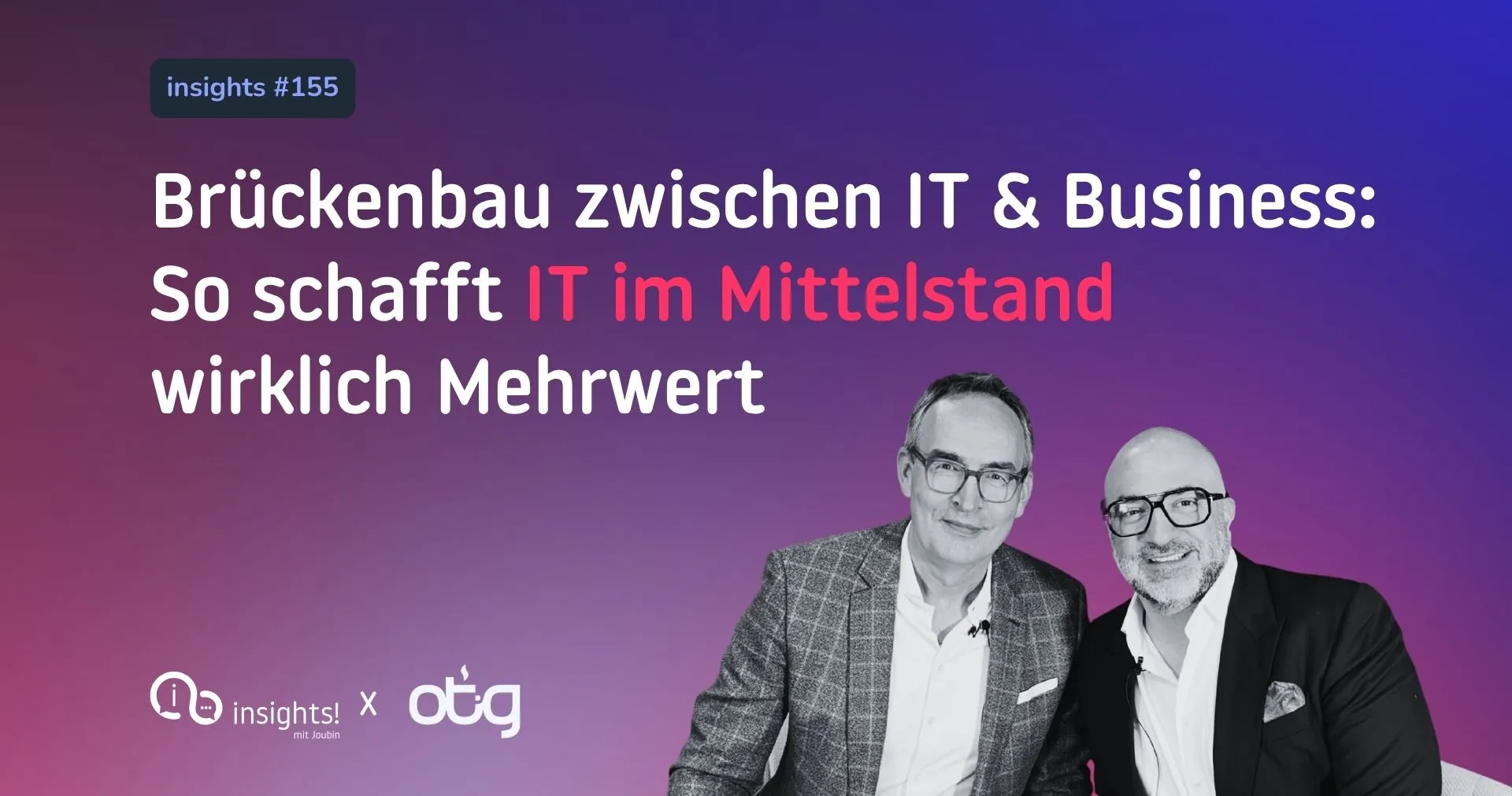
"Many people see governance structures as a brake. I absolutely do not see it that way. If you do it with a good governance structure, with guidelines and data classifications, you tell employees clearly what they are allowed to do and what they are not. That is exactly how you create the freedom to be bold, because you know: these are my boundaries, but within them I have complete freedom."
When the most honest AI story comes from East Frisia
Anyone who wants to know what AI in German mid-sized companies really looks like in 2026 should take a look at Ostfriesische Tee Gesellschaft. Behind the brands Meßmer, Milford, Onno Behrends and Yasashí stands a family-run mid-sized company that produces more than 8 billion tea bags a year and delivers to 90 countries. Its digital transformation has been led for two years by Alexander Cohrs, CIO and CDO in one person, a constellation that many corporations deliberately keep separate. At OTG you can see why combining the two can be a strategic advantage.
In the insights! episode with Joubin Rahimi, Alexander gives deep insights into an AI strategy that is calm, clear and tangible. Instead of buzzword bingo, quick wins are defined, an AI manager was hired early on, and the topic is underpinned with clear governance structures. It is exactly this clarity that many large organizations currently lack and that works better in mid-sized companies than many believe.
From marketing man to IT chief: when unconventional careers suddenly pay off
Alexander Cohrs studied business administration with a focus on marketing and worked for many years at Otto in direct marketing. He then held international positions as managing director in Korea and Russia, did business development for Tchibo in Romania, Poland and Turkey, followed by seven years at Kühne+Nagel with a focus on IT transformation and change management. Today he is CIO and CDO of a tea holding company. This biography is unusual, and it is valuable precisely because at every stage it connects both worlds, the business side and the technology side.
The frequently debated question of whether CIO and CDO can be merged has found a refreshing answer in his person. From his perspective, the separation is artificial. Today a CIO has to shape innovation just as much as a CDO has to understand existing processes. Anyone who combines both in one role decides faster, has fewer losses at the interfaces and can set up topics such as AI earlier. And anyone who cleverly combines this with a good executive structure, in which a board trusts rather than micromanages, gains additional speed.
The bridge between IT and business does not start with a tool
One of the central messages of the episode is an attitude that every IT leader should internalize. Alexander says it clearly: please do not come to me and tell me which tool you want. Tell me where it hurts. This small semantic shift changes the entire collaboration between IT and the business units. Instead of being defined by demo experiences and vendor marketing, the actual business problem is placed at the center. And that is exactly where the best decisions are made.
There is a second observation behind this. Many major platform decisions today are driven by business units that fall in love with a tool without keeping an eye on the overall stack. Interfaces, security and total cost of ownership then become problems that have to be corrected expensively later. A CIO or CDO who builds a bridge eliminates exactly that, without taking away the business units' appetite for innovation. It is not about prohibition, it is about translation.
Governance is not a brake, it is an innovation turbo
When governance comes up, many people think of bureaucracy, slow approvals and endless tickets. Alexander turns this logic around, and that is one of the strongest messages of the episode. With clear guidelines and data classifications, companies give their employees the confidence to try out AI boldly. Those who know what they are allowed to do dare to act. Those who do not know hold back out of sheer caution.
In concrete terms this means that AI at OTG is not the Wild West, but a clearly defined space. Within this space, employees are allowed to use, test and combine tools. And that is exactly the innovation turbo that many corporations wish for but prevent through a lack of governance. The most important question for any organization is therefore not: do we need governance? But: how quickly can we create it so that our people can get started?
AI in mid-sized companies: quick wins beat the perfect solution
Perhaps the most honest take of the episode concerns getting started with AI. Alexander warns against the typical corporate disease of spending months searching for the perfect solution while others are already implementing. His advice is clear: start, test, move fast, set up governance, get going. This order is not accidental, it is proven. Anyone who waits until all risks are eliminated has overlooked the actual risk, namely the gap to the competition.
What quick wins mean for OTG in concrete terms can be summarized in a few points:
Bring an AI manager into the company early, long before that was standard in mid-sized companies.
Prioritize use cases based on real pain points from the business units.
Set up data classifications so that employees know what they are allowed to do.
Work with service providers on a basis of trust instead of micromanaging every project.
Involve the workforce early, because AI changes ways of working and fears are real.
The last point is perhaps the most important. AI adoption rarely fails because of technology, it fails because of people who are not brought along. Anyone who takes this seriously builds a strategic head start.
Speed through trust: the most important takeaway
Perhaps the most emotional moment of the conversation comes up around the topic of trust. Alexander describes how his board supports him, his team challenges him and his service providers are steered at the level of goals. Out of this constellation emerges a simple but powerful principle: speed through trust. Whether in leading a diverse team, in working with service providers, in introducing AI or in dealing with intercultural particularities, the principle remains the same.
Anyone who builds in mistrust builds loops. Tenders, escalation levels, approval processes, all of them arise from a lack of trust in one's own decisions. Anyone who leads with trust, by contrast, wins back time, and time is what decides competitiveness today. It is no coincidence that this principle works better in a family-run mid-sized company than in many large corporations.
Would you like to listen to the full episode?
Here you can find the podcast of the interview:
Please accept the corresponding cookies to view this embedded content.
Would you rather watch the episode? No problem!
Here you can find a recording of the interview:
Please accept functional cookies to watch this video.
Would you rather read?
Joubin Rahimi
Great to have you back for a new episode of insights! My name is Joubin, Joubin Rahimi, and joining me today is Alexander Cohrs from Ostfriesische Teegesellschaft. Alexander, good to have you here.
Alexander Cohrs
Yes, Joubin, many thanks for the invitation.
Joubin Rahimi
My pleasure. And in our pre-talk we discovered a lot of things. First, that we are both bridge builders, that you have brought a huge amount with you, and that is something we want to get into today, bridges from other cultures. But you also took a different path. You come from marketing and are now CIO and CDO, which is rather unusual. How did that happen? You are probably also the only CIO here at OMR who was already here a few years ago.
Alexander Cohrs
That could well be, that could well be, yes, and not to make it too complicated, but it really is a very unusual career path, I notice that myself whenever I tell other people about it. So first of all, about my role: I am with the holding company, officially since November, by the way. We restructured a little, that is the holding company that Ostfriesische Teegesellschaft also belongs to.
Joubin Rahimi
We all know the products from the supermarket.
Alexander Cohrs
I certainly hope so. We make tea. Our core product is Meßmer. Milford and Onno Behrends are part of it. Here is an interesting figure: we produce over 8 billion tea bags a year and supply more than 90 countries around the world, a lot of it private label, but also with our 3 core brands, and we are a German company, an independent family-run company, and everything we do revolves around healthy living. We also have companies that produce fruit bars, cereal bars, cereals. But that should be the advertising part for our company, so very much focused on healthy enjoyment. My story, I always have to go back a bit, I will try to keep it a little shorter. I basically grew up in my parents' retail business. And then, what is the first reaction?
Joubin Rahimi
You kept that from me.
Alexander Cohrs
The first reaction was of course, I want to study business administration with a focus on marketing, because somehow I want to go in that direction too. And I did that, but while I was still studying I went to Otto, worked there as a working student and had to get to grips with technology for the first time, because there was a 386 sitting there, for the younger people who might be watching, one of the first Windows machines. But the established people who were sitting there all walked around it and thought, what is that?
Joubin Rahimi
Everyone thrilled, right?
Alexander Cohrs
And I said, okay. Why didn't they want to? No, they were afraid of it. Really, they were afraid of it. I was relatively fearless, I said, okay, let me have a look at what this thing can do and what I can do with it.
Joubin Rahimi
So a real quantum leap. Absolutely.
Alexander Cohrs
And then I started digging into it more and more, actually started building models in it for multivariate analysis methods, because we were sending out catalogs. You remember the thick Otto tome, and then a lot of smaller catalogs. And I found it really exciting, I built models there.
Joubin Rahimi
How many catalogs did you actually send out for Germany, do you know? Did every household have one?
Alexander Cohrs
No, not that, but we were already at 8 million, that was the order of magnitude when we sent out the thick catalog. On top of that, more than 50 million intermediate catalogs.
Joubin Rahimi
You could actually have counted the people in Germany through Otto. Absolutely.
Alexander Cohrs
And those were part of our youth and childhood. There was also a second big one back then, which at some point became part of Otto, Quelle. No, it was an exciting time. But for me that was not the entry point, because Otto then made me an offer, saying we have now built this model, someone has to carry it on. I did that for a short time, but at some point I realized that it was not my thing. I want to understand technology, I want to know what is possible with it, but I do not want to program it. And that is why I went into marketing, direct marketing it was called back then, email marketing, that kind of thing. Then this strange internet came along, and through that I had the chance at Otto to really develop in various directions. I was in many countries, you just mentioned it. I spent 3 years in Korea, running Otto Korea. I spent 3 years in Russia, running Otto Russia. Lots of opportunities for Otto to go out into the world, but always with a strong technology bias too, because that was e-commerce, which was new for many people and which I first had to understand myself, how does it work. And then we carried it out into the world to our subsidiaries.
Joubin Rahimi
Coming back to the Otto catalog once more, before e-commerce came along. I think everyone of our age, every household had Otto catalogs. And I used to pore over it endlessly and knew all the technology pages by heart. The hi-fi units, all those 42-centimeter-wide hi-fi components, that was my world. Incredible how much it stuck. I still know they were relatively far back, or that there was a block on it.
Alexander Cohrs
Yes, for me the fashion pages were not that relevant either as a young man. I was more interested in the technology pages, of course. But then it continued with furniture worlds, then we started building CD-ROMs where you could place the furniture in the rooms. Revolutionary at the time, you have to say. Absolutely, yes. But that shows my path a little, where I always said, okay, I always want to understand something new about technology and be able to apply it again. And I was able to do that after my time at Otto, at Tchibo. Then I went back to Russia, that was not my dream, but at the time Tchibo wanted to take its non-food business to Russia as well. There was less technology in demand there, even though we did e-commerce, because the owner wanted us to build stores as well. So for the first time in my life I actually built real stores in Moscow and the surrounding area. A very exciting time, I can say. Learned a lot, also in dealing with Russian culture, and before that Korean culture. That was really extremely exciting, and I was then allowed to do more business development for Tchibo in Romania, Poland and Turkey. And that is where, and this is where the circle closes a little, a former colleague from Tchibo brought me to Kühne + Nagel, because at that time Kühne + Nagel was not yet up to date technically either and they were looking for a way to transform further. That means it was the first time I was officially in IT, but still more marketing, more like communication, and my job was to bring together all the topics around digital transformation. And that is where the topic of bridge building came in, because they said, you understand the business side, but you have also dealt with technology, and how do we bring the two worlds together. That was the start, and to cut the story short, I was at Kühne + Nagel for 7 years, including another year in Switzerland, and the last few years in Hamburg, my home town, before I moved to the holding company, or to OTG, 2 years ago and became CIO there. A bold decision, I have to say, but I think I was able to convey to them well why, what my added value is, namely understanding the business side while at the same time knowing what possibilities exist on the technology side.
Joubin Rahimi
And I find that really exciting. You are CIO and CDO in one. And I also had a debate about it with one of our fellows from TIMETOACT GROUP. A CIO cannot be a CDO.
Alexander Cohrs
I know that discussion.
Joubin Rahimi
What is your take on it? Maybe we can put it all in context first. CIOs are the ones who optimize processes with technology or IT. So I have a checkout process, I could have a cash register, and now we have it digitally and then the accounting goes faster and so on. So that is simplification of the business. And a CDO builds digital services that would not be possible otherwise, and new processes.
Alexander Cohrs
Yes.
Joubin Rahimi
And I would say the thought patterns are completely different, aren't they?
Alexander Cohrs
I would not say that they are completely different. We already looked at this at Kühne + Nagel, by the way, and made the same decision back then, to bring the two together. Because you do need a basic technical understanding and a certain technical affinity. And ultimately it is about organizing processes. In my role, my main task is leading, that is, developing things in certain directions. And this combination of course helps us to be very fast and flexible, because I can then also decide things much more autonomously in the moment, in terms of what we want to focus on in the future. Which right now of course, we are at a big trade fair here, when it comes to AI, in my role I had the opportunity to decide relatively early. This is a core topic for us going forward. We created a dedicated role for it, hired an AI manager relatively quickly, someone who had been working on the topic very, very early, at least for a mid-sized company. That was possible because in this role I had the decision-making authority. So I think it really fits together outstandingly well.
Joubin Rahimi
So you do not wear two different hats, sometimes one, sometimes the other?
Alexander Cohrs
I do, well, I think that as a CIO you already wear several hats anyway. We do service desk, we do development, we do security and now the whole topic of AI, and really everything around networks, those have always been different challenges, but in my view they can be brought together very well, you can connect the teams well. Bridge building again, I do exactly the same in my own team, bringing together the different characters and areas of focus.
Joubin Rahimi
Building bridges, and you were in Russia. You were in Romania. We have a few things in common. I was not in Russia, but I was in Romania and also in Korea. And you said Korea changed very quickly too. Was that during the time you were there?
Alexander Cohrs
No, that was when I arrived. You have to say that back then, from my perception, when I got the offer I had zero idea what was happening in Korea at the time. And when I arrived, you could tell they were right on the threshold of becoming a first world country, but at a breathtaking pace. And living in Seoul is yet another matter entirely, I have to say. I used to think Hamburg, gateway to the world and the center of the universe. A cute small town, you simply have to say. Seoul has over 20 million inhabitants, never sleeps, always on fire, incredibly exhausting, but also incredibly inspiring, you have to say that quite clearly. And the bridge to the cultures, that is of course the challenging part, understanding with my employees how to motivate them, how to set them on the right goals. One of my first experiences, if I may tell it, was that I told people which direction I wanted to go in. They ran off, did the work, then came back 3 weeks later and said: that will not work. Okay. And since when had they known that? Well, actually from the moment you said it. Why don't you tell me? That is our culture. You say something, you are the boss, so we do it. Okay, back to square one. Let me tell you how I want it. You are the experts. I want you to bring your expertise in here and to challenge me too. And that worked really well, a great collaboration. The only problem was that when I left they said: great, now I can never work for a Korean again, because they would not accept it.
Joubin Rahimi
Was that change easy for them, or?
Alexander Cohrs
Well, I think you do need a certain willingness to change, a motivation to surround yourself with new challenges. Otherwise I would not have done it either. I also took my family with me and said, if we do it, we do it fully. Incredibly difficult to get into Korean society. You have to know that Koreans spend a great deal of time together for business. Every evening it was my job to take my team out to a restaurant.
Joubin Rahimi
Every evening?
Alexander Cohrs
Every evening, because Seoul is so expensive that most of them could not afford an apartment in Seoul with a family. That means families lived outside the city, the employees in small apartments in the city, and in the evening it was my job to entertain them, so to speak. So you ate with them every evening, drank soju with them every evening, did norebang every evening, that is Korean karaoke. At some point I said, okay everyone, I always have to take care of my family, otherwise I would not have survived it. But, and on Friday they drive out to the countryside and live there. That is the problem, you simply never get to the next level, which is actually really important to me. When I work, I really need a close bond with my people. I find that much easier in a mid-sized company. Because I think it is a much more trusting basis than large corporations can usually manage. And with the Koreans, skipping that step, so to speak, and getting more into the family sphere, that was challenging. Fortunately I managed it with some of them. I was at weddings, and there it was a bit like being paraded around as the long-nose.
Alexander Cohrs
Look who I know.
Joubin Rahimi
And you are rather tall too.
Alexander Cohrs
Yes, that was always the highlight. Not because I am so great, but because I was so out of the ordinary. No, but that was a big learning, engaging with the intercultural side, not completely changing who you are, but coping with the sensitivities and also with the demands. Honestly, the swing from Korea to Russia was much, much bigger. Koreans love Germans, they love punctuality, they love precision, very reliable. It is different with the Russians, to put it positively. That was hugely challenging. The language is challenging. I first learned Korean, then I learned Russian. Korean came very easily to me because it is so different. Russian was not so different, but there are so many irregularities, and you had the feeling that the Russians did not accept it when you tried. It was like, learn it properly or leave it. It really was, and in the end I spent 6 years there, so that was a genuinely tough time, I have to say.
Joubin Rahimi
But did you always go out to eat with the employees there in the evening too?
Alexander Cohrs
To be honest, I commuted to Russia, parked my family in Hamburg in the meantime and then commuted back and forth. I still spent time with them in the evenings, professionally too, of course. I also found a few very good friends in Russia. That was different again. Once you had crossed that threshold, and that was easier there, they really took you in and then you really were best buddies. The kind where you really went out in the evening.
Joubin Rahimi
People stand up for each other there. Absolutely. Is Russia, I was in Romania for a while, is it similar? Because you were in Romania too, or is Romania a bit like Russia light? Or different?
Alexander Cohrs
Yes, I did have the feeling that the Romanians were more open to change and had always looked more at what works best, what we can adapt for ourselves. The Russians have a clear self-confidence that Russia is really out in front to begin with. Yes, there are a few things you can learn from the world, but honestly, what should the world learn from us? That was a bit of the attitude. Nevertheless, as I said, good relationships were possible there too. But with the Romanians I had the feeling that there was a different spirit.
Joubin Rahimi
What do you take with you into the present day, from the past, things where you say they really made a difference?
Alexander Cohrs
Really this accepting of differences, I think that is an incredibly important factor. In my team too, I am totally happy, a very diverse team, which is quite unusual for an IT department, I think. We have almost 50/50 men and women in my team, which I think is great. I also have Syrians, Russians, Belarusians, Koreans in my team, Turks, and it really works outstandingly well. And I also try to encourage everyone else, try to find out what makes the other person special, what the difference is. And they live that really well, and I think I was able to bring that in too, that it is fun and not an annoying interruption.
Joubin Rahimi
Okay, this being able to listen. I think that is also, you said it in the pre-talk too, that is really important.
Alexander Cohrs
Yes, but also regarding what you said at the beginning, building bridges. I mean, you have to, and that was a difficulty for you, I think quite a few people can relate to this, in the past the business would shout something over, and honestly I used to do it too. Of course. I said, hey, IT, go do this. IT took it, said, this is how I understand it, built something, said, here you go, and the business said, what kind of nonsense is this, I do not need this at all.
Joubin Rahimi
It makes no sense at all.
Alexander Cohrs
Maybe you should have talked to each other in between, and this translation, because these really are two cultures, you have to say that quite clearly, so much still to translate. What is really the need in the business? What are the technical possibilities you have? And honestly, that is a bit how I live my CIO role now too, telling my business units: please do not come and tell me which tool you want, tell me your requirements. What is your current pain? What can we change? And it is our job to then find the best possible tool for you. To give 2 or 3 options perhaps, but for me that is also a task that has a lot to do with listening, with understanding what the real operational pain is that we can relieve with it.
Joubin Rahimi
From a CIO perspective or an IT perspective, totally clear. Here at the trade fair I am noticing quite a few things, how the business units are being courted again, we were just at Storyblok, at VTEX likewise, where the business units take the function, let's say CMS, they all do somehow the same thing, only Storyblok is currently a popular choice because it is so easy for editors to use. And that is changing right now. How do you deal with that? You know it, after all you come from the marketing side.
Alexander Cohrs
Yes, yes, exactly, I come from the marketing side, but I have also told them that we are already trying to rein in our product landscape a bit, because there is always something new that is cool and easy again, so we say we do take a somewhat longer-term view. First of all it has to fit on the system side, of course, so that things exchange data well with each other, so that the interfaces work, I have to pay attention to security, but quite clearly the most important thing is that users enjoy working with it and can work well with it. And I think that is the advantage, that I was able to convey the trust to the business units too, that I understand this and nevertheless take the liberty of saying: it is a great tool, the one you just told me you want, but let me question whether it really is the best one or whether there is something better. But then at some point we also stick with it. So we are not going to start throwing everything overboard again every 2 years.
Joubin Rahimi
Do you think a CIO who previously worked in a business unit is a better CIO? That would be unfair.
Alexander Cohrs
I think they do it differently, they have a different perspective and I think there really are advantages. There really are advantages. Maybe I also have the disadvantage that I did not study IT. I cannot code, but at least I know quite well how our systems work, how the interfaces work, and I think the trust in my team is there, that I have enough expertise to make the right decisions with them. But I also have this huge advantage that I was responsible for the business side myself for so many years. I do think it is an advantage, because what is the job of a CIO? First and foremost, as I said earlier, leading. That is my core task. Leading my team in the right direction, positioning myself strategically, advising the company strategically on which direction we should develop in now. I think I definitely took that with me very intensively from the business side.
Joubin Rahimi
Yes, I think my experience shows that if I have a CIO here or a board member for IT who used to be a software developer and some problem comes up with the service provider, they are quickly back down in the depths of the subject matter to understand it, or they also have some understanding for that kind of thing. Yes, it is complex after all. Whereas a business unit says: I could not care less, we bought a service.
Alexander Cohrs
Absolutely. I observe a few other things too. Of course, if someone is that deep in the subject matter, they immediately go into the infight with the service providers as well, trying to prove to them everything they have to do differently and better. Honestly, for me it is again a question of trust. I trust my service providers, they are the experts, I hired them after all, and I want to reach a goal together with them. But how they do it, I do not leave entirely up to them, but I do want them to feel that trust. The same with my employees. I do not tell them, by the way, you have to do it this way, then that way, then that way. I say, okay, that is the goal. You tell me roughly how you want to get there. I say: works for me. And whether they wobble around in there or whether they do it at home or in the office, that is not entirely irrelevant to me. But it is their decision. If it is made together with me, I am completely fine with it. And I really do believe it is an advantage, coming from the way I was, so to speak, domesticated, with this trust-based approach and with a clear perspective: what result do we need in the end?
Joubin Rahimi
I think then it is also easier to delegate. Last question, and this comes from Gartner. Gartner says that in the future IT, the CIOs, will no longer make the decision on new systems and services, but the CFO. Where are the budgets really? What is your assessment? You know it from various companies, of course, but... I do not share that view, by the way.
Alexander Cohrs
Well, I should perhaps say that in our structure we are set up in a somewhat nested way. I am on the executive management team, but there is still a board member above me who is also responsible for finance. What I really appreciate, and this is genuinely a bit different from what I knew from the corporate world, is that we discuss things together, so I do the plan, the strategy, and behind that I put my budget, what I think I need in order to meet the requirements from the business units as well. He challenges it, so of course I have to be prepared and sell it well. And honestly, once the decision is made, it would actually be enough for us to sit down together a year later and say, what did you make of it, what came of it. We do talk in between, and of course he also wants to know certain things at least, but he really does give me the freedom, because he has trust in it. And I appreciate that enormously. I know it from the corporate world, you have the budget and yet you still have to present every single project separately again, get each one approved separately again. That always cost a lot of energy and did not always lead to the best result.
Joubin Rahimi
There is also a nice book about that: The Speed of Trust.
Alexander Cohrs
Yes, I have not read it yet, but I should get hold of it, because I think it is the basis for a respectful way of working together.
Joubin Rahimi
I think you do not even need to read it. I started reading it, at some point I stopped, but for me it was so clear, because you run a tender, a service provider selection, because with one, you do not have the trust that the decision is the right one. That is why you run this loop, and that is okay. And it just keeps going. So yes, if you had the trust that your decision was the right one, without all the other stuff, you would be much faster. It is not about speed as such, but yes, that is true. That was somehow really exciting, which is why I somehow did not keep reading the book, because the title is the essence of it. That really is remarkable.
Alexander Cohrs
Absolutely. If I may bring this together with the trade fair here a little, because of course AI is on everyone's lips too. AI in particular is a topic where you have to build trust. That is why we also looked at which solutions might be the right ones for us and are currently leaning more towards quick wins, precisely in order to quickly build up trust in the company as well, in this technology that is perhaps not entirely transparent, so that people learn to deal with it and their fear is taken away. Because for me that is one of the core messages. If you, well, first of all the most important thing anyway is that you have to start and not always search for the best, but say, okay, test it, do it fast, create a governance structure and then get going. But the most important thing is, bring people along. For me that is always a core message. Employees anyway, but also the managers, the board, the owners. Because only that way do you actually manage, through training, through support, to build this trust. With AI you also know it changes the way we work, and not everyone finds that cool. So you have to bring people along and support them. That has a lot to do with trust, that we are not doing anything to eliminate jobs, but of course we want to use AI to improve ways of working, of course to make things more efficient. That is the core topic. So trust comes fully onto the table there again as well.
Joubin Rahimi
You could not put it more nicely. We had courage as a topic today and I think you can be particularly bold when you also have trust in the team. And trust is certainly one of the essentials you need there.
Alexander Cohrs
And courage, sorry, I do not want to slow you down. I do like courage. Just last night I had another discussion on the topic of governance structures and AI. Of course, people see it as a brake again. I absolutely do not see it that way, because I think if you do it with a good governance structure, we set up guidelines and principles, we did data classifications, in order to tell employees clearly what they are allowed to do and what they are not, because that is exactly how you create the freedom to be bold, because you know, okay, these are my boundaries, but within them I have complete freedom. That means you have created the connection nicely. Courage and trust, those are two truly essential foundations for my work as well, and it gives me so much pleasure that I am now allowed to live that out in my company too.
Joubin Rahimi
And I think if you have questions about courage, trust, bridge building, just head down to the comments or message you directly on LinkedIn.
Alexander Cohrs
Yes, gladly.
Joubin Rahimi
LinkedIn is, I think, the medium you use.
Alexander Cohrs
Just to find me there. Exactly.
Joubin Rahimi
And thank you for your time, thank you for the insights. And I am always really honored that I could already talk to you beforehand, and now here. I always enjoy taking away so many insights! So, thanks again.
Alexander Cohrs
Many thanks for the invitation and the opportunity.
Joubin Rahimi
My pleasure.
Alexander Cohrs
See you sometime. Thanks.
Do you have questions or feedback?
Then feel free to contact us directly.
- Joubin Rahimi
Managing Partnersynaigy
Show phone numberShow mobile numberShow email address
Subscribe to the blog now and never miss any news
✔️free ✔️news every week ✔️expert knowledge
Please accept the corresponding cookies to view this embedded content.