



insights! #110: No future without data – Kristin Lichtblau on Germany's Mittelstand in transition
In this episode, Kristin Lichtblau shares fascinating insights into the challenges and opportunities of digital transformation in mid-sized companies. She talks about the central role of data, about modern leadership culture, and about why change requires clear communication and sustainable structures. Anyone who wants to understand how change really succeeds in a company will find hands-on inspiration here – straight from the day-to-day work of business development.
 Joubin RahimiManaging Partner · synaigy
5 min. read
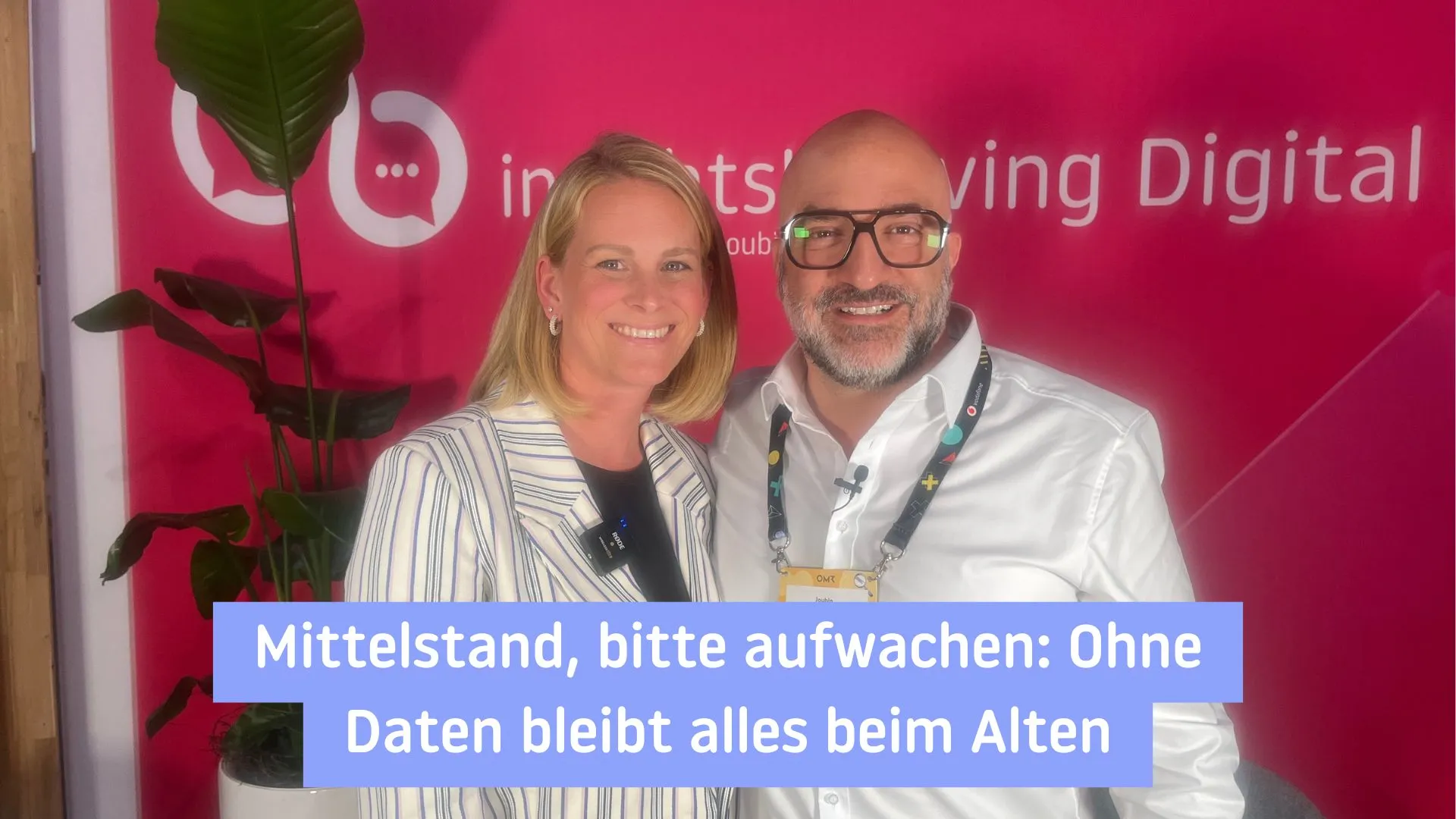
If you don't have your own data under control, you've lost, because what is an AI supposed to access if you can't feed it?
Transformation in mid-sized companies is no walk in the park – Kristin Lichtblau knows that all too well. As the person responsible for business development at the Swash Group, including Megabad, she is steering a far-reaching overhaul: from strategic realignment to M&A synergies to data-driven process automation. Anyone who wants to succeed at this needs more than a plan – they need structure, courage, and above all one thing: clarity.
Plain speaking as a leadership style: an end to gray areas
In many companies people still beat around the bush – that costs time, unsettles teams and blocks progress. Kristin Lichtblau's superpower is her ability to get to the point so precisely that no room for interpretation remains. In an environment where more than 40 projects run in parallel and the organization has to reorganize itself, that is not a nice-to-have but a survival strategy. Her clarity creates commitment. People who understand exactly what is expected of them can take responsibility and act. In practice this means: communication becomes a strategic discipline, not a by-product. The motto is: make decisions transparent, structure processes so they can be followed, and name responsibilities consistently.
Vision as daily practice, not as a poster on the wall
Visions are not a luxury but a necessary compass in times of change. But for them to take effect, they have to be communicated consistently and actively lived out. A mission statement that is not integrated into daily work misses its purpose. Kristin sees this as one of the biggest challenges in transformation processes: management has to convey the vision so clearly and concretely that it provides orientation – not just on paper, but in the everyday work of every single employee. That includes defining values that do not only appear in presentations but are visible in leadership behavior and work processes. Translating strategic goals into operational measures must not be left to chance. Only when employees know what contribution they make to the bigger picture do identification and motivation emerge.
Meeting resistance with method – partner management inside the company
Cultural change does not happen by itself. There are always people who find change harder – whether out of uncertainty, out of experience or simply out of habit. Ignoring these „hard nuts“ or weeding them out early is a mistake, however. Kristin argues for analyzing deliberately who can be involved and in what way. Her method is no cozy approach but targeted internal partner management: actively involve key people, take their perspectives seriously and at the same time tailor tasks strategically so that added value becomes visible. Only when managers recognize that change also brings them personal benefits – for example in the form of better workflows, clearer structures or greater efficiency – does their willingness to help shape it grow.
Data as the foundation of future viability
Anyone talking about digitalization has to talk about data. And not in the abstract, but operationally. Kristin emphasizes that in the context of growing AI applications, structured and consistent product data is the critical success factor – especially in e-commerce. It is the basis for SEO, SEA, marketplace integration, price management and personalization.
Without a functioning PIM (Product Information Management), a good DAM (Digital Asset Management) and clean content processes, no scalable sales strategy can be implemented. Companies that invest too late here not only lose touch with technological development, but also the ability to address customers in a differentiated way. Data management is no longer a purely technical question – it is a strategic topic with a direct impact on revenue and competitiveness.
Organizational setup: teams, tools, transformation
Technical infrastructure alone is not enough. What is needed are teams with clear roles and digital skills. For companies in the mid-triple-digit million range, Kristin recommends a dedicated team of at least ten to twenty people working exclusively on content, product data, visual presentation and the automation of these processes. Beyond that, the organization has to learn to think in process chains – from importing manufacturer data through image editing to AI-supported delivery in the shop. What matters is that the mindset moves away from „copy & paste“ and toward intelligent system management. That requires not only tools, but training, change communication and a clear roadmap for developing digital skills within the team.
AI is changing the rules of the game – and calls for new thinking
Search behavior is changing fundamentally. Customers no longer type in keyword-style queries; they describe needs or formulate problems. The systems that answer them – whether ChatGPT, Gemini or others – need structured data and precise content in order to deliver fitting answers. Companies that are already investing today in semantically clean content, keyword strategies and open data management will remain visible in this new world. The others risk disappearing into invisibility. It takes courage to let go of outdated protective mechanisms and to prepare content specifically for new platform logics.
Product data as an experience building block – understanding customers, not just supplying them
Megabad is not just a shop, it is a service promise. Customers expect not only a product but a whole package of information: compatibility, spare parts, planning aids, visualizations. Kristin explains how crucial it is to recognize these expectations early and serve them with data-driven content – ideally so well that no additional advice from specialist staff is needed. The prerequisite for this: perfect data structure, audience-specific content and the ability to present complex relationships in a user-friendly way. Especially in advice-intensive industries such as sanitary, electrical or construction, this becomes a clear competitive advantage.
Would you like to listen to the full episode?
Here you can find the podcast of the interview:
Please accept the corresponding cookies to view this embedded content.
Would you rather watch the episode? No problem!
Here you can find a recording of the interview:
Please accept functional cookies to watch this video.
Would you rather read?
Joubin Rahimi
Great to have you back for a new episode of insights! Today with Kristin Lichtblau. Hi Kristin.
Kristin Lichtblau
Hello Sabine
Joubin Rahimi
And your superpower is what?
Kristin Lichtblau
My superpower is, as many people tell me, my clarity, which I always express very plainly, and at the same time my humor and my joy in many things.
Joubin Rahimi
But tell me, why is clarity the superpower? Where do you need that?
Kristin Lichtblau
People often beat around the bush, and when people don't know what you want and it isn't phrased clearly enough for them to walk out of the room and get started, then a lot of time and resources are wasted. And that helps especially in my job and in many other companies.
Joubin Rahimi
In your job. You work in business development – sum that up in two or three sentences.
Kristin Lichtblau
Yes. So I'm responsible for business development at the Swash Group for Megabad and two other brands. And, well, it's structured like this. We have a great many projects because we're in upheaval and are, so to speak, overhauling a lot of things in this mid-sized company that was acquired before 2021. And those projects pile up. So it's really more program management when you have 40 projects running at the same time. At the same time it's a change process taking place in the company. That's why development, corporate development. Lots of strategy that we develop and question – we can talk about that in more detail later. And this transformation that is taking place through acquisitions. So the whole M&A business, leveraging synergies within the group, is tucked under the umbrella of business development in my area.
Joubin Rahimi
And that's an exciting task, because you have the different brands from a mid-sized company. You have to change the culture, or you're forced to. The investor has expectations too. It shouldn't just carry on as before, but rather.
Kristin Lichtblau
Growth is what's called for.
Joubin Rahimi
What is the number one priority? When you're in a situation like that.
Kristin Lichtblau
That you bring everyone along in order to reach this growth target, and you only manage that through the manpower that sticks together in this change and in this process, so to speak. Because if you lose them, you lose sight of the strategy, of the big goal. And that's it. You have to bring everyone along.
Joubin Rahimi
Bring everyone along. That's a big, big phrase too. Bring them along to where? So from where to where? With what – the strategy, you said, that's one thing.
Kristin Lichtblau
That's where it starts: presenting the vision or the mission, the purpose of the company, what you intend to do, in a way employees can understand. A certain mission statement and value principles are important for the individual person, so they can identify with them, and then putting that into a strategy with the how. How do we achieve it? And what focus do we set? So what exactly do we want? Which levers, which enablers do we have, which drivers do we have to implement it – and then you simply screen the company. What do we have? Which resources, which skills? What are our systems like, what structure? What is management like, what is leadership like? To then examine and identify what you focus on, and to prepare it so that the individual person understands it – that is the biggest challenge right now.
Joubin Rahimi
Lots of good things said. I have a question about the very beginning.
Kristin Lichtblau
Then let's go back for a moment.
Joubin Rahimi
We're in Hamburg. Yes, and a formerly very well-known politician said that anyone who has visions should see a doctor. There are companies that say: it's always worked this way. Why are you coming to me with this now? Have you already given part of the answer, or all of it? Are you saying the answer is there because you need it to explain where things should go, or where are the visions still visible?
Kristin Lichtblau
Well, the vision has to become visible, because if you want to change, then it's a change process and it has to be described. Because change only happens if you repeat it again and again and remind yourself what the change is. And that's what's contained in a vision.
Joubin Rahimi
Okay. Remind yourself what the vision is. And that's probably the challenge. You can't just say it once and stick up a poster. We worked out a vision, it's right there.
Kristin Lichtblau
You do have to live it in daily life and also be a role model. I think that's always a big aspect too, because if managers don't stand behind this vision and don't pass it on to the teams and aren't role models in implementing it day to day, then you can't demand it from the employees.
Joubin Rahimi
And how do you deal with it when the vision – you can't. From my experience, correct me if I'm wrong. We also worked out this strategy, goals, vision, values as a team. We were still very, very small back then. Yes, that was okay. But I wouldn't do it again. It isn't the employees' job to say where things are heading – that's the managing director's or the entrepreneur's. Bringing people along, yes. So listening too. But where our market is heading, how we position ourselves, I'd always say that's a different circle, and there you don't bring everyone along. And then you have a manager who says: nice, what you're doing there. What do you do then?
Kristin Lichtblau
On the one hand, saying you don't bring them along. So you take parts of it. If you're a good entrepreneur and a good leader, you already know who the tricky characters are that you'd best involve. So that's partner management inside the company. Yes, and somehow also a sales topic inside the company, in order to crack exactly these hard nuts. And you manage that either by actively involving them after all and shaping the idea together with them. Or through topics you give them where they notice that their work gets better. So those would be the two levers I'd try in order to bring the hard nuts along.
Joubin Rahimi
And not weed them out.
Kristin Lichtblau
No.
Kristin Lichtblau
Not at first, because that then also leads to the mood – well, first of all everyone notices it, and then we're quickly at the culture topic, and especially in transformations like the ones we're carrying out, you do have to watch out for what affects the mood.
Joubin Rahimi
So the easiest way, saying we part ways with them, isn't the right one.
Kristin Lichtblau
Not always.
Joubin Rahimi
Mhm.
Kristin Lichtblau
Yes.
Joubin Rahimi
I'm asking about that because these are always the questions people have. Yes, yes, digitalization is actually always a change process too, the way I see it. Now AI is added on top, and then it will go much faster. Yes, can you actually bring people along at the speed you need? Or?
Kristin Lichtblau
It also varies a lot, I'd say, from area to area. In a marketing team like ours, in our digital team, they're all so well up to speed that they explain the world to me rather than the other way around. But there are also areas like logistics or HR, where many people have simply been doing their job the same way for years and don't engage with it. And of course you have to be open to taking on the topic, because training costs enough money and also a lot of capacity and time. If a person doesn't want to, then that's misinvested time. But if you have people who get excited about it and then bring that spirit along and bring it into the team and say okay, my work gets easier this way, I'm a role model, a guiding function – then I do believe you can achieve it again and again.
Joubin Rahimi
The role-model role – I've actually heard that twice already today, now for the third time. Yes, that leaders have to be role models. There seems to be something to it. Purely empirically, yes. How easy or how hard is it when you have leaders who take on this role-model function? To some extent you have to – if you now say okay, we're an open-minded community now, because we're switching to working for one another. However that goes, people have been running in a different direction for ten, fifteen years. What's your experience? How easy or hard is this change when it comes to bringing the leaders along too? Because if they don't join in, the rest doesn't work. That's a cascade, I'd say, or translate it that way.
Kristin Lichtblau
Well, every person is different, as we say in Cologne, but with every person there is something you can get them excited about – I'm convinced of that. And you have to sense that and find it out. And then to satisfy this strength or this desire – that's good leadership work. Depending on the hierarchy, the next boss up has to recognize it. And then try to coax it out.
Joubin Rahimi
How well positioned are we in the German Mittelstand there? I do have my doubts.
Kristin Lichtblau
We still have potential. Is that politically correct?
Joubin Rahimi
You're allowed to answer incorrectly too. That's much nicer, by the way.
Kristin Lichtblau
Yes, there's also a saying: the fish stinks from the head, starts stinking from the head. And yes, there's certainly a lot of potential there. And then you do have to look closely. That's simply how it is, it's part of good management. Because making decisions like that too – when you extend a hand and support and try to lead accordingly, to work together toward the same goal and also convey the same values, and values are always a huge point in this – and that doesn't work over a certain period of time, then at some point you have to part ways. That's just how it is.
Joubin Rahimi
Then find the clear words.
Kristin Lichtblau
Yes, exactly. Find the clear words.
Joubin Rahimi
When I say okay, I'm an entrepreneur, I notice something is changing there – what are the three points where you'd say: dear entrepreneur, this is what you should do to move forward?
Kristin Lichtblau
Joubin Rahimi
Yes. So the question is completely generic. You can put anything into it. You have a plan. Yes. That doesn't surprise me at all. So, Kristin, we have a Behind Closed Doors. We never really made a big deal of it. And the exciting thing is, you're among the best prepared. She always has a plan about who she wants to talk to and about what. That's great. I think you get the most out of the events.
Kristin Lichtblau
Yes, that's true. Yes, that's how I am.
Joubin Rahimi
I threw you off.
Kristin Lichtblau
That's the plan. What was the question again?
Joubin Rahimi
What are the three things you'd share with an entrepreneur?
Kristin Lichtblau
Well, data. So the most important thing is data.
Joubin Rahimi
I'm hearing that again. Today.
Kristin Lichtblau
Because that's the basic prerequisite for becoming successful. And in what is currently changing, especially through AI. If we – as a mid-sized company – if you don't have your own data under control and well placed and in systems so that you can feed it in, you've lost, because what is an AI supposed to access if you can't feed it? Yes.
Joubin Rahimi
I understand.
Kristin Lichtblau
Yes.
Joubin Rahimi
Which data else do you mean? Data covers a great, great deal.
Kristin Lichtblau
Content, product data, product data in particular.
Joubin Rahimi
I was somehow thinking about projects.
Kristin Lichtblau
Well, I was really thinking about product data, because that's the prerequisite for doing good projects too. Starting with the PIM system. If you want to grow and present your product data on marketplaces, then you have to have a good structure there and also how they are described, which content with which words, so that you can respond in Google, SEA and so on. So that's the basic prerequisite. Many still have homework to do there.
Joubin Rahimi
I completely agree. And earlier we had Fabian Haustein on the podcast, and he also said data and curating it is a huge thing in the high-end fashion segment. Now you – I'm a customer of yours too, I built a house. Yes, I think everyone is a user on your platform, because you have so much detailed data. But what I haven't seen, maybe you'll get there – maybe it isn't necessary either – is that curation. So I have the washbasin fitting. What do I need for the concealed installation? That's maybe still easy, but what else do I need? Or what else goes with it? And specifically not the same series from AXA, but.
Kristin Lichtblau
The spare parts you need for it, or the vanity unit and so on. Well, first of all you have to think about it. Or we do, too. We do it again and again. Which customer is the one making the query at that moment or looking for the product – classifying the customer properly. And there we are back at data. Customer data that you hopefully have or enrich in order to then serve the customer what they're looking for. The other thing is having the data in such a way that you have leader-follower products. So we also have private labels, so that our private labels then follow the product at that moment or can stand in comparison, where the customer may get a more attractive price but simply doesn't have the brand behind it or doesn't know it as well. And of course the whole spare parts business, so everything you need to use this product at all, which is then in turn necessary for installation, for the tradesperson and so on, and where our customers – that's our USP as an e-commerce player in this industry, that we offer the customer everything comprehensively and they understand it and can put it in their basket without needing advice from the installer.
Kristin Lichtblau
And that only works with a perfect description of dimensions and technical details. So the content has to be right from start to finish.
Joubin Rahimi
That's why I kept ending up with you privately too, even before you were there. So this isn't advertising. I bought there. For us it's relatively easy to say okay, data, and then you can picture it. An entrepreneur who has perhaps decided a lot about purchasing from the gut. Yes, they have the challenge. They're now heading toward a new world. What do they need for it? PIM, you said, but what do you need in the organization? So that you can collect data, as you said, evaluate it and improve it.
Kristin Lichtblau
Yes, so a good cloud, a good system, a DAM, a PIM, a pricing tool. Those are the tools you need in order to present the product to the customer in this comprehensive way.
Joubin Rahimi
And organizationally and in terms of people?
Kristin Lichtblau
The expertise not to translate by retyping lists, but – and there we're back at the AI idea – to engage with it. How can I set up a process chain so this product is presented, automated, so that the product gets into our shop?
Joubin Rahimi
How big are the teams? So how much do I have to invest? You just named all the technology. How many people would a typical mid-sized company with 100 million euros in revenue need?
Kristin Lichtblau
As things stand today, if I say AI doesn't replace all that much yet, I would say that a content and product data team like that is easily ten, 15 or 20 people you pay to do it properly.
Joubin Rahimi
Yes, I think that's important too, so that this data – I'll do it on the side. I once had someone. No, that doesn't work, does it?
Kristin Lichtblau
And above all especially when you get to private labels, where you then need a team that also creates the photo, so to speak. So if we think in 3D data, in order to have a 3D-animated planning tool on the website, then you first have to have the product data for it plus the images of the product you want to display. And of course the manufacturers aren't yet at the point of providing this data for all their ranges and products. And of course we also have to create these photos or these pictures ourselves first.
Joubin Rahimi
And that's typical for all industries. So now it's bathrooms, but also electrical and whatever they're all called. Proper data is really missing everywhere. Yes. Has data quality – well, let me speculate. Data quality is getting better. I know manufacturers are working on it. Yes, if it's really good now, can you then just take it, or do you say I can't take it because then I no longer have a USP, or I have to take it and look for a new USP? Are you already at that point, or would you say it's still a few years before it even gets that far?
Kristin Lichtblau
Yes, you do keep discovering mistakes, so where you can clearly see, okay, that was created with AI, where the tap simply sits a bit crooked or the shower fitting isn't centered on the wall. You still need the expertise of people who have been doing it for years. They see it at a glance and can then also use the tools properly. I think the quality standard people have for an image these days will also drop, because we'll be dealing with this quality more and more. And then the standard goes down too, because everyone does it that way. That's my assessment.
Joubin Rahimi
Would you then have a USP again if you do it better, or not really?
Kristin Lichtblau
Because then we're back at the customer perspective. I always think it's good to put yourself in the customer's shoes. So always think from the customer's point of view. And I think the customer has also arrived in this world to the point where they no longer have that standard. That's my impression.
Joubin Rahimi
There's a robot running behind us on the left right now. They're standing still at the moment – that's the clattering. And once we have the assistants, an image like that probably won't matter to them at all. It recognizes that the color blue matches the specifications. Yes.
Kristin Lichtblau
Then it's probably more about the content. Which then also influences the decision. And then the one mistake maybe isn't so interesting.
Joubin Rahimi
Like looking into a crystal ball. I've been asking this question a lot lately, and I've never yet had anyone with a plan for it. So all answers are completely fine. The point is: you use ChatGPT too. More and more people use it, and the way we search is changing. Because we no longer search at all, but rather write in concepts. So if someone says I want a new shop platform, then you probably no longer google e-commerce or a list of web shop vendors, but you write: I want my shop – and then you don't just get a selection, but also the first steps. Maybe service providers too, maybe concepts you have to work out beforehand. You can do a lot yourself. Yes, how in this world – and this is transferable to product ranges too – how do we have to set ourselves up in this world so that we continue to be found, so that we can win new customers, because the old way isn't it. How do we get into the new way?
Joubin Rahimi
There we're really looking four or five years ahead, I think.
Kristin Lichtblau
Well, since ChatGPT and Gemini and all of them will more or less replace Google, this Google search, I believe the same process will be required: that you present yourself on the web with the keywords so that you show up, and that will be the challenge, feeding the system that way. And there we're back at the point of how much you as an entrepreneur want to reveal about yourself and how far along you already are on this path. It will probably pay off for those who are already taking that path, and those who want to protect their data and themselves for a long time because they're worried about coming to harm in this new world – they probably won't survive.
Joubin Rahimi
For you. I don't even know whether I'm the typical customer. What can you tell me? We had a general contractor who installed the things. But he isn't an architect. We said okay, this and that, here you go. And then he pushed it together a bit in his program. But in the end we either sourced the products ourselves, when they couldn't get them through their suppliers. From you, that is. Or he sourced them. Someone installed them. I don't know whether that's the typical case. Or rather, is it more common for you that people install it themselves, because the tradesperson – we were incredibly lucky, because he did all the trades. He was always there. Yes, but many people always say I can't find a decent tradesperson, so I'll do it myself.
Kristin Lichtblau
Yes, because we're always dealing with water and also electrics, many people have respect for it and don't go down that route and instead spend longer looking for that tradesperson, who then – it has to do with quality and warranty, that they don't want to take that on. And yes, it's slowly shifting, so that tradespeople are open to it too and take it on.
Joubin Rahimi
But doing it yourself is out of the question. I just had the idea.
Kristin Lichtblau
With various things that will be the case and is the case. But when it comes to the big things, like installing a toilet, then some people don't dare.
Joubin Rahimi
A shower or something.
Kristin Lichtblau
Yes, it is.
Joubin Rahimi
Because you're always wet.
Kristin Lichtblau
Yes, and dimensions are important there too, and then it happens quickly that you end up with water sitting in the walls – you don't want that.
Joubin Rahimi
You don't want that. As we can see, we have a lot of details that are hugely important for driving this forward. Data becomes important there again too. So for you data also means content data, right?
Kristin Lichtblau
Definitely, yes.
Joubin Rahimi
And creating it yourself. I'll do a wrap – creating it yourself is also the case, or bought in.
Kristin Lichtblau
Both, exactly. Fifty-fifty. The way I see it, we do have to present our products. They're fed with data. And likewise the manufacturers have an interest in presenting their products well.
Joubin Rahimi
The generation of data through AI. That was the last loop, then. That's where you say quality is declining. So did I understand you correctly that quality is declining and we're fine with it, or did I interpret that wrongly?
Kristin Lichtblau
Yes, I was primarily talking about image creation, that quality is declining there. In terms of substance, so in content, in text descriptions or product descriptions, it mustn't decline – there it will become even more explicit, and you'll draw on what other building blocks there are and take the input from the manufacturers and so on, and then you'll find some middle ground, I'd guess. Yes.
Joubin Rahimi
What would you say as a closing thought? I'm handing you the closing word, so to speak – we like to pass on three tips. To your peers, from your experience.
Kristin Lichtblau
Well, bringing people along is always. That's a topic close to my heart, that in my communication I always try to speak so clearly that you have followers. So not just followers on LinkedIn or somewhere else, but followers within the company. Exactly – bringing your peer group along and at the same time doing the homework with a sense of sustainability and not forgetting to follow through on it. That's how it is, because it's so much part of my.
Joubin Rahimi
What exactly do you mean by that?
Kristin Lichtblau
Yes, not micromanagement, but leading people in their daily work in such a way that they enjoy closing out topics and celebrating successes and being satisfied. We've now finished another project. Okay, now let's take on the next one – and not overwhelming them with it.
Joubin Rahimi
Great, a nice closing word: finish things and celebrate. Yes, I think that often falls short with us Germans in particular. I was just talking with a Brazilian and he said no, we celebrate more than you do. We do things and celebrate, celebrate the successes.
Kristin Lichtblau
We Germans do that too little. That's true.
Joubin Rahimi
A call to action: let's celebrate. We'll definitely have many more exciting conversations. Have a nice evening.
Kristin Lichtblau
Thank you.
Joubin Rahimi
Thank you for your time. Dear Kristin.
Kristin Lichtblau
Thank you very much for having me.
Joubin Rahimi
My pleasure. And if you have questions, feel free! Write to Kristin Lichtblau or straight into the comments below. We love to discuss.
Kristin Lichtblau
Thank you very much.
Do you have questions or feedback?
Then feel free to contact us directly.
- Joubin Rahimi
Managing Partnersynaigy
Show phone numberShow mobile numberShow email address

Subscribe to the blog now and never miss any news
✔️free ✔️news every week ✔️expert knowledge
Please accept the corresponding cookies to view this embedded content.