



#159 - People, processes, technology: the triad of transformation
Why do so many transformation projects fail even though the strategy, tools and budgets are right? Maj-Britt Pohlmann, executive coach and founder of the MBP Consultancy Group, has an uncomfortable answer: at the first and second leadership levels. In the new episode of insights! with Joubin Rahimi, she shows why the simultaneity of AI initiatives, cost programs and business model change systematically overwhelms middle management, why authentic leadership carries more weight than any training model, and why hidden champions in the Mittelstand now have no choice but to act. This blog post summarizes the key ideas and puts them into practical context for decision-makers.
 Joubin RahimiManaging Partner · synaigy
6 min. read
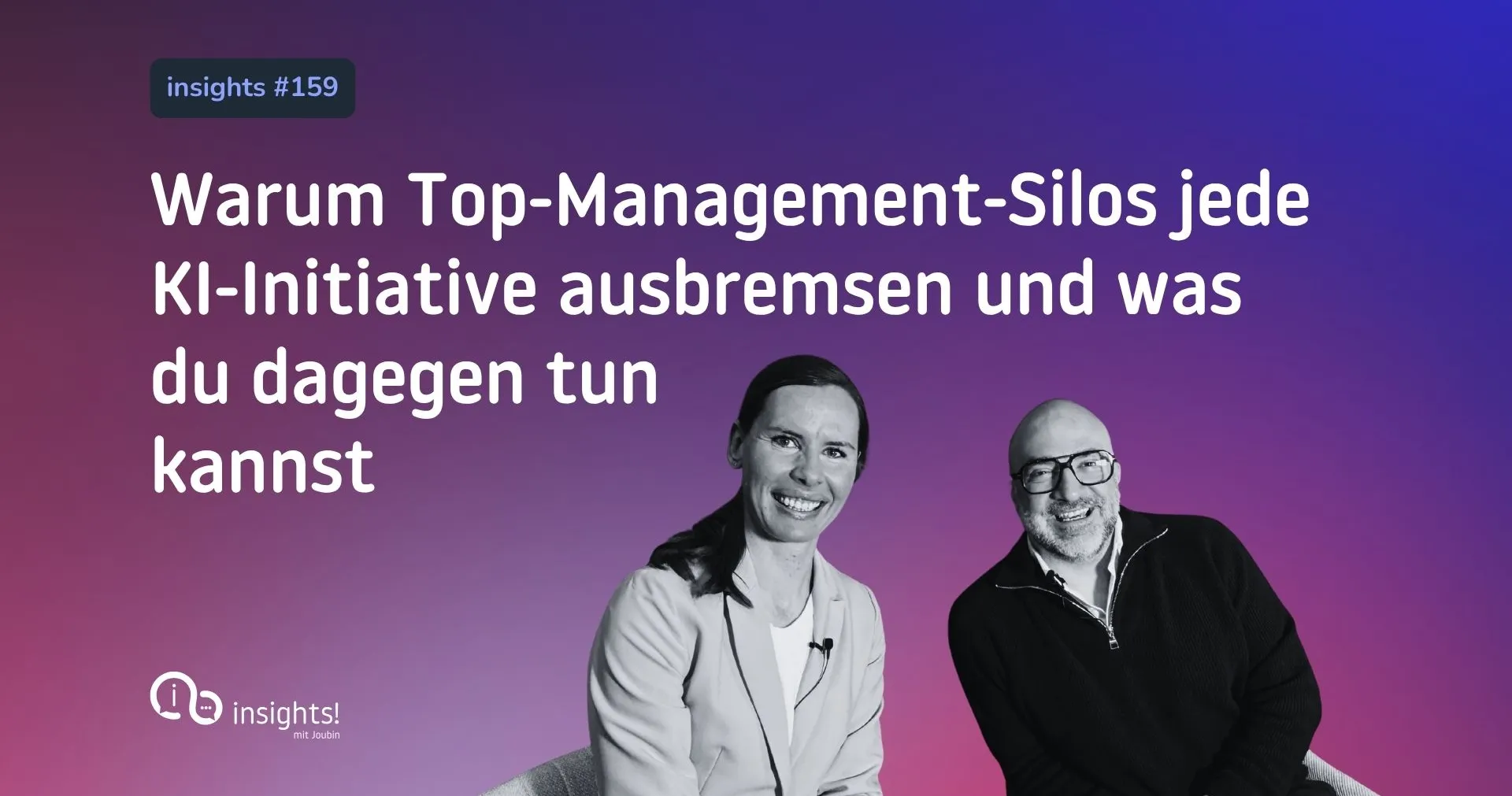
Three transformations, one pressure cooker: why top management is currently the biggest brake
If you sit on the executive board and are currently rolling out an AI strategy, running a cost program and working on a new business model all at the same time, you know this picture: three initiatives, three separate steering committees, three roadmaps. On paper that looks like modern leadership. In operational reality it is one of the most common reasons why transformation tips over.
Maj-Britt Pohlmann has been observing this simultaneity for years. Her diagnosis is sober and uncomfortable at the same time. Anyone in top management who does not actively connect these streams into a shared framework is effectively handing prioritization down to middle management. Precisely where maximum operational responsibility already sits, the strategic decision about which stream gets served first is now made as well. The system becomes rigid. Momentum is lost. The good people start looking around for other roles.
“We have three transformations at once, or three streams of change. And especially in middle management, and of course at employee level too, there is a total clash, because they simply do not know what to do first. From my point of view, the most successful companies are the ones that manage to develop this shared perspective at the very top level, and that is exactly where the great potential lies that is going untapped at most companies today.”
Trust is not a bonus, it is the operating system
Maj-Britt mentions trust several times during the conversation, almost like a common thread. And that is no coincidence. Transformation inevitably creates uncertainty. In that uncertainty, employees reach for something to hold on to, and they look for it where stability in a company is supposed to come from: their leaders.
Once that trust tips over, you will hardly get it back, at least not at the speed a transformation would need. That is also why speed as an isolated value does not work. Anyone who moves too fast without bringing employees along burns trust faster than any tool rollout can rebuild it. Trust is therefore not a soft skill but the operating system layer on which every change runs.
What you as a decision-maker should take away from this can be summed up briefly:
Presence beats frequency: better to communicate rarely and properly than constantly and unclearly.
Listening is part of leadership, not a nice addition.
Always derive pace from the system's absorption capacity, not from the roadmap.
Learning leadership or living leadership: the most honest question in your career
One of the sharpest statements in the conversation revolves around the question of whether leadership can be learned. Maj-Britt's answer is nuanced. You can learn and expand leadership skills at any time, almost like a keyboard. What you cannot invent is the personality underneath that keyboard.
That has immediate consequences for every people development program. A leader who plays a role that does not suit them will not keep it up for long. Employees sense incongruence immediately and decide on that basis whether to follow or to switch off inwardly. In a labor market where talent increasingly picks its employer, authenticity has long since become a competitive issue.
The real lever: the first and second leadership levels
Many companies invest the bulk of their coaching budgets in top management. Maj-Britt deliberately starts one level below. Her argument is compelling. The executive board and management set the strategic direction, but the level below is the implementation level. That, in her words, is where it crunches. That is where it is decided what actually gets delivered, and at what quality.
So if you are looking for a lever that decides between success and standstill, it is not the executive board's offsite. It is the question of how your first and second leadership levels cope with the current load and what space you give them to think anew. Maj-Britt works here with an approach that deliberately leads out of the meeting room. She combines coaching with movement, with walks, with surfing, sometimes with music. The reason: to activate the intuitive level that otherwise barely gets any room in packed days.
AI as a gap question: front runners, hesitators and the bridge in between
On the topic of AI, Maj-Britt gets very concrete. In almost every company, two camps are currently emerging. On one side the fast movers, who already use tools as a matter of course, rebuild their workflows and arrange prompts like tools in a toolbox. On the other side the cautious ones, who wait and see, often out of concern about doing something wrong, and often without clear guidance from above.
The central task of leadership is to actively close the gap between the two camps instead of only accelerating the front runners further. If AI is really to create impact, it has to scale. Scaling only works across the board. And breadth only works if the cautious ones also feel safe and taken seriously.
In practice that means:
Organize knowledge building across the whole organization, not just in innovation hubs.
Create safe spaces for experiments, without mistakes immediately jeopardizing career steps.
Dock AI use cases onto existing processes and system landscapes, not alongside them
Hidden champions, you are out of time for the next excuse
The German Mittelstand is rightly regarded as the backbone of the economy. In her assessment, Maj-Britt takes that not as reassurance but as an obligation. Asked whether the current change driven by the market, geopolitics and AI can simply be sat out, her answer is a clear no.
The strength of many family businesses lies in their long-term view and their ability to invest for the long run. Anyone who does not actively use that advantage now will throw it away. Maj-Britt's image is a catchy one. The train is pulling out right now, and it is not about getting into the first carriage, but about getting on board at all before you are left standing on the platform. Anyone who brings in a few capable people here and has the courage to take the first steps has a realistic chance of still playing in the same league in five years' time as they do today.
What you should take away from this conversation today
If you hold responsibility, three things above all should guide your actions after this conversation. First: make the parallel transformations in your company visible and decide at top level in which order and with which interfaces they run. Second: treat trust like a central KPI, not like a by-product. Third: invest deliberately in the first and second leadership levels, because that is where it is decided whether your AI strategy reaches the whole organization or fizzles out as a showcase.
And perhaps the most important sentence from the conversation, freely following Maj-Britt: courage is no longer an optional quality. Anyone who does not summon it now is actively planning for their own company to lose relevance over the coming years. The good news: the tools, the experience and the coaches have long been there. It is now down to you alone.
Would you like to listen to the full episode?
Here you will find the podcast of the interview:
Please accept the corresponding cookies to view this embedded content.
Would you rather watch the episode?
No problem!
Here you will find a recording of the interview:
Please accept functional cookies to watch this video.
Would you rather read?
Joubin Rahimi
Fantastic that you are joining us again for a new episode of insights!. My name is Joubin, Joubin Rahimi, today from the VTEX booth at OMR with Maj-Britt Pohlmann. Hi Maj-Britt!
Maj-Britt Pohlmann
Hello Joubin, I am really delighted to be here.
Joubin Rahimi
Yes, very happy to have you. You have built up and above all rebuilt and created an enormous amount in the past, and we want to go a bit deeper into that today. But perhaps you would like to say a sentence or two about yourself and your skills, and then we will dive straight in.
Maj-Britt Pohlmann
Yes, very happy to. I guide large transformations in companies, so transformations toward digitalization, excellence, and also major restructurings of companies, as you already said, and I do that on the company side and in particular coach leaders at the first and second level who feel exactly this transformation.
Joubin Rahimi
Why do leaders at the first and second level, probably at the further levels too, but why do they need coaching in digital transformation, or in transformation?
Maj-Britt Pohlmann
Yes, what does transformation mean? Transformation means that an incredible amount changes. That is to say, I am not just doing something new in small steps, but really doing everything radically anew. And that of course does something to the company and to the company system. And you can picture it a bit like a company mobile, where I really start changing something somewhere, a new product, new employees, new teams.
Joubin Rahimi
And then it tips out of balance or-
Maj-Britt Pohlmann
Everything is in motion. And that motion does something to the company and it also unsettles the leaders. And when uncertainty then arises among employees, for example, they want something to hold on to. And where do they get that hold? From their leaders. And that is why it is so important that leaders are very stable, have a very clear stance, are present too and of course are there for their employees, while at the same time taking a courageous path forward and guiding them along it.
Joubin Rahimi
We dived straight in, but I thought, come on, let us take a few steps back. Which transformations are typical right now, from what you see?
Maj-Britt Pohlmann
Yes, so we have major digitalization transformations of course, and then also efficiency improvement, major consolidation. And that of course runs in parallel. That means companies want to do something new, introduce new technologies, and at the same time cut costs a lot. So really something is permanently being changed in the current business model and at the same time something new is supposed to emerge. And that creates a great deal of pressure to change everywhere.
Joubin Rahimi
Is it even possible, when you say I am cutting costs now because I have to, but then I also have to build something new for the day after tomorrow? Let me put it this way, that is a mindfuck, is it not? So to say, okay, here I must not do anything, but there I have to be a different person or a different organization. Is that how it is? Can you bring it down to earth?
Maj-Britt Pohlmann
How much do I change in the current system and how much new do I already create? And do I then create a new role with new teams that do the new things? Or are there people who are supposed to do both? And that of course requires the right profiles. And that is of course also a huge leap for the leaders, especially if I have maybe been in a role for 20 years and have always done it that way. All of a sudden I am supposed to do it differently. And that takes an incredible amount of agility, from leaders too, in saying: okay, how do I do this now? We are all human, it does something to us when we are suddenly supposed to do something completely new. And the question is always, how do I create a level of trust with the employees? And how do I also manage that for myself as a leader when I am unsure? I have been a leader for 13 years too, and I have had moments when I was uncertain, of course. And then it is very decisive how I come across, how I approach employees, whether they believe me, whether they trust me, whether they come along.
Joubin Rahimi
Yes, I have so many levels of questions. So, I will lean back for now. We can talk a bit longer today, that is nice. The - first of all, you said something we often notice too: you have cost pressure at a great many companies, and then artificial intelligence comes on top of it, which changes something again, and then the market changes as well. So 3 things. Is that also what you observe in your environment? Can you serve all 3 things at once or do you have to slice it up?
Maj-Britt Pohlmann
From my point of view it should be that way. And precisely not, that is what I often see right now, that we then have 3 transformations at once, or 3 streams of change. That means I have an AI initiative, I have a cost efficiency initiative and maybe I also have a new business model initiative, and then everything runs in parallel. And especially in middle management, and of course at employee level too, there is a total clash, because they simply do not know what to do first. I am also very active in the operations area. There the question is, what am I supposed to serve first? And the art, from my point of view, lies in managing to place a shared framework over it at the strategic level, at top management level. And that is also how I work a lot, so that you have an overall construct with several streams of change, where you can also keep adjusting.
Joubin Rahimi
Then what you have described is really a lack of top management, because they then leave the decision, the dice roll, to the employees, whether they are leaders or not, right?
Maj-Britt Pohlmann
From my point of view there is enormous potential there. Yes, so that is exactly the-
Joubin Rahimi
Nicely put-
Maj-Britt Pohlmann
That is the great potential, because if, exactly, we are back at that very classic silo thinking, which of course applies here too. So I may have a CTO for the technology initiative, I may have a CSO, CMO for the new markets, I have a COO for cost reduction, and then everything somehow cascades down and somewhere down there it all comes together. And from my point of view the most successful companies are the ones that manage to develop this shared perspective at the very top level. And that is exactly what these shared streams are. And for me it is always absolutely essential to think about 3 things together: process, meaning the end-to-end process in the company, technology, which technologies do I use for it, and people, organization, so how do I connect it all. And there is also, if we look at the training of leaders, of top managers, they often still come from one stream. I come from finance, I come from operations, I come from sales. And that is why, from my point of view, there are relatively few who can really look at the whole thing as generalists. And for me there is huge potential in exactly that, connecting it and above all leading in a way where, if I do not have the know-how, I bring those people to the table.
Joubin Rahimi
Are the, another question comes to mind before the other question, are the leadership structures or people's leadership styles different depending on which stream they come from? So if someone came from finance, does she tend to lead differently from a techie? Or from someone in logistics?
Maj-Britt Pohlmann
There may be certain tendencies, but fundamentally the way I lead is very personal. It is more a matter of: how was I led? What role models did I have? How was I trained? Of course I also have certain personality tendencies. So am I rather quiet? Am I rather loud and do I go out into the world with lots of charisma and energy? And here too it is important to me that you do not change exactly that energy you have as a leader. So do not change it artificially. There are these leadership trainings where they say, yes, here are the 3 models, pick one and then try it out with your people. From my point of view that does not work so well. Yes, so that is exactly why I do executive coaching, where I ask, what feels right for you? So what feels correct for you? And I have also spent a lot of time in male-dominated industries, and I asked myself, as a woman in particular, yes, how do I lead authentically here? So am I actually sensing myself? And that is why it is absolutely essential to me: what feels congruent, authentic and right for me.
Joubin Rahimi
Then, this morning I had, I just mentioned it in the pre-talk, I saw a LinkedIn post: leaders have to play a role, because you can learn a role, but you cannot change your personality. I thought about that and thought to myself, I am not going to share this now, but I am not a leadership coach either. So what does the professional at the table say?
Maj-Britt Pohlmann
From my point of view you can learn leadership skills. That means you can expand your keyboard. How can I lead? So maybe I grew up in such a way that, for example, I always clearly specify what I do. But I find it hard, for example, to bring in experts at the right moment, then I can learn that, expand it. I will still always have a certain way of doing things first. So I can learn leadership skills. What is needed from my point of view is something underneath that feels congruent with me, with how I lead. So it may be that on this keyboard I never play the high C right at the top, because that does not suit me. Yes, I can practice that 15 times, but the employees will always notice, somehow I do not trust them. So as human beings we all have a very deep sense that tells us exactly that: do I trust this person or not. And that is this question of whether it is still somehow congruent with the human being and the person. But what I do consider important, and here the role does indeed play a role, is that I am clear that when I am a leader, I am in a role for a company. I am not sitting there as a private individual. That means I have to be very clear about what effect I have, what I create. And that means being clear that I am in the role, what responsibility I carry, both for the company and for the employees. And then, on your leadership keyboard, choose what fits.
Joubin Rahimi
You have thrown in trust a few times now. Why did you keep mentioning trust.
Maj-Britt Pohlmann
Because in transformations in particular, incredible uncertainty arises, and uncertainty in the system leads to the system becoming rigid. So this mobile becomes totally rigid and then everyone tries to orient themselves and looks somewhere and says: what do I hold on to now? I have no idea what my job will look like tomorrow. I do not know what my team will look like tomorrow. And that is exactly this: I then need someone I trust in order to take the next step. And that is why it is important as a leader to provide this trust through presence. Communication is incredibly important, of course, but not only sending, also hearing what arrives at the other end, and if in doubt asking again briefly and waiting and then looking again, okay, am I at the right point now? And another important point for me is speed. So when can I move ahead faster and when do I also have to wait? Because if I am too fast, I can also immediately lose again the trust I built up over a long time before.
Joubin Rahimi
Very exhausting for everyone else then. Trust touched on. You said the first and second level, that is what you focus on. Why?
Maj-Britt Pohlmann
Because that is where the biggest lever is.
Joubin Rahimi
Why is the biggest lever there and not in top management, where you said that if they get these 3 things stacked on top of each other in the current climate, then there is a big lever there too.
Maj-Britt Pohlmann
For me that is firstly one level, so I coach top management and the level below that.
Joubin Rahimi
I was shaped by IBM. Ah I see, first-line manager is the manager who leads the first level. Upline or second line, good that we have cleared that up.
Maj-Britt Pohlmann
That is the decisive lever for the transformation. Right at the top, the executive board, the management, sets a great deal of direction, and the level below that is the implementation level, that is where it crunches. And that is why they are the decisive ones.
Joubin Rahimi
Okay, great. What do you do with them? Those are often, as you said, male-dominated, I assume. You are also in the 10 More In Circle, and my wife once said there are more men called Christian there than there are women. Imagine that, which is of course completely terrible. But what do you do with them? You have to get them out of their comfort zone.
Maj-Britt Pohlmann
Yes, first of all I do exactly the opposite. First I create a safe space. First I have a safe space to look at what topics are currently occupying them. And that can be various things. It can be, for example: oh god, my head is so full, I do not even know what to do first. Or: honestly, I am currently totally unsure myself. I have started 3 things there, I do not even know where I stand. The first thing is to bring in a bit of calm, and then I work out together with the coachees, okay, what are the topics I want to work on today, so what is weighing on me most right now. And that is a very important process to begin with, calmly looking at what the topics are and what is most important right now, so what is the next small step that matters now. Because often, as a leader at the upper level in particular, we are so full, we go from meeting to meeting to meeting, then we make decision after decision after decision and I have no moment at all to just sit down like this and say, yes okay, now let me take a look at what is coming, and then we work on exactly the topic that is most important right now, because that is what also, as a leader-
Joubin Rahimi
Or the most urgent, right? Not the most important at all, but the most urgent.
Maj-Britt Pohlmann
Important and urgent, of course.
Joubin Rahimi
That would be ideal, but yes.
Maj-Britt Pohlmann
Exactly.
Joubin Rahimi
Although, I do not even know whether that is ideal. If you manage to have few urgent topics, because you have already sorted out many things for the future, then you can work only on the important ones. Now it is getting philosophical, is it not?
Maj-Britt Pohlmann
Now it is getting philosophical. The question is also, what is urgent? What is urgent for me as a leader, in my role, in the step I am currently taking? Is what the others around me are saying is urgent actually urgent? That is sometimes a coaching topic in itself. What is actually urgent right now? Yes, and exactly, and then I work on that defined topic together with the coachees, so that we look at, okay, what does it need, what success factors do I have, what is around me. So we then always do what is called a systemic analysis, meaning we look at the overall system, which resources can I use as a leader. And then my speciality is that I connect that accordingly, so coaching and movement for example. That means we first go in on the content and then we put away all the notes, then we go for a walk, then we go running, we sometimes go surfing, so something intense, in order to clear the head and really move from the cognitive level to the intuitive level.
Joubin Rahimi
That is really smart. I was just on an outing, you have to say, and there we were at Cologne University, at the university hospital, and understood how the brain works and how it learns. And afterwards we did a brain walk, that was really nice too. And now I can, I could not before, recite the American presidents since the Second World War in order. And that has to do with movement, that we combined what we did, learned, wanted to learn, with a movement. That probably triggers other things too, or do you do that in a team, where you say, okay, the entire first level is there and then as a team, or rather individual support per company, or can you not say?
Maj-Britt Pohlmann
Yes, so you can do it as a team. I actually do a lot of one-on-one coaching, where I can also respond individually to the personality. Because there are people for whom it is easier, for example, to really walk calmly in nature. Then there are people who say, I have to burn off some energy first. Yes, so that works too. That means really looking very individually there, just as with the way I lead, individually seeing what works for me. So on the one hand, what brings me calm. For example, I also have coachees, and I am the same myself, when I am being coached, I function really well with music. So I use music to get into different moods, to clear my head and so on. That means I always look and help a bit to open up the view, yes. I offer options, open up the view, what works for you. And so I could, for example, with you too, if you now say, hey, these are the kinds of movement, we could also look at whether we want to combine that with music, maybe with scent as well. And exactly this activity that I then generate in the brain creates space for my topics. And at the same time I can also activate our entire intuitive knowledge system with it.
Joubin Rahimi
There are so many things coming together now. How did you actually come to take this path?
Maj-Britt Pohlmann
Very good question.
Joubin Rahimi
I hope so.
Maj-Britt Pohlmann
I noticed, well, I come very much from the process and technology corner. That means I am good at analyzing processes, I can work well cognitively, and at some point I noticed that there it stops. So it stops with the analytical approach to how I do something. I can explain that 100 times.
Joubin Rahimi
What do you mean by stop? With the other person or with you or in the system?
Maj-Britt Pohlmann
In terms of effect. And that is why over the past few years I have engaged a great deal with process, technology, people, with the human factor.
Joubin Rahimi
So you actually approached it analytically again, where there is also a stop, right?
Maj-Britt Pohlmann
Yes, to some extent, yes. And then I took this systemic perspective and yes, in the end it comes down to the people. In all the changes I have done, the success factors were always the people behind them. And when they came along, it worked. And I first did that myself as a leader, and then I found the topic so exciting that I wanted to say, okay, now I want to go even deeper, and now I want to really learn it as a coach and teach it to others, because from my point of view there is such a huge lever there if we lead companies properly with this holistic perspective. Then we not only create really great companies with great financial results and products, but also employees who are genuinely happy to work there. And that is my ideal picture.
Joubin Rahimi
I also started the leadership development program at IBM, I have to say. I never finished it. And there was something really nice by Goleman, I think it was, Emotional Leadership, or I think the book was called Emotional Leadership, plus studies that IBM gave us as future leaders, saying: 35% better results when a team is in a good mood. In a nutshell. But I have the feeling that this is really lived in very few companies. A shame. Absolutely. So, but why? Why is that? Are we not capable of leading well, or is the pressure too high, so that many simply collapse and then do not do it, but instead just crack the whip and fall back into old patterns?
Maj-Britt Pohlmann
I fundamentally believe that we as human beings, if we strip everything else away, enjoy work, we like creating something, we like being with other people to do something, and we also want to achieve something together. And I think we then have to question exactly our structures: which structures, which incentive systems do we work with, and in what way? And then it is exactly these mechanisms you just mentioned. Yes, so how much pressure is in the system, how much is in the system at the same time? Because that does something to our emotions, to us. And the more pressure I apply, and if I do not notice that the pressure cooker is already pretty full, if I then push even harder, at some point the team falls apart. And it is exactly this sensitivity that leaders need more of, from my point of view. This: how much can my system take right now? And even more understanding for the people I have in my teams. So not: yes, I have now brought in a financial accountant and I have now brought in a marketing specialist and I have now brought in an AI expert, but rather what else do they bring? So are they able to inspire? Can they teach people things well? Can they take people along because they can tell stories? And that is what will be needed in future, because everything will change. That means we need people who also use their strengths on themselves.
Joubin Rahimi
Yes.
Maj-Britt Pohlmann
And I also use the Clifton StrengthsFinder, for example. I do not know whether that means anything to you. I am totally convinced that the more we engage with which strengths we have and what drives us, if we can use that in companies, we are 3 steps ahead of everyone else who never asks about it.
Joubin Rahimi
I have 2 detours. One more toward AI and what that changes. And then also a nice experience I would like to share. We were in Hamburg. I was out and about with the kids there, and I think Mel was at an event in Hamburg. So there were three of us out and about and it was already late afternoon, early evening. And then we went to Douglas, because my daughter really wanted to buy a face mask. So, we went in there. She was given advice and I found it totally sweet somehow. And our son, who likes fragrances, then tried out fragrances, but was snapped at by the sales assistant to leave them alone. Douglas is dead to him. The store, totally funny, is so utterly dead. He goes to Rossmann. So what did that do for Douglas? Rossmann is no comparison. There they are nice, and at dm too, but Douglas is not nice. That will stick. And on the same day, actually shortly afterwards, we went to Apple and there you could really feel what a difference the employees make. It was, I think, 7 pm and I thought the stores were open until 8 pm, but somehow it was only until 7. And then we wanted to look at a computer for Marie, for starting school, for a school. And the question was whether portable or fixed. So we went in, just before, five to or so, and then we were greeted the way Apple usually does. Yes, how can I help you? I asked the question right away, and he said, you are welcome to look at the back there, but I would really love to tell you much more, because is it for you? Yes, pointing at my daughter. Yes, this is an important decision for you. Yes, because he wanted to take proper time for you. And that was - oh yes, I only have 5 minutes, then the store closes. I think in 5 minutes it will be stressful. Or what do you think? No, that is stressful. Yes, then we will come back on Monday. And that was - well, it still warms my heart, because you can really see how the kids then love Apple. That is why, there I get advice, they listen to me, right, they knew what was needed. And I do not think they select their employees for being good at explaining Apple products, but rather, I would guess, for their hospitality, without knowing it for sure.
Maj-Britt Pohlmann
That is very much a basic attitude too, exactly, how do I lead my sales staff, with what basic attitude do I approach people. Great examples. Because it shows so well how important emotions are for people and how quickly I link things.
Joubin Rahimi
They remembered that and they will remember it forever.
Maj-Britt Pohlmann
And with this example in particular, once I have linked something negatively like that, it takes an incredibly long time and an incredible number of attempts to overwrite it again, because it is so deeply anchored in our brain too. And that is why it is a really great example to show that once I have lost the employees with some change or in the AI rollout, to bring it back round to that, then I have lost them for the time being, because I have lost exactly this trust. And that is this: people are not only cognitive, yes, among other things we are also very emotional. And how I feel perceived there, how I feel seen, has an enormous effect on me.
Joubin Rahimi
Yes, brilliant. And when I now think about AI, where a lot is changing too, so in customer communication, what really is the difference between human and no longer human, how does leadership relate to that, are you already seeing it in your work, that you say, okay, teams have to be reduced because AI does that, how do I deal with that now?
Maj-Britt Pohlmann
Yes, here too we are back in this simultaneity, so we now have AI agents that replace certain roles, at the same time new ones are being created and at the same time we have a lot of senior knowledge that is being lost and somehow has to go into the AI. And there we have this classic picture: I have some front runners who say, oh great, yes, I will go ahead. Especially in the younger generation of course, although I also have great examples of really very experienced colleagues who say, yes indeed, I am going into this now. But of course I have a few front runners and I think what we have to watch out for is that the gap does not become too big between those who are now racing ahead and doing things quickly, and those who are a bit anxious and not really on board. And for me it is the task of leaders in companies to close exactly this gap and build the bridge. So the bridge between those who are moving fast now and those who are somehow still waiting. And that is on the one hand of course knowledge building that simply has to happen across the board, and it is repeatedly involving people and not just letting the individual initiatives run ahead, but also making sure that you take the broader mass along more and more. Because in the end, if AI really is to bring the impact for companies, I also have to manage not just to run individual cases but really to scale across the board. That means I have to set the mass in motion, so to speak, and simply bring many people along. And for that you first need a safe framework so that I can try it out, so that I can learn it, and then really integration into everything that is happening. And there too not so fast, we will just do a workshop now, now we do cases, and then we implement it super quickly, but there too taking another look, appreciating what else is happening in terms of processes. So again looking at the overall system. What other processes are running there, with which technologies? And of course how do I integrate that too, that is more the technical part, into the overall company system, into my software system landscape, so that I can really always scale up.
Joubin Rahimi
Now in Germany we have the hidden champions, a large Mittelstand sector. Often run across family generations, they have seen crises come and go. The good ones have always survived them too. How fundamental is the change now really, through the market, through the geopolitical situation and AI? Is it something that can also be sat out?
Maj-Britt Pohlmann
No.
Joubin Rahimi
Or - okay, no need to ask any further. And how do you make it clear to many of these people that it cannot be sat out? Or can you not do that at all? Do they have to experience it?
Maj-Britt Pohlmann
Every person has to have that for themselves.
Joubin Rahimi
You can lead the horse to water, but it has to drink by itself, right?
Maj-Britt Pohlmann
Yes, I think that already - we have a great many wonderful family businesses in Germany and their strength really is the long-term view. And all the companies in that area that I know, the ones that keep putting out feelers into everything happening around them, do then manage to integrate it properly. And that really is the strength compared to the large corporations, that you can think longer term, invest longer term. And all I can ever say is: A) open your eyes, so precisely not eyes shut, and B) have the courage now to take the steps. Because if you do not have the courage now, then the train has left. Yes, so take the train, buy the ticket and then there is another carriage attached, and hire a few capable people and off you go.
Joubin Rahimi
I think that is a really lovely closing word. Yes, courage is part of it, right? Because it is a journey to somewhere where you do not yet know where the end is.
Maj-Britt Pohlmann
Absolutely, yes.
Joubin Rahimi
On that note, thanks for listening, and if you have questions, also about how you coach and how you combine coaching with movement, write them below in the comments. Write to Maj-Britt directly. I was allowed to experience a bit of it yesterday, and I find it absolutely great. And maybe that will be the next point of contact and not just the LinkedIn comment. On that note, thank you, Maj-Britt, for being here.
Maj-Britt Pohlmann
Thank you for the wonderful conversation
Joubin Rahimi
My pleasure, you owned the stage.
Maj-Britt Pohlmann
I look forward to your feedback and comments.
Do you have questions or feedback?
Then feel free to contact us directly.
- Joubin Rahimi
Managing Partnersynaigy
Show phone numberShow mobile numberShow email address
Subscribe to the blog now and never miss any news
✔️free ✔️news every week ✔️expert knowledge
Please accept the corresponding cookies to view this embedded content.