



insights! #98: Machine learning: who's actually controlling whom here - customer or algorithm?
Machine learning is changing e-commerce for good. But while the technology creates new possibilities, it also raises questions: Will online shops become interchangeable as a result? Will the personal touch be lost? And what about data protection and fair pricing? I addressed these questions in an interview with freelance journalist Sonja Fuhrmann and answered them for you.
 Joubin RahimiManaging Partner · synaigy
3 min read
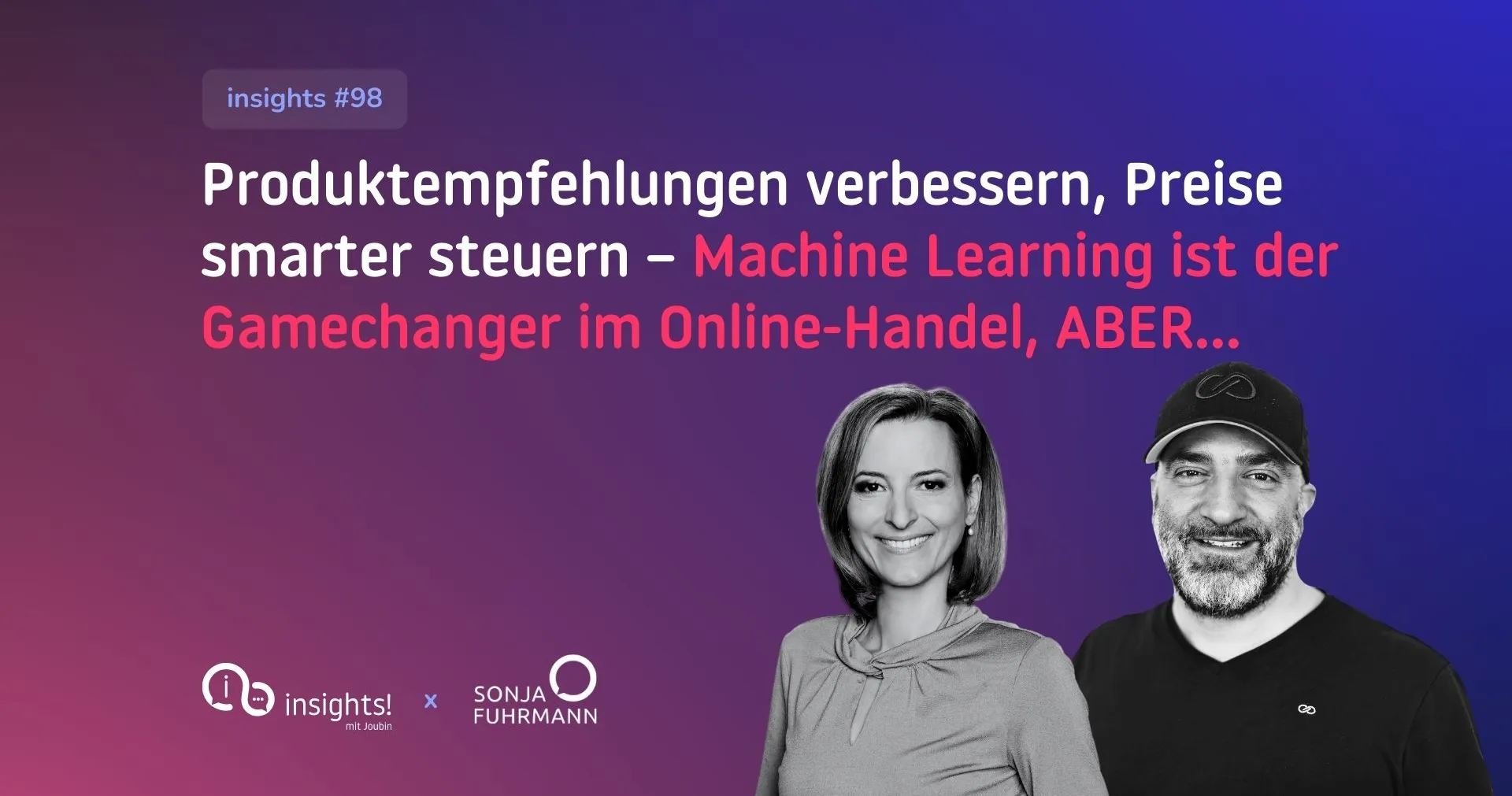
Machine learning can take customer experience to a new level – but it requires a balance between progress and fairness.
Individuality despite standardised technology
Machine learning is based on neural networks that process data and deliver individual results. Many shops use similar technologies, but the data they process differs. Factors such as search behaviour, time of visit or speed of interaction influence the result. As a result, the customer experience stays individual, even though the underlying technology is standardised. However, the use of these tools does mean that shop quality improves overall – which, viewed from a distance, can create a certain similarity.
The personal touch in the digital space
The personal touch in customer service is often invoked as an ideal. Tools like brytes try to close this gap by analysing users' "digital body language". For example, such a tool can detect whether a customer is having trouble finding a product, or is specifically searching for a particular item. These insights enable more targeted support and create a sense of personalisation — even though it isn't genuine human interaction.
Data protection and dynamic pricing: the downsides
The use of machine learning in e-commerce also raises ethical questions. Every click is analysed, creating a kind of surveillance culture. Users can regulate this via cookie settings, but the convenience these technologies offer often means consent is given anyway. Another controversial topic is dynamic pricing. Two customers can pay different prices for the same product, depending on factors such as location, device or purchasing behaviour. While retailers see this as a way to maximise revenue, it can create a sense of unfairness among customers – especially when they later find out that others paid less.
Revenue optimisation versus customer loyalty
Machine learning enables retailers to optimise revenue efficiently. But does this risk pushing customer loyalty into the background? Joubin Rahimi emphasises that acceptance of dynamic pricing strongly depends on customers' subjective perception. If they feel they're paying a fair price for a good product, satisfaction is high. But if they feel taken advantage of, this can undermine trust in the retailer in the long term.
A practical example is Tesla: through aggressive price cuts, the company reduced the residual value of its vehicles, which caused discontent among large fleet operators like Sixt. This shows that pricing policy can affect not only the individual customer experience but also business relationships. Aside from the discussion around prices and data protection, machine learning also offers opportunities to improve the customer experience. Personalised recommendations, intuitive search functions and predictive offers are just a few examples of how the technology can make the shopping process more pleasant and efficient.
Conclusion: a balance between progress and fairness
Machine learning in e-commerce is a powerful tool that brings both opportunities and challenges. The technology can take the customer experience to a new level, but it also requires responsible use. Retailers must find a balance between revenue optimisation and customer loyalty, between personalisation and data protection. Only then can the potential of machine learning be fully exploited without jeopardising customer trust.
Would you like to listen to the full episode?
Find the podcast of the interview here:
Please accept the corresponding cookies to view this embedded content.
Prefer to watch the episode? No problem!
You'll find a recording of the interview here:
Please accept functional cookies to watch this video.
Prefer to read?
Sonja Fuhrmann
Machine learning in service of the customer experience, Joubin – doesn't that ultimately make all online shops look the same?
Joubin Rahimi
Yes and no. Mega exciting question here. First: what is machine learning in this context, especially compared with customer experience? Machine learning is something like neural network. Meaning, when I input something, it processes based on information it has and spits something out. And with customer experiences it's about: "What's intention I have and how can I make it as simple or experience-rich as possible on other side? Even if neural networks all same, results will differ, cause data available in such neural network naturally differs shop to shop, and cause surrounding parameters, meaning: when do I go to shop, what am I searching, how fast am I searching, which topics do I have on that, also differ. Meaning I then have different experiences. So on one hand it's different, but all shops move toward higher level, and so, viewed from certain distance, it's quite similar again.
Sonja Fuhrmann
Okay. I personally don't know how you feel about it. I do like the personal touch in customer service. Doesn't that get lost as a result, Joubin?
Joubin Rahimi
So A: I find that much, much cooler too. Or I'm in demand mode and just get through it, but first I'd say that didn't exist yet in the digital space. There I'd like to break a lance for tools like brytes. We put information in below, because such a tool recognises digital body language. And we haven't had that so far. For example, you have a search and you type something in and get search results, and type something in again, more search results, then it'll look as if you're not finding what you're looking for. And if you recognise that, you can say: search please, filter and so on. But if you enter something like a product name, very, very detailed, or an item number, then you know you want this exact item. And then of course you can support the customer quite differently on the website. And that doesn't exist yet. And I think that then feels more personalised and more personal - though of course it isn't.
Sonja Fuhrmann
But of course there's a price for that. Doesn't machine learning lead to a surveillance culture where every click gets analysed?
Joubin Rahimi
Well first of all: the good thing about it: we're already all being monitored. We can also switch it off via cookie consent. So we already have that. But I believe more and more people will leave it on, because many things are simply so much more convenient. Regarding price, that's of course a very exciting question, because prices are also increasingly being allocated dynamically.
Sonja Fuhrmann
Really unfair. Suppose the two of us were to buy this bunch of flowers now – you might know this from home too – we'd probably both pay a different price. Isn't that completely unfair?
Joubin Rahimi
The question is, who you ask. Sure. If you ask the retailer, they say: I'm maximising sell-through or revenue or margin through this. And the answer isn't that simple within that construct. If you take, say, a Strauss, that's from a Swedish furniture manufacturer, it costs the same everywhere in Germany, unless you have the Family Card, I believe. And that's fine. But if you have prices like flights, then we all know that. And sometimes it's been done very, very unfavourably, because they say, anyone who visits with an Apple product gets a higher price than non-Apple users, people from Munich pay more than if I log in from Mecklenburg-Vorpommern with an older Windows device. That's something where profit is essentially being skimmed off. You can view that morally however you like. In B2B that's actually even quite common. On the other hand there's also quite a lot of room when I say, I'm not just looking at a single item, but I'm buying a bundle. And then it's more about people buying more, so whatever, clothing, trousers, shoes.
Joubin Rahimi
Then it's about volume.
Sonja Fuhrmann
About the volume. And then I'm also willing to simply say: okay, I'll give a better price. Then the person benefits from it, and the retailer benefits at the same time.
Joubin Rahimi
Sure, businesses are naturally after their profit. Are you not concerned that machine learning puts revenue optimisation front and centre, while customer loyalty perhaps takes a back seat?
Sonja Fuhrmann
Yes, I think revenue optimisation, we have that everywhere, and I think that's something every e-commerce lead here, or managing director of a company where the managing director works for another owner, private equity or shareholders, has to do one way or another, and already does.
Joubin Rahimi
And that's a tool where it becomes even easier. Now your question was, but does it come at the expense of the customer experience? That's important too. Yes, and I'd say, with price it's like this, if I feel it's worth it, I'm happy to pay it. If I then find out afterwards that it's somehow become cheaper, that's annoying. And there are examples right now where a lot is changing. Take Tesla, which is starting an incredible price war, especially in the car market. Some are actually parting ways with it. Sixt just said: "We're not taking any more Teslas, because that doesn't work for me." Large fleet owners, like companies, can say exactly the same thing, because they say: "I buy, and the residual value is now significantly lower. So it costs me too much." That leads directly to the B2B customer experience, but also, if you feel taken for a ride, that costs points. That's right. It's a balancing act. It's a balancing act, yes. But Machine Learning was also the question: can you use that to create experiences you didn't have before?
Joubin Rahimi
And that, regardless of price. And that's of course the exciting part.
Sonja Fuhrmann
It's exciting, and like everything in life, it has two sides. Thank you very much, Joubin, for the conversation. Thanks to you all for your attention.
Joubin Rahimi
Thanks and, as always, I look forward to comments, remarks and ideas, let's discuss in the comment field below or feel free to send a direct message.
Have questions or feedback?
Then feel free to contact us directly.
- Joubin Rahimi
Managing Partnersynaigy
Show phone numberShow mobile numberShow email address

Subscribe to the blog now and never miss any news
✔️free of charge ✔️weekly news ✔️expert knowledge
Please accept the corresponding cookies to view this embedded content.