



insights! #115: Rethinking leadership: 3 levers for better collaboration in the workplace
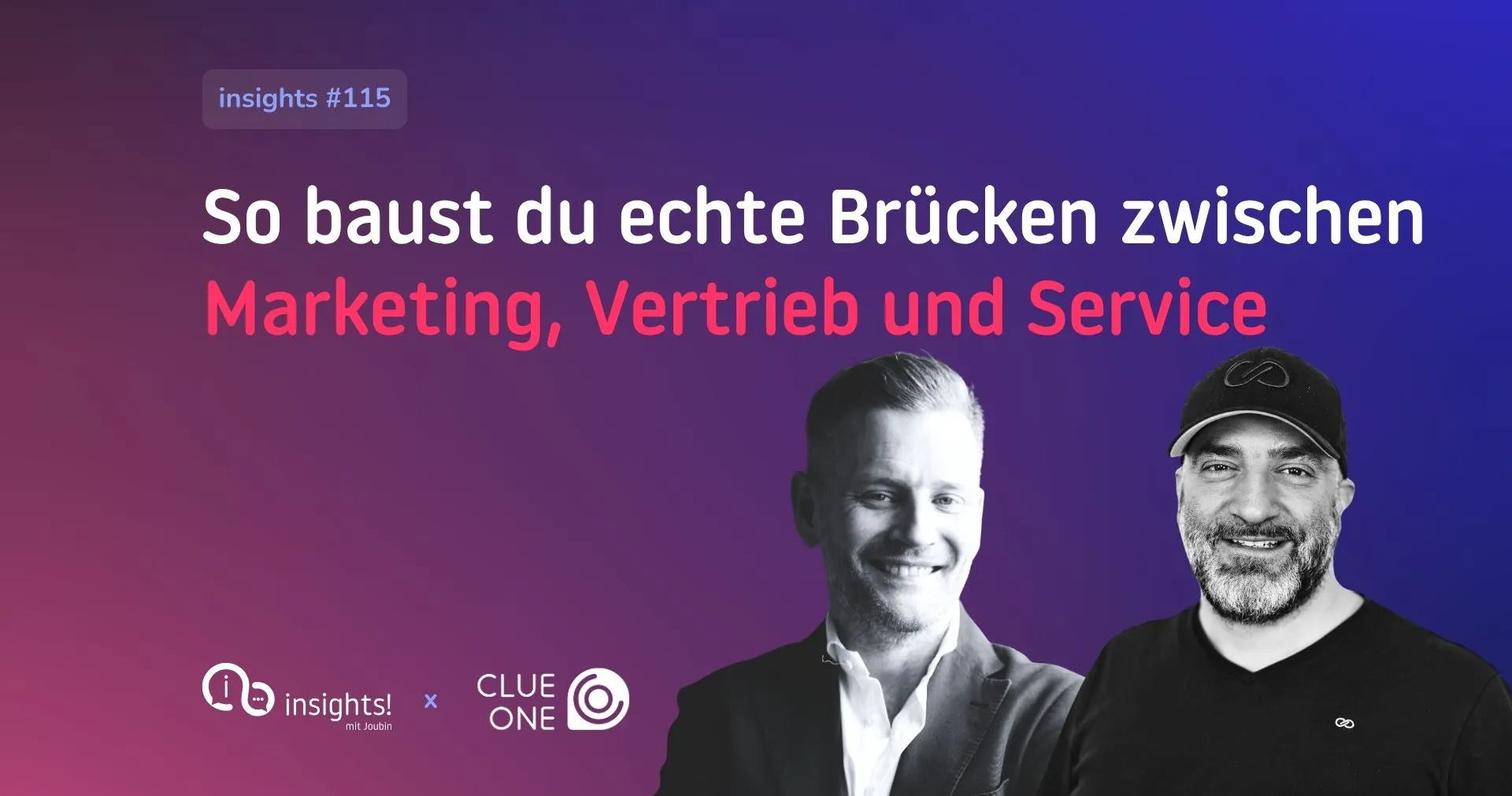
In this episode, Heiko Willers explains why marketing today is no longer a place for “campaign romanticism,” but rather a cross-disciplinary leadership role that brings together technology, structure, and people. Anyone who truly wants to foster collaboration must understand processes, allow for accountability, and speak plainly - and that’s exactly what this episode delivers. You’ll find more insights in the episode.
 Joubin RahimiManaging Partner · synaigy
5 min read
"You can have the best people, the best strategy and the most modern technology – if the person at the top puts control above trust, it's all for nothing. There are types of leaders who actively block any form of progress. And once you recognise that, you shouldn't run any more workshops. Then you have to act."
How you build bridges between marketing, sales and service
Every company has processes, departments, systems. Many also have tools, workshops and consulting projects. And yet collaboration often doesn't work. Why? Because collaboration doesn't come from software, but from attitude. Heiko Willers of Clueone knows exactly where it gets stuck – he's worked in marketing, sales and service. And he knows the friction points from his own experience.
Where organisations fail: three units, three worlds
Marketing wants to build the brand. Sales wants revenue. Service wants to keep the damage as small as possible. Sounds exaggerated? Unfortunately it often hits the core. Heiko puts it well: the three units rarely speak the same language. Everyone builds their own database, everyone pursues their own goals. Result: friction, frustration, wasted potential. The consequence: • Marketing approaches customers who are later not handed over properly to sales. • Sales sells independently of the strategic considerations from marketing. • Service has to deal with it later – with incomplete information and wrong expectations. A functioning company doesn't need a side-by-side or a with-each-other. It needs a clear for-each-other. And that means: everyone works with the same customer, the same purpose, the same success in view.
In the end, it's all B2C
Even if your company operates in B2B: the last one in the chain is a human being. Someone who decides, compares, buys – or doesn't. Heiko says: whoever really wants to understand what matters in a company has to look at the money flows. Where does the revenue come from? Who pays it? And what does this customer really need? That means: • You need clarity about the market you're operating in. • You need to be able to quantify the market size – in units and in euros. • You should be able to explain in one sentence what your company earns money with. Sounds trivial, but in practice this is shockingly rarely the case. Whoever falters here has no strategic foundation. And without a foundation, no department will ever harmonise sensibly with another.
Technology is no substitute for clarity
CRM systems, PIM, content hubs, SaaS platforms – all available. But all of this helps little if nobody internally knows how to work with it. Or if systems are introduced but not integrated. There are companies that send every customer the same newsletter, even though they've invested millions in personalisation technology. On top of that: • Many companies buy tools but don't budget properly for the rollout. • Processes stay the same – the new systems gather dust, unused. • Decisions are made based on opinions, not on data. Heiko calls this the "HPPO principle": Highest Paid Person's Opinion. If the boss's opinion counts for more than the reality in the market, no technology in the world can save that.
The CMO in the engine room
In the past, it was enough for a CMO to have a good feel for agencies and creative work. Today, things look different. Anyone wanting to run a modern marketing department needs a basic technical understanding. Because relaunches have long since become IT projects. And it's not enough to bring in external support for that. Anyone who can't professionally lead the service provider loses control over their own project. Modern CMOs need to: • Know what a headless CMS is – and when it makes sense. • Understand which systems communicate with each other in the background, and how. • Be able to ask platform providers the right questions – especially on topics such as data protection, performance or scalability.
Culture beats tool – always
So what to do if you want to improve collaboration? Heiko gives three clear recommendations for anyone with responsibility:
Review leadership and replace where necessary. Anyone who doesn't enable collaboration, or even prevents it, has no place in the company. Some leadership styles simply no longer fit reality.
Lead by example on what you demand. Anyone calling for a culture of learning from mistakes must set a good example themselves. Anyone wanting collaboration must communicate transparently and share responsibility.
Redesign roles. Away from purely "fair-weather positions", towards genuine responsibilities. Anyone holding responsibility today must understand operationally what is required technically and organisationally.
Conclusion: those who want collaboration must go to the core
Collaboration between departments rarely fails due to lack of tools. It fails due to lack of understanding, lack of clarity, and often also due to leadership that would rather delegate than inspire. Anyone who wants real progress needs: • a shared vision, • a clear view of the customer, • and leaders capable of building connections – not silos. Next time you think about new software, a new tool or a relaunch, ask yourself a different question first: do we even have the foundation on which this can work?
Would you like to listen to the full episode?
Find the podcast of the interview here:
Please accept the corresponding cookies to view this embedded content.
Prefer to watch the episode?
No problem!
You'll find a recording of the interview here:
Please accept functional cookies to watch this video.
Prefer to read?
Joubin Rahimi
Great that you're back for a new episode of Insights. Today with Heiko Willers, and Heiko Willers from Clueone also has a seriously great superpower, building bridges, and you've already experienced a lot of hardship. That's certainly exciting to hear what you say. Not everyone knows Clueone.
Heiko Willers
Not yet.
Joubin Rahimi
No, not yet. We're working together. The exciting story is, you said, you know the pain of the marketing, sales and service units.
Heiko Willers
Yes, exactly.
Joubin Rahimi
What do you mean by that?
Heiko Willers
I did that myself. I was head of sales, I was head of marketing, I did work in service and I know how annoying that can be.
Joubin Rahimi
Working together with the others?
Heiko Willers
Yes, indeed. So you sit in marketing and do things there and think up something about the brand and know, the brand is our asset. Then you talk to sales and in truth they don't really care, because they need to sell now. Then you do sales yourself and notice for the first time: Okay, a lot of things marketing does really aren't relevant for you, but should they be? And then you go into service and find: Marketing somehow approached customers that sales forgot to take over. Then sales has its own database and then you're stuck with your service database, stuck in front of it, and actually you're supposed to be a customer-centric company. And I've experienced all of that and I've somehow kept that frustration. Because I think it provides good grounding, because we're at OMR, here everything is technically possible, theoretically AI everywhere and everything works. And when you then know that reality in companies fails at completely different things, not just at technology, but at cultural things, at misaligned targets between different units, at the wrong organisational structure, wrong processes and so on, that makes you humble and you know, okay, technology is cool, but the problems mostly lie elsewhere.
Joubin Rahimi
So when we talk to each other, I always think of a story about collaboration. Let me bring in the analogy briefly. Collaboration can be against one another, but politics likes to do that. Then there's side-by-side within the corporation. So what you also said, the frustration of marketing doing something I don't need to repeat. Then working with one another, which many already celebrate, but also for one another.
Heiko Willers
Yes, exactly.
Joubin Rahimi
We do all this stuff for clients. If they could do it cheaper, faster, higher quality themselves, they would. For any service provider, whoever has to produce something, it always has to be better, cheaper, higher value than they could do themselves. Yes, correct. But you always do it for someone.
Heiko Willers
Correct.
Joubin Rahimi
Does the analogy fit? You're saying you've kept the frustration of running side by side.
Heiko Willers
Yes, well I think it has two dimensions. One is you first have to understand that when you're in a larger system, you have more than three people who somehow need to work together, then you actually have a togetherness, we need to somehow make that work well for ourselves. But the real key is recognising: and in truth we're doing it for someone out there? In truth it's out there. In the end everything is B2C. Eventually everything is B2C, and understanding that: where does the chain come from? Where does the money actually come from? How do these flows move? And what does it actually mean to really make a customer happy? And how happy are we allowed to make them, so we're still better than the competition, but not endlessly better than the competition? We don't make money on that and all that. And that's why I think those are the two perspectives you have. You meant it in terms of B2B.
Joubin Rahimi
You'd then have to say in the chain: okay, I need to think B2C into this. Always.
Heiko Willers
I think-. Let's start like this: I had a few traumatic experiences, I'd almost say, at the start of my career. I was lucky enough to be socialised in a mid-sized publishing house. There was a publisher, and the publisher asked questions that gave me a cold sweat every time, and I had no answers to them. And those questions were in truth quite simple.
Joubin Rahimi
Were you in marketing, sales, or was it service there?
Heiko Willers
At the start I was in marketing, and later I was head of it. And the simple things he asked were: Which market are you active in? And I stand there like: magazines, media brands, damn. So when I go to clients in consulting today and sit with them and say: tell me, which market are you in?, I unfortunately still experience exactly the same thing. They all sit there too, get the same look. Yes, something or other.
Joubin Rahimi
Ask something else. Ask something harder.
Heiko Willers
Yes, and then? How big is it in euros and in units? And that's where it falls apart. And I find this happens quite often …
Joubin Rahimi
I mean, I always ask the question: which market are you in? And can you answer that clearly?
Heiko Willers
And how big that is? In euros and in units. Right. Then next question comes: How do we actually make money? Back then I learned, we make money by printing colour on paper and selling that. And that was, in one sentence, simplest business model, where you really had highest cost drivers in there, main revenue driver in there. And if you break that down that crudely, then you know: Okay, that's what we're actually here for. And I think, when you talk about collaboration, everyone needs same big picture. What are we actually doing here? What are we actually doing this for? That's why, I think, especially in B2B you first need to know who your customers are. And then in B2B you also have complex trade structures and everything else behind that. But in end I always have to ask: In end everything is B2C, so what actually comes out at other end?
Joubin Rahimi
In pre-chat, when bit private, we drifted onto cars. Yes, bit. Right, I drive Kia and you asked how is it? And so on. Also drove BMW, Audi and so on. And haptic feel matter lot to me too. Kia moved from ten years ago to now, and now I throw in one we haven't discussed: Porsche. Porsche increasingly borrow from VW's shelf. Saw a YouTube video — Porsche put in new 911 the switches and certain adjusters, plain VW parts. Pay 220,000 euros for the car. Know that? Think: bit rubbish somehow.
Heiko Willers
Yes, Lachsen was right. Glorified Beatle.
Joubin Rahimi
But that's where they're heading now, cost pressure. But the question is: how can the B2B player assert themselves in this? Then I say: I produce something better if VW says: we all have the same switch. Feels the same everywhere.
Heiko Willers
Well, I don't think I could do it better than the current Porsche CEO. So, I honestly can't say whether that's a good or a bad idea, because my feeling is, Porsche customers either way, doesn't matter. They don't care. I mean, you want a GT3 and can't buy it. It just doesn't work that way. You can't just go and say: I'd like a GT3. Yes, exactly. There's a history and so on. There are cars you're only allowed to lease or finance.
Joubin Rahimi
That's crazy. He has to become an influencer.
Heiko Willers
Yes, exactly. That means they have elasticity with their customers, they're relaxed about that. But if the question is, if your customer simply no longer values certain things you produce and says: that's all commodity, then of course you have an issue. Then you naturally have to look: how do you differentiate yourself? Can you improve your services somehow? And I think that's also the point where technology comes back in, where you also notice it. And again the topic of collaboration by the way. If I notice, we also have a supplier, if you will. We also have a partner we do something together with, you for example. Exactly. So, and if we now noticed, on the other side, on the partner side, there are people who keep having a go at each other. That's ‘Hauen', what's it called?
Joubin Rahimi
Struggle.
Heiko Willers
Dog eat dog, exactly. So, then you get a strange feeling. And then we also say afterwards whether that's such a good partnership with them, if it's like it is with you. That's great, you know — when you see, okay, cool, they're all pulling together. You notice there's a good atmosphere, they work together.
Joubin Rahimi
Something's always rattling somewhere. Yes, of course. And then you have to, I always think the key skill is you have to talk to each other and find a solution for the customer.
Heiko Willers
Yes, exactly. And that naturally comes with its own challenge, because I don't know how you see it, but we often have clients who don't yet know what they need.
Joubin Rahimi
Yes, well of course.
Heiko Willers
And somehow getting a feel for saying: okay, we understand, you believe the problem lies externally in communication, in I don't know what, but actually that's just a reflection of an internal problem. And getting the client to that point somehow, honestly that's what I find most exciting about the job and most challenging, but at the same time, because of course you can come in as a consultant and say: here's the problem, and then you notice that people don't really accept that.
Heiko Willers
Perhaps not agreed on now either. I've developed quite a good feel by now for companies that don't make it. We have some that no longer exist.
Heiko Willers
The oracle, yes. Let's go through the OMR later and you just say yes or no.
Joubin Rahimi
Bang, bang, bang, yes, or with customers. There are also customers who give a sales process where we say: priority three. Can we earn money? But he won't manage it. Where savings are simply made in the wrong places, or where things are done that he says are simply inefficient, where nobody listens. So totally, totally exciting. We have dozens of points there, for example toxic e-commerce heads. Also exciting. Where they say we invest a lot and then you have toxic e-commerce heads, where you notice you can talk to them, you can make them a suggestion, but they always do everything themselves. They can always do everything better. Then you know: no, in this collaboration story, is it then side by side or against each other?
Heiko Willers
But have you actually experienced companies really shutting down, seriously, really?
Joubin Rahimi
We have Esprit, we have Reno, though with Esprit the toxic part happened on quite a different level. Reno Shoes doesn't exist any more in that form either. The brand is only being bought up now and we have loads of others. Very often it's this not working together properly. And then things get bought - they buy an expensive CRM system and then with Reno it was like: then I get sent high heels? And you want to tell me that's personalised. No, I was there with the kids and always only bought trainers there, and kids' shoes and toddler shoes. Then he says: why do I get this? We send this to everyone. You've got Salesforce, you've got everything in there. The money simply wasn't enough any more. Then they said: let's build this in properly. Then they bung in a big system, but don't have the money to implement it. Yes. You're seeing that right now, where it's no longer booming and everyone then says: okay, we don't have the budget for that, but we do have the high SaaS costs.
Heiko Willers
Can happen very quickly.
Joubin Rahimi
Where it's quick.
Heiko Willers
Well, I'm bad at forecasts when it comes to whether shops survive or not. I started out working in publishing, responsible for TV listings magazines.
Joubin Rahimi
And those still exist, of course.
Heiko Willers
So there I sat, and I was pretty sure, in five years this won't exist anymore. And yes, of course, circulation figures are all going down, advertising revenue is going down, but in truth it's still a profitable business. I once sat on the railing outside the gravure printing plant and thought: this will be closed tomorrow. It wasn't closed tomorrow, but ten years later it was closed. Which means, I think you can see reasonably well where trends are heading. And I find, you notice it when you see rising profit alongside falling revenue, and you do that over a few years, then you know, okay, something's not right there. I just notice with myself, I'm not able to say whether that'll happen in five, in ten, or in one year.
Joubin Rahimi
That's also difficult.
Heiko Willers
Because I find that too. That's really difficult. And at the same time I always notice: with all of it, I know the frustration and I know what... And we do go into companies and see what happens there, technically and procedurally etc. And I still find it fascinating how much money some companies still make, so they can still afford this mess. So there's just so much going on there – there's so much stuck in the gut and you notice, you have no idea how great it could be, but because things are still going reasonably well for you, the margins are still there and so on, it doesn't seem that important. And I think now it's kicking off, because now with AI the pressure is really coming in, and now trade policy is coming in, and if TEMU suddenly can't offload its goods in the US any more but maybe in Germany instead. I think things are really about to move now, and that's why I believe this is a huge opportunity to actually do something in this market right now.
Joubin Rahimi
You can take that very positively, because I think this inefficiency between departments that exists is honestly enormous.
Heiko Willers
Yes, and nobody wants them. Nobody wants them. Talk to people and if you ask them: Should it be like this? Everyone says no, we actually want... And actually they're all nice and so on. And usually it's not lacking in many things. You can address it on a few levels.
Joubin Rahimi
To finish up: what are the top three things that, if you were the managing director, you'd say: I'd do this, I'd introduce this, or I'd change this, or these three levers?
Heiko Willers
These are all three cultural things. When it really comes down to collaboration, it's all three, culturally. First I'd really look, you picked the topic of toxic leaders. I'd look closely at who's sitting there and how they lead and how they foster collaboration or fail to. And then I'd swap those people out, hard. I think there's a certain type where you say, you won't manage it. Forget it, please go elsewhere.
Joubin Rahimi
Fish on the table, we're also in Hamburg.
Heiko Willers
Yes, that's how it is. What's the point? That's one thing, that you really achieve clean leadership. And then above all you have to start with yourself. Meaning, if you want them to collaborate, to make mistakes, you have to lead by example. You have to demonstrate it. And the third thing is: in terms of the allocation and scope of jobs... I was head of marketing, and my job was: I had to produce advertising that my boss liked. That was the job. And I managed that with agencies and so on. I didn't need to know anything about technology. I didn't actually need to know about a lot of details. Today the scope has to be different. Today you actually have to go and, for people who were in a classic leadership position and understood their job as leading people, they need, in my view, to understand that they need to have their feet on the ground in the machine room, because the machine room has become more complex. You have far more tasks, far more complexity in there. You shouldn't be able to do it all, but you need to have your feet on the ground so you can even be a good sparring partner for your team.
Heiko Willers
And that's the third thing I would do. And that's really deep.
Joubin Rahimi
The third one is 3x3, actually.
Heiko Willers
Absolutely.
Joubin Rahimi
I'd add this too, I think very often advertising in marketing is made for the boss. Correct. Because he then says over it: "Yes, the text is fine.
Heiko Willers
KPI is HPPO, Highest Paid Person's Opinion.
Joubin Rahimi
Exactly. Totally. Exactly. We see that very often too. And the second thing you mentioned is remembering yourselves in the process. So these KPIs and the collaboration. Let that sink in.
Heiko Willers
Yes, absolutely. So my thesis is also, if you're 'CMO of the Future'. If you now think, 'I want to become CMO', what do you actually need to be able to do? In the past you could become CMO by working with your agencies, great media agencies, great creative work, a bit of CRM stuff, then you delivered great campaigns, 'I liked it, your boss thought it was great.' And then it somehow always continued... That was one core part of it. Or even at a big car maker, you did advertising for the countries, and if the countries said: 'That's a great spot, I'll take it,' then you made a career out of it. Look at what you have to do today as a CMO. Today, if we think of it as a sort of T-shape, you obviously need to know all the leadership topics, you need to be able to do it all and so on, you need to know a few things methodically, but suddenly you're responsible for technology. Who does the relaunch? Marketing does a relaunch. And a relaunch and a 'CM launch' today means: 'Damn, we've got a shop behind it, we've got 26 different systems behind it.' PIM, PAM, all that stuff gets added on. And then you sit there as CMO and you probably, very few CMOs have actually ever led IT projects, and then they bring someone in who leads IT projects, but they can't manage them.
Heiko Willers
Not technically, they can't really do anything there. That means as a CMO today you really have to go deeper into a great many topics. In the past, as a CMO you had to know: what's a final artwork? How does that work? Print runs and so on, the difference between gravure and digital printing. And today you need to know: headless CMS? Yes, no. Advantages, disadvantages.
Joubin Rahimi
You can make things more efficient with AI. Correct.
Heiko Willers
That just doesn't work at all. Right, so what does that mean? And you also have to be able to, if, I don't know, Salesforce comes along and says: "Einstein, and it all works. What does that actually mean? What does that mean for data protection? That means the topics have become so complex that if you want a leadership role there, you have no choice but to get into the subject matter yourself.
Joubin Rahimi
Great, brilliant. That as a closing word, and if you want to know more, message Heiko directly or head to Clouon. From our side we can say: always happy to work with you and collaborate with you. Likewise, happy to return that. And we all always learn hugely from one another. That's great. Yes, absolutely. Working with professionals, I'd say. Very nice. Heiko, thanks for your time. Thank you.
Have questions or feedback?
Then feel free to contact us directly.
- Joubin Rahimi
Managing Partnersynaigy
Show phone numberShow mobile numberShow email address
Subscribe to the blog now and never miss any news
✔️free of charge ✔️weekly news ✔️expert knowledge
Please accept the corresponding cookies to view this embedded content.