



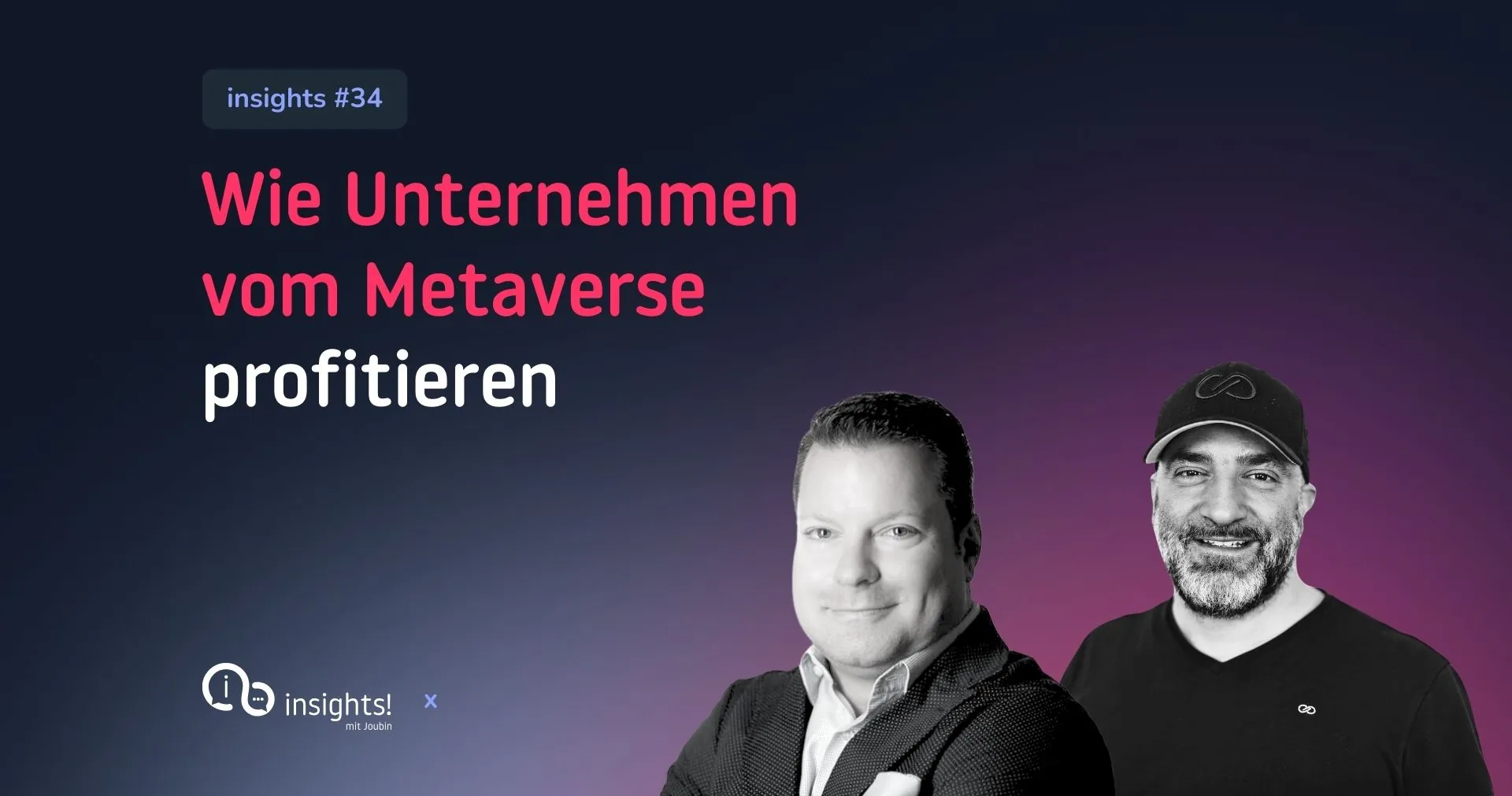
insights! #34: How companies benefit from the metaverse revolution
The metaverse promises to become the game changer for the future of virtual reality and digital interaction, and it has the potential to permanently transform commerce, the world of work and leisure. Metaverse platforms can help companies create innovative business opportunities and tap into new customer groups. In this context, they offer the next big opportunity for companies in e-commerce to stay competitive and grow your business. What the metaverse is all about, how companies can benefit from the metaverse revolution and what we can learn from the pioneers is what you will find out in the new insights! episode with Christian Gleich.
 Joubin RahimiManaging Partner · synaigy
4 min. read
The metaverse isn't even here yet, and it's not going away either
Christian Gleich has 25 years of digital experience and is firmly convinced that the metaverse is a constantly evolving concept that will be a key topic in the future. It is a combination of various virtual platforms and gaming platforms. There are 300-500 million active users on these platforms. For comparison: the biggest TikToker has 150 million followers.
In the metaverse you can, among other things, create your own avatar, dress it in virtual clothing and use virtual currency to buy digital items such as shoes. These digital items are called non-fungible tokens (NFTs). In the digital world it is possible to buy both digital avatar shoes and shoes from the real world, which enables hybrid forms of shopping.
The younger generation is used to this dual world of physical and digital and may not even feel the need to own their own car or any other physical object. People in the digital age spend more time in virtual worlds, so companies have to catch up and seize these new opportunities in order to stay competitive and make money there.
Business opportunities in the metaverse for companies
Companies should consider the possibilities of metaverse platforms in order to build innovative businesses and retain customers. 3D product data can easily be transferred into virtual worlds, allowing people to create personalized avatars and buy virtual products such as limited-edition clothing. Reviews of brands like Nike, which have adapted to platforms such as Roblox, can be found on YouTube and give an insight into the shopping experience. Walmart has built virtual worlds that are playful and colorful, but the shopping experience is said to be not particularly attractive.
Companies are now exploring the metaverse and experimenting with new forms of e-commerce and marketing, such as 3D commerce and pop-up spaces. These technologies are converging and becoming increasingly accessible, so consumers can access digital versions of products and services. They hope for the following benefits in the metaverse:
Improve customer experiences: The metaverse gives companies the opportunity to create immersive customer experiences that go beyond the boundaries of the physical world. For example, companies can host virtual events and conferences to reach and interact with their customers.
Open up new sales channels: The metaverse can offer companies new sales channels, especially for products and services that are hard to sell online. Companies can open virtual stores in the metaverse or present their products and services in virtual environments.
Increase brand awareness: By being present in the metaverse, companies can increase their brand awareness and improve their image. One example would be companies sponsoring virtual worlds or games and thus presenting their brand in a new way.
Develop new business models: The metaverse gives companies the opportunity to develop new business models, for example by selling virtual goods or services that are available exclusively in the metaverse. Companies can also make money by accepting or selling virtual currencies.
Improve product development: Companies can use the metaverse to develop and test products before they are launched in the physical world. By using virtual worlds and environments, companies can test different prototypes quickly and cost-effectively and get feedback from users.
Christian shares his insights on meta tags, how to use them and why they matter for SEO. His book, „Praxisbuch Metaverse“, will be published on April 25. You can pre-order it here: https://www.amazon.de/Praxisbuch-Metaverse-Internet-Revolution-Unternehmen-Business/dp/3967391418
Would you like to listen to the full episode?
Tune in right away and find out more:
Please accept the corresponding cookies to view this embedded content.
Would you rather watch the episode? No problem!
Here you will find a recording of the interview:
Please accept functional cookies to watch this video.
Would you rather read?
Joubin Rahimi: Great to have you all back for a new episode of insights. My name is Joubin Rahimi. Today I'm talking with Christian Gleich about the metaverse. Christian, would you like to briefly introduce yourself to our listeners and viewers?
Christian Gleich: With pleasure. Christian Gleich, many thanks for having me. I have more than 25 years of digital experience. After studying economics it was important to me to position myself as an all-rounder. I always found the whole topic of digital and the internet very exciting and said: „Okay, I simply do too much technology for marketing and too much marketing for technology.“ So that I know my way around: „How does the technology of advertising on the internet work behind the scenes?“ But also: „How does the advertising itself work? How do all these mobile developments work in general?“ I always found innovations on the internet really exciting. Over time, the metaverse came along as well. After a lot of consulting for Nike, for O2 for example, for Samsung and NASA, things became more and more concrete in the direction of the internet itself. But also in the further development towards the metaverse. I find it really exciting, it's not going away, it isn't even properly here yet, but it's not going away either. Because of that I think it will be a very exciting topic in the future, seeing how it all turns out. I'm looking forward to our conversation.
Joubin Rahimi: Let's dive straight in. You say: „The metaverse isn't even here yet, but it's not going away either.“ That's quite a statement to start with. The first question is: where can I log in?
Christian Gleich: A good question, I hear it quite often. You can't really log in centrally. Where is this metaverse and where is the domain for it? The metaverse will be made up of various virtual platforms that you can visit with VR glasses or, at some point, with AR glasses, augmented reality glasses. But also via the browser. So there are various platforms. The origins come more from the history of gaming platforms. There are already Fortnite and Roblox, which very young target groups play too. This playful basis, let's say, is what led to platforms like Decentraland or Sandbox, all of which often claim to be the metaverse, which they are not. Rather, the entirety of these platforms, including B2B platforms and city platforms that will exist and are currently being built, together will constitute the metaverse.
Joubin Rahimi: So it's basically like the internet used to be? You had CompuServe, AOL and the like. You have different entry points, it's not one website that you're inside of. I think that's a good thing to understand in this context to begin with. It was great, I had the chance to listen to and watch a presentation you gave in Munich at the LBMA. It included extracts from your book, which is still to be published. I found one or two figures exciting. This playful metaverse, so Roblox, Minecraft – how many users per month does a platform like that have? Tell us that figure you mentioned there, it's really impressive.
Christian Gleich: Sure. There is currently a statistic saying that on these platforms – and of course they are mainly occupied by gamers – there are 300 to 500 million active users per month, which is of course a very respectable number. But that hasn't only been the case since the thing has been called the metaverse; it was already very large before that. Because these are people who play Fortnite or Roblox, for example, via various technical access points, and there are a great many of them. These 300 or 500 million is an extremely impressive number, because you say: „People, that really is a lot of people who are in this metaverse.“ They aren't really in this metaverse yet. Because when you look at the usage figures of Decentraland or of Sandbox, for example, which go more in the direction of what this metaverse might one day feel like, the numbers are far lower. You have to strike a few zeros off the end.
Joubin Rahimi: But 350 million, 500 million to start with – that's six, seven, eight percent of all humanity. That's a serious number. 300 million, fun fact on the side, is twice as many as the TikToker with the most followers has. I find that a striking number too. There is one TikToker with 150 million followers. Crazy.
Christian Gleich: Absolutely fascinating. What I would also find exciting – and there is no reliable figure for it, which I think is a shame – are the synergy numbers. How many people who play on a metaverse platform – let's call it a virtual platform to take the confusion out of it – or meet people there or buy and sell digital assets, for example, how many of them are also on the big social media platforms in the same age group, like TikTok for example, or Instagram. Perhaps not so much Facebook, because I think the age groups vary a little there.
Joubin Rahimi: That's a new step as well. Internet 4.0, 3.0. I think you called it 3.0.
Christian Gleich: Yes, the whole thing is called Web 3.0. I mean, we all still know Web 1 – the older ones among us – where you could really only read and do a bit of research and couldn't contribute much. Web 2 was, at some point, that era that most of us actually know. The internet as it ultimately exists today, where you can read and also write yourself or interact and communicate with others and also create content. Then a lot of people always ask me: „When is this deadline? When Web 2 becomes Web 3, what's the date?“ Of course there is no such hard date; it's a very blurred process. Between Web 2, where we have these websites we know today, which unfortunately are still a bit boring. Of course you can look at information and read through it. But it would actually be much nicer if you could play around with the information you see there, or if you could move within the information. When I look at a product, of course I can rotate the product 360 degrees these days and decide on that basis whether I want to buy it or not. But to actually look at this product, pick it up, get a feeling for how heavy 200, 300, 500 grams is for the shoe, let's say? Does it feel light or heavy? That's another area where the different handling of the internet and of products is really exciting, especially for retailers. At the moment you look at the sneaker, for example. I'm a big fan of sneakers and I buy and sell them too when they're a bit rarer. So you look at the sneaker, or you already know what the thing looks like anyway. Then you decide whether you want it or not, whether it's too expensive or not, put it in the shopping cart or not, and then you buy it or not. There are already first analyses of how avatars in this metaverse – today in these individual platforms you are ultimately represented by your avatar – that these avatars have funnily enough picked up a habit that we have as humans when we physically walk into a retail store. To stay with the sneaker example: at some point you pick it up and look at the sole underneath. What does it cost? You can see quite clearly that avatars do that too, because it's learned behavior. Also looking inside the shoe: how big is it, where is the size marked, for example. At the same time – not so well today, that will all come – you can pick the shoe up as an avatar and determine whether it's too heavy for me, whether it's light, whether it's suitable for running and so on. Accordingly, there are the same patterns of behavior as in the real physical world. On the other hand, you get to know a whole lot of new things. Because you have three axes along which you can move this shoe, you can of course extract far more data learnings than is possible today in the very flat display-and-monitor world. I put the shoe in the cart or I don't. Of course you can learn a bit from that too. But the topic of cookies is becoming more and more difficult in the future. There will be less and less to learn from that. But with the three axes we have learnings such as: how many things were taken off the shelf, put back on the shelf by the avatar, the shoe next to it taken out, or a completely different shoe that happens to have the same color. All these learnings and data points are becoming more and more numerous.
Joubin Rahimi: I think you can also learn things in the metaverse that you can try out offline in the store, if the behavior is similar. We have three streams that I would like to go through with you. First: what do you need for it? Maybe we can start with that. What hardware setup do I need if someone says: „I want to get into this, I want to try it out a bit, I can invest a little.“ That's what it means on the one hand. On the other hand, the topic of making money with the metaverse itself, in the sense of the metaverse as a platform where I earn money – thinking about that again. The third point is: what are the industries doing with it? How can they use it? People used to say about the internet that you can't make money with it and nobody buys through a web shop. That was unthinkable. Now the question is: where is it heading, and for which industries? Those are the three areas I have. Would you like to get into them?
Christian Gleich: Sure, gladly.
Joubin Rahimi: Shall we start with the first one? What do you need for it? That, I think, is the easiest.
Christian Gleich: Collin and I have written a book on the topic, Praxisbuch Metaverse. We deliberately didn't want to write yet another book about the metaverse full of marketing blah blah. Instead, half of the 250 pages actually relate to 25 industries, use cases that are interesting and exciting for them and that will also become exciting in the future. In it there is a chapter – I think we'll come to that in a moment – on what you were just talking about. But there is also a chapter: „What does it actually take to get into this metaverse?“ A bit of a guide, because that's also what many people ask us: „How do I get in there? Do I need a single log-in to get into this metaverse? Or how does it work?“ The most immersive way, as they say, meaning the most impressive and with the highest level of involvement, is doing it via VR glasses. There are many of them, not least of course an Oculus Pro for example, from Meta, the newly renamed corporation that used to be called Facebook. But there are many people who say: „It always makes me feel sick, and if I move too fast I've got a huge thing sitting on my head. Can't I have that more simply?“ Yes, of course it can be done more simply, namely with a relatively powerful laptop or computer. Let's say the ones we have today – you don't need to buy an expensive gaming computer specially – make it possible to go into the metaverse, into these virtual platforms. But because of the flat surface it is simply less immersive. Even so, you see the same content that you see through the VR glasses. In terms of content, yes; in terms of immersion, considerably more limited, of course. That's quite clear. The best thing is to build yourself an avatar; this avatar represents you in these digital worlds. This avatar can be created at Ready Player Me, for example, a very large avatar manufacturer or service provider. There are a few others as well. What also works – I tried this out myself recently – is having yourself 3D-scanned so that you really look the way you look in real life as an avatar in the metaverse or on the platforms. That works too. You can dress these avatars in different ways, with T-shirts, sweaters, hoodies, shoes, hats, however you like. An exciting topic for the fashion industry is that you can also buy these items of clothing, as is often the case on the internet. You have a standard outfit and can buy something extra because you find it especially nice or because it's from a certain brand. That costs money. But you can't swipe your credit card across the screen of your monitor or laptop; for that you need virtual money, cryptocurrency. You can buy this cryptocurrency by, for example, loading money onto it via credit card, or by purchasing this cryptocurrency and loading it onto what is called a wallet. Translated into German that's „Geldbörse“, a purse. It doesn't look like one, but it behaves exactly like one. The cryptocurrencies – there are several of them – can sit in this wallet, and then my avatar can go into a store and say: „I'd like this T-shirt in a different color, these cooler shoes.“ And I pay for them with cryptocurrency, for example.
Joubin Rahimi: That's actually already one of the business models: saying „I produce digital assets and can sell them and make money with them.“ In this context the term non-fungible tokens, NFTs, keeps coming up. We already said in our pre-talk: „Who came up with that name?“ It wasn't a marketer, it was definitely a crypto nerd. But maybe you can say a few words about it. What exactly is it and why does it matter?
Christian Gleich: Non-fungible token – what German can make anything of that? That really is a dreadful word and I think it's similar in other countries. It translates more easily as non-replaceable currency, non-replaceable goods for example. They belong to the class of digital assets, of digital goods. That's really how you can translate it. So you can imagine, for example, that a shoe – let's stay with the shoe example – that exists in the real world, I can represent exactly as it looks in the real world, as what's called a digital twin for these virtual worlds. The avatar buys this digital twin there, this digital sneaker, in order to wear it, just as it is in the real world. Why do you buy the sneaker? You think it's cool, or you want to belong to a certain community. It's similar there. Many people always ask: „That doesn't help me in my real world if my digital avatar can't buy a real shoe at all.“ That's true. But there is a hybrid form. Such that, for example, you buy this digital sneaker as an avatar in the virtual world of this metaverse. At the same time you buy the same sneaker for yourself in the real world so that you can actually wear it yourself. That's where it gets exciting, because by now all forms exist. We all know real shopping. We go into the store, buy the sneaker, put it on, for ourselves. But by now the avatar can also go into a virtual store, buy these virtual sneakers, put them on there for itself. I can buy both objects and I can also see mixed forms. That's already happening; it's not a thing of the future, it's happening already, that I have a real sneaker made or customized and can get exactly the same one for my avatar. In some cases there are already digital sneakers in this digital world that don't exist in the real world at all. They can then be produced in the real world because they existed in the digital world first. That is of course an exciting story, because it turns a lot of what we've known so far on its head.
Joubin Rahimi: One point as preparation for our conversation. What is digital, what is the real world? I would say both are real. One is a physical world and the other is a digital one. I don't even want to call it virtual; virtual again sounds like it isn't real. It is a digital world. We humans move around in the physical world. We've been used to that for millions of years. Now we additionally move around in this digital world. We don't beam ourselves anywhere physically. But suddenly you can be in one place with other people who are physically somewhere else, and build friendships because you move around there. A bit scary, like in The Matrix. But our children are already growing up with it, saying: „I have my physical world, school and so on, but I also have my digital world.“ I think maybe you really do have to put it like that.
Christian Gleich: Absolutely. Anyone who has seen the film Ready Player One – there the worlds merge or enrich each other. That's a film, of course, but as we know from the past, many science fiction films provide the basis for what comes in the future. You're completely right: our children, the young generation, for them what was or is important to us is no longer important. For example describing a car as property. That's my car. If today you include young people in market research and also in some of the workshops we run, in order to talk to the new target group you will sooner or later be working with as colleagues, who also represent a group of buyers and a buyer target group, they say: „Why should I have a car? Why should it be my property? If I need one, I'll rent one.“ Whether it's ShareNow or all these electric scooter systems. „I rent that for the time I need it to get from A to B, but otherwise the thing doesn't have to sit in the garage.“ That's a different approach, a different perspective. It happened to me that in a café I actually watched four girls who were maybe – hard to say – between twelve and fifteen. Four girls all sat there staring into their phones and – as I found out afterwards when I asked them – were playing together in the same world on Roblox. In fact they were in the real world, and I also said to them, in our older way of thinking, let's say: „You're together in a real world now, in this café, use the time, talk to each other!“ But maybe they don't have the same preferences or the same hobbies, or school is boring and you don't talk about it. I don't know. You play together in this virtual world. There are forecasts saying that future generations – and that doesn't only refer to our children but also to subsequent generations – that they will spend far more time in virtual worlds than in the real world.
Joubin Rahimi: Really exciting! Let's come to the third question. We've learned that the metaverse isn't one thing, it's many. We've learned what you need. Your book gives good tips for that. How can you build a digital business model with it? Now I'm a retailer or manufacturer or industrial goods producer. What can they do with it? It's certainly not the same for everyone. But one or two company leaders and decision-makers are surely asking themselves these questions. Do I have to look into this, or is it another trend? One I just watch like Second Life until it goes away again?
Christian Gleich: The question is of course very legitimate. To answer it very briefly and quickly up front: it is fairly clear that all those who don't engage with it today, for whatever reason, will be completely left behind in the future. I'm not saying that out of self-interest; this metaverse doesn't belong to me. Rather, it's visible and can be deduced from the current Web 2 world, that it was exactly the same there: „No, we don't need a website. And then a contact form as well – who should it go to? Does it always go to the boss, or does it always go to sales? Let's wait and see whether we can somehow afford to be without it.“
Joubin Rahimi: P&C Düsseldorf has just filed for insolvency under a protective shield procedure. Among other things they said: „We were far too hesitant when it came to e-commerce.“ They were surely told that dozens of times. In itself it's a very nice flagship store in Düsseldorf, but maybe it will survive.
Christian Gleich: Absolutely, I know that quite well. Unfortunately that's how it is: if you sleep through it these days, it has after-effects, not just on the next morning but really on the next few years. Because you simply can't establish yourself in people's minds as an innovative company, as a new company, perhaps also as a sustainable company. There are a great many possibilities, especially on the topic of sustainability, with the metaverse. You mentioned earlier that you meet friends there. That's one of the basic ideas: that you do things together, solve puzzles in the community, meet up, look at content together. But also the topic – and this is a really exciting topic, I personally think – as you said, retailers. That includes tourism companies, airlines, the hotel industry, etc. Of course they are all afraid of the metaverse, because they say:
Christian Gleich: „Good heavens, now nobody will travel any more, now everyone will buy VR glasses, then people will lie fully dressed on the couch at home but effectively be on the beach as an avatar. Then they won't travel to the destinations at all any more. Then we can't sell any more flight tickets, can't sell any more hotel rooms.“ The opposite is actually the case. If you look at the surveys, basically everyone who has VR glasses and is interested in the topic of the metaverse says: „Today I can inform myself far more easily, far better, far more impressively about my holiday destination, about my hotel, than was the case before.“ What do we do today to book a hotel? The flight is easy: I enter my departure point and my arrival point. The ticket costs X. That's relatively clear. Somehow I have to get to this holiday destination. Then today we look at all the booking platforms. What does my hotel look like? What hotel rooms do they have available and so on. The pros among us check: what does it look like right now? Is there a construction site there that will somehow spoil my holiday?
Joubin Rahimi: A gap under the door, a big gap, and ideally hard floors as well, then you know it's loud.
Christian Gleich: Ideally right in front of the elevator. Exactly. I think we both have experience in that direction, you can tell. You can look at something like that in advance with VR glasses. How far away is the beach really? Walking distance from the hotel, that's what the brochure says. In fact it's perhaps a bit further. I can really estimate something like that at the real distance with VR glasses. I can really look at a room, don't have to watch a sometimes very embellished or very well-lit 360-degree video and say: „That's a great room.“ Then I arrive, and it is the room, but it looks completely different because the lighting is different, or the lighting for the promo video was different. The likelihood that someone will look at their hotel or their room or their destination in advance and, for example, pick out tours, hiking tours for instance, that they can walk in advance and say: „Wow, I'd really like to see that in real life. That's on the route, I didn't even know that, that's great.“ There will be a great many providers who organize that in this direction and say: „If you want to go on holiday there, look at it in VR beforehand.“ That makes it more of a sales tool or a promotion tool for travel companies than an alternative. I mean, anyone who has ever lain in warm, beautiful, turquoise water of course wants it that way again and not just to be able to look at it through glasses. Sure, it will all become more immersive in the future, so that you get a bit of wind blown into your face through the glasses, maybe you'll even feel the warmth. But that doesn't replace the very pleasant and also the learned way of really being on holiday, of taking that feeling with you. The classic retailer, whether in the mall or not, of course also asks the question: „How does this work? What can I do with it?“ There's a really nice example from many stores. But one that comes to mind in particular is a Lego store in Dubai, an experience store. You can do various things there with the Lego bricks and not just buy boxes of something. You can, for example, have the Lego figures customized. How does something like that work? There are completely normal white tops that get printed. But for that I need software, for example, to select which stickers I have printed on the tops of the Lego figures, where I can also draw myself. That all happens digitally. The command goes digitally to the digital printer, which prints this white top, so that I can have this figure put together with matching trousers and hairstyle. If I have everything digital anyway in a physical store, something like that can of course very easily be replicated superbly in the digital store – the same store, which perhaps even looks the same, which is a digital twin in a mall or a standalone store. When it really comes to the hard product you want to sell – earlier we were talking about the T-shirt for the avatar – if I have three-dimensional product data or product images, I can of course implement them in the virtual world, and there in turn there are service providers who can imitate the drape of fabrics, of materials, in such a way that if you try it out on a flat surface, like on a laptop display, you can see that it's a heavier fabric because it moves a bit more sluggishly. The T-shirt appears to be comfortable because it doesn't crease much and is a bit stretchy. That kind of thing can be seen by now as well. If you have the 3D data, you can translate it to the metaverse very easily. When we think of limited collections, it's of course very easy to say: „The limited collection for the avatar costs more, or the limited edition for the ordinary person in the real store costs more than a non-limited T-shirt.“ It works exactly the same way with the avatar, people are really keen on it, because the avatar can walk around everywhere and people see: „He bought this limited edition of the T-shirt. That's pretty cool.“ Then people also speak to you. One avatar speaks to the other avatar, in German. Sounds fancy, but it works.
Joubin Rahimi: Since you were just talking about Dubai and Legoland, or the Lego experience stores. Where should you simply orient yourself? Which country does it particularly well, or which brands? Which platforms would you say you should visit? I know there are certainly a few things from the book in there, but maybe you can give us a sneak peek already.
Christian Gleich: With pleasure, of course. I always find it really exciting, I have to say, if you don't know your way around the whole thing yet, to log in at Decentraland and register there and do the same at Roblox. It's actually always advisable, or a very good idea, to watch a few videos on YouTube. It works quite well by now, because there are already many brands milling about on these platforms, so you can simply enter brands there on the off chance, together with the name of the platform. For example Decentraland, for example Roblox, spelled with an x – maybe you can include the link in the podcast summary. On Roblox, for instance, there are very exciting examples from Nike. How does Nike build its store there? That is of course influenced by the general look and feel of Roblox. Roblox looks a bit like Lego – it isn't, but that's what the figures look like, at least in my opinion. Nike adopts that and says: „I'll go along with this look and feel.“ Which already means a lot, and there they also run promotional periods at various points in time within certain time frames. Promotion for certain shoes, for certain sports and so on. Entering Nike and Roblox on YouTube is, I think, a very good idea for taking a look at it. Walmart for example – these are all American examples, which in principle are of course retailers. The retail experience you have there, from Walmart on Decentraland for example, isn't particularly impressive. The aisles and shelves look just as ugly as they do in real life. But Walmart says: „We want to teach people Walmart as a desirable, as a playful brand and environment, and because of that we have built, so to speak, two worlds.“ The Walmart worlds, which are very playful, very colorful, where you can look at the products – one for drugstore items and one for groceries – in two different worlds and also learn something about them. But as I said, if you click on it and say: „I'd actually like to buy that virtually“ – which works and happens on such a virtual platform – the shopping experience isn't particularly attractive, because in real life they don't have particularly attractive shelves either and they implemented it exactly like that. I think you have to put a bit of thought into it there. How can you make the shopping experience – especially when they are boring worlds where there are just some shelves standing around – nicer in the virtual worlds? Walmart didn't make much of an effort there. But no matter whether you enter Gucci, enter Nike, or enter Adidas for example. Who else do we have? We have H&M. Especially all the beauty and cosmetics brands, for example, are worth entering. There are also media and TV brands. Sport1, for example, broadcast the 2022/2023 Darts World Championship in the metaverse. You can find all these examples on YouTube so you can get your bearings a bit. Maybe you'll also find: „I don't like this platform so much, I don't see my brand there.“ On the platform you find nicer you'll surely also start out, register there, walk around once, take a look at it. In my opinion it also makes sense to look at the platforms you perhaps didn't find so nice. Because each of them has a few different ways of working, different possibilities, one more playful, the other a bit more straightforward. There, I think, there's something for everyone, in inverted commas, and those won't be the only platforms of the future. All of a sudden more and more will come along that no longer look playful and pixelated but rather really semi-photorealistic or photorealistic. Then of course there are also many brands that say: „No, if it looks this pixelated here, I'm not going into this metaverse at all, into a virtual platform like that. My products are high quality, and I want them conveyed exactly that way.“ Those we will see on such photorealistic platforms.
Joubin Rahimi: That brings another thought to mind. It has fundamentally changed. We're both just over 30. In the past we went to the retailer and wanted to buy a TV, the retailer advised us, and if he did it well we walked out with a TV. Typically we didn't even know which brand or which model we would walk out with. Maybe influenced a little by TV advertising, but he advised us. There was an advisory function, a service function, a logistics function and so on. Now it's different, and has been for a few years. But I keep telling it, because it's changing the market so significantly. Now it's like this: I inform myself in advance on the internet and already have something in mind that I want to buy. When I go in, I only use the retailer as a showroom perhaps, because I want to look at something and he has it, or because I'm perhaps not quite sure and would like a second opinion. But actually I've already made up my mind. If that changes that way, then on the one hand the retailer is no longer as important in that form, and the manufacturer has to think: „How can I sell directly too?“ Nike is leading the way, Adidas is leading the way, Esprit has almost always done it. In the fashion environment we are relatively far ahead when it comes to D2C. But more and more brands are coming out with it, of course. All I'm saying is: if one person can have 150 million followers worldwide, then this marketing barrier has become easier, and so has being a brand and positioning it. In that respect D2C is a good story. I have a gut feeling that it could be an advantage for companies to engage with the metaverse directly and leave everything else aside in order to get straight onto the new train. Is it that far along already, what do you say? Do you run two experiments to see whether the metaverse becomes something and your business model, or not?
Christian Gleich: The companies that are already venturing into the metaverse are experimenting a lot there. That's a lot of experimental budget, you mustn't forget. But even within the experimental budgets, revenue is being generated. Revenue through a kind of e-commerce. I call it 3D commerce. At the end of the day it's actually the way the processes work that we know from e-commerce, but it takes place – as I already said earlier – with various additional functions or possibilities. These three axes, for example, that you have to rotate products, look at them and so on. You mentioned D2C, direct to consumer or customer. It's not yet widely practiced, but it is widely discussed that direct to consumer, D2C, in the metaverse is D2A, to avatar. The avatar is the buyer, who is only the extended arm of the human being who is wearing the glasses or sitting in front of the display and is a customer. Who can, or perhaps should, be addressed directly. Especially in the transition phase, in the early days – we really are in the infancy of the metaverse, not even that, even before it. Everything we know from the real world we will also see in the first years on the internet in the metaverse. The first malls are being built, I've already seen the first ones. They look okay, they're not such that you'd say: „I absolutely have to go there with my avatar.“ But that will come. What takes place there? If you look in a real mall or in large shopping centers, there are promotional spaces, pop-up spaces. That will happen there too, because someone doesn't want to afford, for example, to buy land there to set up a shop twelve months a year. Of course it makes sense if you've established for yourself that it's a rounded thing for you. But maybe you want to try it out first. Ergo we will see promotional spaces and pop-up spaces there that we also see in the real world. What I find very exciting: in the past, technologies always took a long time to emerge, to rise, and then they sat there rather siloed. By now we're seeing – and it will get faster and faster, and it will get more and more exciting – that these technologies merge with each other at an extremely early point in time. I've often used the word avatar, which is the digital version of your own self that walks through this metaverse, buys things, meets people and so on. Perhaps some viewers and listeners also know the phenomenon of ChatGPT. A generative artificial intelligence. You can do an incredible number of great things with that thing. It is incredibly smart, because it draws on the knowledge of the internet. Then of course the question arises: why shouldn't I, as an avatar in the metaverse, look for a service avatar? To stay with your example, of a TV brand manufacturer or an electronics retailer, MediaMarkt or Saturn or whatever. To ask: I'm currently looking for a TV, it should have a certain screen size, it should have a certain refresh rate, but I don't need a remote control any more. I do all that via voice control or via the phone, for example. Which one should I take? Then one avatar speaks to the other avatar. This service avatar, equipped with ChatGPT, is a far better salesperson, because it is neutral and because it can have all the specifications of all brands, all models on the market at hand, and is therefore, as an information robot, let's call it, considerably better than if I go to Samsung and say: „Which one should I buy?“ Of course they want to sell me a Samsung TV. And even if I go to MediaMarkt, it may be that one brand or another pays higher commissions. Because of that the salesperson there is perhaps also not the salesperson when it comes to neutrality. I'm only raising this topic. There an avatar really is a great thing. If we imagine today that we want to buy a car, classically we go on the internet, do research, as you said earlier, and then you have these unbelievably boring PDFs with the specifications and the engine output on them. If I imagine I do that in the metaverse in the future and can hear the sound. And the model I actually want to buy is already there, because in most car dealerships the model I want isn't available any more at all. Either it can't be produced and can't be sold because of the chip crisis, or on the other hand they simply don't have the space to display all cars, all models. In the metaverse I can look at all the models, I can configure everything, I can also listen to the sound if that interests me, for example. I can, for example, also get a completely different kind of consultation, one that is more of a storytelling consultation, where I can imagine how this car performs, based on the specifications – which would be on the PDF, in our current Web 2 world – but which are conveyed to me completely differently by an avatar in the Web 3 world. Maybe they're even projected onto the car, floating out of the car. Whatever. If you imagine what would be cool, that's what we will see in the metaverse. Versus these boring PDFs with the specifications. Of course you can hold them nicely side by side, but that will be just as possible in the metaverse, because I can read PDFs there too. That's an awful thought for me, but it's possible.
Joubin Rahimi: The topic of customer experience plays a role. That is certainly a very important building block for the future. We are firmly convinced that we have to take much more care of customer experience with our customers, and the customers for their customers, so that what we do is really fun. For companies it's a chance not to leave the entire field to Amazon but to step on the gas. So, thank you for that. I looked at the clock, we're well over 40 minutes and it feels like five minutes to me.
Christian Gleich: Absolutely, for me too.
Joubin Rahimi: Really great. Many thanks, Christian! We'll definitely link to your book. Depending on whether the book is out yet, but already teased, we'll link to it. If it's already out, of course we'll link to it too. The things you recommended we'll put in the notes below. First of all I'd like to say many thanks for the really pleasant conversation, you have a really great podcast voice.
Joubin Rahimi: Thank you.
Joubin Rahimi: Thank you for letting us learn so much in terms of content. I hope everyone else who listened was able to take away a lot too.
Christian Gleich: I hope so too. I really enjoyed it a lot as well. The book will be published on April 25, is called Praxisbuch Metaverse and will really be a practical book. It is finished. I think printing has just started. It really will be a practical book, where there will be something for all industries, all lines of business. Examples included are, in some cases, revenue figures that already exist, revenue forecasts. Something you can use as a basis to decide: „Do I really want to put a test budget into this for myself as a company?“ I think if you're proud of your own book, that's a pretty good sign. You should always be, logically, but in this case it really has turned out to be a good work. I'll be delighted if you link to it.
Joubin Rahimi: Great, many thanks. We'll see it in the reviews, but I have no doubt. Based on what has already come across today, it will be a good book. Until next time, to everyone on their headphones and watching. And thanks again to you, Christian!
Christian Gleich: Many thanks to you too.
Do you have questions or feedback?
Then feel free to contact us directly.
- Joubin Rahimi
Managing Partnersynaigy
Show phone numberShow mobile numberShow email address

Subscribe to the blog now and never miss any news again
✔️free ✔️news every week ✔️expert knowledge
Please accept the corresponding cookies to view this embedded content.