



#140 - 3 lessons from 100 years of German SMEs that every decision-maker should know
A 100-year-old family business from the wholesale sector is introducing AI, building driverless transport systems and living a culture of error that puts many large corporations to shame. Philipp Ehlert, managing director of Gustav Ehlert GmbH & Co. KG, talks on the insights! podcast about digitalisation without buzzwords, change management at eye level, and why security in business is an illusion – and why that can be a liberating realisation.
 Joubin RahimiManaging Partner · synaigy
5 min read
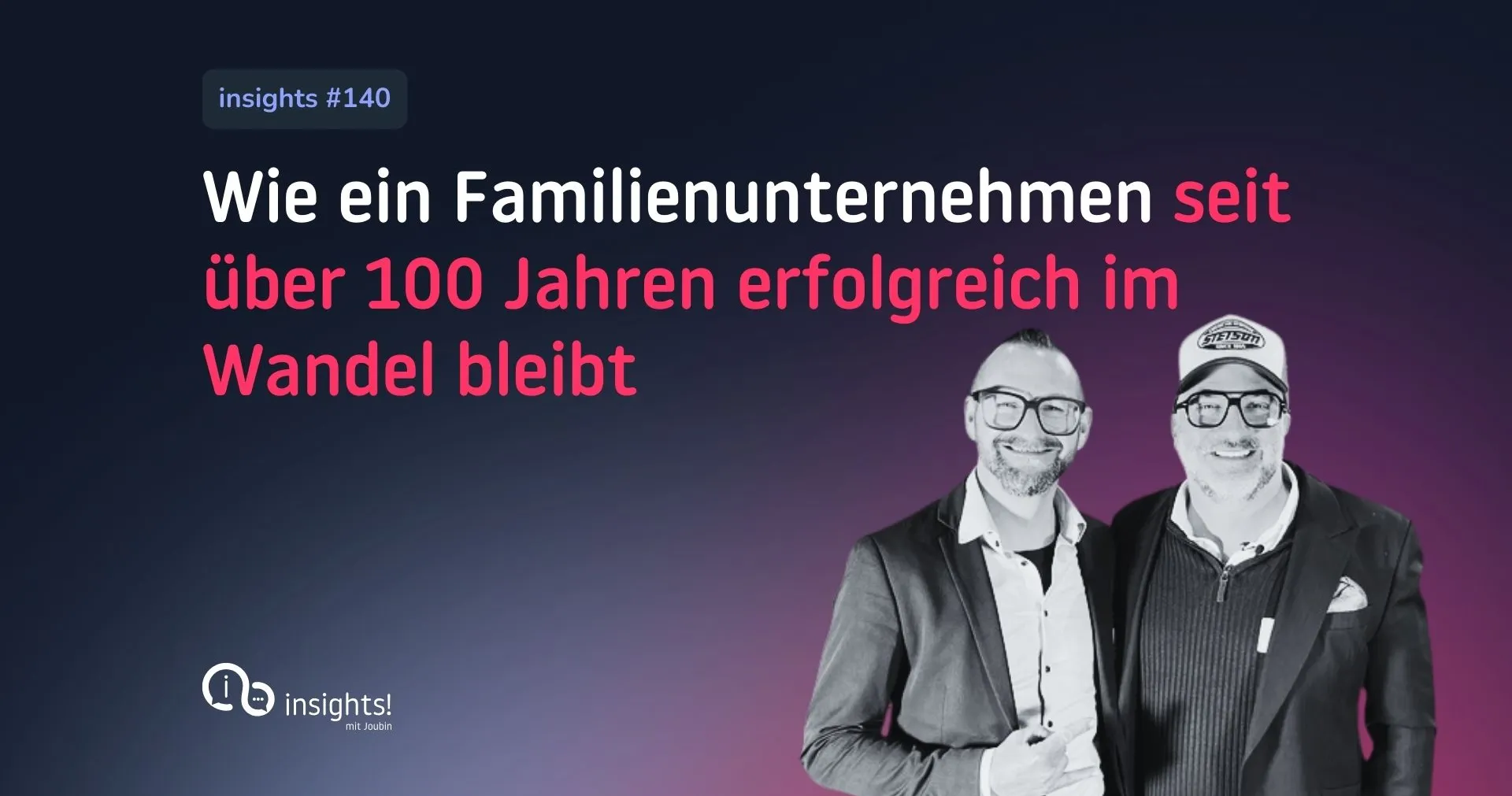
For very many companies, starting is already the first hurdle. I have to bring my line manager on board, and they have to bring their line manager on board. The bigger the company, the longer the decision chain – and then there's so much theorising about everything that won't work that in the end the starting never even happens. Because it's not going to work anyway. And that's the daftest thing you can do.
100 years old and still the bravest one in the room!
Sometimes you don't need a Silicon Valley start-up to understand how digitalisation really works. A 100-year-old family business from East Westphalia selling knives, casings and spices for the food industry is enough. Philipp Ehlert, fourth-generation managing director of Gustav Ehlert GmbH & Co. KG, was a guest on insights! and delivered an illuminating conversation.
Gustav Ehlert GmbH & Co. KG is a specialist wholesaler for food production supplies: everything food producers need, except the raw material itself.
AI reads what people no longer want to read
The starting point sounds familiar: a large proportion of orders arrive by e-mail. Sounds trivial, but it isn't once you know what's attached. Handwritten notes, scanned forms, embedded images, documents with half-illegible article numbers. People sat for hours in front of the screen typing out data. Duplicate data entry. Wasted time. Source of errors.
Philipp's solution is an AI project that automatically reads these documents, interprets them and converts them into order data. Plug and play? No. But possible. And that's exactly the point: AI isn't a self-runner, but it takes tedious work off people's hands and gives them time for what really counts: customer conversations, product advice, proactive communication. Because that's what Philipp wants. He wants employees who talk to customers, develop solutions and build relationships, not type in numbers.
Robotics in the warehouse: from idea to reality
In parallel with the AI rollout, Gustav Ehlert is rolling out a second wave of automation. The high-bay warehouse is already automated. Mid-year, driverless transport systems follow – robots that move pallets independently through the warehouse. And on the medium-term roadmap are cobots: robots that work directly alongside people without a safety fence, for example in spice production.
Philipp describes what this means in practice soberly and without overstating it:
Automation isn't an end in itself. It's a consequence of decades of cost pressure
Every new technology is tested on a concrete use case: does it really bring us anything?
Decisions are made quickly and can be reversed just as quickly
That might sound like pragmatism. It is. But it's exactly this pragmatism that's kept the company running for 100 years.
Change management: what leadership really means
One of the strongest moments in the conversation comes when Philipp talks about his role as a leader. In the last year and a half, there wasn't a single day when he didn't spend at least an hour in the warehouse – to explain, to convince, to bring people along. His analysis of the staff is honest and unvarnished: there are early adopters who love change. There's a silent majority who wait and need guidance. And then there are those who simply don't want to. Philipp's conclusion is clear, but not cold: "This isn't a matter of ability or permission. It's a matter of willingness. And anyone who doesn't come along has to find their own path. I'm not forcing anyone. But we as management set the framework conditions. So that we still exist for the next 100 years."
Security is an illusion and that's a good thing
Perhaps the strongest statement of the episode comes almost in passing. It's about the question of how to make decisions in an uncertain business environment. Philipp flips the logic: we all live in uncertain times – politically, economically, socially. And yet many in business demand one hundred percent certainty before trying anything at all. His argument is beautifully simple: the only real certainty comes from experience. Through doing, failing, learning. Anyone who only ever analyses what could go wrong never gains confidence. They stay paralysed. This attitude also shows in the collaboration with synaigy: contracts that allow flexibility. Pilot projects instead of annual contracts. Trying things out instead of hedging. And if something doesn't work? Stop, change course, carry on.
Innovation team & error culture: the infrastructure for failure
Philipp has built up what's called an innovation team in the company, namely a monthly meeting with younger employees. Topics are gathered, solutions proposed, tasks assigned. No waterfall process. No committee. Instead: submit idea, work out solution, present, implement.
What makes this possible is a culture of error that lives up to its name. Mistakes have consequences at Gustav Ehlert, but not the ones people fear. The consequence is not sanction but learning. Even the boss makes mistakes. That's not a PR statement, but lived reality. And that's exactly what removes the paralysis many companies face when it comes to trying new things.
What you can take away
The conversation with Philipp Ehlert isn't a best-practice presentation. It's an honest look into a company that has spent decades learning what it means to innovate under pressure. Three things particularly stand out:
AI doesn't need a perfect use case, but a real one. Automated order processing doesn't sound glamorous, but saves hours daily.
Change management is a contact sport. Those leading change must be present.
Security comes through doing. Not through analysis, not through hedging, not through the perfect concept. But through the first, bold step.
Would you like to listen to the full episode?
Find the podcast of the interview here:
Please accept the corresponding cookies to view this embedded content.
Prefer to watch the episode? No problem!
You'll find a recording of the interview here:
Please accept functional cookies to watch this video.
Prefer to read?
Joubin Rahimi
Brilliant to have you back for insights! My name is Joubin Rahimi, and today joining us, not for the first time but for the third time we're speaking together, is Philipp Ehlert from Gustav Ehlert. Hi Philipp.
Philipp Ehlert
Morning Joubin.
Joubin Rahimi
You're basically a regular here already, but could you still say two or three sentences about yourself for those who might not have seen you here before?
Philipp Ehlert
Okay, my name is Philipp Ehlert, I'm 46 years old, a family father, have a son, and lead our family business — I can almost say that by now — Gustav Ehlert GmbH Co. KG, now in its fourth generation. We turned 100 two years ago, and we're a specialist wholesaler for food production supplies, so everything you need to produce food, except the raw material, roughly speaking.
Joubin Rahimi
In that sense all of us have eaten something of yours or taken it with us or come into contact with knives.
Philipp Ehlert
I wouldn't yet, well, eaten, what our customers produce, that's pretty much irrelevant where, whether that's in the supermarket, i.e. grocery retail, or in the food service sector, but everything you get there is actually products that our customers in turn make using our products.
Joubin Rahimi
So something for everyone, and there should be something for today too, and we thought about talking about the day after tomorrow. We get to do some exciting things with you, but I don't want to focus on that — instead, you always say things aren't moving fast enough for you. You can do much, much more, and I'll reflect back to you: as a company you're already doing a lot more than other companies we know, and that's why the day after tomorrow is a great topic — something you do not today, but the day after tomorrow. AI, we're here at the ECC Forum. AI is a big topic. Robotics gets mentioned here too. Where do you see the things where you say you're preparing yourself and the company for the day after tomorrow?
Philipp Ehlert
I think the field between AI and robotics is already spanned out. We do that too. Short version, we try to, let's say, in the areas where we use AI, we're already involved. Order processing, so we're a classic wholesaler and a large share of our orders still comes in by post somehow, so
Joubin Rahimi
E-mail, not by post or
Philipp Ehlert
Yes, it's the same thing really. What I get as an image document, it doesn't actually matter much whether it. We actually still get real post once a year too. Regardless of that, we just get emails and there are some documents attached and we have to process those into orders. It wouldn't be so bad if it were somehow always one template that's used. But you have qualities ranging from to, you have embedded text, you have only images, whatever comes in, handwritten, scanned notes shown, and now we're doing a project where we say, okay, let's take an AI, run it over it and see if we can get it read out. Then you have to check, does the customer write a proper article number on it error-free, a proper description, if not, how do you get hold of the data and so on and so forth. I know there are providers on the market who already do this, but of course these are also always things you still have to adapt to your data, or rather the data your customers then supply you with in that case. So plug-and-play AI that can, that doesn't really exist yet so simply, to internally ensure that people no longer have to type things off the phone or from paper, i.e. in this case from the screen, i.e. do double data entry and spend time on tedious work, but rather make it available to our customers when they really have an issue. I want to answer questions, I want to intensify product advice, I want to say, OK, current situation right now for example, we have these and these economic conditions, meaning delivery times are extending or whatever. So I want to communicate proactively with customers and build the relationship, because humans are simply better at that. Well, or actually, that's not even true, that's not true at all, bots can also build great relationships unfortunately these days. But regardless of that, this is still a strength humans can draw on, or working out a creative solution approach, because data-wise things simply don't fit together and you sometimes need a completely mad chain of associations to arrive at a solution. I want my employees to do that, and that's why I want to relieve them of the other tasks. That's a project we're doing right now currently. Then we're also doing things like robotics, for example, starting in the middle of this year with driverless transport systems in our warehouse. Last year we did automation, i.e. storage, high-bay warehouse, retrieval runs essentially automatically now, and now we're moving on to say, okay, the transport, essentially from goods issue full pallet to the shelf for restocking or to the place where it's used, we're now doing that with robotics. And of course there are lots of other ideas you can pursue. We regularly look at things too, for example cobots, i.e. robots you can deploy as genuine co-workers. Exactly, running alongside because from a safety setting point of view they don't need a fence. These aren't huge bulky machines. Where could we deploy those in our spice production, for example, and similar topics. And that's how you keep looking, where can I pick up a trend, what's cool right now, try to implement something quickly to test it out, does it fit for us, does it fit our processes? And our company, can this offer us added value in the long run? And then it's not just, does it pay off, but what strengths might I develop instead, or deploy resources differently. Or also to say, mate, that was a good idea, but it's rubbish, let's drop it, we're now focusing on something new.
Joubin Rahimi
Is it the case in your industry that you'd say you also have a price war, because then the grocery retail and food service sector come along and say quality is secondary, but I just need 20 percent, I don't know, 2 percent, a 0.2 percent cheaper price.
Philipp Ehlert
We always have a price battle, we have had it since - I don't want to say directly since the company was founded, but at the latest with the rise of grocery retail our customers have had price pressure, because the cheapest gets the contract, and so of course we also have the price pressure, because we essentially supply the C-parts for food production, and they simply can't have a huge cost contribution to the end product, they simply can't. Full stop. And that's why we've always been driven to implement our processes as efficiently as possible, because we simply can't afford otherwise.
Joubin Rahimi
You're actually caught between having to be totally efficient while also delivering great customer service and products. Exactly, that's the balancing act you've been running for over 100 years.
Philipp Ehlert
Exactly, that's summed up pretty well.
Joubin Rahimi
Well first of all it's remarkable, the company is over 100 years old. There aren't that many. I believe the average is around 50 or 55 years.
Philipp Ehlert
That's possible.
Joubin Rahimi
A great achievement, across generations too. So it has to be said that it's great. Fantastic.
Philipp Ehlert
What's funny is I always get this newspaper from the IHK Ostwestfalen, once a month there's this paper, I don't even know if it's called Wirtschaft, OWL or something, and it always lists company anniversaries, and since we turned 100, I always check who's older. And surprisingly, every issue has companies at 125, 130, and I think, we need to get there too.
Joubin Rahimi
Yes, but you won't catch up with them now.
Philipp Ehlert
Well, outdated. No, not that, but more as a brand milestone, not as a brand-brand.
Joubin Rahimi
And over these decades you've also kept changing, and the employees change too, or should change in that sense. How do you do that? Because you've touched on a lot. Suddenly someone who used to work as a warehouse operative isn't moving pallets around any more, but is supposed to do other tasks. Can they even do that, or do they want to? I don't know. Maybe they say: Yes, brilliant, I don't fancy pallets any more, or actually pushing pallets around is great.
Philipp Ehlert
No, we already noticed that at the first step with the high-bay warehouse. There's a proportion of employees who say, this is great, this is good, I get involved with it and I support everyone in implementing it and making it a success. So I think you could call them early adopters, however you want to frame that theoretically. And then there's a whole block of more sluggish colleagues, not meant negatively, but they simply don't know exactly, is this good for me, what's coming? Will it be used against me? Am I breaking something? So various reasons why people don't embrace it enthusiastically. But you can win them over by making the added value clear to them, and that's daily work. In the last eighteen months, since this project really came to life, there hasn't been a single day where I haven't spent at least an hour, two, sometimes even the whole day walking round the warehouse or on the construction site, precisely to do that. Not just to check whether things are going properly, but also to bring people along, to explain it to them. And then there are those who say, no, I don't want to. And that's generally always a matter of willingness. It's not a matter of ability, it's not a matter of being allowed to, it's a matter of willingness. And that willingness issue is very hard to get at. Then at some point you can say, right, look, this is good. Please do it this way now. And if you don't do it this way, then I have to find another role for you. And if you can't live with that, then it's fine with me if you leave. I'm not forcing anyone to work with us. But those are simply the conditions, and we as management set them so that we can keep doing what we do for the next hundred years too, and not so that individuals feel comfortable and cosseted if they don't want to go along with it.
Joubin Rahimi
It's not fair to the others either.
Philipp Ehlert
No, definitely not.
Joubin Rahimi
We had warehouse staff, or I had addressed warehouse staff in sales marketing or the sales team, order processing inside sales is exactly the same,
Philipp Ehlert
It's exactly the same. I don't think, no, it's exactly the same. There too we have people who say, when we set up new things like this and talk to them, I think that's good. And we have some who say, my job, and just to be completely clear about this, we're not doing this to cut jobs, but to realign jobs, to actually make them more aligned with requirements, to shape them sensibly for the person too, so they can also enjoy their work. But if someone doesn't want that, then I won't force them, and in that case someone has to be able to, and be allowed to, and then also should, move on. But it's definitely the same there.
Joubin Rahimi
We once talked in Berlin about trainers. You also train apprentices and have also sat on the examination board at some point.
Philipp Ehlert
I'm essentially on an examination board. We conduct the oral technical interview as the final exam for training e-commerce clerks, we do this
Joubin Rahimi
And I find that mega exciting, because you're basically right there with young people. How do you perceive this? Are they open with friends about saying, this is just normal, I already do it this way or that way?
Philipp Ehlert
Yes, so fundamentally, there's of course an incredible openness to technology in the sense of let's just try it. What strikes me strongly is how that translates into the business context. We always have lots of expert discussions that are of course very focused on a specific project. That's where the framework, the focus, kind of narrows, the view is then very tightly directed at one topic. But when you then go up to the meta level and say, okay, why are we doing this at all, it gets quite difficult to get there and say, this is for the company, for revenue, for growth. At the end of the day we're a commercial business and what we do has to pay off, and that's where the view is still a bit lacking, that this is why you do it. They love trying things out incredibly, but a bit aimlessly too, I'd say. But they have the least fear of things. I'd definitely say that. And there are always surprising impulses where someone says, I see it like this and that and I'd like to do it like this and that, and ah cool, great, let's try it. Didn't even think about it, it's a good idea.
Joubin Rahimi
So in the end, you tackle the topics. You said just do it and rather start small.
Philipp Ehlert
Yes, old news, but yes, old news,
Joubin Rahimi
Well but I mean starting isn't exactly old news, right?
Philipp Ehlert
But the topic, what's it called again? Fail fast, learn fast or whatever — endless phrases out there. It's felt like it's been on the agenda for years somehow, all of it came in with this agility wave. What I do notice, though, is that at a great many companies starting is already the first hurdle, because I have to bring my line manager on board, and they have to bring their line manager on board. So the decision chains have simply become far too long, and the bigger the company, the longer that chain, and then there's already so much theorising in between about what won't work. And what can't possibly function, that in the end starting doesn't happen at all, because it won't come to anything anyway. And my approach is, and this is the nice part, when you can decide it yourself and say, hey, I think that's a good idea, let's give it a try, then we just try it out. And then you can still say at some point, damn, this isn't getting us anywhere, let's stop again.
Joubin Rahimi
The same goes for our contracts.
Philipp Ehlert
Right.
Joubin Rahimi
So you say, OK, we do this, we don't do that, and we have less security for it, but you have maximum freedom.
Philipp Ehlert
Yes, but honestly, the topic of security, yes, but also, well, not for you, not for me, but generally speaking, hit on the topic of security. Well, good point. But we're talking about an insecure environment the whole time. Ten years ago we said, wow, the working environment is VUCA, and how are we supposed to get employees, and now we've had war in Ukraine for four years, or rather Russia attacked Ukraine in violation of international law. Uncertain times. Since the start of March, Trump has been bombing around in the Gulf states and thinks he's the king. Excuse me, please. So we've got the Iran conflict. Uncertain times, and everyone always says uncertain, uncertain, uncertain. But if we're now talking about business, do I want a hundred percent certainty? Who believes in that? If there's one thing that's certain, it's always change and the uncertainty that comes with it. There is no certainty. I only gain sovereignty and trust by doing things, gathering experience and learning from it, and not making the same mistakes next time. That's the only certainty I have. But if I only ever discuss what could go wrong, I'll never gain certainty. Then I'm always only certain that it won't work anyway.
Joubin Rahimi
Absolutely brilliant.
Philipp Ehlert
But if everyone always says it won't work anyway, then please come on, then cave, fire, just cave, fire, no one would've said that. That could set the whole cave alight. We can't do that. That's with the children, sorry, but that's what I mean. You can't always say, or we're in uncertain times anyway, politically, socially, economically, resulting from that, especially politically, economically, ecologically too. But if I want to try out whatever for a small chunk of money, then I need one hundred percent certainty. You couldn't really behave more foolishly than that.
Joubin Rahimi
I think that's amazing. I'm really pleased. Yes, because that's the entrepreneurial spirit. How do you keep that in the company too?
Philipp Ehlert
Yes, roughly like that. Honestly. No, don't know. But I was always impatient. Always restless. Always wanted to make things happen. And when I have an idea, I want it implemented now, please. I know that's not always possible. I've also become calmer over the last ten years. But fundamentally, sit down, make a plan, that's where I want to go. That's my idea. Perhaps get two, three more people who have a plan for what they do, talk with them and check, is this the right path, yes or no? If you then come to the conclusion, yes, I like this, want to do it. Do it fast
Joubin Rahimi
And you have to let everything in the company go through you?
Philipp Ehlert
We have a clear division of tasks. I'm not the sole managing director. We also have Mr Ortkraft with us. He mainly handles purchasing and sales topics for us, and I naturally exchange views with him regularly. I say, I've got an idea. Oh God, go away with that. So that's always the first challenge already. But basically we work fairly independently and keep each other informed about what we're doing. And when we really do say, I think that's complete nonsense, or I've already had the experience that this gets a bit difficult. Better try it this way instead, so that we sort of optimise each other a bit. And then I've still got my father in the company too, the senior, whom I of course still have to bring on board with certain decisions as well.
Joubin Rahimi
And what about employees, how does that look? Is this mindset present with both of you in management, or
Philipp Ehlert
It's the same for both of us. True for most staff too. We're currently in the process of, well, a bit of change. We've always been organised very flat. So we had the management team and then basically everyone else. And now, at strategic positions, we've added another management layer, so to speak.
Joubin Rahimi
You're not exactly a 10-person outfit.
Philipp Ehlert
We currently have 104 people in the warehouse in production. We have drivers. We have the whole office. And then we said, because you can't really build a bond with everyone, not with that many people. So people talk about ten, for me it's probably more like five. I'm not that much of a people person. You need people who do that for you, and we're discussing that now too. We've formed a team of these young people, we call it quite provocatively the innovation team. But that's simply just it. We meet once a month, then important topics that have popped up over the four weeks get listed. Then we discuss it, say, that could be a solution, that could be a solution. Please take care of it. Next time present a solution, implement it. Thanks. So that you get a bit of momentum going. That already takes a bit longer than it did 15 years ago. But it's simply necessary to really carry that spirit everywhere. But for that you also need, on the other hand of course, the inner attitude towards it, and not everyone has that, but not everyone needs to either. I don't expect that of them. But that they know how we tick, that's important. And that we tick the way we tick, that's important too.
Joubin Rahimi
I do something and stop again from time to time and that's good, because it means saying I'll try it out, and that's not fickleness, it's courage.
Philipp Ehlert
Exactly. And that in the end is still what comes out of it. And of course you also learn through this – what I find really important – that there is genuinely a culture of learning from mistakes, that the boss is allowed to make mistakes too, and that does have consequences, but not the kind where he gets his head bitten off at the end of the day. Instead, you've learned something, maybe you've put some money into it that you won't get back, but it's still the case that things carry on. And of course that also takes away the fear of failing, even in a small context.
Joubin Rahimi
And I think that's a great closing word, especially the ending - no security, there is none. You're kidding yourself. Dare. Many people can learn a great deal from you all and from you too. From the heart, Philipp, really. Thanks, and thanks again. Feel free to comment what you think. And Philipp is active on LinkedIn.
Philipp Ehlert
Right.
Joubin Rahimi
You can certainly ask Philipp directly too, if one idea or another comes up. Or certain things emerge. Relationships have already formed through our networks as well.
Philipp Ehlert
Reach out to me via LinkedIn or drop me an e-mail, or you'll find my contact details on ehlert-shop.de under contacts. So I'm available if anyone wants to say something, disagrees, has different experiences. We're happy to exchange views on anything.
Joubin Rahimi
Thanks.
Have questions or feedback?
Then feel free to contact us directly.
- Joubin Rahimi
Managing Partnersynaigy
Show phone numberShow mobile numberShow email address
Subscribe to the blog now and never miss any news
✔️free of charge ✔️weekly news ✔️expert knowledge
Please accept the corresponding cookies to view this embedded content.