



#156 - 50,000 SKUs, 7 languages, 900 categories: how a mid-sized company really uses AI
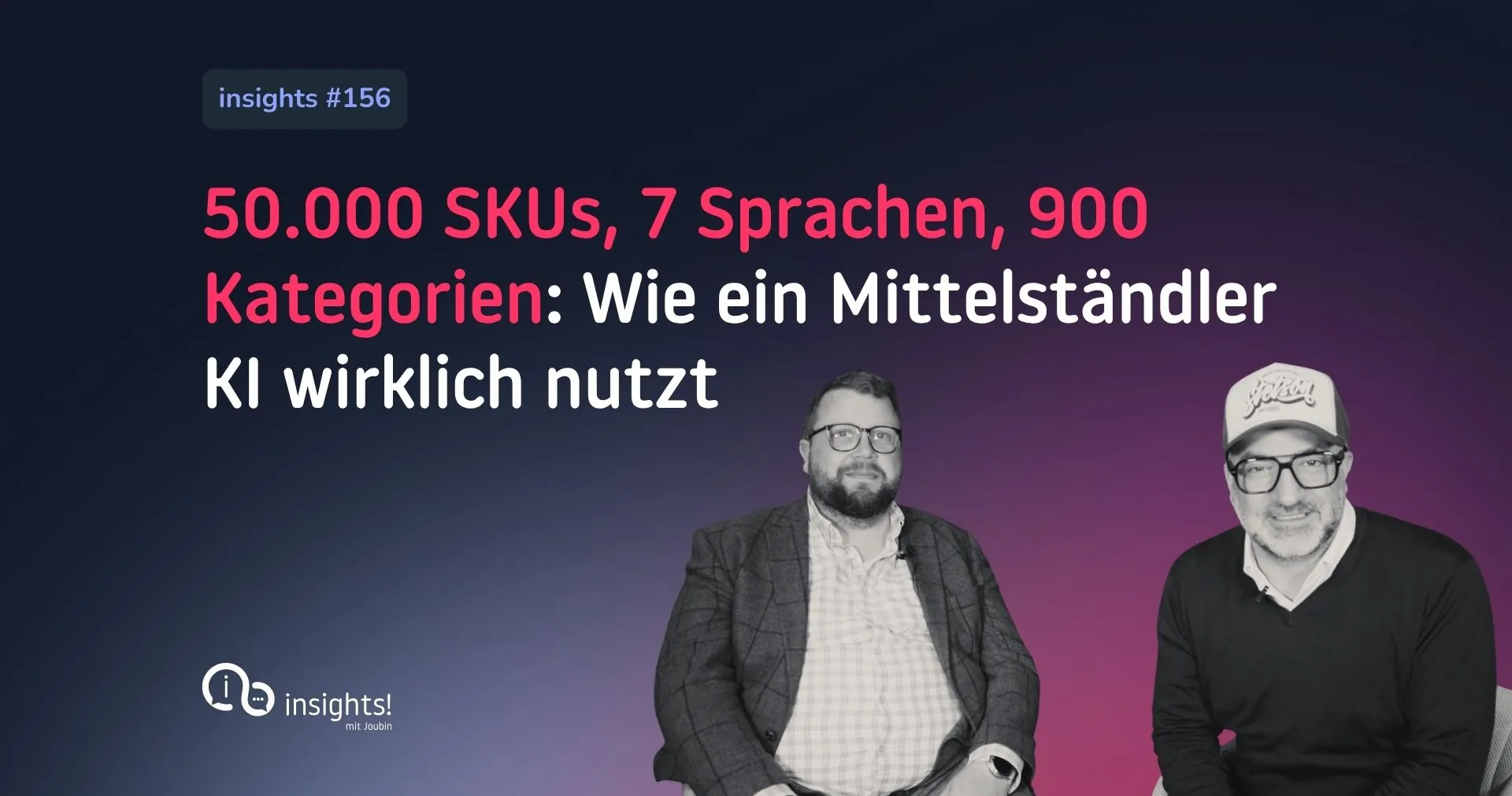
How does AI change 80-year-old family business? Alexander Zindler, CMO at Grube KG, was guest in new insights! episode with Joubin Rahimi and delivers very concrete answer. You learn how Grube went from classic catalogue mail order to online pure player with 50,000 SKUs, how AI compressed 10 years of SEO work into 3 months and why concept of mini-CMO breaks classic marketing hierarchies.
 Joubin RahimiManaging Partner · synaigy
5 min read
I now have around 20 employees in my marketing team, and we've been stable for 2, 3 years, though we grew strongly before that. For us, staying stable means we've increased output per employee. And I see that especially colleagues who embrace AI increase their output enormously.
When 10 years of agency work become a 3-month AI sprint
If you want to know what AI really achieves in e-commerce, it's worth listening to the Mittelstand. At Grube KG, a family business founded in 1945 from the Lüneburg Heath, AI has long since moved beyond the pilot stage into everyday value creation. The most striking example: SEO texts for around 900 online shop categories, translated into 7 languages. Produced classically via agencies, the team had completed about 165 categories in 10 years. With LLM-based processes, the entire setup was rolled out in 3 months, including building the pipelines.
The example shows two things. First: AI in operational e-commerce is no longer a research topic, it delivers reproducible, measurable results. Second: whoever invested early in clean product data and a well-maintained PIM system can pull the levers much faster today. Grube did exactly that — a PIM was already introduced in 2010, and by now everything runs on the NovoMind platform with iShop, iPIM and iAgent. On this data foundation, the AI use cases don't emerge in a vacuum but on a stable base.
From forester to online pure player: Grube's journey
Grube is today Europe's leading forestry supplies retailer. Company founded 1945 by forester who had unusual business idea after war: instead of managing forest himself, he started supplying surrounding forestry districts with equipment. From that old van has grown international mail-order business with around 50,000 items, today serving professionals from forestry, hunting, arboriculture and tree care as well as hobby woodworkers, garden enthusiasts and municipalities with traffic safety needs.
The digital journey began in 2008 with an XT-Commerce shop, followed by Magento 1 from around 2010 and Shopware 5 from 2015. Today Grube runs on NovoMind. What stands out about this journey is the consistency. Grube didn't follow every hype, but at every point had a solution that matched its own scaling. That's one of the lessons that can be taken away in the Mittelstand: maturity beats haste.
The 5-year buffer is history
For a long time, many mid-sized companies could rely on their customers adopting tech trends around 5 years later than the market. Alexander Zindler describes this in the episode with refreshing clarity. At Grube, customers spent a long time in the forest, with gloves, chainsaw and without constantly checking their smartphone. This delay was a welcome strategic buffer, because you could first observe trends and then respond calmly.
With AI, however, this window is noticeably narrowing. Development is exponential, not linear. Anyone not actively testing today, building their own use cases and enabling their teams, loses momentum. The lesson from this episode: you don't have to implement every trend immediately, but you do have to stay actively in the game, or you'll fall behind yourself.
PIM, AI and the uncomfortable truth about product data
An often underestimated success factor in the AI era is the quality of your own data. AI doesn't turn bad product data into good data, it only scales what you already have. Grube invested early here. Work on a PIM began back in 2010, long before that was standard in the SME sector. The AI use cases that work today are a direct result of this groundwork.
Specifically, Grube uses AI at various points in the data and content stack:
Automated product copy generation based on structured attributes.
Product attribution, i.e. the systematic enrichment of data in classifications.
Image processing and marketing graphics.
Category and SEO texts across all 7 languages.
Internal service with the iAgent as an AI-powered helpdesk layer.
Anyone still debating PIM investments within their organisation should, at the latest now, ask whether they want to catch up before or after the AI wave. Delaying will get more expensive.
Marketing teams stop growing, and still get better
One of the most remarkable statements of the episode came almost in passing. Alexander leads a marketing team of around 20 people. This number has been stable for 2 to 3 years, having grown continuously before that. And yet output has risen, significantly. The explanation is simple: colleagues who embrace AI increase their productivity to a degree that wouldn't have been possible without AI.
Side effect is also interesting. Smaller programming projects no longer go to external providers, but get done internally, by colleagues who with help of AI can suddenly take on code tasks. External agencies get deployed more selectively and precisely. This fundamentally changes value-creation logic in marketing: in-house generalists win, classic specialist and routine tasks become more interchangeable.
Mini-CMO: why specialist roles are breaking apart
Anyone mapping out a classical marketing organisation today usually finds a familiar pattern within it. Beneath the CMO sit e-commerce managers, social media leads, performance specialists, content managers, each responsible for their own discipline. Alexander brings back an intriguing thesis from a masterclass: this specialist structure is vulnerable in the age of AI.
In his outlined model, so-called mini-CMOs sit beneath the CMO. Generalists who take holistic responsibility for a range, a product group or a customer segment, and essentially think and decide like a small CMO. Agents take over the operational work. Sounds provocative, but it's consistent. Because wherever a specialist discipline becomes serviceable by AI, the need for dedicated specialists falls and the need for people who understand the big picture, derive strategy and safeguard quality rises. At synaigy we call this role Business Partner. The point's the same.
Would you like to listen to the full episode?
Find the podcast of the interview here:
Please accept the corresponding cookies to view this embedded content.
Prefer to watch the episode? No problem!
You'll find a recording of the interview here:
Please accept functional cookies to watch this video.
Prefer to read?
Joubin Rahimi
Great to have you back for a new episode of insights! My name is Joubin, Joubin Rahimi, and today I'm especially pleased to have Alexander Zindler with me. Hi Alexander!
Alexander Zindler
Yes, morning, thanks a lot for having me.
Joubin Rahimi
Sure, we have a few things in common. You live here in Hamburg or near Hamburg, right?
Alexander Zindler
A little south in the Lüneburg Heath, exactly.
Joubin Rahimi
I'm a Hamburg lad, always pleased to hear the dialectal linguistic flourish, it just warms my heart. And you studied roughly what I never managed to.
Alexander Zindler
Yes.
Joubin Rahimi
It was forestry science, wasn't it?
Alexander Zindler
Right.
Joubin Rahimi
I wanted to study forestry in Hamburg, that only exists... Existed, I should say, in Hamburg. Now you've enlightened me, yes, not any more. But my grades weren't good enough, so it ended up being IT instead. Yes. Yes, Grube, perhaps you'd like to say two or three sentences about yourself and Grube so people can place it.
Alexander Zindler
I'll do that. So, I'm Alexander Zindler, I'm CMO at Grube. I've now been at Grube for almost 19 years, built up the e-commerce division at Grube, and ultimately led Grube from a classic catalogue mail-order retailer through digital transformation to here — it's not finished, as we all somehow know. And by now we're something like an online pure player, I think you'd say. That means we essentially have no stores, it's a pure direct-shipping business we run through our online shops. We've actually been on the market in Germany as a mail-order retailer since 1945. Back then it was like this — we were also founded by a forester. All the German eastern territories were lost, and what happened was that all these officials — foresters were always civil servants back then — fled to West Germany, and there were far too many forestry officials in West Germany. And then two or three of them were stuck in one forestry district, and he didn't quite know what to do with himself, and thought, well, I can sell equipment to my colleagues too. He quickly got hold of a van and founded the business in 1945 and started supplying the surrounding forestry districts with equipment. And from that quickly grew the leading mail-order retailer, nationwide, for trading forestry equipment and everything you need for forest work.
Joubin Rahimi
Since not all of us forestry workers, though we said, we announce the cherry laurel cup this year. That's then chainsaws, chippers, consumables.
Alexander Zindler
Exactly, so it's not just harvesting in the forest, it's also about maintenance, it's also about planting. There are special tools for planting trees, there are special tools for protecting them from game and so on. Game is of course also a topic. Hunting is also part of the classic forester's job profile. That's why, back in the 90s, we developed into a supplier that also covers that area, because our customers asked us: listen, we order all our equipment from you at this point. What about the jacket and the binoculars I need for hunting? Just by the way. And today we of course cover this whole professional area, plus the semi-professional area for people who make their own firewood, for example, and work in the forest. At the same time also for people like you, the whole log splitter area or similar. Exactly, log splitters, so someone who goes into the forest with a chainsaw, makes their own firewood, drives it out, log splitters etc. All of that.
Joubin Rahimi
Happy to do that too.
Alexander Zindler
Yes, exactly, you'll definitely find what you need with us. Then of course for everyone who has a garden like you and needs to tend it, everything you ultimately need for that.
Joubin Rahimi
And also tree climbers, so also—
Alexander Zindler
Exactly, the professional one. This has played an increasingly larger role in recent years, area of urban tree care, which is different. In forestry, it's partly of course about preserving forest, but naturally also about using this natural resource sustainably. And in urban tree care it's correspondingly different. It's more about traffic safety, complicated felling. There isn't the space to just lay a tree down. You have to climb and so on. So a completely different setup ultimately, but that's also become a very important part of our work.
Joubin Rahimi
And this moves a bit away from digitalisation, but mega exciting when you see a tree climber like that. We just had one who stretched ropes like that between big branches, so that in strong wind a big branch doesn't suddenly break off and fall onto road. Yes, and then safety parts in there too. But how they climbed up there, incredible! And then my son said, do they lie in there, or do they just take a break up top too?
Alexander Zindler
Real passion in the guys.
Joubin Rahimi
Yes, well, and folks, men and women, wow! And we have a tree where they say, in the next 5 to 10 years, it's so old it will simply have to be felled.
Alexander Zindler
Exactly, the diagnosis is part of it too. Even beforehand, it's no longer simple these days, especially in urban areas. You can no longer just have a tree felled; someone first has to come and look at what the tree looks like on the inside, how much longer it will live, how dangerous it is, before you get approval to remove such an old tree at all.
Joubin Rahimi
And then they said, right, we'd fell it onto the other plot, which isn't built on, but we've got a fence and shed and so on there. And then my son said, well, the fence will get damaged. Yes, he said, but it'll be much cheaper for your dad than taking it down piece by piece. And then I asked, how do you actually do that? And then they climb up and saw it off from the top, piece by piece.
Alexander Zindler
Right, that gets cut down bit by bit, quite cool actually, tied with ropes so that it also falls into such a rope, you know. So it actually does fall into a rope, drops down in a controlled way, so it doesn't swing off to the side and become a hazard.
Joubin Rahimi
Yes, definitely super exciting to drill into this topic. And you said 2008, you started, or did you start at Gruber?
Alexander Zindler
Yes, I started in 2008.
Joubin Rahimi
And then one of the first tasks was to programme a webshop.
Alexander Zindler
That's how I got into it, exactly.
Joubin Rahimi
Almost 20 years ago now.
Alexander Zindler
We're owner-managed, still, now in the third generation. The fourth has just joined. And back then there was still this handover between the second and third family generation. And they said, okay, we need a web shop and you already have experience, after all. With programming websites, do you think you can do it? We think it's great that you actually come from the industry. But through my studies I'd already gone self-employed, back then with a small agency, and I built websites, looked after a bit of online marketing activity, and they somehow saw me as the sweet spot to build exactly that kind of thing. And as it goes with family businesses, when it fits, well, it's great, you stay there too.
Joubin Rahimi
And how did you build the first one? I once built one too, a project work, which took much longer than the project work itself, because I hadn't studied. I did it with Java and Servlets, all by hand, so it was really, really cheap, but it was a proof of concept, I'd say. But how did you handle it in 2008?
Alexander Zindler
Yes, back then we'd decided on XT-Commerce Vayton as the solution, and that was still an open-source project in the end, and then I spent days just reading into the community, and it ran on PHP, so, and I started customising it so it fit our processes.
Joubin Rahimi
I think you still see a lot of XT shops around; it's unbelievable how they're still hanging on. Yes, okay, but you replaced that one too, you replaced it a long time ago.
Alexander Zindler
Right, that one wasn't very long, I think about 2 years, right, so it moved quickly too. With our customer base, I always say we're lucky, because our customers are also out and about in the forest and not always as tech-savvy, let's say, as perhaps the average German. But they don't stay that way, we always have a delay of about 5 years built in. That means we can look quite well at what everyone else is doing, and we've had about 5 years to react. This timeframe is getting a bit narrower now, because with AI and so on it's naturally developing exponentially. But still, we don't have to implement every trend immediately, we're in the fortunate position, purely from the customer side, to sometimes wait a little and see, okay.
Joubin Rahimi
And then you switched from XT to Magento, I think, was that right? Right, that was 2010 or 2012?
Alexander Zindler
That was 2010, yes.
Joubin Rahimi
That was Magento, Magento, so not yet Magento 2.
Alexander Zindler
Right, that was Magento 1. We switched from there and moved to Shopware in 2015.
Joubin Rahimi
Held for 5 years.
Alexander Zindler
Yes, roughly. Maybe it was also 2012, the switch to Magento.
Joubin Rahimi
Was that already a version 5 or still a 4 at Shopware?
Alexander Zindler
5. Right, that was then a version 5, and we were on that through the Corona period, and have now ended up with a NovoMind shop.
Joubin Rahimi
Nice, you can really see how you've probably also grown in maturity level and then simply been carried along by the systems too.
Alexander Zindler
No question, that's how it is.
Joubin Rahimi
Shop is one thing, but shop alone without product data, without other topics, doesn't work well. So what's the ecosystem like?
Alexander Zindler
That's right. We noticed that quite quickly, of course, back when we had our first shop and were still maintaining product data in the backend – that this reaches its limits fast. And in 2010 we went straight ahead and introduced a PIM system. At the time, we were right at the forefront in our field. That's quite good. By now we have a lot of experience with just how important it is to build up good product data, and we can also draw on very good product data. And back then, the system was called JCatalog, a company from Dortmund. They then changed hands a few times. Today, I believe they're called Prodexa.
Joubin Rahimi
Right.
Alexander Zindler
Well, it still exists, and we worked with them for a long time, almost 10 years, but at some point it no longer quite fit our scaling.
Joubin Rahimi
How many products do you have?
Alexander Zindler
We currently have around 50,000 SKUs in the system. And then a colleague came back to us who had trained with us, was away for a bit, came back and brought, so to speak, Hamburg-based NovoMind into play and said, that's what I've been working on lately. And then we—
Joubin Rahimi
And now you have, I think, the trio you called it, right? Exactly, iShop, iPIM and iAgent.
Alexander Zindler
Right, we started with iPIM, then iShop came along somehow, because it's at least one big API you don't need to worry about anymore, namely for that product data, right? That was already settled, and in the meantime iAgent has also joined our service.
Joubin Rahimi
What are you doing with AI in the field you work in? Where does AI turn up everywhere?
Alexander Zindler
Well, ever since this became a topic, we immediately tried to jump on board, because AI naturally promises to solve many uncomfortable problems we've been carrying around for years. So let's start, let's stay with PIM. There are of course loads of processes where AI helps us. Be it product description writing, product attribution, but also when it comes to images and so on. All of these are places where agents can quickly help us. Or, one topic I find really cool, we'd already rolled out our online shop in 7 languages and in 6 European countries. And for 10 years we'd always worked with agencies to write SEO texts for the categories. Ah, yes, okay. With almost 900 categories in our online shop, that was always a losing battle. At best we'd managed 165, I think. The rest was never touched. And then we already had problems revising the ones we had, updating them again to the latest categories and so on. That was one of the first topics we solved on the LLM side, and we actually managed all 900 categories, all languages, within, I think, 3 months in total, including setting up the AI processes.
Alexander Zindler
We'd got all the copy spotlessly done, come and see on our site what products there actually are, which brands are represented and so on.
Joubin Rahimi
Did you have an agency back then?
Alexander Zindler
We did that 50/50. So we have an agency we've simply been working with for years, that's the company Webnetz from Lüneburg, also a bit of a homie for us, right around the corner, and together with them we ultimately developed it. And in the meantime we also have our own employee on my team who does nothing but AI.
Joubin Rahimi
OK, with AI you now need, and you probably don't even need an employee any more, external support, right?
Alexander Zindler
We still need that anyway.
Joubin Rahimi
Yes?
Alexander Zindler
Yes, we still need that though, because it's a huge topic. So the employee has for now really only just dealt with, let's say, AI enablement for our staff generally. We've now rolled out a platform for that, so that not everyone is off on their own privately with Gemini and ChatGPT. We've now rolled out our own platform to bundle that and to also make pro models available to everyone somehow. And that alone already keeps them busy. But there are so many angles at once where this comes at you, and where it simply makes sense, and where, if we're not on top of it, we immediately feel we're losing touch, that on top of that they're also busy orchestrating several external partners who are involved as well.
Joubin Rahimi
How do you think AI is changing marketing? You've already given a bit of insight. And also how roles and organisation are changing, what's your view?
Alexander Zindler
Yes, so impact is, I think, already huge. With us, at 7 - I've got about 20 employees now in my marketing team, and we've been stable for 2, 3 years now, but grew strongly before that. And staying stable over recent years means for us that we've essentially only increased output, i.e. output per employee. And I see it quite clearly now, smaller programming projects just aren't going external any more, we do them internally, coded by some colleague who knows enough about it. And I see that colleagues who really engage with AI in general are massively increasing their output, even in areas where they perhaps couldn't score before.
Joubin Rahimi
How is— thanks, there's a lot in there where you talk about efficiency gains, and also the last point, that people are doing things they never used to do. Is there sometimes also the impression that others are now doing your jobs, because they throw something into AI and say: hey Alexander, here's a concept for you. Yes, especially techy.
Alexander Zindler
I must admit I don't find that so bad at all. Yesterday I had a rather amusing masterclass here on site about it. He'd sketched out a modern marketing department, and he said he believes that's what a department will look like in future. He'd put up an org chart on the wall, CMO at the top, and below that there was no longer an e-commerce manager and social media, but below that there were only mini-CMOs, as he called them. That's essentially the level below the CMO, because everyone below is basically able to handle the entire marketing processes in their totality, the way a CMO should too, and the operational side is taken over by agents. That was his sketched-out picture. I found that really exciting, because I do think that's the direction things are heading. So I think these specialist roles are breaking up, because in the end they become more operable by a generalist. And I found this approach really And he said you'll see it quite differently. He said a mini-CMO like that would sit rather on a particular product group, perhaps, or on a range, or even on a customer segment. That's essentially what they're sitting on and operating on. And I found that a really interesting approach. And I do see things heading a bit in that direction. So we too will certainly have to organise ourselves internally differently than we have so far, to stay agile in the market and also be able to react quickly, because I think none of us can yet foresee how big the impact actually is.
Joubin Rahimi
I now get to handle marketing operations for us within the group — what can we do as a group, what capabilities do we already have, where can I support the brands, what do we need to set up newly for the brands. But this AI wave is changing so much at the same time, and right now it's genuinely exciting to work out, okay, how do you proceed sensibly? At the moment my approach is to split it into stages. I find this mini-CMO idea an exciting approach too. We have — I used a different name, but also someone who supports the brands holistically. We have text writing, the AI does that now. But you still need someone who maintains quality assurance and context.
Alexander Zindler
And so, what name did you give the child then?
Joubin Rahimi
We don't have one yet.
Alexander Zindler
Ah right, you still have that, okay good. So mini-CMO, you say, could hold up.
Joubin Rahimi
I'll take that with me. Maybe colleagues will hear it then. Then they'll have mini-CMO. The name we have is business partner or accounter. Accounter is actually typically agency. But if you have a really good accounter, they know your brand, they think along with you.
Alexander Zindler
Yes.
Joubin Rahimi
It's not an account manager, as is often the case.
Alexander Zindler
Yes, I also think the idea fits somehow.
Joubin Rahimi
Yes, and mini-CMO I find really funny too. So thanks for the time and the insights there. If you have questions for Alexander, feel free to comment here. I'm sure you can also find him on LinkedIn.
Alexander Zindler
Otherwise grube.de for the entire product range.
Joubin Rahimi
What to buy and then ask about the order afterwards. That's how it is.
Alexander Zindler
It actually reaches us too, and me.
Joubin Rahimi
So we've clarified the paths. Thanks for your time.
Alexander Zindler
Sure.
Joubin Rahimi
And until next time. Thanks.
Have questions or feedback?
Then feel free to contact us directly.
- Joubin Rahimi
Managing Partnersynaigy
Show phone numberShow mobile numberShow email address
Subscribe to the blog now and never miss any news
✔️free of charge ✔️weekly news ✔️expert knowledge
Please accept the corresponding cookies to view this embedded content.