



#151 - Why your company needs a motorsport team if it wants to survive in the age of AI
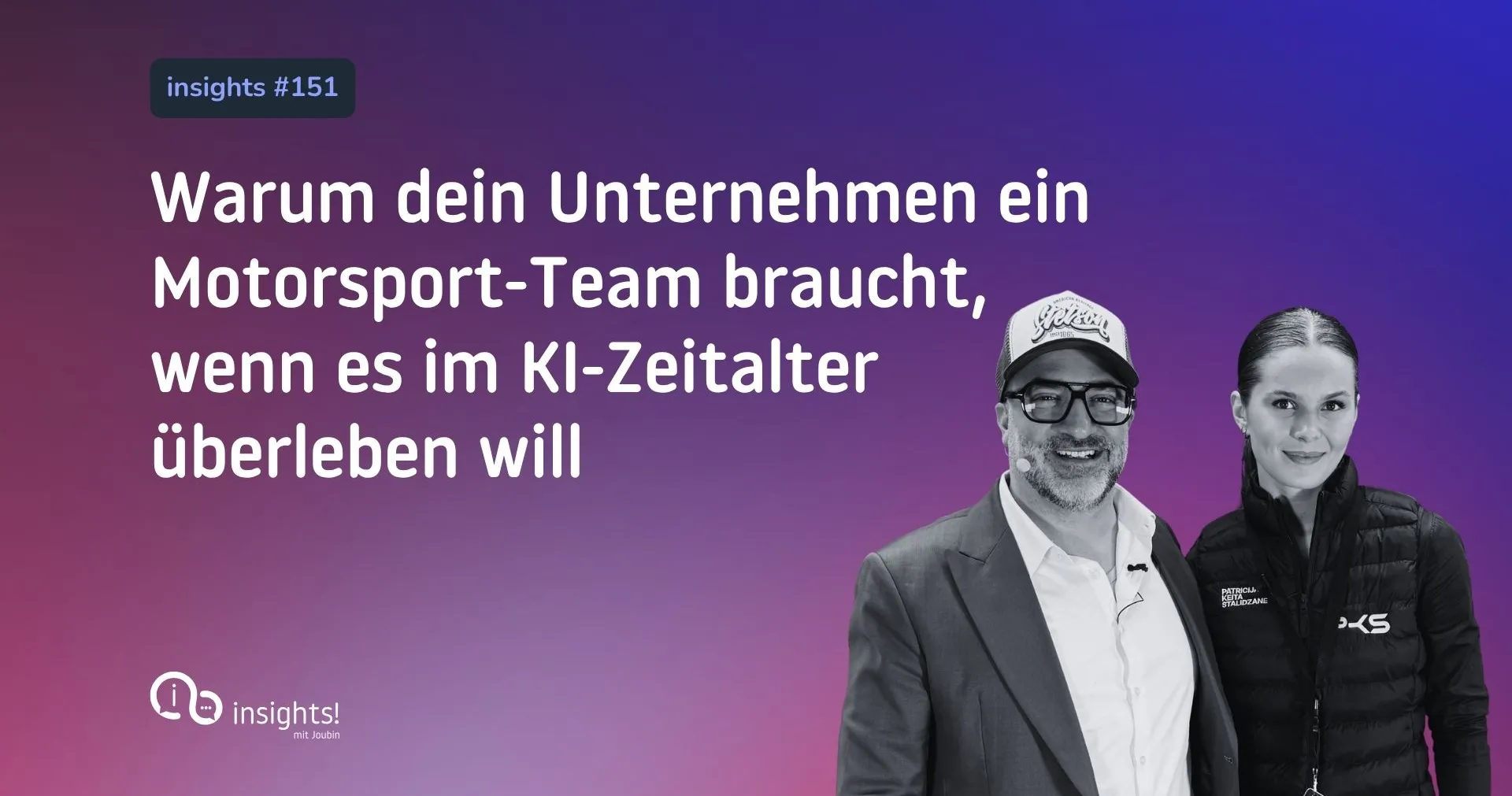
In a single hour, a 20-year-old GT3 driver dismantles more leadership myths than many a management book does in 300 pages. In this episode of insights!, Joubin Rahimi talks with Patricija Stalidzane about changing habits, mental clarity, trust within a team, and why every company needs a „motorsport team“ in the age of AI.
 Joubin RahimiManaging Partner · synaigy
6 min. read
People are happy to wait for some dramatic life event before they start dealing with themselves. That is why people say after dramatic events: I am moving away, I am going to do everything differently. But that is actually wrong, because to me it only means one thing: you never questioned anything before.
Forget your next strategy offsite. Listen to this GT3 driver instead.
When companies say the word transformation, it often sounds like a promise nobody really intends to keep. Roadmaps get drawn, tools get bought, target pictures get formulated. What rarely happens in the end: people change their behavior. That is exactly where the conversation between Joubin Rahimi and Patricija Stalidzane picks up, which you can watch in the new episode of insights!. Patricija races GT3, comes from a family business in the construction industry, and takes apart the most important leadership myths in the space of an hour without having planned any of it. That is exactly what makes her perspective so valuable.
What we get served in this episode is not coach-speak and not stage storytelling. It is the matter-of-fact reality of someone who has lived with decisions made in milliseconds for years. Anyone who decides wrong in motorsport is not risking a bonus, but life and limb. It is precisely that harshness that forces Patricija to be clear with herself. And that is exactly the lesson so rarely practiced in business.
Manifesting is nonsense: what changing behavior really means
Patricija boils the topic of mindset down to a point the self-optimization scene does not like to hear: manifesting will not get you to your goal. What counts is being aware of your actions every single day. Making one right decision once achieves nothing at all. What counts are the hundred small decisions you make every day afterwards.
For leaders, that is an uncomfortable truth. Because real behavioral change cannot be delegated and cannot be outsourced. It is manual labor on your own head, every morning, even when you have no time for it. Patricija's line „Everything is a choice“ hits exactly that nerve: nobody has the time to reflect. And that is precisely why it is a question of priority, not of availability.
Clarity beats strategy: why most careers fail
If you do not know who you are and where you want to go, you will make the wrong decision when in doubt. Patricija describes this with a term long established in English-language career literature: stuck in the middle. You cannot say a clear yes if you do not know what you would say no to. That applies to career planning, to strategic investments, to the question of whether you stay in a job or not. Clarity is not the outcome of a workshop, but the outcome of a day-to-day process.
What Joubin and Patricija unpack in this part of the episode concerns every digital decision maker. You can buy as many AI tools as you like. If you are not internally clear about where you want to go as a company, the next wave will simply wash you away. Visualization is not an esoteric concept here, but a performance practice that has been mandatory in motorsport for decades.
Trust is a performance metric, not a feel-good factor
Patricija describes how a lack of trust plays out in a race car: if she does not trust her team, she has subconscious thoughts behind the wheel that measurably limit her performance. Transfer that to your company: every meeting in which information is held back, in which unspoken conflicts ride along, in which people latently do not trust a colleague, ultimately feeds into a performance metric. It is just not called that.
Three areas in which a lack of trust makes itself felt directly in your company:
The speed of decisions, because teams cover themselves politically instead of delivering.
Willingness to innovate, because nobody wants to expose themselves if the team will not back them when it matters.
Talent retention, because high performers can feel it when the culture does not hold, and sooner or later they leave.
Patricija says her colleagues are her friends because they have built trust over years. That does not rule out entering into new partnerships. It only means you look very closely at who gets on the racetrack with you.
The motorsport team inside the company: Joubin's explosive thesis
At the end of the episode, Joubin Rahimi formulates a thesis that is uncomfortable for many leaders. Anyone who wants to set new standards in the age of AI needs a motorsport team inside their own company. A small, focused unit that tries things out, fails, learns, and in doing so raises the standard for the entire organization. Exactly the way motorsport is the foundation for the commercial automotive industry. What works on the racetrack is later realized in series production.
This unit only works under three conditions. It needs clear goals, it has to consist of the right people, and it needs an environment that allows it to be different. Anyone who cannot or will not create those conditions may as well save the investment. And that is exactly where the provocative truth lies: most companies do not afford themselves a real innovation cell. They afford themselves an innovation officer with too little budget and too many quarterly targets.
E-fuels, the Nordschleife and female empowerment: more than a mindset talk
But the episode is not just a mindset talk. Patricija reports just as insightfully on the reality of e-fuels on the Nordschleife, where they have now become standard operating practice. She drives the Lambo in GT3 and, in parallel, races with a Girls Only team in a Porsche fueled with e-fuels. Her conclusion: feels the same, performs the same, is more sustainable. A very sober answer to a politically highly charged debate.
She also speaks openly about women in male-dominated fields, in motorsport as well as in tech. Her answer is not complaint, but initiative. She is planning track days for women because she is convinced that networking at 300 km/h builds trust faster than the next stand-up coffee at a conference. It is exactly this mix of pragmatism, mission and appetite for being different that makes the conversation so valuable.
What you take away from this episode
If you watch or listen to this episode, you will not walk away with finished slides, but with questions that are uncomfortable. That is intentional. You will ask yourself how clear you actually are, who you really trust, and whether your company has the courage to allow a real innovation cell.
If you work on transformation, AI or customer experience as a CEO, CIO, CDO or Head of E-Commerce, this episode is more than a mindset talk. It is an invitation to question your own operating model. And it is proof that the most important lessons often come from people who play in a completely different discipline. Have a listen. It is worth it.
Would you like to listen to the full episode?
Here you can find the podcast of the interview:
Please accept the corresponding cookies to view this embedded content.
Would you rather watch the episode? No problem!
Here you can find a recording of the interview:
Please accept functional cookies to watch this video.
Would you rather read?
Joubin Rahimi
Great to have you with us again for a new episode of Insights. My name is Joubin Rahimi and today I have Patricia Stadiziane with me. Hi Patricia!
Patricija Stalidzane
Hi Joubin!
Joubin Rahimi
You are a very untypical guest for us. We often have a lot of people here who talk about IT, about digitalization in that context, although we could talk about digitalization today as well. We also often talk about change and transformation, but you do something else on top of that. Maybe you would like to say two or three sentences about yourself and about the thing that definitely excites me in my free time too and that connects us.
Patricija Stalidzane
Well, for me it is not free time, but I do motorsport alongside our family business, where we of course work in the construction industry. That means digitalization, business, all the topics being discussed elsewhere today are absolutely relevant there. But from my side I would of course like to bring in a bit of the values I learned in motorsport, because there are a great many exciting parallels there.
Joubin Rahimi
And one thing made a real impression on me, the first time I heard you on stage and again today: change habits. How did you arrive at that phrase? Or at the thought behind it in the first place?
Patricija Stalidzane
By falling flat on my face a lot in life. I think motorsport is simply an industry, or a career you pursue, where you have to learn extremely fast, because everything carries an enormous risk. There is a lot of money involved, there are many and harsh consequences, on the racetrack as well. Everyone knows the sport is dangerous, the sport is expensive, you are rarely alone, there are always people involved in what you do and in the decisions you make in milliseconds. And yes, I simply gathered experience where I noticed, okay, I make decisions based on who I am. And then I reflected and analyzed on my own for a long time until I came to the conclusion: okay, at the end of the day it is not just what I do on the track, but my preparation for it. And that preparation is not only bodily and physical and how I trained for it and how much I drove on the track, but also how clear I am in my head and how well I can make decisions. And that comes purely from the daily process of: okay, what am I doing to get there?
Patricija Stalidzane
How often do I remind myself? Okay, what do I actually want? What am I doing to get there? Are my actions really in line with what I want to achieve? Because I believe that if you let it slide, even for a few days, you fall back into old habits very quickly. And old habits are always a thing. They are often not conducive to your goal, because why do you pursue goals? Because it is of course something higher that you want to achieve. Which means you are not there yet. And if you want to achieve it, then you also have to do something for it that is different, because otherwise everything would stay the same. And yes, many people think, I make one right decision now and then I am done with it, but unfortunately that is not how it works. Many people talk about manifesting these days and that kind of stuff, but at the end of the day it is simply your constant awareness. So every day, what are you doing for your end result?
Joubin Rahimi
Yes, and it is this change habits thing and what you also said, you have to do it daily or do it continuously. You have to be focused and resilient to all the setbacks you face, or to resistance. People spend a lot of money on that. Do you know Tony Robbins?
Patricija Stalidzane
Nope.
Joubin Rahimi
You do not need to. You are already doing it. He sells courses for 30,000, 40,000, 50,000. And really it is only about changing your behavior. About picturing things, and I found that so exciting, that you also said: I picture things when I race, I picture how I take corners and so on. And again and again, in order to have a target image or a picture of how I win. And in the end that is what it is, that I know where I want to go and then do things differently day after day.
Patricija Stalidzane
Yes, that is how it is. Just what I already said. The critical decisions are often the ones you have to make very fast. So you get an opportunity and what do I do now? And then you often regret it if you made the wrong decision. For example, you think, oh, I could have done that differently and whatever. First of all, the reason people make wrong decisions is that they are not clear with themselves, because they do not know at all, because they have never visualized it, and then the situation is new to them and they do not know how to react. That is why visualizing is a very big topic in motorsport.
Joubin Rahimi
Why do you have to be clear with yourself?
Patricija Stalidzane
For various reasons. As I said, for one thing, so that you simply make better decisions from the gut, from instinct. Because as I said, if you are not clear with yourself, then you do not know where you want to go at all, and you often trip yourself up. That is exactly what I meant. I know it from myself. Some things you just do, you never questioned them. That is just how I am and that is how you do it. And you never thought: okay, what effect does that actually have on my career, on my goals? Clarity is the be-all and end-all for me. I think otherwise you end up, as people always say: stuck in the middle. So if you are not clear about where you want to go, who you are, what you actually want, then you do not know what to say yes to, what to say no to, what do I actually want and who am I actually? And then you simply get lost. That is how it is.
Joubin Rahimi
And that is really deep.
Patricija Stalidzane
Yes, deep talk for sure.
Joubin Rahimi
Really fast.
Patricija Stalidzane
Yes, but deep talk at the end of the day, career, passion, who you are, that is life. I mean, we can—
Joubin Rahimi
Friends, family, health, it is all of it.
Patricija Stalidzane
It is all deep at the end of the day. So motorsport, as I said—
Joubin Rahimi
If you want it to be. If you want it to be.
Patricija Stalidzane
Not everyone wants it. But if you think about it for a moment, or start thinking about it, then that is how it is. As I said, motorsport, it is about... You notice it again and again, it is a dangerous sport. So it really is about important decisions you make. Just the same, perhaps, in everyday life. If you get really profound about it, then, as the saying goes, it could all be over tomorrow. So why not be profound?
Joubin Rahimi
Do you think about it? Before a 24-hour race, say, or now before qualifying?
Patricija Stalidzane
Sometimes more, sometimes less. There are certainly moments like last race weekend, when someone died, and then it becomes very clear again and you start questioning things for a moment. But I think you should try to hold things up to yourself anyway and not wait for life to teach you a lesson. People like to wait for some life event, something really dramatic to happen, before they start dealing with themselves. That is why people say after dramatic events, I am moving away now and I am going to do everything differently.
Joubin Rahimi
I am separating, everything.
Patricija Stalidzane
Yes, but that is actually wrong, because to me it really only means one thing: you never questioned anything before. And that is wrong. Actually you should know what happens in life, how serious things are, what you are doing all this for. And for that you should simply, as I said, look in the mirror during the day. I think it is really cool to look in the mirror, because sometimes I lose myself completely in everyday life, because you simply have to do a lot. And another important topic in my talk is of course stress and highly competitive environments. Motorsport is a shark tank and so are many business areas and industries. How do you cope with that? Because you are busy all day, and then you think, I have no time at all to reflect. You lie in bed in the evening with a thousand thoughts, but they are mostly about work and then you never get around to questioning what is going on with me. But it all plays into each other a bit. As I said, everything is connected.
Joubin Rahimi
How do you create space for yourself so that you can say, now I am dealing with me?
Patricija Stalidzane
I have to force myself. Everything is a choice. Yes, I do not have the time. That is a fact. I do not have the time. Every day I think the day is too short, but that is how a lot of people feel. And the decisive question is: do you take the time or not, and do you prioritize or not? And I simply want to put the focus on this: you have to take that time for yourself, because if you do not, if you drag those old habits along for a long time, then over time you get the negative effect. Just as you can turn the spiral the other way, so that if you deal with yourself every day and do take the time, and reflect again and again, look in the mirror, then the spiral goes in the other direction too.
Joubin Rahimi
I have a completely different question. I hope it is not too private.
Patricija Stalidzane
I do not think so.
Joubin Rahimi
You are in your early twenties and have a lot of things that many people perhaps only notice and start to change much later in their lives. What does your circle of friends look like? Are they people your age?
Patricija Stalidzane
I have a good friend with me, she is also my work colleague. So there are a few things I can tell you about that. My circle of friends is extremely small. That is a fact. It also came about because I noticed, okay, my time is scarce. I have to concentrate on myself. I have to concentrate on my career. Which means I can really only be around people day in, day out whom I trust, who share the same values and so on. And the second point is that I work together with many of them. So my colleagues are my friends. Yes, because I say it too, shared goals are a very, very big factor. And trust built over time is a very big factor. Because I took responsibility for my own decisions and my own mistakes in life, and my friends did the same, we simply developed such a bond that they really are my closest friends. Of course I know a huge number of people, but real friends, actual friends, I have fewer of. And I also say, my two best friends whom I still know from my university days, who really are still my friends, they would definitely say too, there is little time left for that in a life like this.
Joubin Rahimi
But when you do meet them, then it is probably—
Patricija Stalidzane
As if you had seen each other only yesterday.
Joubin Rahimi
You mentioned trust.
Patricija Stalidzane
Very important.
Joubin Rahimi
Trust is very important. Why do you say it is so important?
Patricija Stalidzane
In motorsport especially, if you do not trust your team, then you simply have bad subconscious thoughts while driving that strongly affect you, and you underestimate that. I think it is the same in a team, if you cannot rely on the other person, if you think there are some bad feelings or bad thoughts that are not being spoken out loud, or something like, okay, that person might rip me off now, as is often the case. If you do not have that sense of security within you, then I think your performance is limited too, in my opinion. Which means the people you gather around you are, first of all, a reflection of yourself. So whenever you have a bad deal, a bad partner, whatever, I think you should first question: okay, what did you do? Did you play your part in making the whole thing work? And if you can confidently tell yourself: yes, that is how it was, I gave my best, then you simply have to part ways and look for new paths. But often enough I have had the lesson where I had to tell myself: okay, hey, I did not play my part in making it work either. And of course you have to be willing to see that. And as I said, at the end of the day everything depends on yourself.
Joubin Rahimi
And that leads me to something as well. We met for the first time about a week ago, I think. So you are being very spontaneous here too.
Patricija Stalidzane
Yes, you have to be.
Joubin Rahimi
Thank you for that.
Patricija Stalidzane
Thank you for the spontaneous invitation.
Joubin Rahimi
Yes, you said it was your first time. Is that right? The first time in front of us business clowns? Which you are as well, mind you. But have you ever spoken in this context before?
Patricija Stalidzane
Yes, it just came about that way.
Joubin Rahimi
How did you prepare?
Patricija Stalidzane
Far too badly, far too little.
Joubin Rahimi
Like for a race?
Patricija Stalidzane
No, I prepared far too little. But actually that may even have been the key, because preparation, that is really also, it is all connected. I did not prepare by rehearsing anything, I did not need that preparation at all, because I really only talk about experience. So I do not have to learn or rehearse anything, because I'm talking about my life and I know what happened and I can say what I tell myself in front of the mirror every day anyway. And really I just shared that, and I think that is one reason it went down so well with you, because—
Joubin Rahimi
I think in my case, they were all blown away.
Patricija Stalidzane
Because I simply said, hey, these are the conversations I have with myself every day. That is what I tell myself every day and I work on myself every day. And as I said, it's still an ongoing journey. So I am far from having arrived either. And nobody ever does. But those are my experiences so far, my learnings. And I work on them, I optimize them, and of course I try to hold my standard every day.
Joubin Rahimi
And every standard, once you have reached it, you put something on top again, right?
Patricija Stalidzane
Of course. Yes of course, that is also a thing. I talked to my boyfriend about it recently, because thankfully we are slowly reaching a point where you hit your milestones. And then of course this phenomenon comes into play: and then what? Yes, you have it now, you have reached your goal, and then what? And now what? What do I do now? And then you have to set new goals. And that is simply human nature, I would say. You are always chasing something. There are people whose philosophy is balance and not being satisfied with anything. I do not think that is wrong at all, but ever since childhood I have simply had something in me, that I just, how do you say it, have bees in my behind. Yes, I always have to—
Joubin Rahimi
Ants in your pants.
Patricija Stalidzane
You can tell I am not German. No, that I have ants in my pants and always want to achieve something and always set new goals. And that is simply my way. You can be different, but I actually think that purely in terms of the characteristics of business people and so on, the tendency is usually to pursue goals, to drive and push innovation and motivation and of course to want to bring people along. And I have that too. So once you have reached a goal, you have to start looking at the bigger picture straight away and see how things continue.
Joubin Rahimi
Now you are at the 24-hour race and you said you are in the pit next to Max Verstappen.
Patricija Stalidzane
Yes, last weekend as well.
Joubin Rahimi
Okay, what is that like? He is changing teams, maybe he will drive even more 24-hour races, there is Formula 1. I have no frame of reference for how big those jumps are. Is that also a path where you would say, that would be exciting, or do you have to take completely different routes for that?
Patricija Stalidzane
Look, I am open when it comes to that sort of thing. Actually that may be an interesting aspect too. I do have my goals, but I still stay flexible. So another important point in my talk is: everything is connected and you have to stay in balance somewhere too. I have my goals, I pursue them clearly. I know what I want, I know where I stand. At the same time you have to stay open to opportunities. Things can come up. I am not saying I would not drive a Formula 1 car, but it is of course also not my immediate goal, because I have my plans. I am driving the 24-hour race. I simply want to keep developing there in endurance racing, which initially has nothing to do with Formula 1. And when you have a Max Verstappen next to you, then you feel closer to the whole thing. That is true. But otherwise it does not concern me at all, actually.
Joubin Rahimi
Because they are very different, I mean it is motorsport, but they are completely different disciplines then.
Patricija Stalidzane
Absolutely. Yes, yes. Formula cars and touring cars are almost impossible to compare. With formula cars you have much, much more aero, which factors into your driving style, and touring cars simply have a completely different driving style and a completely different approach.
Joubin Rahimi
So that was basically my private question. Marc is already grinning back there.
Patricija Stalidzane
Maybe it is interesting for someone.
Joubin Rahimi
Exactly, we saw each other in the elevator when we were at that event. You had PKS then, and I have just got the racing license but only the very small ones, super cool, really cool. But at the Nürburgring you can do those timed runs on a really narrow stretch there. I get sick when I drive too fast, you see. So I could— you also do something else, you give something back. You are doing, or planning, track days for women. Yes, exactly.
Patricija Stalidzane
Exactly. I want to do a few track days this year. Simply because, as I said, I notice through events like this that I have to come out of my shell. As you said, last time was my first time. And now I am here again and I notice it is really pleasant to meet new people and come out of yourself a bit. It is not my industry and yet there are so many parallels and similar experiences after all. Women in male-dominated fields is being discussed today too. At the end of the day it is the same in tech as in motorsport.
Joubin Rahimi
In tech it is the same as in motorsport, right?
Patricija Stalidzane
That is how it is and as a woman you probably have many similar experiences and so on. And it is simply nice. As I already said, I have a very tight circle of friends because it built up over the years, but you have to stay open for the future, think about the future too, and that of course also means new partnerships, new people, and that sort of thing does me a lot of good. In that respect a track day is of course a great opportunity, because you can combine both. The fun of motorsport as well as networking and building a bit of trust. What could be better than sitting together in a race car at 300 km/h. Exactly, that is what I am planning, both with women and in general as track day activities.
Patricija Stalidzane
Suddenly people had a lot of trust in me. No, I think that would be super, super cool. My boyfriend has a racing team with a Lamborghini Huracán Evo 2, he still has it. We want to run it and invite a few people and maybe bring motorsport a bit closer to them. I think that is a really cool experience.
Joubin Rahimi
In this era of motorsport, with the fuel shortage currently being discussed, but also CO2 reduction and so on. Is that changing right now, or with e-fuel and so on, are there changes there?
Patricija Stalidzane
Absolutely. E-fuel is a very, very big topic. Super, super exciting too, and by now it really is getting closer and closer to commercial distribution, further all the time. I think that is cool too, because for a long time electric motorsport and so on was of course a topic. I also competed in an electric racing series for the last two years. So I actually got into that track with sustainability and so on. I was always anti-waste and anti living beyond your limits, but in that depth within motorsport it was new to me as well. I have warmed to it a bit now, and I find it really, really exciting, especially when it does not compromise the motorsport. So there are many pros and many cons, but as long as people keep working on it and it does not actually bother anyone, I see absolutely no drawback to doing it. I do understand the people who say the sound is missing and so on, that is okay.
Joubin Rahimi
That is what my son says, so hmmm.
Patricija Stalidzane
I understand that, I completely understand that, but as everywhere there can be different disciplines. So both can exist, I think one does not rule out the other. Does not rule out the other, and e-fuels are standard operation on the Nordschleife by now. So both, I of course drive the Lambo this year in GT3, big thing, but I also race with the Girls Only team in the Porsche, we run on e-fuels and it does not restrict you at all. You do have a separate fuel pump and that is it, otherwise it makes no difference.
Joubin Rahimi
But it feels the same and so on.
Patricija Stalidzane
Feels the same, drives just the same, performs great and is simply more sustainable, especially in a 24-hour race, a race where we of course burn a great deal of fuel, among other things.
Joubin Rahimi
That also shows that top-level sport and this constant pushing beyond really does lead to new things coming through, because politically there are big discussions about e-fuels, but by trying things out, or in Formula 1 with the batteries, driving like Mario Kart now, that is something different. Exactly, that is something different. That moves the whole thing forward, that sets new standards too.
Patricija Stalidzane
I keep emphasizing it: motorsport is really the foundation for development in commercial automobiles, in the automotive industry. Everything we test on the racetrack is in fact the groundwork that is later implemented commercially. That is a fact. There is no other way, because who else is supposed to test it if not us? Which means motorsport is very, very multifaceted. On the one hand it is of course a passion, a competitive sport, on the other hand it is of course a development area for the automotive industry, and then of course it is also a line of business. So it is about money, it is about business relationships and deals. Which means, yes, motorsport really is very, very complex, something I had to learn very early on.
Joubin Rahimi
Thank you, thank you so much. We, or rather I, took away three things. The first is: to really achieve something, you need focus, clarity, resilience, persistence. And you only achieve that, and that is the second point, through genuine behavioral change. I think you cannot say that often enough. You always fall back into your patterns. The third, especially in the age of AI, if you want to do things in a new way, you want to raise the standards in your own company. You need your own motorsport team in the company. So that is what I took away today, that you say: okay, you need a motorsport team that simply does things differently, tries things out. And for that you need different people who really want it. And with those results you can go in. That is why it is so incredibly inspiring to see these parallels and then to see so clearly: okay, we need a motorsport team like that.
Patricija Stalidzane
That is how it is. People make processes and every single person contributes their part to the success. And of course you have to pursue the same goal. Those are exactly the parallels I see between motorsport and our family business, among other things. By now we are represented nationwide and there you also see, okay, for that to work flawlessly, everyone has to be on the same level. You have to be clear in your communication. People have to know what their part is, the part they contribute. They have to stay self-reflective, come up with new ideas themselves, and still of course find their place in this process and so on. So there too, it is super, super important to have a team behind you that pushes this process through and of course keeps moving forward innovatively and so on. It is like a racing team, everyone has their place, the driver, the race engineer, the tire guy, the mechanic.
Joubin Rahimi
You are there for each other, right?
Patricija Stalidzane
Absolutely, that is also super, super important, that just as you should not trip yourself up, you should not trip up your team either. It is the same at the end of the day. So if you are pursuing the same goal, then this community almost creates itself, because you understand, you do something, I do something, and we both do it for what we want. Exactly, so I also think it is nonsense if some kind of competition, an unhealthy one, arises there, at least within a team. Team, because as you just said, you want the same thing and you are doing yourself a disservice if you do not support the other person in reaching that same goal together.
Joubin Rahimi
Thank you, a perfect closing word.
Patricija Stalidzane
Yes, many thanks.
Joubin Rahimi
Thank you for your time. My pleasure. Great feedback and I would love to have another chat in 2, 3, 4, 5 years. Yes, I am curious too. And I do not even know whether you will say: yes, I will drop by. The calendar is nothing like that. I am in Osaka or wherever.
Patricija Stalidzane
Setting priorities.
Joubin Rahimi
Thanks for stopping by. Thank you all. If you have questions, you are on LinkedIn too.
Patricija Stalidzane
Of course, gladly. Write to me.
Joubin Rahimi
Then we can put it all down there, ask questions and have discussions
Patricija Stalidzane
Thank you. My pleasure.
Do you have questions or feedback?
Then feel free to contact us directly.
- Joubin Rahimi
Managing Partnersynaigy
Show phone numberShow mobile numberShow email address
Subscribe to the blog now and never miss any news again
✔️free ✔️news every week ✔️expert knowledge
Please accept the corresponding cookies to view this embedded content.